
Executive Summary & Equity Mandate
The widespread deployment of statistical AI writing detectors in secondary and higher education has precipitated an acute educational equity crisis: English Language Learners (ELLs), multilingual writers, and international students are disproportionately misclassified as AI cheats. Because traditional, whole-document AI detectors rely on surface statistical metrics—specifically word-sequence predictability (low perplexity) and sentence length uniformity (low burstiness)—they systematically mistake the constrained vocabulary and standardized clause structures of legitimate Machine Translation (MT) tools (e.g., Google Translate, DeepL) and digital bilingual dictionaries for Generative AI (LLMs). However, computational linguistics and writing process telemetry reveal profound structural and behavioral distinctions between the two. While LLMs generate hyper-fluent, generic English probability distributions that erase non-native thought patterns, Machine Translation faithfully preserves a student's first-language (L1) syntactic calques, idiomatic literalisms, and cultural discourse markers. Crucially, Checkmark Plagiarism solves this evidentiary crisis through patent-pending Essay Playback™ and the External Paste Buffer Inspector. By capturing the temporal drafting journey—hesitation pauses during vocabulary selection, recursive backspacing friction, and granular clause-by-clause clipboard telemetry—educators gain defensible, transparent evidence to exonerate honest multilingual students and transform punitive confrontations into restorative learning dialogues.
Across secondary schools, community colleges, and global research universities, educators face a daily forensic dilemma. A multilingual student submits an essay displaying grammatically formal phrasing, rigid transitions, and uniform sentence structures. When run through a standard commercial AI detector, the document triggers an alarming flag: "92% AI Generated." Yet the student insists they labored for hours bridging vocabulary gaps with DeepL, Google Translate, and bilingual dictionaries.
The Multilingual Integrity Crisis: Algorithmic Injustice in the Modern Classroom
When automated AI detectors evaluate student work, they analyze only the static, frozen text string. For multilingual writers who rely on legitimate second-language scaffolding, this methodology creates a catastrophic false dilemma.
Multilingual Composition
- Student conceives original thesis in L1
- Uses DeepL or Google Translate for complex clauses
- Selects targeted vocabulary via bilingual dictionaries
- Spends 4+ hours actively typing and revising
Statistical Classifier
- Low Perplexity: Predictable dictionary words → flagged as AI
- Low Burstiness: Consistent sentence lengths → flagged as synthetic
- Opaque whole-paper percentage output
- Zero visibility into physical drafting effort
False Accusation
- "94% Probability of AI Generation"
- Student threatened with zero or disciplinary action
- Destroys educator-student trust and student confidence
- Student forced to prove a negative
Core Philosophy: "Stop guessing, start trusting." Navigating this crisis requires understanding the computational linguistics separating Machine Translation from Large Language Models, paired with multidimensional writing process telemetry that captures the student's authentic labor.
This scenario is not an edge case; it is a systemic failure of black-box statistical classifiers. Educators are caught between unjustly punishing honest multilingual students who engage in legitimate second-language scaffolding and ignoring academic integrity standards out of fear of wrongful accusations. Checkmark Plagiarism resolves this dilemma with verifiable, multi-factor writing telemetry.
The Stanford Landmark Study: Empirical Proof of Detector Bias
The vulnerability of multilingual writers is supported by extensive academic research. In a landmark 2023 study conducted by Stanford University researchers (Liang et al., "GPT detectors are biased against non-native English writers," published in Patterns / Cell Press), computer scientists evaluated seven leading commercial AI text detectors across two distinct corpuses:
- Authentic essays written by native U.S. eighth graders.
- Authentic, human-written Test of English as a Foreign Language (TOEFL) essays composed by non-native English speakers prior to the public release of modern generative AI models (guaranteed 100% human-authored).
Stanford University Empirical Findings (Liang et al., 2023)
Evaluation of 7 Commercial AI Detectors on 100% Pre-AI Authentic Human Essays
Correctly classified as human-authored across all detectors tested.
False AI accusation rate was negligible (< 2.8%).
Falsely classified as AI-generated text despite zero AI involvement.
Over 20.4% of essays were unanimously flagged as AI by ALL 7 engines.
Computational Linguistics: Machine Translation (MT) vs. Generative Large Language Models (LLMs)
To differentiate Machine Translation from Generative AI, educators and academic integrity committees must understand how each technology processes and produces human language. While both utilize neural networks, their underlying architectures, training objectives, and linguistic outputs are fundamentally distinct.
| Dimension | Neural Machine Translation (NMT: DeepL, Google Translate) | Generative LLM (Autoregressive: GPT-4, Claude, Gemini) |
|---|---|---|
| Primary Architecture | Sequence-to-Sequence Encoder-Decoder with cross-attention. | Autoregressive Decoder-Only Transformer architecture. |
| Objective Function | Maximize semantic equivalence between Source Language ($L_1$) and Target Language ($L_2$). | Predict next most statistically probable token given context window. |
| Cognitive Origin of Argument | 100% Student (Conceived in native language $L_1$). | Synthesized entirely by AI model weights. |
| Syntactic Calques (L1 Transfer) | Heavily Preserved: Word order, prepositions, and clause hierarchies mirror $L_1$. | Flattened / Erased: Replaced with standardized native academic idiom. |
| Discourse Structure | Mirrors student's authentic cultural and native rhetorical logic. | Formulaic LLM template ("In today's rapidly evolving landscape..."). |
| Lexical Perplexity ($PPL$) | Low: Deterministic mapping to high-frequency dictionary words. | Low: Mathematical optimization for expected token distributions. |
| Burstiness ($B$) | Variable to High: Retains human $L_1$ pacing, run-ons, and clause spikes. | Low / Monotonous: Ergonomically smooth sentence lengths (18–24 words). |
| Hallucinated Citations/Claims | 0%: Translates input text only; cannot invent synthetic facts. | High Risk: Regularly fabricates plausible citations and quotes. |
1. Architectural Differences: Sequence-to-Sequence vs. Autoregressive Generation
- Neural Machine Translation (NMT) operates via an Encoder-Decoder framework. The encoder ingests a student's source-language sentence (e.g., in Spanish, Mandarin, Arabic, or Ukrainian), maps its semantic vectors, and the decoder reconstructs that exact meaning into target-language tokens (English). The translation engine creates no new arguments, invents no facts, and generates no structural thesis statements. It is a linguistic transposition mechanism.
- Generative Large Language Models (LLMs) operate as Decoder-Only Autoregressive Transformers. When prompted with an essay topic, the LLM constructs an entire rhetorical structure from scratch, choosing each word based on statistical token probabilities learned across hundreds of billions of training texts. The LLM performs the thinking, structuring, and rhetoric, replacing student cognition entirely.
Structural & Syntactic Fingerprints: Preserved L1 Calques vs. Homogenized LLM Fluency
The most definitive linguistic proof distinguishing Machine Translation from Generative AI lies in Syntactic Calques (cross-linguistic structural transfer) and Discourse Markers.
When an English Language Learner conceives an argument in their native language ($L_1$) and translates it using Google Translate or DeepL, the translation engine frequently preserves the underlying grammatical hierarchy, clause subordination, and metaphorical idioms of the source language. In contrast, Generative LLMs generate native-like, hyper-polished American/British academic prose that completely sanitizes these cross-linguistic footprints.
"El problema muy grave es que el gobierno no apoya..."
• Post-nominal adjective order
• Romance clause syntax
"The problem very serious is that the government does not support..."
✓ Preserves L1 adjective order
✓ Clunky but authentic thought
"A critical challenge facing modern democratic governance involves..."
✗ Standard academic idiom
✗ Sanitized, synthetic voice
"虽然下雨,但是我们还要去公园。"
• Mandatory paired conjunctions
• Topic-prominent structure
"Although it is raining, but we still must go to the park."
✓ Retains paired "Although... but"
✓ Direct Mandarin grammar calque
"Despite the inclement weather, our attendance remains imperative."
✗ Flawless subordination
✗ No paired conjunction error
"وشرح الكاتب الفكرة وأكد النتائج ودعا إلى قوانين جديدة."
• Heavy polysyndeton (proclitic "wa-")
• Coordinate sentence flow
"And the author explained the idea, and he confirmed the results, and he called for new laws."
✓ Preserves Arabic coordinate rhythm
✓ Repetitive "and" syntax
"Furthermore, the author delineates the thesis, subsequently confirming the empirical data..."
✗ Varied transitional adverbs
✗ Hierarchical structure
Language Transfer Diagnostic Breakdown
- Romance Languages (Spanish, French, Portuguese, Italian): Look for post-nominal adjective errors ("a decision very important"), pro-drop/null-subject awkwardness ("Is necessary to study"), and prepositional calques ("think in a solution" instead of "think of a solution"). LLMs almost never produce these errors.
- East Asian Languages (Mandarin, Cantonese, Japanese, Korean): Look for topic-comment structures ("This book, I have already finished reading"), paired conjunction redundancy ("Although... but" or "Because... therefore"), and temporal fronting ("In yesterday morning at the laboratory, the reaction occurred").
- Semitic Languages (Arabic, Hebrew): Look for persistent polysyndeton (continuous and-coordination connecting sentences and paragraphs). LLMs use complex subordinating adverbs ("Consequently," "Moreover," "In contrast").
Mathematical Metrics: Perplexity ($PPL$) and Burstiness ($B$)
To appreciate why commercial AI detectors fail so catastrophically on multilingual writing, educators must inspect the mathematical formulas governing automated detection: Perplexity and Burstiness.
1. Perplexity ($PPL$) Calculation
Token SurprisePerplexity quantifies how "surprised" a language model is by a sequence of tokens $W = (w_1, w_2, dots, w_N)$:
- Native Writing: High perplexity due to idioms, colloquialisms, and unusual word collocations.
- Machine Translation: Low perplexity because NMT models map text to standard, high-frequency dictionary words ("important," "show," "problem").
- The Detector Flaw: Detectors see low $PPL$ and falsely trigger "AI-Generated."
2. Burstiness ($B$) Calculation
Rhythm VarianceBurstiness measures sentence length and structural variation across a document of $M$ sentences:
- LLM Output Burstiness: Low ($B approx 0.15 - 0.35$). Synthetically uniform 18–24 word sentences.
- Machine Translation Burstiness: Moderate to High ($B approx 0.45 - 0.85$). Retains the student's natural L1 pacing (sprawling run-ons mixed with punchy assertions).
- Evidentiary Value: High burstiness in translated text proves human pacing.
The Ethics and Pedagogy of Translation Assistance: Scaffolding vs. Cognitive Offloading
In modern language pedagogy, there is a fundamental ethical and cognitive boundary between digital translation scaffolding and unauthorized generative ghostwriting.
Single-word lookup (WordReference, dictionary).
Verdict: Ethical Scaffolding
Translating short phrases (DeepL, Google Translate).
Verdict: Authorized Drafting
Drafting in L1, converting paragraphs to L2.
Verdict: Scaffolded Drafting
AI generates arguments, student edits prose.
Verdict: Partial Misconduct
Student enters prompt, pastes complete essay.
Verdict: Authorship Fraud
Second Language Acquisition (SLA) Theory
Grounded in foundational research by applied linguists—including Merrill Swain's Output Hypothesis and Ofelia García's framework of Translanguaging—multilingual students naturally utilize their entire linguistic repertoire (L1 and L2) to make meaning.
When a student uses a bilingual dictionary or machine translation tool, the student conceives the thesis, selects the evidence, and structures the argument in their primary language. The translation tool functions as a bridge for lexical access and grammatical encoding. The critical thinking, synthesis, and analysis remain entirely with the student.
Checkmark Plagiarism: Multi-Factor Writing Telemetry & Forensic Suite
Because static text analysis is fundamentally vulnerable to false positives on multilingual writing, Checkmark Plagiarism bypasses black-box guesses in favor of Multi-Factor Writing Telemetry.
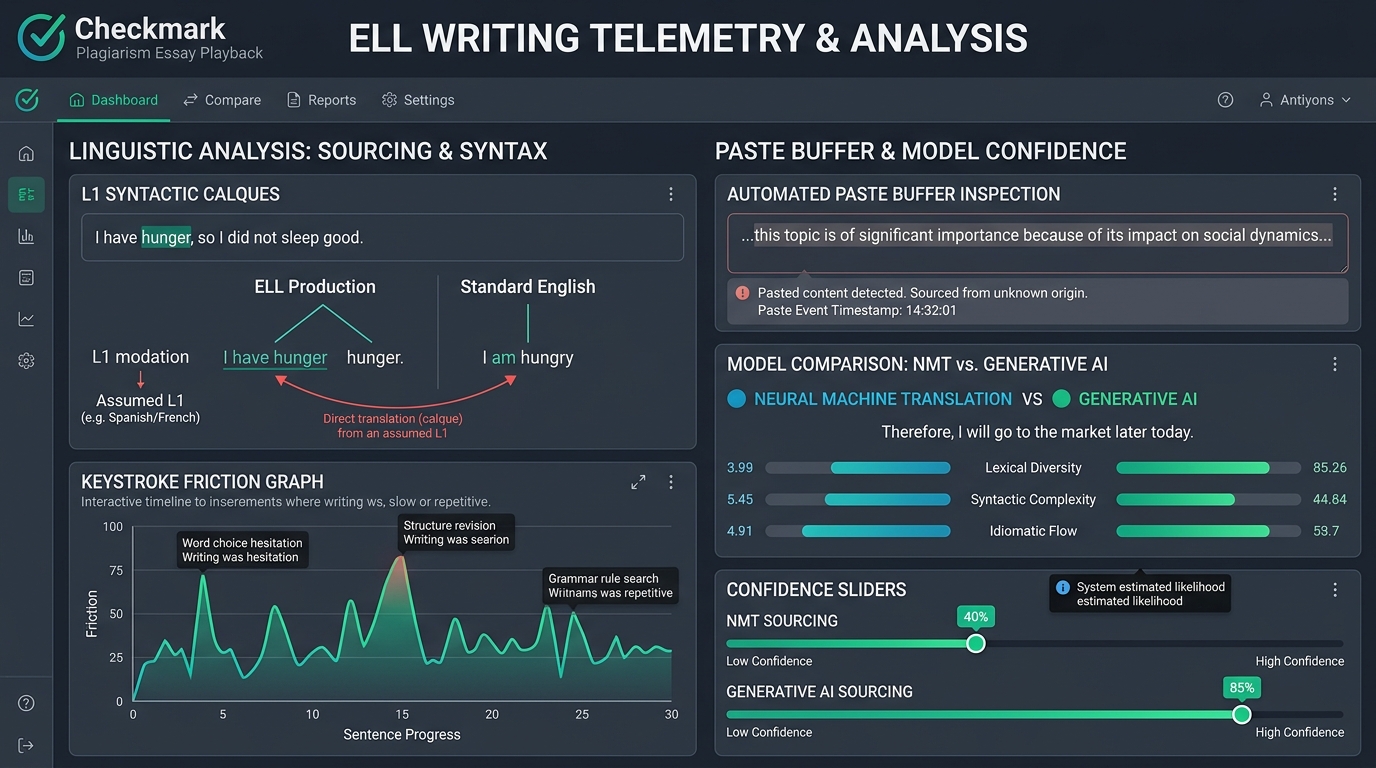
Checkmark Essay Playback™ — ELL Drafting Telemetry Timeline
Assignment: Persuasive Policy Essay (Mateo R. • Spanish L1 • 10th Grade)
1. Patent-Pending Essay Playback™: Keystroke Dynamics and Cognitive Friction
Embedded natively within assignment workflows in Canvas LMS, Buzz LMS, and Google Docs, Essay Playback records a microsecond-by-microsecond chronological log of document creation. Educators can scrub through the entire writing session at 1x, 2x, 4x, or 8x speed.
Keystroke-to-Output Ratio ($KSR$) Metric
Cognitive FrictionCheckmark calculates $KSR$ to mathematically quantify human drafting struggle:
Types a phrase, deletes three words, consults a dictionary, retypes a clause, and corrects verb agreement. High friction proves human authorship.
Student copies character-by-character from ChatGPT on a phone without hesitation, producing a flat typing cadence with near-zero backspaces.
2. The External Paste Buffer Inspector: Raw Clipboard Telemetry
When students use translation tools, copying and pasting is inevitable. Traditional revision tools (like Google Docs Revision History) only show periodic diff snapshots, failing to distinguish between an ELL student pasting a 10-word translated phrase from DeepL and a student pasting an 850-word complete essay generated by ChatGPT.
interface PasteTelemetryRecord {
  timestamp: string;               // ISO 8601 UTC microsecond timestamp
  characterCount: number;          // Total characters inserted
  wordCountEstimate: number;       // Tokenized words
  rawClipboardPayload: string;     // Full unmutated text string from clipboard
  cursorInsertionIndex: number;    // Exact position in document
  subsequentMicroEdits: number;    // Number of manual keystrokes applied to pasted text
  pasteCategory: 'BilingualClause' | 'DirectQuote' | 'MassiveExternalBlock';
}- Event #1 (00:04:12): Paste 14 words ("the socioeconomic inequality between...")
- Session: Student spends next 8 minutes retyping, editing, adding 120 keystrokes.
- Event #2 (00:14:30): Paste 8 words ("leads to severe educational disparities").
- Event #1 (00:01:05): Paste 842 words ("Certainly! Here is an essay analyzing...").
- Session: Student spends 45 seconds deleting the AI greeting and tweaking two words.
- Single massive insertion event with zero iterative drafting friction.
3. Granular Passage-Level AI Detection & Calibrated Confidence Sliders
Checkmark rejects single, opaque whole-document percentages (e.g., "87% AI"). Instead, Checkmark provides:
- Passage-Level Granularity: Specific sentences are highlighted directly within the text, linked to evidence cards in the sidebar.
- Calibrated Confidence Sliders: Displays a nuanced spectrum comparing the passage against typical human writing styles versus typical AI probabilistic patterns.
- Strict Short-Text Guardrails (< 150 Words): For passages or submissions under 150 words, Checkmark displays
N/Arather than guessing on statistically insufficient sample sizes. - Educator-Only Flag Privacy: Integrity flag statuses (Flagged, Resolved, Not Flagged) are strictly private to teachers, preventing automated accusations from reaching students before human review.
4. Defensible Plagiarism Matching & Teacher-in-the-Loop Autograding
- Side-by-Side Live Web & Academic Matching: Scans billions of live web pages, journal databases, and peer submissions, presenting direct side-by-side quote comparisons with clickable source links.
- Uncited Source Differentiation: Visually separates uncredited source usage from direct plagiarism matches, allowing teachers to treat missing quotation marks as a citation coaching opportunity rather than an ethics violation.
- Teacher-in-the-Loop Rubric Autograding: Evaluates student essays against custom, school, or LMS rubrics (Canvas LMS, Buzz LMS). All grades remain preliminary drafts until the instructor reviews, edits, and finalizes them, passing scores straight back to the LMS gradebook.
Real-World Forensic Case Studies
To see how writing telemetry, syntactic calques, and Essay Playback resolve complex submissions in practice, consider three real-world educational scenarios.
| Case | Student Profile & Assignment | Initial Detector Flag | Forensic Telemetry Result |
|---|---|---|---|
| #1 | 10th-Grade ELL (Spanish L1) Persuasive English Essay |
94% AI Generated | Exonerated: 58m active drafting, KSR 1.74, 6 short DeepL pastes, post-nominal calques. |
| #2 | College Freshman ESL (Mandarin L1) Literature Synthesis Paper |
88% AI Generated | Exonerated: Preserved "Although... but" calques, 112 backspaces, 14 verified citations. |
| #3 | Graduate Student (Arabic L1) Physics Lab Experimental Report |
76% AI Generated | Exonerated: Arabic *wa-* polysyndeton, oscilloscope CSV paste, 90m active typing. |
Case Study 1: 10th-Grade ELL Argumentative Essay (Spanish L1)
Student: Mateo (Colombia, in US for 14 months) • Assignment: 750-word persuasive essay
1. Essay Playback™ Audit: Total active composing time was 58 minutes across two sessions, logging 5,420 keystrokes for a 780-word final draft ($KSR = 1.74$). 14 distinct pause clusters (3s–12s) occurred before specialized terms ("photovoltaic," "infrastructure," "subsidies").
2. Paste Buffer Inspector: Six discrete paste events were logged with an average paste length of 11 words. Paste #3 payload was "los subsidios gubernamentales para la energía solar reducen costos" translated via DeepL to "government subsidies for solar energy reduce costs." Mateo manually replaced "reduce costs" with "lower installation barriers" over the next 4 minutes of active typing.
3. Syntactic Calque Identification: Paragraph 2 contained "The energy solar is a solution very viable for cities...", a direct Spanish post-nominal adjective calque ("energía solar", "solución muy viable").
Outcome: The teacher canceled the referral, validated Mateo's authentic drafting process, and held a supportive conference on English adjective placement.
Case Study 2: Undergraduate Freshman ESL Synthesis Paper (Mandarin L1)
Student: Lin (Economics Major) • Assignment: 1,500-word comparative synthesis
1. Linguistic Calque Diagnostics: Paragraph 3 contained mandatory Mandarin paired conjunctions: "Although traditional manufacturing has declined, but the service industry has experienced rapid expansion." Paragraph 4 exhibited Topic-Comment structure: "Regarding foreign investment, the government regulations have become more open." An LLM would never generate the double conjunction error.
2. Essay Playback™ Telemetry: Active drafting session lasted 2 hours and 42 minutes with 112 backspace corrections recorded in paragraph 3 alone.
3. Citation Verification: Checkmark side-by-side matching verified 14 cited quotes against academic journals with accurate page numbers and attributions.
Outcome: The university academic integrity office dismissed the detector flag. The writing center used Essay Playback to coach Lin on English transition clauses without fear of false AI flags.
Case Study 3: Graduate Engineering / Physics Lab Report (Arabic L1)
Student: Tariq (Applied Physics) • Assignment: Technical laboratory report on electromagnetic interference
1. Computational Discourse Analysis: Heavy Arabic polysyndetic coordination throughout the methodology: "And the laser was calibrated to 632.8 nm, and the slit width was adjusted, and the sensor recorded values." Pure machine translation artifact preserving Arabic *wa-* conjunction cadence.
2. Paste Buffer & Data Audit: Checkmark Paste Buffer Inspector revealed Tariq pasted raw numerical CSV data directly from the oscilloscope at 14:22:04, then manually typed the analysis over the next 90 minutes.
Outcome: The department chair confirmed authentic authorship within five minutes of reviewing Essay Playback, bypassing the flawed detector score.
The 4-Phase Multilingual Authorship Verification Protocol
When an educator or department chair encounters a flagged submission from an English Language Learner, they should execute this 4-Phase Verification Protocol:
Phase 1: Ingestion & Telemetry Audit
Open Checkmark Essay Playback™; scrub timeline at 4x speed. Calculate Keystroke-to-Output Ratio ($KSR$). If $KSR > 1.30$, human drafting is verified. Check active composing time against expected duration.
Phase 2: Syntactic & Linguistic Calque Diagnostics
Scan for L1 language transfer fingerprints (Romance post-nominal adjectives, East Asian paired conjunctions, Arabic polysyndetic "and" coordination). Compare against known LLM hallmarks.
Phase 3: Paste Buffer Inspection & Clipboard Audit
Inspect the Checkmark Paste Buffer log. Differentiate short clause pastes (10–25 words from DeepL) from massive text drops. Verify subsequent micro-edits applied to pasted text.
Phase 4: Restorative Academic Dialogue
Conduct a supportive, student-centered conference using Essay Playback as visual proof. Celebrate student effort, clarify boundaries between translation tools and LLMs, and connect with writing center resources.
Institutional Policy Frameworks & Syllabus Language
Schools and universities must establish transparent policies defining authorized translation assistance versus unauthorized generative generation. Vague policies like "No AI tools permitted" create confusion, as students do not know whether Google Translate, DeepL, or spell-checkers constitute "AI."
| Category | Permitted Tools | Policy & Pedagogical Rule |
|---|---|---|
| Tier 1: Lexical Scaffolding (Fully Authorized) |
Bilingual Dictionaries, WordReference, Merriam-Webster | Permitted unconditionally across all assignments. |
| Tier 2: Machine Translation (MT) (Authorized with Disclosure) |
DeepL, Google Translate (Clause-level assistance) | Permitted for phrase/sentence drafting; must be student-conceived in L1. |
| Tier 3: Grammar & Spell Checking (Authorized) |
Checkmark Editor, Native LMS Spellcheck | Permitted for editing; student retains editorial control. |
| Tier 4: Generative Content Creation (Unauthorized Authorship Fraud) |
ChatGPT, Claude, Gemini, Undetectable AI, QuillBot | Prohibited unless stated in explicit prompt rubric. |
Model Syllabus Policy Statement
"In this course, we celebrate linguistic diversity and recognize that multilingual writers draw upon their full language repertoire to develop ideas. You are fully encouraged to use digital bilingual dictionaries (e.g., WordReference) and machine translation tools (e.g., DeepL, Google Translate) to assist in translating individual words, phrases, or sentences that you have personally conceived.
However, all arguments, thesis statements, evidence selection, and rhetorical structures must originate from your own intellectual effort. Using Generative AI tools (such as ChatGPT, Claude, or automated paraphrasers) to generate outlines, write paragraphs, or synthesize sources on your behalf is a violation of academic integrity.
Our course utilizes Checkmark Plagiarism and Essay Playback™ to celebrate your writing process. Your authentic drafting history, revisions, and keystrokes protect your work and ensure you receive credit for your genuine learning journey."
Restorative Dialogue Scripts for Educators
When meeting with a multilingual student whose essay triggered an automated AI flag, educators should avoid accusatory interrogations. Instead, ground the conversation in Checkmark's Essay Playback telemetry:
Conversation Script: Restorative Writing Conference
Teacher-Student DialogueFrequently Asked Questions (FAQs)
1. Why do commercial AI detectors flag English Language Learners more frequently than native English writers?
Commercial AI detectors evaluate static text for perplexity (word-choice unpredictability) and burstiness (sentence length variation). Non-native writers and machine translation tools naturally rely on high-frequency, safe vocabulary and taught, standardized sentence structures. Because these patterns result in low perplexity and low burstiness, statistical classifiers misclassify authentic multilingual writing as machine-generated text at rates exceeding 60% to 90%.
2. What is the fundamental difference between DeepL/Google Translate and ChatGPT?
DeepL and Google Translate are Neural Machine Translation (NMT) sequence-to-sequence systems designed strictly to translate source-language words into target-language equivalents while preserving the human author's original meaning, logic, and structure. ChatGPT is an Autoregressive Large Language Model (LLM) that generates new arguments, ideas, and complete paragraphs from scratch, taking over the cognitive thinking and rhetorical structuring of the paper.
3. How does patent-pending Essay Playback™ prove a student didn't use generative AI?
Essay Playback™ captures the chronological keystroke dynamics of the drafting session. It records natural inter-keystroke pauses (such as hesitations before vocabulary selection), backspaces, structural revisions, and typing friction. A student who generates an essay with AI and pastes or transcribes it produces an unnatural, flat typing cadence ($KSR approx 1.02$) with zero cognitive pauses, whereas an authentic multilingual writer exhibits high revision friction ($KSR > 1.40$).
4. Can Essay Playback tell the difference between pasting a translated sentence vs. pasting an entire AI essay?
Yes. Checkmark's External Paste Buffer Inspector intercepts browser DOM paste events, recording the microsecond timestamp, character length, and exact text payload of every paste. Educators can easily distinguish an ELL student who pastes six 12-word translated phrases over an hour from a student who pastes an 800-word block of ChatGPT-generated text in a single second.
5. What are syntactic calques, and why are they important in integrity investigations?
Syntactic calques (or loan translations) occur when a writer translates text from their native language ($L_1$) into English ($L_2$) while inadvertently retaining $L_1$ grammatical rules (such as Spanish post-nominal adjectives, East Asian paired conjunctions like "Although... but," or Arabic polysyndetic "and" coordination). Because Generative LLMs generate smooth, native-like English that eliminates these errors, the presence of syntactic calques serves as strong linguistic evidence of human machine translation rather than generative AI ghostwriting.
6. Is Checkmark Plagiarism FERPA and COPPA compliant?
Yes. Checkmark is fully compliant with the Family Educational Rights and Privacy Act (FERPA) and the Children's Online Privacy Protection Act (COPPA). Student submissions are encrypted in transit and at rest, and Checkmark never uses student essays to train general AI models.
7. How does Checkmark integrate with Canvas LMS and Buzz LMS?
Checkmark embeds directly into Canvas LMS (including SpeedGrader) and Buzz LMS via standard LTI integrations. Teachers can review Essay Playback, paste logs, plagiarism sources, and passage-level AI detection directly inside their existing grading workflow, with one-click grade passback to the institutional gradebook.
Summary & Next Steps for Academic Leaders
The rapid rise of AI detection tools must not come at the expense of educational equity. English Language Learners deserve an academic integrity framework that honors their hard work, recognizes the realities of second-language acquisition, and provides transparent, defensible evidence.
Eliminate single-percentage AI detectors that discriminate against non-native writers.
Deploy Checkmark Essay Playback™ to capture authentic keystroke dynamics and paste buffers.
Authorize digital bilingual scaffolding while maintaining clear boundaries on LLM use.
Use writing playback telemetry as a supportive teaching tool rather than a punitive weapon.
To learn how your school district, college, or writing department can deploy patent-pending Essay Playback™ and protect multilingual writers from algorithmic bias, explore Checkmark Plagiarism and request an institutional pilot today.