
Executive Summary
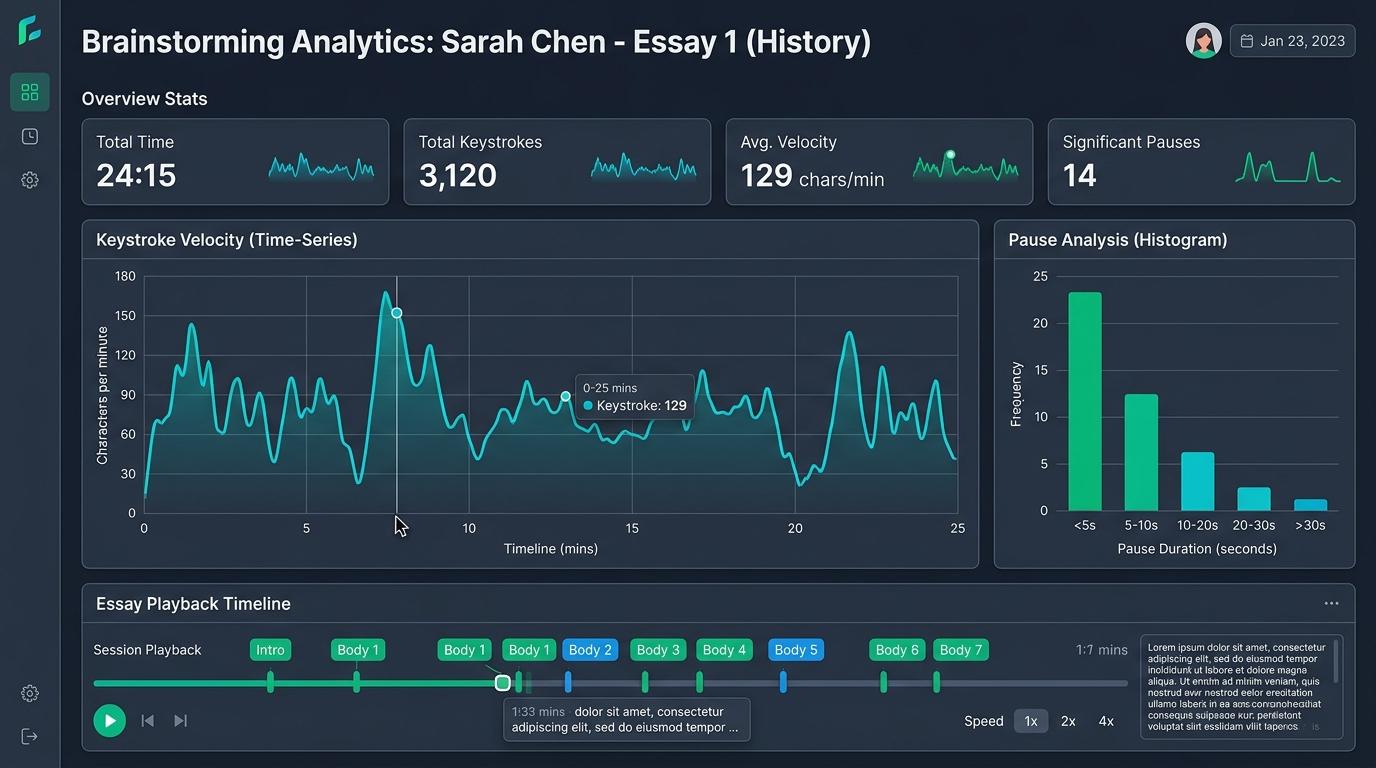
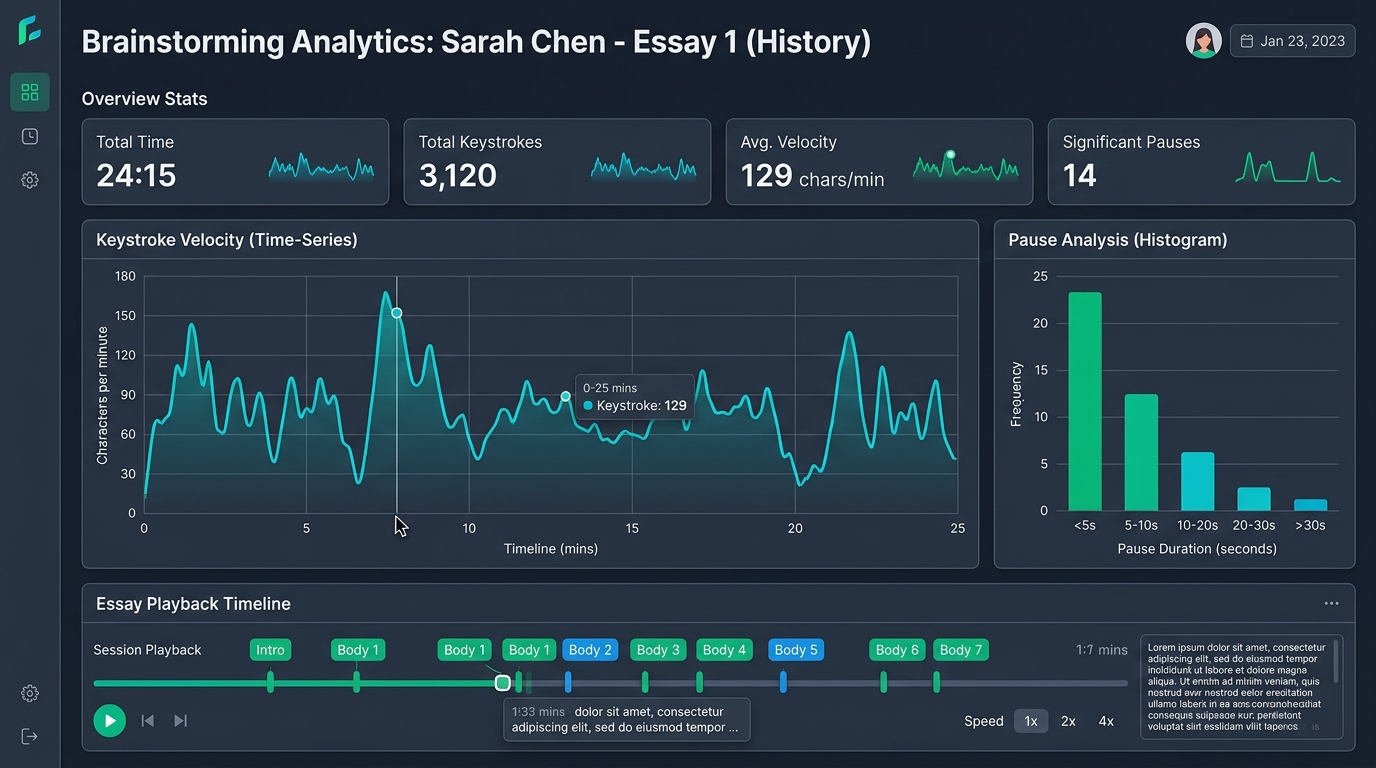
The initial brainstorming and early drafting phase is the most cognitively demanding stage of the writing journey. When students wrestle to formulate an original thesis, outline arguments, or synthesize complex research, their cognitive friction leaves behind an unmistakable biometric signature: fluctuating typing speeds, high Inter-Key Interval (IKI) variance (σIKI ≈ 0.70 – 1.50 · μ), production bursts (P-bursts) punctuated by reflective pauses (2–15+ seconds), and significant recursive backspacing (12%–28% deletion ratios). Conversely, when a student bypasses genuine ideation by manually retyping AI-generated text from a secondary screen or phone, their telemetry reveals an unnaturally flat, metronomic velocity curve with near-zero exploratory revision. Guided by the core philosophy of “Stop guessing, start trusting,” Checkmark Plagiarism’s patent-pending Essay Playback™ suite equips educators with transparent, timestamped keystroke analytics, velocity heatmaps, and clipboard paste tracking—empowering formative, restorative writing conferences while providing bulletproof proof of innocence for honest writers.
In modern writing instruction across secondary and higher education, academic integrity has reached a critical inflection point. Traditional plagiarism checkers catch only direct text copies, while static whole-document AI classifiers generate opaque percentage scores that frequently misidentify hardworking students, particularly non-native English speakers. Checkmark Plagiarism solves this crisis by combining patent-pending Essay Playback™ process telemetry, passage-level AI detection, multidimensional plagiarism matching, and teacher-in-the-loop rubric grading across Canvas LMS, Google Classroom, and Buzz LMS.
The Crisis of the Blank Page: Why Brainstorming Is the Crucible of Academic Integrity
In secondary and post-secondary writing instruction, the most vulnerable moment of the writing process occurs before the first paragraph is finalized. Faced with an open prompt, a complex research assignment, or a blank document, students experience peak cognitive load.
- Working Memory Saturation: Continuous negotiation of claims, evidence, and rhetorical tone.
- Recursive Ideation: False starts, exploratory bullet outlines, and thesis revisions.
- High Friction: Heavy backspacing (12%–28% deletion ratio) as ideas get reshaped.
- Cognitive Hesitations: Extended reflective pauses (2–15s) at conceptual junctures.
- Non-Linear Navigation: Cursor hops between outline sections and source notes.
- Zero Ideation Friction: Prompt submitted to LLM on secondary screen or smartphone.
- Optical Transcription: Student manually copy-types generated prose to bypass clipboard monitors.
- Metronomic Velocity: Uniform, unbroken typing rhythm across all sentences.
- Near-Zero Revision: Deletion ratios < 2%, restricted to single-typo corrections.
- Monotonic Insertion: Strictly linear character flow (0 → N) with no structural rewrites.
Core Pedagogical Insight: When honest students struggle with the blank page, their telemetry is messy, fragmented, and non-linear. The absence of cognitive friction is the defining tell of manual transcription.
When a student chooses to embrace the productive struggle of authentic brainstorming, their early writing is naturally unpolished. They draft partial claims, delete them, re-order bullet points, pause to consult a source, and revise their core thesis multiple times before settling on a cohesive structure.
However, when a student experiences deadline panic or imposter syndrome, generative AI presents an alluring escape hatch. Instead of wrestling with their own thoughts, the student prompts a Large Language Model (LLM) to outline or write the assignment on a phone or split-screen browser. To evade standard clipboard monitors, they manually type the output into their learning management system (LMS).
To a traditional plagiarism scanner or a static AI detector, this retyped submission presents severe diagnostic challenges:
- Clipboard Listeners Register Zero Pastes: Because the text was manually entered, no external paste event is logged.
- Document Timers Show Active Engagement: The student spent 35 minutes actively typing, mimicking normal active session duration.
- Static AI Detectors Yield Inconclusive Percentages: If the student tweaked words or used a paraphraser, whole-paper statistical classifiers generate ambiguous, non-actionable probability scores.
Yet, despite bypassing superficial text-matching filters, manual transcription cannot duplicate the cognitive psycholinguistics of authentic human ideation. The biomechanical telemetry of typing while formulating original thought differs fundamentally from the mechanical act of retyping pre-formulated text.
The Psycholinguistic Foundations of Pre-Writing and Early Drafting
To understand why keystroke velocity and pause analysis provide definitive evidence of authentic ideation, we must examine the cognitive architecture of text production.
- Idea generation & retrieval
- Goal setting & argument mapping
- Non-linear outline restructuring
- Generates macro pauses (5.0s–30.0s+)
- Syntactic packaging & lexical selection
- Motor execution (finger-to-key mapping)
- Rapid bursts of prose (P-bursts)
- Micro-hesitations at clause junctures
- Continuous evaluation of drafted text
- Immediate backspacing (R-bursts)
- Thesis statement reformulation
- Cursor backtracking to revise earlier lines
In the seminal cognitive models of writing developed by John R. Hayes, Linda S. Flower, and Ronald T. Kellogg, the pre-writing and early drafting stages require continuous coordination across three core cognitive systems:
1. Working Memory Saturation and Cognitive Load
When an author initiates a document:
- Central Executive Control: The writer must hold the macro-structure of their argument in short-term working memory while simultaneously generating micro-level syntax and selecting precise vocabulary.
- Lexical Retrieval Latency: Accessing discipline-specific vocabulary, rhetorical transitions, and domain concepts requires active semantic search, generating natural micro-hesitations.
- Knowledge Transforming vs. Knowledge Telling: As Carl Bereiter and Marlene Scardamalia demonstrated, novice copyists engage in simple knowledge telling (linear stringing of pre-set ideas), whereas mature writers engage in knowledge transforming—an intensely recursive process where the act of composing alters the writer’s underlying conceptual understanding.
2. The Cognitive Pause Hierarchy
Pauses during organic writing are not random idle periods; they represent physical manifestations of cognitive computation. Writing researchers categorize pauses into three distinct structural tiers:
| Pause Tier | Duration Window | Cognitive Function | Biomechanical Location |
|---|---|---|---|
| Macro / Conceptual Pauses | 5.0s – 30.0s+ | High-level planning, structural outlining, thesis formulation, source consultation, and re-reading preceding paragraphs | Paragraph boundaries, section headers, major argumentative shifts |
| Micro / Syntactic Pauses | 1.5s – 4.9s | Clause construction, grammatical planning, selecting transition phrases, and discipline-specific lexical retrieval | Sentence boundaries, comma junctures, coordinating conjunctions |
| Nano / Motor Pauses | 0.2s – 1.4s | Motor coordination, syllable transitions, physical typing rhythm, and short-term muscle execution | Intra-word letter transitions, spacebar strikes |
When an author is genuinely brainstorming, Macro and Micro pauses account for 40% to 65% of the total document session time. The writer spends more time thinking, evaluating, and hesitating than physically depressing keys.
Biomechanical Telemetry: Organic Ideation vs. Optical AI Transcription
By logging millisecond-accurate keystroke events, writing process analytics transforms intangible cognitive effort into concrete, observable telemetry metrics.
Dynamic spikes (P-bursts up to 85 WPM) separated by deep cognitive valleys (14s–22s reflective pauses) and backspace friction dips.
Uniform, metronomic velocity curve across 24 minutes with zero planning pauses and near-zero revision friction.
1. Inter-Key Interval (IKI) Variance and Production Bursts (P-Bursts)
The fundamental metric of keystroke dynamics is the Inter-Key Interval (IKI)—the elapsed time in milliseconds between sequential key-down events:
In authentic composition, typing speed is never constant. Instead, text is generated in Production Bursts (P-bursts)—brief flurries of rapid motor execution (typically 5 to 25 words typed at 50–90 WPM) corresponding to a single pre-formulated thought chunk, followed immediately by an evaluative pause.
Displays a highly skewed, multi-modal log-normal distribution with substantial standard deviation. Motor bigrams are fast, while lexical and syntactic boundaries generate major temporal spikes.
Displays a tight, single-mode Gaussian distribution with minimal variance. Because the typist reads pre-constructed sentences off an external screen, they never experience the cognitive pause of conceptual invention.
2. Revision Dynamics and Backspace Friction (R-Bursts)
Brainstorming is inherently exploratory and error-prone. Genuine pre-writing is characterized by high deletion and backspace friction:
- Organic Ideation Benchmarks: Genuine brainstorming and early draft formulation routinely exhibit deletion friction ratios between 12% and 28%. The student writes a claim, realizes it lacks supporting evidence, backspaces 14 words, tries an alternative framing, pauses, and retypes.
- Optical Transcription Benchmarks: Retyping an existing text exhibits deletion ratios of < 2%. Deletions are restricted almost exclusively to immediate, single-character motor slip corrections (e.g., typing “teh” and hitting backspace once). There are zero exploratory sentence purges or structural reorganizations.
Telemetry Comparison: Authentic Brainstorm vs. Optical AI Transcription
| Telemetry Metric | Authentic Brainstorming | Optical AI Transcription |
|---|---|---|
| IKI Standard Deviation (σ) | Wide (σ ≥ 0.75 · μ) | Narrow (σ < 0.25 · μ) |
| Velocity Profile (WPM Curves) | Dynamic spikes (P-bursts) & deep pause valleys | Flat, sustained metronomic line |
| Pause Frequency at Major Headings | High (5.0s – 30.0s reflective hesitations) | Near-Zero (< 1.8s optical saccades only) |
| Deletion / Backspace Ratio | Heavy (12% – 28% friction) | Negligible (< 2% motor slips) |
| Cursor Hop Trajectory | Highly recursive / Non-linear hops | Strictly linear (0 → N character flow) |
| False Start Purges (Lines Deleted) | Frequent (2 – 6 full iterations) | None (Zero false starts or thesis purges) |
| External Paste Buffer Presence | Source quotes / Notes cited with quotation marks | None (Manual retyping to avoid paste detection) |
| Final Composition Session Ratio | 40%–65% Thinking / Pauses • 35%–60% Typing | > 90% Active Continuous Typing |
Checkmark Plagiarism’s Patent-Pending Essay Playback™ Suite
To empower educators to evaluate writing telemetry effortlessly without needing data science expertise, Checkmark Plagiarism provides an integrated, classroom-ready solution: Essay Playback™.
Session Reconstruct: AP English Synthesis Pre-Draft
1. 1x–8x Scrubbable Chronological Video Replay
Essay Playback™ reconstructs the entire writing lifecycle keystroke-by-keystroke. Educators can scrub through the timeline at variable speeds (1x, 2x, 4x, or 8x) to observe:
- How the student organized their initial thoughts from a blank document.
- How rough notes or outlines evolved into structured topic sentences.
- Where the student hesitated, revised vocabulary, or abandoned dead-end arguments.
2. Dedicated Drafting Velocity & Pause Analysis Charts
Checkmark automatically graphs the student’s Inter-Key Interval distribution, pause duration histograms, and WPM velocity curves. Teachers can immediately identify:
- Organic Composition Spikes: Distinct P-bursts followed by authentic planning valleys.
- Transcription Flags: Unnaturally uniform typing lines that indicate the student was reading from a phone or secondary monitor.
3. External Paste Buffer Tracking with Full Text Preservation
When a student incorporates research quotes or external notes, Checkmark’s clipboard listener captures and preserves the full original pasted text alongside an exact timestamp. Even if the student subsequently edits, rewrites, or deletes every individual word of the pasted passage, the teacher can click a single button in the sidebar to inspect the original clipboard payload.
4. The Multi-Factor Verification Triad
Checkmark never relies on a single isolated metric. It synthesizes writing process telemetry with two additional defensible pillars:
Essay Playback™ Process Telemetry
- Keystroke IKI variance & WPM curves
- Syntactic pause duration frequency
- External paste buffer tracking
- 1x–8x scrubbable session replay
Passage-Level AI Detection
- Sentence-by-sentence confidence sliders
- No single whole-paper score guesswork
- Honest <150w N/A cutoff threshold
- Private teacher evaluation notes
Multidimensional Plagiarism Matching
- Billions of indexed web pages
- Live clickable source URLs
- Student-to-student peer cohort repo
- Side-by-side quote distinction
Real-World Classroom Case Studies: Brainstorming Telemetry in Action
To appreciate the diagnostic power of keystroke velocity and pause analysis, let us examine three realistic classroom scenarios across secondary and post-secondary institutions.
Case Study Telemetry Summary
| Metric | Case 1: AP Lang Thesis | Case 2: First-Year Comp | Case 3: ESL / ELL Writer |
|---|---|---|---|
| Session Duration | 32 Minutes | 64 Minutes | 52 Minutes |
| Word Count | 380 Words (Intro + Draft) | 720 Words (Outline + Body) | 410 Words (Draft) |
| Deletion Friction | 22.4% (Heavy revision) | 18.1% (Outline shifts) | 14.8% (Word search) |
| IKI Variance | σ = 1.24 · μ | σ = 0.98 · μ | σ = 1.42 · μ |
| Macro Pauses (>5s) | 18 Pauses | 31 Pauses | 42 Pauses |
| External Pastes | 1 (Prompt rubric pasted) | 3 (Source quotes) | 0 Pastes |
| Integrity Verdict | Authentically Authored | Authentically Authored | Authentically Authored |
Case Study 1: The Secondary AP English Language Thesis Struggle
Student: Maya, 11th Grade AP English Language & Composition
Assignment: Timed Synthesis Essay on Environmental Policy
Initial Flag: A 3rd-party static detector flagged Maya’s introductory paragraph as “78% Likely AI-Generated” due to complex subordinate clauses and elevated vocabulary.
“Renewable energy is very important for the future of the planet...”
“Although solar and wind power have high initial costs, governments must invest in green subsidies to prevent ecological collapse.”
“While economic detractors cite the substantial capital expenditure of grid modernization, targeted federal subsidies for localized solar infrastructure yield long-term geopolitical and ecological resilience.”
Case Study 2: The First-Year College Composition Outline Reorganization
Student: Marcus, First-Year University Student
Assignment: 1,500-word Argumentative Research Paper on Algorithmic Bias in Healthcare
Initial Concern: Marcus submitted a structured outline and introductory draft in under an hour, prompting his instructor to check for AI-generated outlining shortcuts.
- [00:04:10] Marcus drafts rough bullet headers: Background, Datasets, Clinical Impact, Conclusion.
- [00:12:45] [Paste Event #1] Paste buffer captures 38-word quotation from Obermeyer et al. (2019). Checkmark stores exact DOI URL and original snippet.
- [00:18:30] [Non-Linear Cursor Hop] Marcus moves cursor from Section 4 back to Section 2, deletes “Clinical Impact” header, moves it below “Dataset Bias”, and types 3 counter-arguments with 6.2s pauses between each bullet.
Case Study 3: Exonerating a Non-Native English (ESL/ELL) Writer
Student: Sun-Woo, International Sophomore Student
Assignment: Comparative Literary Analysis of Things Fall Apart
Initial Flag: A generic whole-document AI scanner returned an “82% AI Detection Score” because Sun-Woo’s syntax was formal, slightly repetitive, and adhered strictly to five-paragraph essay templates—a known failure mode of statistical perplexity detectors.
“Okonkwo is afraid of appearing weak because...”
→ 16.4s Pause: Long cognitive hesitation (Bilingual lexicon search).
“...unmanly.” → 7 Backspaces → Deleted “...unmanly.”
→ 9.1s Pause: Consults Korean-English online dictionary for precise synonym.
“...effeminate, which reflects his deep-rooted fear of his father’s legacy.”
The 4-Phase Educator Verification Protocol
To implement keystroke velocity and pause analysis effectively, schools and universities should adopt this standardized 4-Phase Verification Protocol:
- Check summary telemetry card
- Inspect IKI standard deviation (σ)
- Verify deletion friction (12%–28%)
- Audit external paste buffer log
- Scrub timeline at 2x or 4x speed
- Watch minutes 0–10 (Blank page setup)
- Evaluate thesis evolution milestones
- Confirm presence of organic P-bursts
- Correlate telemetry with passage AI cards
- Inspect preserved paste clipboard content
- Check web & peer similarity matches
- Enforce honest <150w N/A cutoff
- Conduct side-by-side student conference
- Adopt “Stop guessing, start trusting”
- Ask metacognitive reflection questions
- Provide targeted revision coaching
Restorative Dialogue Scripts for Writing Conferences
When discussing writing telemetry with students, educators should use restorative, supportive framing that builds trust and encourages metacognition.
Confirming and Celebrating Authentic Brainstorm Struggle
Teacher: “Hi Jordan! I was reviewing your draft submission in Checkmark, and I was really fascinated by your pre-writing process. Let’s look at the playback timeline together around minute 8.
I noticed you wrote out two different introductory hooks, deleted them, and then paused for about 20 seconds before writing this strong analytical claim about the protagonist’s motivation. Can you walk me through what you were thinking during that pause?”
Student: “Honestly, I was really stuck at first. My first idea felt like a middle-school summary. Then I remembered what we discussed in class about character flaws, so I checked my reading notes and decided to focus on his fear of vulnerability.”
Teacher: “That reflection shows right here in your writing telemetry. That kind of wrestling with ideas is exactly what mature writers do. Excellent work.”
Addressing a Metronomic Transcription Profile
Teacher: “Hi Taylor. Thanks for meeting with me today. I’m looking at your essay draft on environmental economics. Our writing platform logs our drafting timeline so we can look at the writing process together.
When I look at the playback here, I notice that the entire 800-word draft was typed at a continuous 72 words per minute with zero pauses longer than one second, and not a single backspace or outline note. When we write complex essays, our brains naturally pause to think, plan, and revise.
Help me understand how you created this draft. Were you copying from notes you wrote elsewhere, or did this come from a different tool?”
Student: (Pauses) “I was panicking last night because I had three tests today. I put the prompt into ChatGPT on my phone and typed what it gave me into Canvas so it wouldn’t show up as a paste.”
Teacher: “Thank you for your honesty, Taylor. I know how overwhelming junior year workload can feel. But using AI to write your essay means you missed the chance to build your own analysis skills. Let’s look at the assignment prompt together right now, start a fresh outline, and brainstorm two original arguments you can develop.”
Departmental Syllabus Policy Models
To establish clear expectations around writing process telemetry and AI use, schools and departments can adopt these customizable syllabus policy templates:
Academic Integrity & Writing Process Policy: English Department
In this course, we believe that writing is a process of thinking, discovery, and personal expression. The true value of an essay lies in the cognitive struggle of brainstorming, drafting, and revising your own ideas.
1. Writing Process Telemetry: All major essays must be drafted in our designated LMS editor or connected environment with Checkmark Essay Playback™ enabled. This tool records your writing timeline, keystroke rhythms, and drafting revisions.
2. Authorized vs. Unauthorized AI Support:
- Authorized: Using AI for initial topic brainstorming or grammar feedback when explicitly permitted by the teacher.
- Unauthorized: Using generative AI to write, outline, paraphrase, or generate essay content, whether pasted or manually retyped.
3. Protection for Honest Writers: Keystroke dynamics and playback history serve as your digital receipt of authentic authorship. If an external AI detector ever questions your work, your authentic drafting timeline provides complete proof of innocence.
First-Year Writing Program: Policy on Authorship, Process, and Telemetry
The First-Year Writing Program emphasizes authentic inquiry, ethical research, and rhetorical decision-making.
- Authentic Composition Requirement: All submitted papers must represent the student’s original cognitive work. Manual transcription of text generated by Large Language Models (LLMs), machine translation tools, or peer assignments constitutes academic misconduct.
- Process Analytics & Verification: Course submissions are analyzed through Checkmark Plagiarism’s multi-factor integrity platform, incorporating passage-level analysis, web/peer source matching, and patent-pending Essay Playback™ keystroke dynamics.
- Restorative Due Process: In the event of a question regarding authorship, students have the right to a collaborative process conference where their writing playback and telemetry logs will be reviewed in a transparent, restorative setting.
Frequently Asked Questions (FAQ)
1. How does keystroke velocity analysis account for neurodivergent writers (e.g., ADHD, Dysgraphia)?
Keystroke velocity analysis does not measure typing speed against a rigid, arbitrary WPM threshold. Instead, it measures internal variance and cognitive friction. Neurodivergent writers—including students with ADHD or dysgraphia—exhibit highly authentic, non-linear telemetry: rapid bursts of hyperfocus, extended pauses while re-reading, frequent recursive backspacing, and non-linear cursor movements. These natural idiosyncrasies are the exact opposite of the flat, metronomic cadence of artificial transcription.
2. What happens if a student brainstorms on paper and then types their draft into the LMS?
If a student develops a complete handwritten outline or draft in a physical notebook and subsequently types it into the computer, their typing telemetry will reflect authentic human transcription rather than AI generation. While their typing may be steadier than someone composing from scratch, human transcription of handwritten notes still features reading pauses, handwriting deciphering hesitations, and natural typographical self-corrections. Furthermore, during a restorative conference, the student can simply present their physical notebook, which matches the timestamped text in Essay Playback™.
3. How does Checkmark differentiate voice-to-text dictation from pasted AI text or transcription?
Voice-to-text dictation tools (such as Apple Dictation, Google Voice Typing, or Dragon NaturallySpeaking) insert text in distinct speech-cadence burst chunks (typically 4 to 12 words per breath group) accompanied by unique audio-buffer latency signatures. Checkmark’s telemetry engine recognizes these speech-to-text input signatures and differentiates them from both block clipboard pastes and continuous optical keyboard transcription.
4. Can fast touch-typists (90+ WPM) be mistakenly flagged as optical transcribers?
No. High typing speed is not a flag for transcription. In fact, proficient touch-typists exhibit even higher IKI variance than novice typists during authentic drafting. When a fast typist composes original prose, their P-bursts may reach 100+ WPM, but their macro-pauses before complex clauses and their high-speed backspacing remain prominent. Transcription detection identifies the absence of cognitive variance, not raw speed.
5. How does Checkmark protect student data privacy under FERPA and COPPA?
Checkmark adheres strictly to zero-retention principles and enterprise data privacy standards: student writing and telemetry data are never used to train commercial AI models, all telemetry streams are encrypted in transit (TLS 1.3) and at rest (AES-256), and Checkmark is fully compliant with the Family Educational Rights and Privacy Act (FERPA) and Children’s Online Privacy Protection Act (COPPA).
6. Why are whole-paper AI detection percentages unreliable for assessing brainstorming?
Whole-paper AI detectors rely on static text classifiers that analyze surface statistical properties like perplexity (word predictability) and burstiness (sentence length variation). These static metrics cannot observe how the text was created. A student who uses elevated vocabulary or structured academic templates will often trigger high false-positive AI scores on static detectors. Keystroke telemetry solves this by providing empirical, chronological proof of the physical writing process.
7. How can teachers integrate keystroke playback into everyday grading without increasing their workload?
Teachers do not need to watch full-length videos for every student submission. Checkmark’s automated telemetry diagnostic dashboard summarizes key metrics at a glance with green verification badges for normal IKI variance, healthy deletion friction (12%–28%), and authentic pause distributions. Teachers only open the 1x–8x playback scrubber when investigating a flagged submission or conducting a formative writing conference.
Conclusion: Stop Guessing, Start Trusting
The arrival of generative AI in education has exposed the limitations of traditional, punitive plagiarism detection. Black-box percentage scores and opaque suspicion algorithms alienate honest students, inflict disproportionate harm on English Language Learners, and consume countless hours of educator time in adversarial disputes.
By focusing on the psycholinguistics of the writing process through keystroke velocity, pause analysis, and patent-pending Essay Playback™, Checkmark Plagiarism restores clarity and trust to writing instruction.
When educators can see the authentic cognitive struggle of student brainstorming—the pauses, the false starts, the deleted sentences, and the hard-won breakthroughs—they no longer have to guess. They can support their students with confidence, celebrate their genuine intellectual growth, and uphold academic integrity with transparent, defensible evidence.
Experience Patent-Pending Essay Playback™ in Action
Bring keystroke velocity analytics, passage-level AI detection, and defensible writing process forensics to your Canvas, Google Classroom, or Buzz LMS courses.