
Executive Summary & Equity Mandate
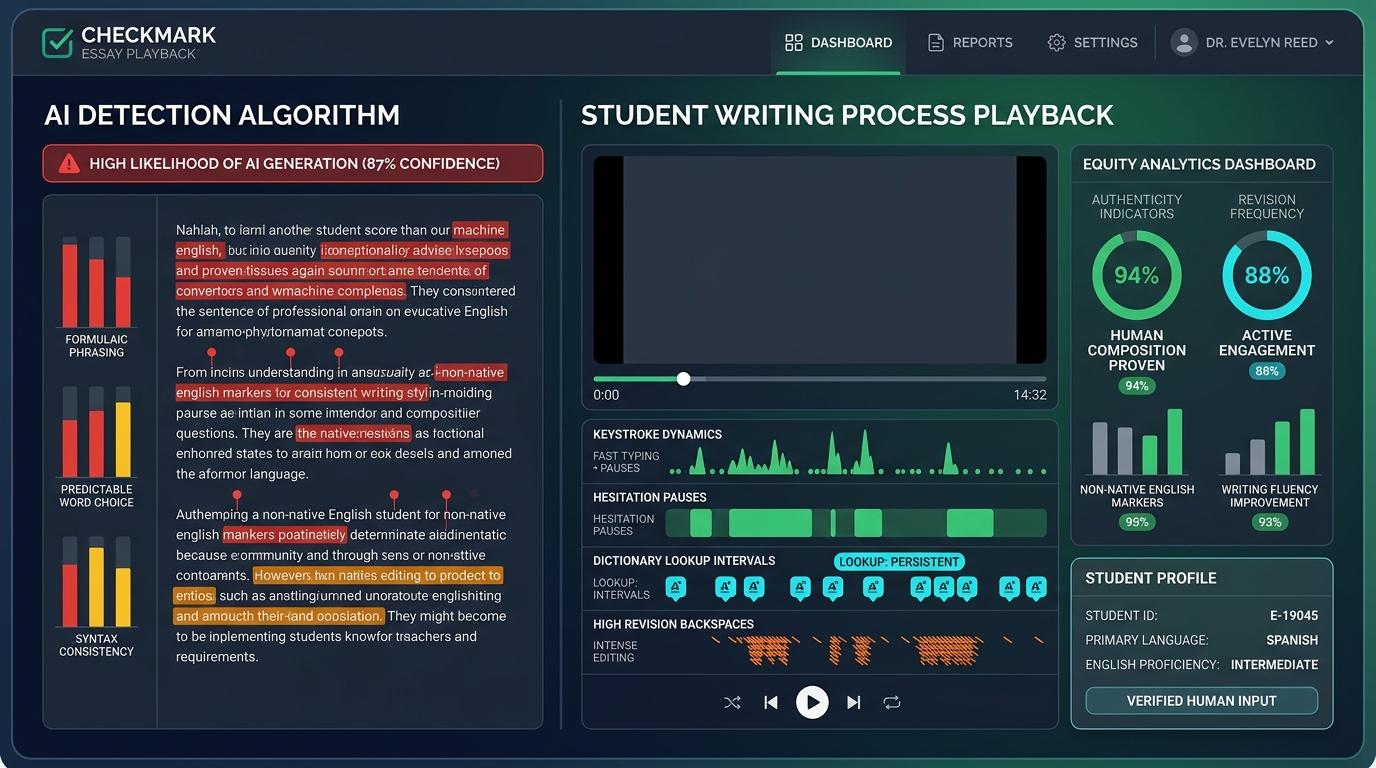
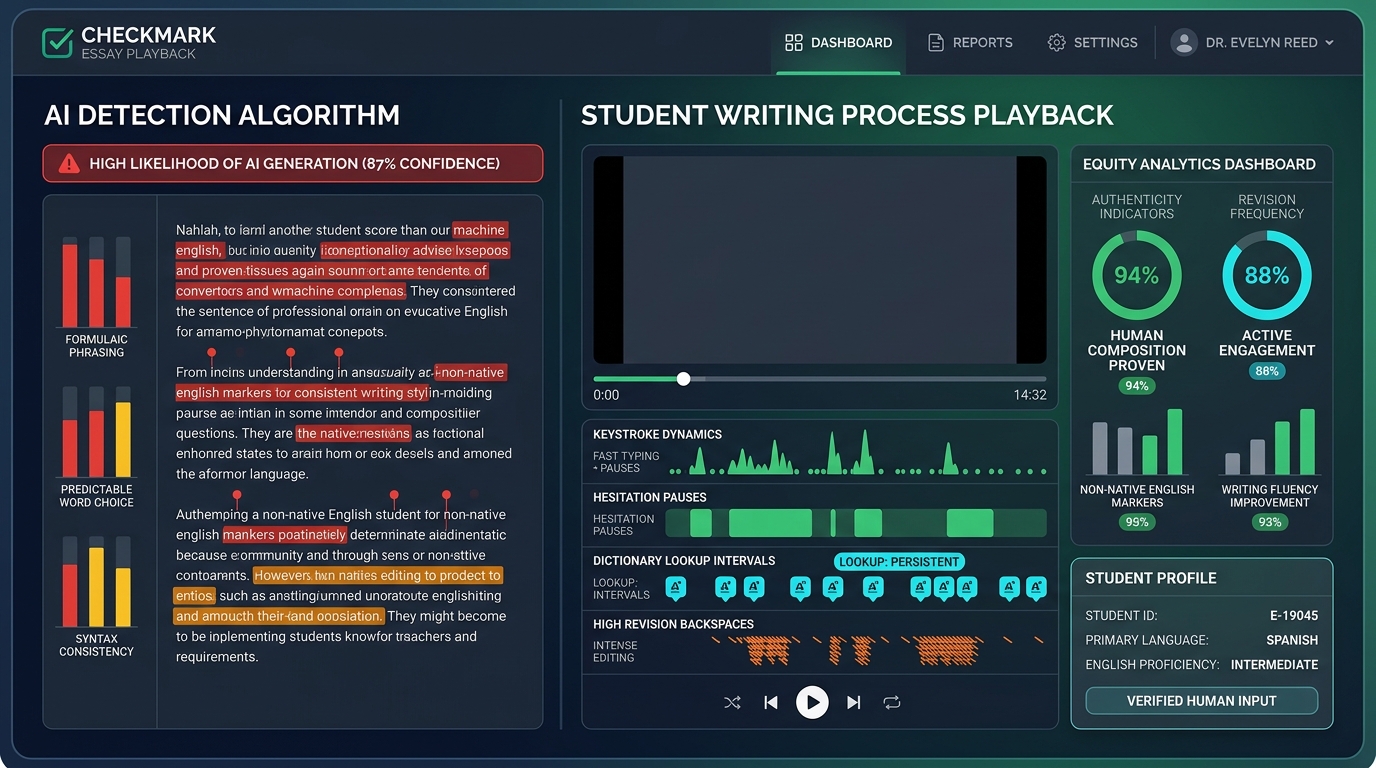
The rapid adoption of statistical AI writing detectors across K-12 districts and higher education institutions has triggered an urgent educational equity crisis. Empirical research—most notably landmark studies from Stanford University—proves that generic, whole-paper AI detectors misclassify the authentic writing of non-native English speakers as AI-generated at catastrophic rates exceeding 60% to 98%. Because statistical classifiers evaluate static text for lexical predictability (low perplexity) and structural uniformity (low burstiness)—the precise stylistic hallmarks of developing English Language Learners (ELLs) and international students—multilingual writers are disproportionately subjected to traumatizing false accusations, disciplinary hearings, and threatened academic standing. Writing process playback fundamentally solves this algorithmic bias. Guided by Checkmark Plagiarism's core philosophy of "Stop guessing, start trusting," educators can bypass fallible statistical text classifiers entirely and rely on patent-pending Essay Playback™ telemetry. By capturing keystroke-level hesitation dynamics, dictionary search pauses, recursive backspacing, and time-stamped drafting histories, process telemetry provides undeniable, objective proof of human authorship—exonerating honest multilingual students and turning stressful confrontations into supportive, restorative learning conferences.
As artificial intelligence language models become embedded in everyday productivity suites, academic institutions face an unprecedented ethical crossroads. Static classifiers evaluate only the frozen, final text artifact, penalizing the formulaic clarity and deliberate phrasing that multilingual students work tirelessly to master. Checkmark Plagiarism resolves this structural injustice by pairing patent-pending Essay Playback™ with passage-level AI detection, multidimensional plagiarism scanning, and teacher-in-the-loop rubric autograding for Canvas LMS, Google Classroom, and Buzz LMS.
The Algorithmic Discrimination Crisis: Why Statistical AI Detectors Target Non-Native Writers
When large language models (LLMs) like ChatGPT burst into modern classrooms, educational institutions rushed to deploy automated AI detectors to safeguard academic integrity. However, this reactionary rollout exposed a profound, algorithmic blind spot: statistical AI detectors systematically discriminate against non-native English writers.
Multilingual Composition
- Standardized grammatical constructions
- Constrained, high-frequency vocabulary
- Repetitive transitional phrases
- Uniform, predictable sentence lengths
- Strict adherence to taught templates
Perplexity & Burstiness
- Low Perplexity: Predictable words → Flagged as AI token choice
- Low Burstiness: Consistent length → Flagged as AI rhythm
- Opaque whole-paper percentage score
- Zero context on physical writing effort
Catastrophic False Positive
- "89% Probability of AI Generation"
- Student spent 6 hours writing by hand
- Unfair disciplinary referral & lost trust
- Student forced to prove a negative
The Fundamental Flaw: Statistical AI detectors do not detect artificial intelligence; they measure lexical complexity and syntactic unpredictability. By doing so, they inadvertently penalize the natural linguistic traits of non-native English writers.
The Stanford Landmark Study (Liang et al., 2023)
In 2023, a research team from Stanford University led by Weixin Liang, Merton Yuksekgonul, Yining Mao, Eric Wu, and James Zou published groundbreaking empirical research titled "GPT detectors are biased against non-native English writers" (published in Patterns / Cell Press and presented at global AI ethics forums).
The Stanford team evaluated seven widely used commercial AI text detectors against two distinct datasets:
- Authentic TOEFL (Test of English as a Foreign Language) Essays: Written by non-native English speakers from China prior to the public release of modern generative LLMs (guaranteed 100% human-authored).
- Native English US 8th-Grade Essays: Standard argumentative essays written by native English-speaking U.S. middle school students.
Empirical Findings of the Stanford Study (Liang et al., 2023)
Evaluation of 7 Commercial AI Detectors on 100% Pre-AI Human Essays
Accurately classified as human-authored across all detectors tested.
False-positive rate on native writers was negligible (< 3%).
Falsely classified as AI-generated text despite zero AI involvement.
Over 20% of essays were flagged as AI by ALL 7 detectors simultaneously.
The Linguistic Mechanics: Perplexity, Burstiness, and Syntactic Regularity
To understand why statistical classifiers fail so egregiously on multilingual writing, educators and administrators must inspect the mathematical mechanics behind traditional AI detection: Perplexity and Burstiness.
| Mathematical Metric | Large Language Model (LLM) Output | Non-Native English (L2) Drafting | Traditional Classifier Verdict |
|---|---|---|---|
| Perplexity (PPL) Token unpredictability / surprise |
Low PPL: Selects mathematically probable tokens based on pre-training weights. | Low PPL: Relies on high-frequency, safe vocabulary learned in ESL curricula. | False Positive Flag ("AI-Generated") |
| Burstiness (B) Sentence length & rhythm variance |
Low Burstiness: Generates smooth, balanced, consistent sentence structures. | Low Burstiness: Employs standard subject-verb-object syntax and taught templates. | False Positive Flag ("AI-Generated") |
| Lexical Diversity Type-Token Ratio (TTR) |
Moderate: Avoids colloquial or erratic dialectical tokens. | Moderate-Low: Constrained active vocabulary in second tongue. | False Positive Flag ("AI-Generated") |
| Discourse Markers Transitions & scaffolding |
Formulaic: "Furthermore," "Moreover," "In summary," "Notably" | Formulaic: "In conclusion," "On the other hand," "First and foremost" | False Positive Flag ("AI-Generated") |
1. Perplexity Math vs. Second-Language Acquisition
Perplexity measures how "surprised" a statistical model is by a sequence of words. For a token sequence $W = (w_1, w_2, dots, w_N)$, perplexity is computed as the exponentiated negative average log-probability:
- Native English Writers: Draw upon rich vernaculars, idioms, parenthetical clauses, and creative word combinations, resulting in high perplexity (high statistical unpredictability).
- AI Language Models: Optimize for maximum likelihood estimation across billions of training parameters, yielding low perplexity (high statistical predictability).
- Non-Native English Writers: Deliberately select from foundational vocabulary lists and taught grammatical collocations. A multilingual student writing "The experiment was successful because the temperature remained stable" generates ultra-low perplexity because every token is safe and statistically expected. Traditional detectors misinterpret this careful competence as synthetic generation.
2. Burstiness Math vs. Academic Writing Scaffolding
Burstiness measures the standard deviation of sentence lengths and syntactic complexity relative to the mean:
While native writers oscillate between punchy 4-word statements and 35-word periodic sentences, multilingual students are explicitly instructed in secondary and university ESL courses to write structured 15-to-22-word declarative sentences using standard 5-paragraph formats. This structural consistency produces low burstiness, triggering false-positive alerts on static detectors.
The Human Cost: Psychological, Academic, and Immigrant Vulnerability
The human toll of algorithmic bias extends far beyond an unfair zero on a single assignment. When an educational institution relies on opaque statistical classifiers, the fundamental burden of proof is unjustly reversed: vulnerable students are forced to prove a negative against an inscrutable computer program.
Student spends 10+ hours laboring with bilingual dictionaries, thesauruses, and grammar handbooks; receives a 0% grade and an automated accusation of dishonesty.
Student begins deliberately introducing typos, bad grammar, and convoluted syntax into polished drafts to artificially inflate detector perplexity.
For international students on F-1/J-1 visas, an integrity violation risks suspension, SEVIS record termination, and immediate visa revocation.
1. Imposter Syndrome and Linguistic Invalidation
Multilingual learners already navigate significant cognitive friction when composing in English. They must translate conceptual thoughts, manage dual-language lexical searches, navigate complex grammatical agreements, and adapt to unfamiliar Western academic conventions.
When a student spends ten grueling hours crafting a paper—checking every conjugation and revising every sentence—only to be told that an automated tool determined their writing was generated in three seconds by a machine, the psychological impact is devastating. It reinforces toxic imposter syndrome, sending an implicit message: "Your English is too clean to be yours, yet too rigid to be recognized as human."
2. High-Stakes Institutional Vulnerability (Visas, Scholarships, Standing)
For international university students studying under F-1 or J-1 visas, an academic integrity violation is not a minor inconvenience—it is an existential threat:
- SEVIS Termination & Deportation: A formal finding of academic dishonesty can trigger immediate suspension or expulsion, resulting in SEVIS record termination and requiring departure from the country within days.
- Loss of Graduate Funding: International graduate teaching assistants (TAs) and research assistants (RAs) face immediate revocation of tuition remissions and stipends upon receiving an integrity sanction.
- Adversarial Hearing Disadvantages: International students who are still mastering conversational English nuance are severely disadvantaged when defending their thought processes in intimidating honor council hearings against an inscrutable "92% AI probability" printout.
3. The "AI Anxiety" Paradox & Language Acquisition Breakdown
Perhaps the most perverse consequence of statistical AI detectors in ESL/ELL classrooms is what researchers term "AI Anxiety." To protect themselves from automated suspicion, non-native students frequently begin adopting self-destructive writing behaviors:
- Intentional Grammar Degradation: Students deliberately leave spelling errors or awkward prepositional phrasing in their drafts to evade low-perplexity flags.
- Avoidance of Clear Academic Terms: Students abandon clear, precise terms taught in class in favor of convoluted thesaurus synonyms that raise statistical unpredictability.
- Stifled Writing Stamina: Fear of algorithmic suspicion turns the writing process into an exercise in algorithmic evasion rather than intellectual exploration and linguistic growth.
Why Static Classifiers Fail vs. Why Writing Telemetry Is Infallible
Static AI detectors attempt to answer a historical question ("How was this text created?") by analyzing only the final, static artifact ("What words are on the page?"). This methodology is fundamentally flawed.
- Analyzes only the final frozen text artifact
- Guesses authorship based on superficial stylistic traits
- Systematically confounded by ESL/ELL formulaic syntax
- Produces opaque, unexplainable probability percentages
- Easily spoofed by paraphrasers and AI humanizers
- Unjustly reverses the burden of proof onto the student
- Records every keystroke, pause, backspace, and revision over time
- Proves physical human effort and cognitive struggle character-by-character
- Exposes distinct multilingual cognitive hesitation biomechanics
- Provides visual 1x–8x scrubbable video replay via Essay Playback™
- Immune to humanizers, paraphrasers, and copy-pasting
- Provides incontrovertible receipts to exonerate honest writers
The Cognitive Biomechanics of Multilingual Writing
Authentic human composition is physically messy, non-linear, and cognitively taxing. In Second Language Acquisition (SLA) theory and writing research (expanding on the Hayes-Flower cognitive model), multilingual writers exhibit distinct biomechanical signatures that cannot be replicated by automated tools or optical transcription:
Student conceptualizes an argument in their primary language (L1 mental model), structuring the core thesis before mapping into English.
Mid-clause hesitation (3,000ms – 12,000ms) preceding abstract nouns or prepositions; tab switch to dictionary or translation reference.
Student types a 4-word burst, backspaces 8 characters to fix verb agreement, inverts adjective order, and resumes drafting.
1. Keystroke-Level Hesitation Dynamics
When a native English speaker writes, cognitive planning pauses occur predominantly at macro-boundaries (between paragraphs or between complete sentences). In contrast, non-native English writers experience frequent, highly characteristic micro-pauses at intra-sentence and intra-word boundaries:
- Lexical Search Pauses: Latencies of 3,000ms to 12,000ms immediately preceding abstract academic nouns, complex verbs, or idiomatic prepositions (e.g., pausing for 6.2 seconds between "interested" and "in" while deciding between in, on, or at).
- External Verification Hesitations: Pauses where active typing stops for 20 to 60 seconds while the student references an online dictionary, checks a conjugation chart, or verifies a definition in another browser tab, followed by typing a single, carefully chosen word.
2. Recursive Revision Patterns (R-Bursts)
While AI models generate text in a single, linear unidirectional pass, non-native writers compose recursively:
- High Backspace / Deletion Ratio: An authentic ELL drafting session exhibits a backspace-to-keystroke ratio typically between 15% and 35%. Students type a phrase, delete four characters, fix a verb tense agreement, delete the entire clause, and rephrase.
- L1 Transfer & Syntactic Inversion: Multilingual students frequently type a clause following the word order of their native language, recognize the structural mismatch, backspace the phrase, and reconstruct it according to English syntax.
- Prolonged Multi-Session Drafting: An authentic 1,000-word essay by an ELL student typically reflects 2 to 6 hours of active, fragmented drafting across multiple sessions—a biometric profile impossible to forge through instantaneous AI generation.
Inside Checkmark Plagiarism's Defense Engine: The Essay Playback™ Telemetry Suite
To protect non-native writers from unjust algorithmic bias while maintaining uncompromising academic integrity standards, Checkmark Plagiarism replaces speculative percentage scores with verifiable, patent-pending writing process telemetry.
Checkmark Essay Playback™ — Telemetry Milestone Inspection
Assignment: Biology Unit 3 Argumentative Essay (Mateo R. • ELL Level 3)
1. Patent-Pending Essay Playback™ (1x–8x Scrubbable Chronological Video Replay)
At the core of Checkmark's protection suite is Essay Playback™, a patent-pending engine that reconstructs the complete drafting lifecycle character-by-character. Educators can scrub through the entire writing session like a high-definition video at 1x, 2x, 4x, or 8x speed.
For an educator reviewing an essay flagged by a generic detector, thirty seconds of Essay Playback™ provides instantaneous, indisputable proof of authenticity:
- The teacher watches the student struggle with sentence construction in real time.
- The teacher sees every typo, every backspace, every false start, and every gradual refinement.
- The visual presence of organic drafting completely eliminates any doubt regarding synthetic AI generation.
2. Time-Stamped External Paste Tracking with 100% Text Preservation
One common reason multilingual students are unfairly suspected of cheating is the presence of pasted content—such as when a student drafts an outline in their native language in an external tool, translates their own thoughts, or copies reference quotes from an assignment sheet.
Checkmark Plagiarism captures and logs every external paste event with microsecond timestamps. Crucially, Checkmark permanently preserves 100% of the raw pasted clipboard text, even if the student subsequently edits, rewrites, or deletes every word across subsequent revisions.
External Paste Audit & Text Preservation Card
Logged: 2026-08-18 14:22:04 UTC • Origin: External Research Tab
"Mitochondria are membrane-bound cell organelles that generate most of the chemical energy needed to power the cell's biochemical reactions..."
Student highlighted the pasted technical jargon at 14:23:15, backspaced 34 words, and translated the concept into original student prose:
"The mitochondria act as the cell's power plant, creating energy for biological tasks..."
3. Optical Transcription & Retyping Detection
When students attempt to cheat by using AI on a smartphone or second screen and manually retyping the text into their document, they create a mechanical, unnatural biometric footprint: a constant 60–80 WPM typing speed across all syntactic boundaries with virtually zero backspaces (< 1%).
Checkmark’s telemetry instantly flags this optical transcription profile. Conversely, it validates that non-native writers exhibit authentic human drafting rhythms—characterized by variable inter-key intervals, natural cognitive pauses, and recursive self-correction.
4. Granular Passage-Level AI Detection with Honest Guardrails
Checkmark Plagiarism rejects opaque whole-document percentage scores. Instead, Checkmark provides Passage-Level Granularity:
- Underlines specific passages directly in the essay text.
- Displays dedicated sidebar evidence cards with calibrated confidence sliders (Typical Human Writing Style vs. Typical AI Pattern) based on multi-factor linguistic analysis.
- Honest Guardrails (< 150 Words): For submissions or passages under ~150 words, Checkmark displays
N/Arather than guessing on insufficient sample sizes, preventing frivolous false flags on short assignments.
5. Private Educator-Only Flag Controls
To protect student dignity and psychological safety, all integrity flag statuses in Checkmark (Flagged, Resolved, Not Flagged) are strictly private to educators. Unverified statistical flags are never displayed on student portals, preventing the trauma of automated, public accusations before an educator has conducted a professional review.
6. Teacher-in-the-Loop Rubric Autograder with LMS Passback
Checkmark integrates AI to support educators, not replace them. The AI Autograder generates draft rubric scores, per-criterion point breakdowns, and quote-anchored feedback justifications tied directly to the student’s prose.
All grades remain drafts until reviewed, customized, and approved by the teacher, after which finalized scores and formative comments sync back seamlessly into Canvas LMS, Buzz LMS, or Google Classroom.
Technical Comparison: Telemetry Signatures Across Writing Modalities
The following matrix illustrates how writing process telemetry definitively separates authentic multilingual drafting from AI generation and evasion tactics:
| Telemetry Metric | Authentic Multilingual (L2) | Direct AI Copy-Paste | Secondary-Screen AI Retyping |
|---|---|---|---|
| Total Drafting Time | Prolonged (60–240+ min across sessions) | Instantaneous (< 1 min) | Linear / Compressed (15–30 min) |
| Inter-Key Interval (IKI) | Highly Variable (120–800ms) with cognitive peaks | N/A (0ms bulk clipboard insertion) | Highly Uniform (180–280ms Gaussian) |
| Production Bursts (P) | Short (3–8 words per burst) | N/A (Single batch block) | Medium-Long (8–15 words per saccade) |
| Revision Ratio (R-Burst) | High (15%–35% backspaces & cuts) | Zero (0% revision) | Near-Zero (< 2% backspaces) |
| Pause Distribution | Clustered at intra-clause lexical bounds | Zero cognitive pauses | Flat; only visual saccade pauses |
| External Paste Buffer | Preserves 100% clip history with timestamps | Flags single massive block insertion | Zero paste event logged |
| Essay Playback™ Visual | Organic struggle, restructuring & growth | Instant block appearance | Monotonic mechanical typing conveyor |
Real-World Case Studies in Multilingual Student Protection
Grade 10 Biology Argumentative Essay
The Crisis: Mateo R., an ELL Level 3 high school sophomore, submitted a 750-word biology essay. Because Mateo used clear, formulaic structures ("Furthermore," "In the second stage," "Consequently"), the district's legacy AI detector flagged the submission with an 88% AI-generated score. Mateo faced an automatic zero and a formal disciplinary referral.
The Telemetry Investigation: The ESL department chair opened the submission in Checkmark Plagiarism and launched Essay Playback™:
- Drafting Duration: Mateo spent 3 hours and 42 minutes composing the paper across three distinct evening sessions in Canvas LMS.
- Revision Biometrics: Telemetry recorded 2,410 keypresses, including 682 backspaces (a 28.3% revision ratio).
- Hesitation Patterns: Playback revealed Mateo typing a sentence in Spanish-influenced syntax, pausing for 14 seconds, deleting six words, and consulting an online English-Spanish dictionary before finalizing the correct technical terminology.
The Resolution: The teacher immediately marked the private flag as Resolved, canceled the disciplinary referral, and used the conference to praise Mateo’s writing stamina while offering targeted feedback on complex sentence combining.
MS Civil Engineering Literature Review
The Crisis: Wei L., an international graduate student on an F-1 visa, submitted a 3,000-word literature review synthesizing 34 peer-reviewed geotechnical engineering papers. Because technical engineering writing adheres to rigid templates and standardized formulas, a commercial detector flagged the review as 94% synthetic. The university integrity board scheduled a formal expulsion hearing that threatened Wei’s degree and legal visa status.
The Telemetry Investigation: Wei’s faculty advisor requested a full Checkmark process telemetry audit:
- Paste Buffer Preservation: Checkmark verified that all 22 paste events corresponded to direct citations, with 100% of the pasted text matching published DOI abstracts and academic data tables.
- Recursive Synthesis: Essay Playback™ revealed Wei spending 45 minutes restructuring Paragraph 4, moving citations, adjusting claim hedges ("may indicate" vs. "proves"), and refining methodological comparisons.
- Passage Analysis: Checkmark’s sidebar evidence cards proved that similarity flags were caused exclusively by standard chemical formulas and domain-specific terminology.
The Resolution: The Academic Integrity Board dismissed all charges with prejudice before the hearing convened. The university subsequently updated its institutional policy to prohibit bringing misconduct charges based solely on statistical AI scores without corroborating telemetry.
64 Multilingual 11th-Grade IB History Students
The Challenge: In a dual-language high school where students write historical research papers in both English and their native languages, over 40% of authentic student submissions were triggering whole-paper AI alerts on legacy software, causing teacher grading paralysis and contentious parent emails.
The Checkmark Solution: The humanities department deployed Checkmark Plagiarism across Google Docs and Canvas LMS:
- Process-First Calibration: Teachers replaced whole-paper scores with 30-second Essay Playback™ audits during weekly conferences.
- Quote-Anchored Feedback: Teachers utilized the AI Autograder to generate draft rubric comments, editing them to provide language-acquisition coaching anchored directly to student quotes.
- Elimination of Evasion: With process transparency established, students ceased using AI humanizers or intentionally inserting typos.
The Result: False accusation appeals dropped to 0%, grading turnaround time was reduced by 55%, and multilingual students reported a 78% reduction in writing-related anxiety.
The 4-Phase Restorative Verification Protocol for Multilingual Submissions
When evaluating writing from multilingual students, educators should adhere to this structured, equity-first four-phase restorative protocol:
Teacher inspects Essay Playback™ at 4x speed, verifies active drafting time, > 15% revision ratio, and clipboard paste buffer history.
If ambiguous paste blocks exist, host a collaborative screen session: "Let’s look at your drafting replay together so you can share how your ideas grew."
Connect hesitation points and dictionary pauses to second-language acquisition milestones; student explains word choices authentically.
Mark private flag Resolved; provide quote-anchored formative feedback; guide citation mechanics if uncredited sources were pasted.
Institutional Policy Framework: Building an Equity-First Academic Integrity Policy
School district technology directors, department chairs, and university provosts must proactively establish institutional guardrails to protect non-native writers:
| Policy Dimension | Traditional Punitive Policy (Legacy) | Equity-First Restorative Policy (Checkmark Model) |
|---|---|---|
| Evidentiary Standard | Automated zero for AI detector probability scores > 50% | Strict prohibition on penalties based solely on statistical AI scores |
| Burden of Proof | Reversed: Student must prove they did not use AI | Institutional: Clear process evidence (Essay Playback™) required |
| Investigation Format | Adversarial disciplinary hearing or honor board referral | Supportive, collaborative side-by-side drafting conference |
| ELL / ESL Protection | Zero safe-harbor provisions; ignores documented linguistic bias | Mandatory safe-harbor protections recognizing L2 syntax patterns |
| Data Privacy & IP | Vendor retains and trains commercial models on student essays | Zero-model-training guarantee; strict FERPA and COPPA compliance |
Key Policy Mandates for School Boards and Academic Senates:
- The Inadmissibility of Standalone AI Scores: Explicitly codify in student handbooks that automated statistical AI detector scores do not constitute evidence of academic misconduct and cannot be used as the sole basis for grading penalties or disciplinary referrals.
- Mandatory Writing Telemetry Verification: Require that any formal inquiry into essay authorship include documented writing process evidence, such as Essay Playback™ timelines, keystroke dynamics, or verified revision history.
- Safe-Harbor Provisions for Multilingual Writers: Establish clear guidelines recognizing that developing second-language syntax naturally mimics low-perplexity statistical patterns, protecting ELL students from frivolous investigations.
- Data Privacy and Zero-Training Guarantees: Partner exclusively with integrity platforms like Checkmark that guarantee student essays are never used to train commercial AI models, ensuring full compliance with FERPA and COPPA.
Frequently Asked Questions (FAQs)
1. Why do commercial AI detectors flag non-native English writing at such high rates?
Commercial AI detectors evaluate static text using statistical algorithms that measure perplexity (word predictability) and burstiness (variation in sentence structure and length). Non-native English writers (ELL/ESL students) naturally rely on standardized vocabulary, high-frequency grammatical constructions, and structured sentence templates taught in language acquisition programs. Because these clear, formulaic structures exhibit low perplexity and low burstiness, statistical algorithms misclassify them as AI-generated text.
2. Can a student fake authentic keystroke dynamics using automated scripts or macros?
No. Authentic human typing is biomechanically complex and non-linear. It involves variable inter-key intervals (IKIs), cognitive pauses clustered at semantic and lexical boundaries, frequent cursor hops, and recursive backspacing (typically 15%–35% of keypresses). Automated typing scripts generate unnaturally uniform keypress intervals and flat, linear cursor progression without cognitive pause latencies, which Checkmark’s telemetry immediately detects as artificial transcription.
3. How does Essay Playback™ handle students who use bilingual dictionaries or translation tools?
Essay Playback™ perfectly accommodates legitimate language learning tools. When an ELL student switches tabs to consult an online dictionary (e.g., WordReference or Google Translate) and returns to type a word, Checkmark logs a natural cognitive pause followed by character-by-character drafting. If a student pastes a short translated phrase, Checkmark’s external paste buffer captures the exact timestamp and preserves the text, allowing the teacher to see that the student actively revised and integrated the phrase into their own prose.
4. What is the difference between a student using an "AI Humanizer" versus authentic ELL drafting?
"AI Humanizers" and paraphrasing tools (e.g., QuillBot, Undetectable AI) mechanically alter surface vocabulary and inject artificial irregularities into AI-generated text to fool perplexity detectors. However, when these humanized essays are submitted, they are pasted in a single instantaneous block or typed via mechanical second-screen transcription. In contrast, authentic ELL drafting displays hours of organic effort, high backspace counts, iterative paragraph restructuring, and natural cognitive hesitations in Essay Playback™.
5. Does Checkmark Plagiarism use student essays to train its detection algorithms?
No. Checkmark Plagiarism maintains a strict zero-retention and zero-model-training policy. Student submissions are never used to train, fine-tune, or develop general AI models or commercial algorithms. Checkmark is fully compliant with FERPA, COPPA, and international data privacy standards, ensuring student intellectual property and educational records remain completely confidential.
6. How does Checkmark integrate with learning management systems like Canvas, Buzz, and Google Classroom?
Checkmark Plagiarism integrates directly into Canvas LMS, Buzz LMS, and Google Classroom via standard LTI and native integrations. Telemetry is captured seamlessly within native LMS text editors, Google Docs, and Microsoft Word. Teachers can launch Essay Playback™ directly from their grading workflow, and AI-assisted rubric evaluations can be edited, approved, and passed directly back to the LMS gradebook with a single click.
7. What should an educator do if an essay receives an AI flag but the student claims innocence?
The educator should never engage in an adversarial confrontation based on the flag. Instead, open the submission in Checkmark Plagiarism and review the Essay Playback™ timeline. If the playback shows authentic drafting, revision history, and cognitive hesitation dynamics, the educator should immediately resolve the flag in the private educator portal. If questions remain regarding uncredited research, invite the student to a supportive, side-by-side conference to walk through the drafting replay together.
Stop Guessing. Protect Every Multilingual Writer With Essay Playback™.
Eliminate traumatic false AI accusations across your district or institution. Replace speculative statistical classifiers with patent-pending writing process telemetry, 100% paste preservation, and teacher-in-the-loop rubric grading.