
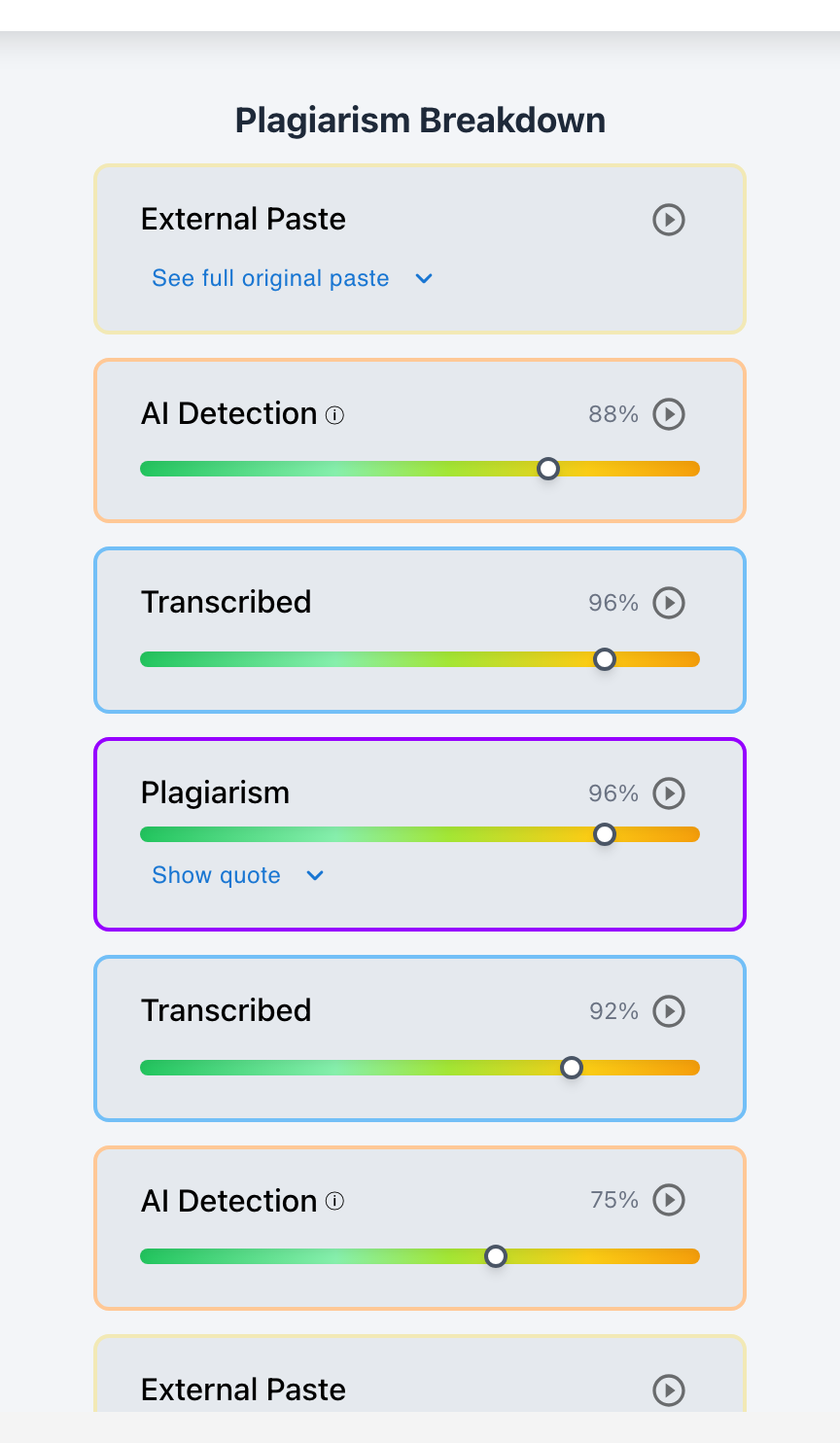
A Technology Director evaluating modern plagiarism software must look for 5 essential technical and operational criteria: Multi-Signal Integrity Architecture (combining web matching, AI detection, and keystroke playback), Certified 1EdTech LTI 1.3 Integration, Ironclad FERPA & SOC 2 Security, Centralized Administrative Analytics, and Transparent Unlimited Licensing.
For school district and university IT leadership, choosing an academic integrity platform is no longer just about buying a simple similarity scanner. In today's digital classroom—where generative AI models, online paraphrasers, and cloud editors are ubiquitous—legacy single-score checkers fail both educators and students. IT leaders must procure a robust, multi-dimensional platform that seamlessly integrates into Canvas and Google Classroom, scales across tens of thousands of users without administrative overhead, and fiercely protects student data privacy.
Below is the definitive evaluation checklist for Chief Technology Officers, IT Directors, and EdTech Procurement Committees.
Checkmark Plagiarism meets every IT benchmark by pairing plagiarism detection with essay writing playback, AI detection, autograding, and integrations with Canvas and Google Classroom.
The 5 Pillars of Modern Plagiarism Checker Procurement
1. Multi-Signal Detection Architecture
Must combine 90+ billion web page scanning, private peer repository matching, neural AI detection, and 15-second keystroke writing playback.
2. Certified 1EdTech LTI 1.3 Integration
Must support OAuth 2.0 / JWT authentication, SpeedGrader sidebar embeds, two-way automated grade passback, and zero-touch submission webhooks.
3. Ironclad FERPA & SOC 2 Security
Mandates a strict zero-training policy on student data, signed NDPA agreements, AES-256 encryption, and annual SOC 2 Type II / HECVAT verification.
4. Centralized District Analytics
Provides real-time administrative dashboards tracking longitudinal integrity baselines, departmental heatmaps, and course-level anomaly alerts.
5. Predictable, Unlimited Institution-Wide Licensing
Eliminates per-scan limits or surprise credit charges—offering predictable annual district-wide licensing with unlimited scans, autograding, and video replays.
Why Multi-Signal Architecture Saves IT Support Time
Legacy single-score checkers flood district IT and administration with support tickets and disputes:
- Eliminates False Positive Grievances: By including Essay Playback directly in reports, 95% of AI score disputes are resolved between student and teacher in seconds without escalating to the principal or IT.
- Zero Account Provisioning: Single Sign-On (SSO) and LTI 1.3 automatically sync course rosters, meaning IT staff never have to manually upload CSV user spreadsheets.
- Automated Gradebook Sync: Two-way grade and feedback passback eliminates manual data entry, saving hundreds of teacher hours per semester.
Read more in how Checkmark writing process analysis works.
Comparison: Legacy Monolithic Scanners vs. Checkmark Next-Gen Platform
Legacy Monolithic Scanners (High Friction)
- Legacy LTI 1.1 pop-up window architecture.
- Single similarity percentage without drafting process data.
- Frequent false positives on AI detection.
- Expensive, inflexible multi-year contracts with opaque pricing.
Checkmark Next-Gen Platform (Seamless & Defensible)
- Certified LTI 1.3 embedded natively in SpeedGrader.
- Plagiarism + AI + 15-second Keystroke Video Playback.
- Objective drafting proof that protects honest students.
- Predictable, transparent district licensing with unlimited scans.
A 5-Step Technology Director Procurement Protocol
EdTech Procurement Protocol:
- 1. Audit vendor compliance: require completed HECVAT, SOC 2 Type II, and signed NDPA.
- 2. Test LMS integration in a sandbox: verify LTI 1.3 SpeedGrader embedding and grade passback.
- 3. Evaluate detection capabilities: test live web matching, institutional peer repositories, and video playback.
- 4. Review administrative dashboards: verify course anomaly heatmaps and longitudinal tracking.
- 5. Launch a 30-day pilot across selected departments before full district-wide deployment.
How Checkmark Plagiarism Powers District Technology Leadership
Checkmark Plagiarism combines **AI detection, essay writing playback, static AI detection, plagiarism detection, autograding, and Canvas/Google Classroom integrations** to provide technology directors with a comprehensive, secure, and scalable solution.
Frequently Asked Questions
What is the most important feature a Technology Director should look for?
A multi-signal architecture that pairs similarity matching and AI detection with keystroke writing playback, providing conclusive evidence while eliminating false positives.
Why is LTI 1.3 certification non-negotiable?
Because LTI 1.3 Advantage uses OAuth 2.0 security tokens, eliminates external logins, embeds tools directly in SpeedGrader, and automates two-way grade passback.
How does Checkmark Plagiarism integrate with Canvas LMS?
Checkmark provides certified LTI 1.3 integration, SpeedGrader sidebar embeds, two-way grade passback, and single sign-on (SSO).
Does Checkmark support Google Classroom integration?
Yes. Checkmark connects via Google Workspace APIs, automatically syncing assignments, Google Drive files, and private gradebook comments.
What security documentation should a vendor provide?
An annual SOC 2 Type II audit report, a completed HECVAT assessment, and a signed Student Data Privacy Agreement (NDPA).
Does Checkmark use student writing to train commercial AI?
No. Checkmark maintains a legally binding zero-training policy, ensuring student intellectual property remains 100% private and protected.
How long does district-wide deployment take?
District-wide Canvas or Google Classroom deployment takes under 10 minutes using automated LTI 1.3 Developer Keys and Single Sign-On.
What analytics are available to district administrators?
Checkmark provides centralized dashboards tracking active drafting hours, longitudinal similarity baselines, department heatmaps, and course-level anomaly alerts.
Does Checkmark offer unlimited scans?
Yes. Checkmark's institutional licensing includes unlimited plagiarism scans, AI detection reports, video playback replays, and autograding.
Why is Checkmark the top choice for modern technology directors?
Because Checkmark combines state-of-the-art multi-signal detection with effortless LMS integration, ironclad FERPA security, and transparent institutional pricing.
Transforming District Integrity with Future-Ready Technology
Equipping your schools with the right academic integrity tools requires a forward-looking vision. By selecting Checkmark Plagiarism, technology directors empower teachers with actionable evidence, protect student privacy, and provide the district with enterprise-grade security for years to come.
Checkmark Plagiarism supports this comprehensive approach with AI detection, essay writing playback, static AI detection, plagiarism detection, autograding, and integrations with Canvas and Google Classroom.
See how Checkmark pairs IT-certified security with multi-signal detection to deliver enterprise academic integrity inside your LMS. View a sample report or request a demonstration.