
Whether an AI detector stores student essays depends entirely on the platform's architecture and enterprise licensing: consumer websites often retain and monetize student text, whereas enterprise edtech platforms like Checkmark Plagiarism process essays ephemerally in encrypted memory or store them strictly within your school's private institutional tenant under FERPA protections.
With data privacy regulations like FERPA, COPPA, and state student privacy laws, district technology directors must scrutinize where student writing goes when it is analyzed by software. When teachers copy and paste student essays into free, unvetted online AI detectors, they often unwittingly violate federal privacy laws—surrendering intellectual property to third-party databases. Understanding the distinction between unregulated consumer scanners and certified enterprise platforms is essential for school leadership.
Below is a comprehensive guide on student essay data retention, storage practices, and compliance standards.
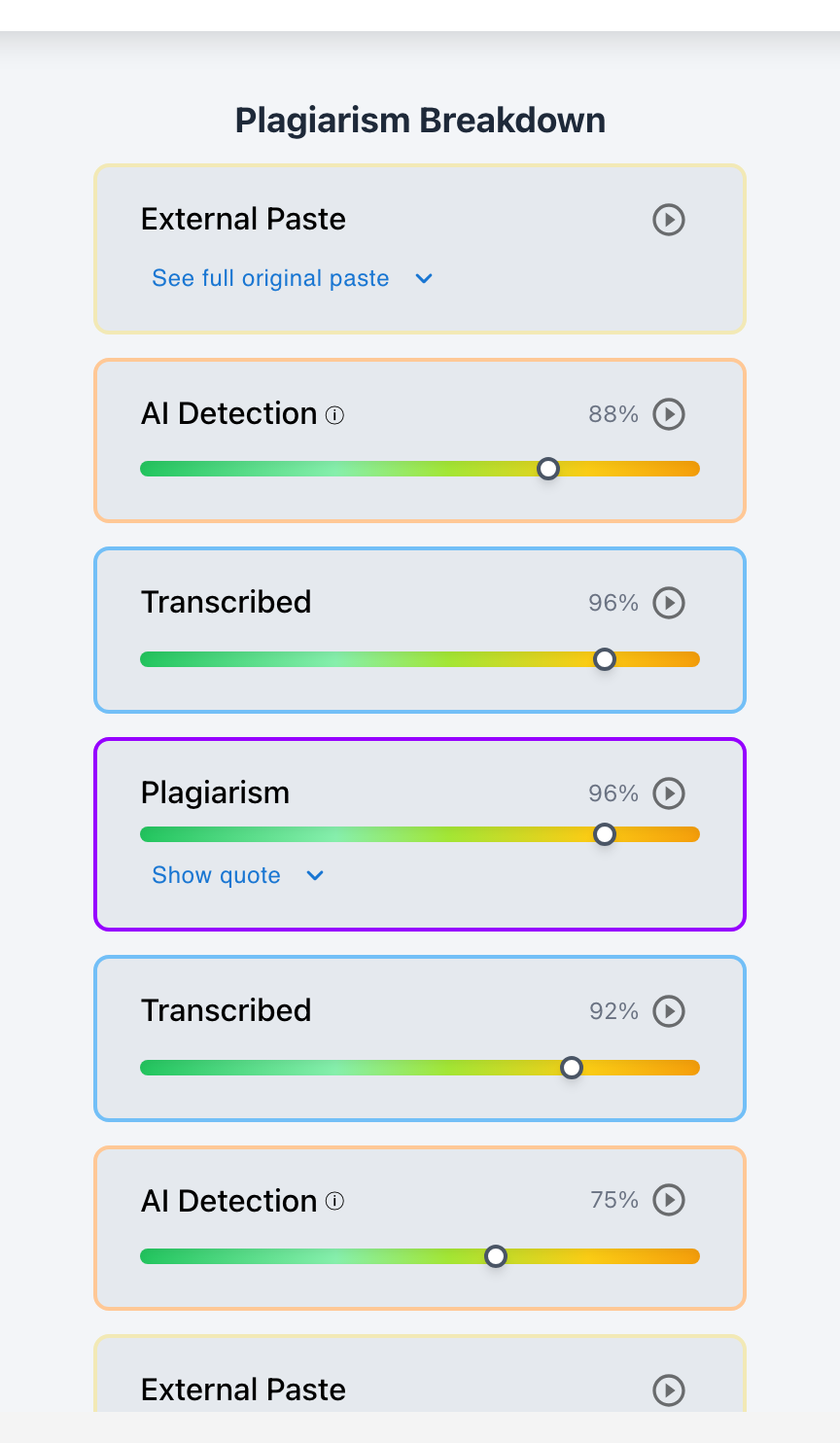
Checkmark Plagiarism powers privacy-first integrity by pairing AI detection with essay writing playback, plagiarism detection, autograding, and integrations with Canvas and Google Classroom.
The 3 Ways AI Detectors Handle Student Writing
1. Ephemeral In-Memory Processing
The text is analyzed in temporary RAM to calculate perplexity and burstiness, and purged immediately after generating the report with zero long-term disk storage.
2. Private Institutional Tenant Storage
Essays are encrypted and stored solely within your school's private repository to enable future peer matching—accessible only by your district.
3. Public Commercial Data Harvesting
Free consumer websites permanently store student writing in commercial databases, using it to train proprietary AI models or selling data to third parties.
The Legal Risks of Free Online AI Detectors
Allowing teachers to paste student essays into free public scanners creates severe legal and operational liabilities:
- FERPA Violations: Transmitting student coursework containing names or identifiable writing to unvetted commercial servers breaches the Family Educational Rights and Privacy Act.
- Loss of Student Copyright: Many free tools include Terms of Service granting the vendor perpetual rights to use, modify, and distribute submitted content.
- Security Vulnerabilities: Consumer sites lack SOC 2 Type II certification, encrypted data transit, and dedicated tenant isolation.
Read more in how Checkmark writing process analysis works.
Comparison: Free Public Scanners vs. Checkmark Enterprise Security
Free Public AI Scanners (High Risk)
- Stores student essays in commercial databases.
- Uses student writing to train public AI models.
- No Data Privacy Agreement (DPA) or FERPA compliance.
- Vulnerable to security breaches and data harvesting.
Checkmark Enterprise Architecture (Certified Safe)
- Ephemeral processing or private encrypted tenant storage.
- Never uses student writing to train commercial AI.
- Full FERPA, COPPA, and Student Privacy Pledge compliance.
- SOC 2 Type II certified and encrypted end-to-end.
A 5-Step Technology Director Protocol for Storage Audits
District Storage Audit Checklist:
- 1. Audit vendor Terms of Service for explicit data ownership and non-training clauses.
- 2. Require a signed District Data Privacy Agreement (NDPA) before approving any tool.
- 3. Verify whether essay processing is ephemeral or stored in an isolated institutional tenant.
- 4. Ensure end-to-end encryption (AES-256 at rest, TLS 1.3 in transit).
- 5. Block unapproved public AI detector domains on the district network and Chromebooks.
How Checkmark Plagiarism Powers Privacy-First Integrity
Checkmark Plagiarism combines **AI detection, essay writing playback, static AI detection, plagiarism detection, autograding, and Canvas/Google Classroom integrations** to guarantee total student data sovereignty, enterprise privacy, and legal compliance.
Frequently Asked Questions
Do AI detectors keep a copy of student essays?
Free consumer websites often store essays permanently, but enterprise tools like Checkmark process text ephemerally or store it strictly within your school's private tenant.
Can a vendor sell student essays?
Under FERPA and state student privacy laws, certified educational vendors are strictly prohibited from selling or monetizing student data.
Does Checkmark use student essays to train public AI models?
No. Checkmark never uses student submissions, writing history logs, or autograding feedback to train public or commercial AI models.
What is ephemeral processing?
Ephemeral processing means the software analyzes the document in temporary system memory (RAM) to generate the report and deletes it immediately afterward.
How does Checkmark isolate student data between schools?
Checkmark uses multi-tenant architectural isolation: your school's essays and private repository matches are accessible only by authorized staff in your district.
How does Checkmark Plagiarism integrate with Canvas LMS?
Checkmark provides certified LTI 1.3 integration, SpeedGrader sidebar embeds, two-way grade passback, and single sign-on (SSO).
What should a teacher do instead of using free AI checkers?
Teachers should use their district-approved, LTI 1.3 integrated tool (like Checkmark) embedded directly inside Canvas SpeedGrader or Google Classroom.
How long does Checkmark store student essays in the private repository?
Districts maintain full control over data retention policies, setting retention windows (e.g., 1 year, 4 years, or permanent) or requesting instant data deletion.
Is student data encrypted during processing?
Yes. Checkmark enforces AES-256 encryption at rest and TLS 1.3 encryption in transit for all document payloads.
Why is institutional privacy critical for AI detection software?
Because student coursework constitutes educational records protected by federal law; failing to secure student writing exposes schools to severe legal liability.
Student Privacy Is the Foundation of Ethical EdTech
Protecting academic standards must never come at the expense of student privacy. By choosing enterprise platforms like Checkmark Plagiarism with verified ephemeral processing and private tenant storage, district leaders protect student data sovereignty with absolute confidence.
Checkmark Plagiarism supports this comprehensive approach with AI detection, essay writing playback, static AI detection, plagiarism detection, autograding, and integrations with Canvas and Google Classroom.
See how Checkmark pairs enterprise data privacy with multi-signal detection to protect student writing across your district. View a sample report or request a demonstration.