
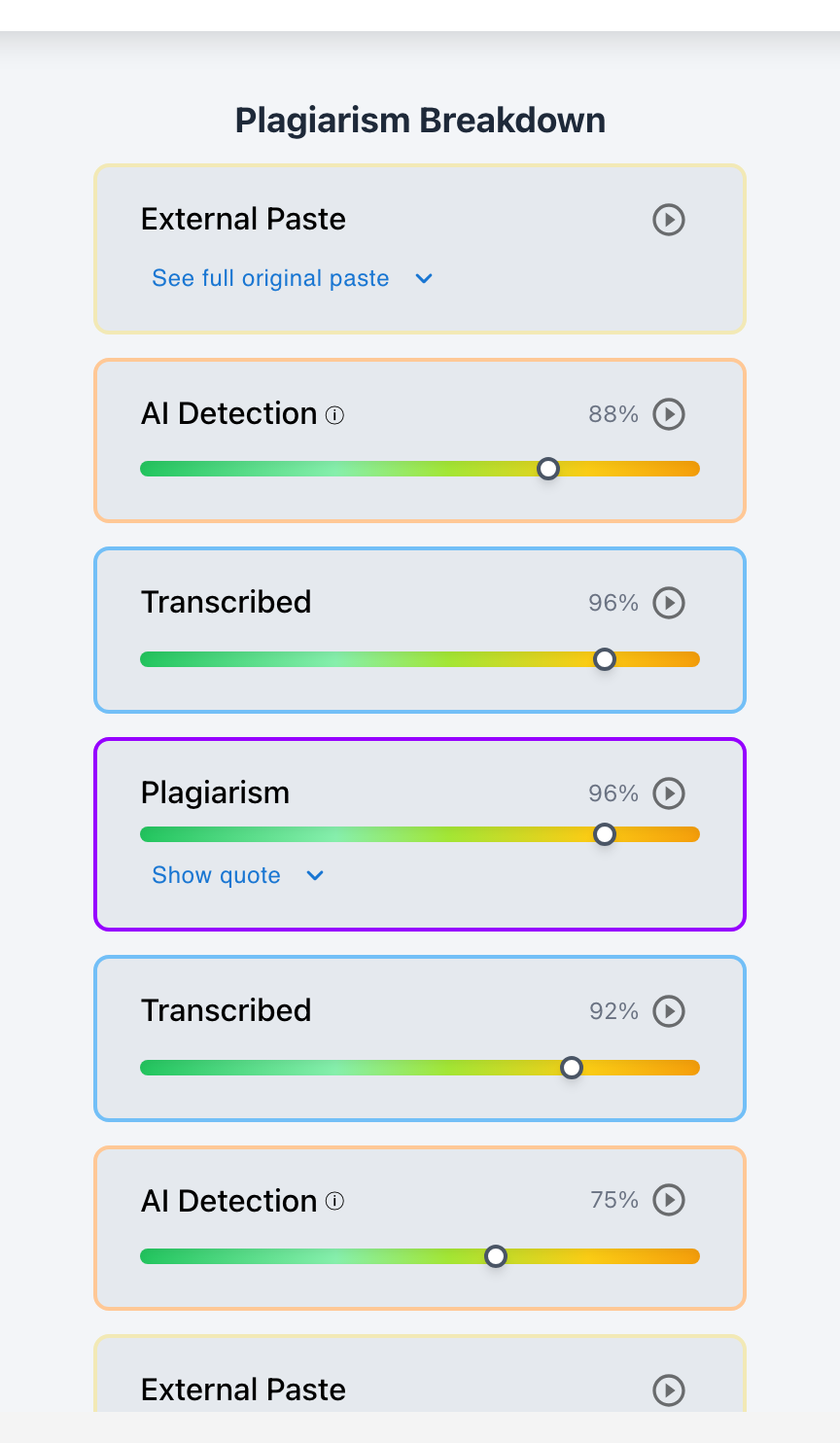
Before purchasing an AI detection tool, school leaders and procurement committees must ask 10 essential questions—evaluating how the vendor handles false positives on articulate human writing, whether the tool includes keystroke writing playback, whether student writing is protected from AI training, and whether the platform integrates natively via certified LTI 1.3.
The market for educational AI detection is crowded with standalone startups offering statistical percentage scores without due process protections. Buying an AI detector that provides only a single probability number exposes schools to disastrous false accusations, contentious parent disputes, and damaged student-teacher trust. To make an informed, defensible investment, district procurement committees must evaluate vendors across accuracy, privacy, workflow integration, and pedagogical evidence.
Below is the definitive 10-question evaluation scorecard for school boards, superintendents, and technology directors.
Checkmark Plagiarism answers every question with enterprise excellence by pairing AI detection with essay writing playback, plagiarism detection, autograding, and integrations with Canvas and Google Classroom.
The 10 Vital Questions for AI Detector Vendors
1. How do you protect students from false positives?
Acceptable Answer: "We provide embedded Essay Playback, allowing teachers to verify active typing hours and backspaces to clear articulate human writers instantly."
2. Do you use student writing to train AI models?
Acceptable Answer: "No. We maintain an ironclad, contractually binding zero-training policy; student writing is never used to train any AI algorithms."
3. Does your tool embed directly in SpeedGrader?
Acceptable Answer: "Yes. We are certified for 1EdTech LTI 1.3 Advantage, embedding AI scores, heatmaps, and video replays directly in Canvas SpeedGrader."
4. Can you detect paraphrased and humanized AI?
Acceptable Answer: "Yes. We pair semantic perplexity tracking with Original Paste Preservation and transcription keystroke cadence analysis."
5. Does the tool include full plagiarism checking?
Acceptable Answer: "Yes. We scan 90+ billion web pages, academic archives, and your private institutional repository in the same scan."
6. Does your platform include Autograding?
Acceptable Answer: "Yes. We convert your custom rubrics into automated, quote-anchored feedback with full teacher-in-the-loop approval."
7. What third-party security audits do you hold?
Acceptable Answer: "We maintain annual SOC 2 Type II certification, completed HECVAT documentation, and sign standard district NDPAs."
8. What analytics are available to administrators?
Acceptable Answer: "We provide centralized dashboards tracking longitudinal integrity baselines, department heatmaps, and course anomaly alerts."
9. How are student data lifecycles managed?
Acceptable Answer: "Districts configure custom retention windows (e.g., 4-year cohorts) with automated graduation purges and 1-click tenant wipes."
10. Is licensing predictable and unlimited?
Acceptable Answer: "Yes. We offer transparent, district-wide annual licensing with unlimited scans, video replays, and autograding."
Why Buying a Multi-Signal Platform Protects the District
Standalone percentage detectors fail because statistical probability is not legal proof:
- Defensibility in Student Conferences: Showing a student an abstract "88% AI Score" leads to denial and confrontation. Showing an accelerated video of 1,500 words pasted in 0.05 seconds creates undeniable clarity.
- Protecting Advanced Writers: Articulate, formal student writing frequently triggers high AI probability scores. Checkmark's writing playback provides physical proof of multi-hour drafting, protecting honest students from wrongful penalties.
- Eliminating Software Redundancy: Checkmark unifies AI detection, plagiarism matching, keystroke playback, and rubric autograding in one tool, cutting district software licensing costs.
Read more in how Checkmark writing process analysis works.
Comparison: Standalone AI Detectors vs. Checkmark Multi-Signal Suite
Standalone AI Detectors (Incomplete & High Risk)
- Provides only a single isolated AI percentage.
- Zero insight into drafting time, revisions, or pastes.
- High false positive risk on articulate students.
- Requires buying separate plagiarism and grading tools.
Checkmark Multi-Signal Suite (Comprehensive & Safe)
- AI Detection + Plagiarism + 15-second Writing Playback.
- Quantifies active typing hours, backspaces, and paste logs.
- Conclusive proof that clears false positives in seconds.
- Includes Autograder for rubric feedback and grade passback.
A 5-Step Procurement Protocol for School Leadership
District AI Procurement Scorecard:
- 1. Issue the 10 Vendor Evaluation Questions to prospective software providers.
- 2. Request a live demonstration inside your district's Canvas or Google Classroom environment.
- 3. Test sample human and AI essays: verify that writing playback accurately reflects composition.
- 4. Have your IT security team review the vendor's SOC 2 Type II report and HECVAT assessment.
- 5. Execute the Student Data Privacy Agreement (NDPA) and deploy across your secondary schools.
How Checkmark Plagiarism Answers Every Procurement Need
Checkmark Plagiarism combines **AI detection, essay writing playback, static AI detection, plagiarism detection, autograding, and Canvas/Google Classroom integrations** to provide school districts with the industry's most comprehensive, accurate, and ethical academic integrity platform.
Frequently Asked Questions
Why is asking about false positive protections the most important question?
Because static AI detectors regularly flag articulate human writers; without writing playback to verify drafting hours, honest students face wrongful accusations.
What is the difference between an AI detector and a multi-signal integrity tool?
An AI detector only analyzes static text, whereas a multi-signal tool (like Checkmark) pairs AI scores with web plagiarism matching, keystroke playback, and paste tracking.
Does Checkmark support both Canvas and Google Classroom?
Yes. Checkmark provides certified 1EdTech LTI 1.3 integration for Canvas SpeedGrader and direct API synchronization for Google Classroom.
How does Checkmark protect student intellectual property?
Under Checkmark's binding zero-training guarantee, student writing is never used to train, retrain, or fine-tune commercial or proprietary AI models.
What is Autograder in Checkmark Plagiarism?
Autograder automatically converts teacher rubrics into instant, quote-anchored feedback, allowing teachers to review and approve grades in half the time.
How does Checkmark Plagiarism integrate with Canvas LMS?
Checkmark provides certified LTI 1.3 integration, SpeedGrader sidebar embeds, two-way grade passback, and single sign-on (SSO).
Does Checkmark provide district-wide analytics?
Yes. Centralized administrator dashboards track active drafting hours, longitudinal similarity baselines, department heatmaps, and course-level anomaly alerts.
What happens during student disciplinary appeals?
Checkmark generates complete forensic evidence dossiers—including 15-second video replays, active typing hours, and paste logs—providing total clarity for appeals.
Is Checkmark licensing based on scan limits?
No. Checkmark offers predictable institutional licensing with unlimited plagiarism scans, AI detection reports, video playback replays, and autograding.
Why is Checkmark the best choice for forward-thinking school districts?
Because Checkmark is the only platform that unifies neural AI detection, internet-wide plagiarism matching, keystroke playback, and rubric autograding in a single LTI 1.3 tool.
Making the Right Choice for Your Students and Teachers
Investing in academic integrity software is an investment in your school's educational culture. By asking the right questions and demanding multi-signal evidence with Checkmark Plagiarism, district leaders ensure fair evaluations, protect student privacy, and build a lasting foundation of academic excellence.
Checkmark Plagiarism supports this comprehensive approach with AI detection, essay writing playback, static AI detection, plagiarism detection, autograding, and integrations with Canvas and Google Classroom.
See how Checkmark pairs multi-signal detection with enterprise security to deliver complete academic integrity inside your LMS. View a sample report or request a demonstration.