
Usually, an AI detector should not be the only evidence used to determine that a student committed academic misconduct. AI detection can be useful: it can identify writing that appears consistent with AI-generated text and help teachers decide which assignments deserve a closer review. But an AI detection result does not automatically explain how the assignment was created.
A detector generally cannot tell a teacher with certainty whether the student used ChatGPT, which AI tool was used, whether AI generated the entire assignment or was used only for brainstorming/editing, whether the student rewrote AI material, whether the AI use violated course policy, or whether the detector produced a false positive.
For those reasons, an AI detection result is strongest when it is considered alongside other evidence: previous student writing, writing history, citations, drafts, assignment requirements, and the student's explanation of how the work was completed.
Checkmark Plagiarism supports this evidence-based approach with AI detection, essay writing playback, static AI detection, plagiarism detection, autograding, and integrations with Canvas and Google Classroom.
What Does an AI Detector Actually Tell You?
An AI detector analyzes submitted writing and looks for characteristics associated with AI-generated text. If the detector raises concerns, it indicates that the assignment deserves additional attention.
There is a fundamental distinction between:
- "This text contains characteristics associated with AI-generated writing."
- "This student violated the academic-integrity policy."
The second statement requires more information: academic misconduct is about what the student actually did and whether that behavior violated course rules. A detector analyzes text—it does not reconstruct the student's entire writing process.
Why an AI Detection Result Is Not the Same as Proof
Imagine a student essay receives a high AI detection result. The student may have generated the essay with ChatGPT, used AI to rewrite their own drafting, utilized an editing assistant, combined AI prose with human work, or written the paper independently and triggered a false positive.
Because the score alone cannot distinguish among those possibilities, teachers should avoid moving directly from "The paper was flagged" to "The student cheated." There should always be an investigation between those two conclusions. Read our analysis on can I prove that a student used ChatGPT?
Can AI Detectors Produce False Positives?
Yes. A false positive occurs when human-written text is incorrectly identified as AI-generated. Highly structured, formal, and concise prose often triggers statistical flags. Read our complete guide on can AI detectors give false positives?
Can AI Detectors Miss AI-Generated Writing?
Yes. A false negative occurs when AI-generated writing is not flagged. Rewritten, edited, or blended AI content often evades text-only detection. A low score does not prove human authorship. Learn more in can ChatGPT writing pass an AI detector?
What Evidence Should Teachers Consider Alongside AI Detection?
A strong academic-integrity review uses multiple sources of information:
Previous Student Writing
Compare the assignment with earlier student work across vocabulary, sentence structure, grammar, organization, tone, and depth of analysis. A sudden shift from basic sentences to complex academic prose warrants inquiry.
Writing History
The drafting process provides information that the final document cannot. An essay built through an outline, multi-day drafting, and continuous sentence revisions provides a starkly different picture than an empty document that suddenly receives 1,300 words all at once.
Essay Writing Playback With Checkmark Plagiarism
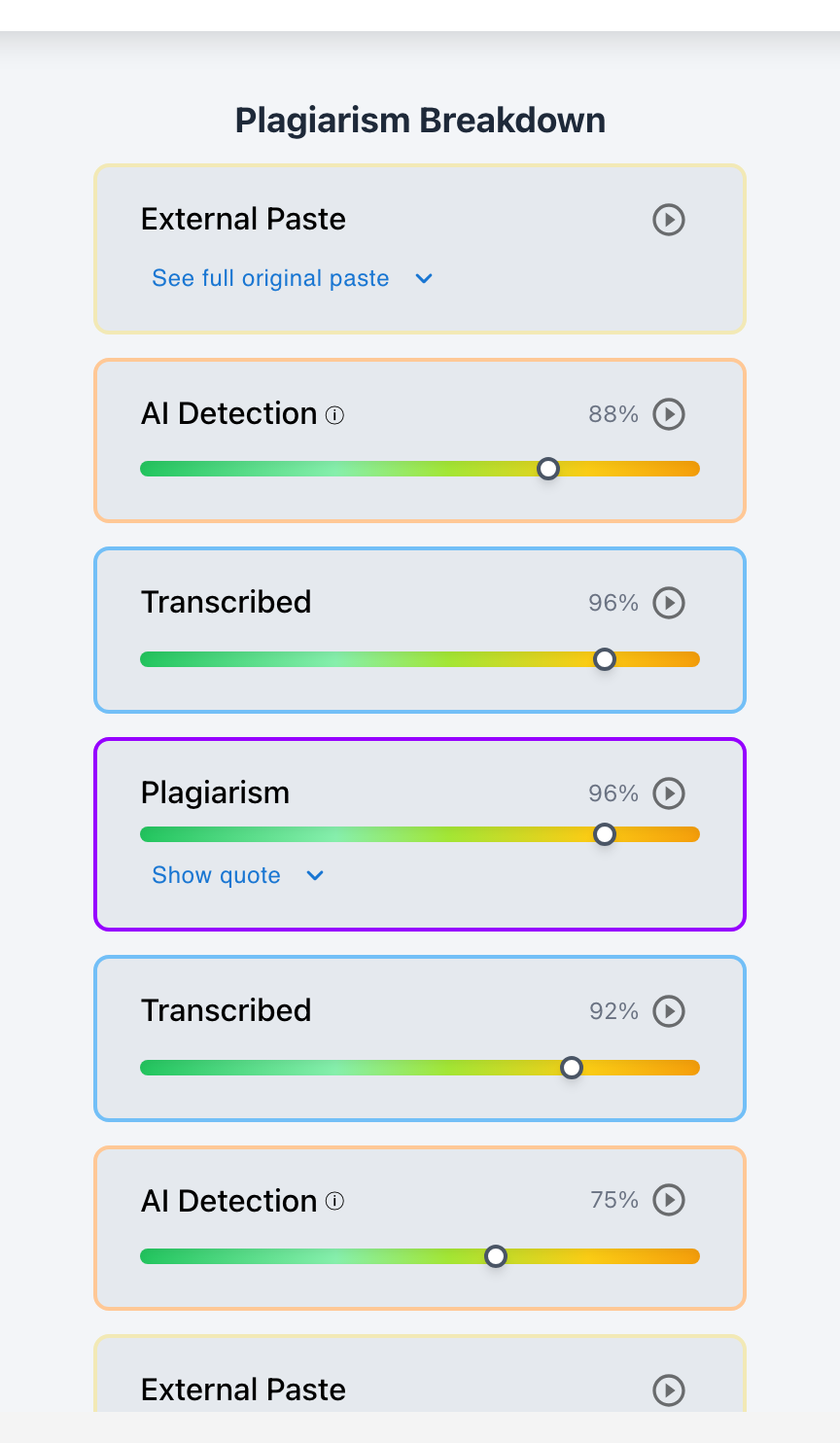
Checkmark Plagiarism's essay writing playback allows teachers to review how an assignment developed over time: gradual drafting, larger text additions, revisions, deleted material, and editing activity. Instead of presenting a student with an arbitrary percentage, teachers can ask targeted questions based on observable drafting activity. Read more in how Checkmark writing process analysis works.
Does a Large Paste Prove Academic Misconduct?
No. A large text insertion could come from a student's earlier draft, research notes, quotations, or another document. Writing history provides context that prompts constructive questions rather than automatic guilt.
Check the Student's Sources
Generative AI systems frequently fabricate citations or hallucinate page numbers. Verifying citations is an essential evidence-gathering step:
- Does the cited article or book exist in academic databases?
- Is the author and title accurate?
- Does the quoted passage actually appear in the source?
- Does the cited text support the student's claim?
Talk to the Student
Avoid beginning with "The detector says you cheated." Instead, approach the conversation as an evidence-gathering inquiry: "I have some questions about how you completed this assignment. Can you walk me through your writing process?"
For conversation strategies, see our guide on how do I talk to a student I suspect of using AI?
Ask the Student to Explain Their Own Work
Students who wrote an essay should generally be able to explain the core thesis, define the terminology used, and describe how they found their evidence. Unfamiliarity with the central arguments of their own paper provides important context alongside AI detection flags.
What If the Student Admits Using AI?
An admission of AI use does not automatically constitute misconduct—you still need to determine how AI was used. There is a major difference between brainstorming ideas, checking grammar, rewriting sentences, and generating full paragraphs. Academic misconduct depends on whether the student's behavior violated the assignment's rules.
Clear AI Policies Matter
Institutions must clearly delineate permitted and prohibited AI usage before submissions:
Allowed
- Brainstorming ideas
- Creating study questions
- General feedback on drafts
Allowed With Disclosure
- Outlining topics
- Grammar/style editing
- Sentence-level suggestions
Not Allowed
- Generating final answers
- Submitting AI paragraphs
- Writing on student's behalf
What Does Strong Evidence of Academic Misconduct Look Like?
Strong Evidence of Misconduct
- Writing style shifts dramatically from prior work
- Writing playback shows 1,000 words pasted instantly
- Multiple citations do not exist in databases
- Student cannot explain core arguments or terminology
- Explanation directly contradicts document history
Weak Evidence (Vindicated Student)
- Writing matches student's established formal voice
- Playback proves days of gradual multi-session drafting
- Student provides research notes and verified citations
- Student fluently explains thesis and arguments
- Explanation perfectly matches writing history
What If the AI Detector Is the Only Evidence Available?
When students submit PDFs or Word files with no writing history, Checkmark Plagiarism's static AI detection evaluates the final text. Teachers should combine this score with previous writing samples, citation verification, and a student conversation rather than relying on the percentage alone.
AI Detection Is Different From Plagiarism Detection
Plagiarism detection compares text against indexed databases, while AI detection measures statistical language patterns without direct external source matches. Read our full breakdown in AI detection vs. plagiarism detection.
Should Schools Automatically Fail Students Based on an AI Score?
Automatic penalties based on scores (e.g., "over 50% = zero") ignore false positives, tool discrepancies, and legitimate editing assistance. A defensible policy follows a four-step framework: Detection concern → evidence review → student conversation → policy decision.
A Practical Evidence Checklist
Practical Evidence Checklist for AI Integrity Cases:
About the Detector & Text
- What does the score specifically measure?
- Does the style match past student submissions?
- Does the paper directly answer the prompt?
About the Process & Citations
- Was drafting gradual or pasted in large chunks?
- Are all cited sources, authors, and quotes verified?
- Can the student explain terminology and arguments?
How Checkmark Plagiarism Supports Evidence-Based AI Investigations
Checkmark Plagiarism combines **AI detection, essay writing playback, static AI detection, plagiarism detection, autograding, and Canvas/Google Classroom integrations** so educators have the multifaceted evidence required for fair academic integrity proceedings.
Frequently Asked Questions
Is an AI detector enough proof that a student cheated?
An AI detection result can provide a reason for further review, but it should generally be considered alongside additional evidence before determining that academic misconduct occurred.
Can a school punish a student based only on an AI detector?
School policies differ, but relying entirely on one AI detection result can be problematic because AI detectors can produce false positives and do not necessarily establish exactly how an assignment was created.
What evidence should teachers use with AI detection?
Teachers can consider previous student writing, essay writing history, sources and citations, drafts, assignment requirements, student understanding, and the student's explanation of their writing process.
Is a high AI percentage enough evidence?
A high AI result may justify closer review, but the percentage should be interpreted according to what the detector actually measures and considered alongside other evidence.
What if the student denies using AI?
Review the broader evidence. Ask the student to explain the assignment, writing process, sources, unusual passages, and any tools used while completing the work.
Can writing history prove AI use?
Writing history can show how an assignment developed and may reveal unusual text additions or revision patterns. It does not necessarily establish where inserted text originated, so it should be interpreted with other evidence.
What if writing history supports the student?
That evidence matters. A fair academic-integrity review should allow information to weaken an initial suspicion as well as strengthen it.
Is using ChatGPT always academic misconduct?
No. Whether AI use constitutes misconduct depends on the rules for the assignment. Some instructors allow brainstorming, feedback, or other limited forms of AI assistance.
How does Checkmark Plagiarism help with academic-integrity investigations?
Checkmark Plagiarism combines AI detection, essay writing playback, static AI detection, plagiarism detection, autograding, and Canvas and Google Classroom integrations, giving teachers multiple sources of information when reviewing questionable assignments.
An AI Detector Can Raise the Question—It Should Not Be the Entire Answer
AI detection can analyze submitted text and identify writing that deserves review, but it cannot tell the teacher how the assignment was created or whether the student violated course policy. The strongest academic-integrity decisions rely on a full body of evidence.
Checkmark Plagiarism supports this evidence-based approach with AI detection, essay writing playback, static AI detection, plagiarism detection, autograding, and integrations with Canvas and Google Classroom.
See how Checkmark provides educators with the evidence needed for fair academic-integrity reviews. View a sample report or request a demonstration.