
No. In almost all academic, administrative, and legal contexts, a student cannot and should not be disciplined based solely on an automated AI detector score.
Imposing academic penalties—such as assigning a failing grade, recording an academic misconduct violation, placing a student on disciplinary probation, or issuing a suspension—requires reliable, defensible evidence. Because AI detectors generate statistical probability estimates of language patterns rather than definitive forensic proof of authorship, relying exclusively on a detector score violates basic educational due process and carries significant institutional and legal risk.
Leading universities, school districts, and academic integrity organizations broadly agree: an AI detection score can serve as a preliminary reason for inquiry, but disciplinary sanctions require a multi-signal evidentiary package that incorporates essay writing playback, citation audits, baseline writing comparisons, and student interviews.
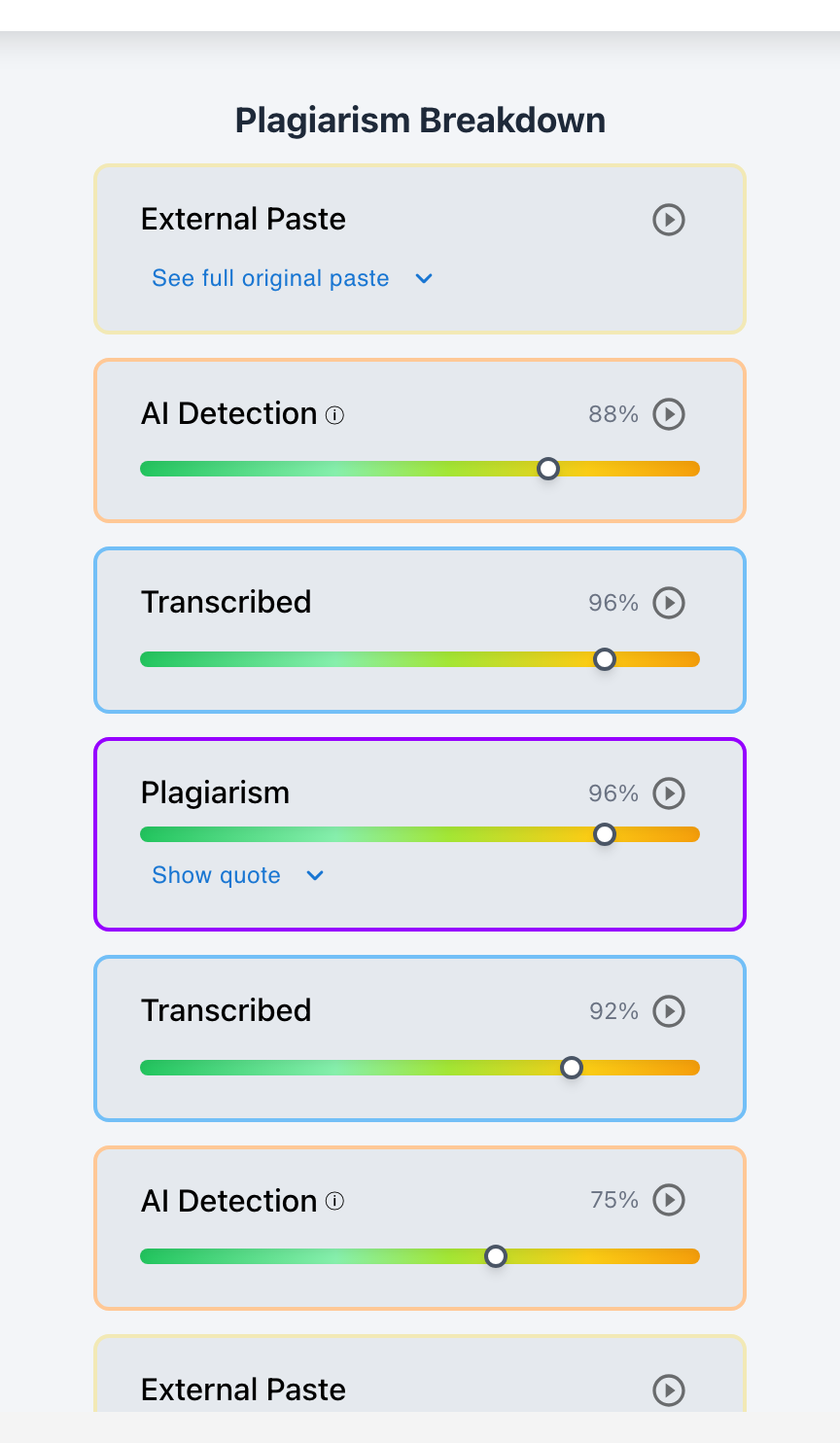
Checkmark Plagiarism protects both academic standards and student due process by combining AI detection with essay writing playback, static AI detection, plagiarism detection, autograding, and integrations with Canvas and Google Classroom.
Why Single-Score Discipline Is Academically and Legally Indefensible
1. Statistical Heuristics ≠ Forensic Proof
AI detectors evaluate text predictability (perplexity) and sentence length variation (burstiness). A high score simply indicates that phrasing resembles training patterns—it does not prove who typed the words.
2. Documented Algorithmic Bias
Peer-reviewed studies confirm that detectors exhibit elevated false positive rates on non-native English writers (ESL/ELL) and neurodivergent students who utilize structured grammatical templates.
3. Lack of Verifiable Source Artifacts
Unlike traditional plagiarism detection, which produces side-by-side text comparisons against published articles, AI detectors cannot point to an original external source file.
4. Procedural Due Process Violations
In public institutions, disciplining students without transparent, contestable, and corroborated evidence infringes upon constitutional and institutional due process rights.
Read more in is an AI detector enough evidence for academic misconduct?
Traditional Plagiarism Proof vs. AI Detection Scores
Understanding why single-score discipline fails requires contrasting traditional plagiarism with AI detection:
Traditional Plagiarism Matching
- Evidence Type: Direct, verifiable physical comparison.
- Artifact: An existing website, journal article, or peer submission.
- Proof Standard: Side-by-side matching of identical sentences.
- Defensibility: High; undisputed objective proof of copying.
Automated AI Detection
- Evidence Type: Circumstantial statistical classification.
- Artifact: Mathematical probability score (no source document).
- Proof Standard: Inferred likelihood based on language regularity.
- Defensibility: Low on its own; easily challenged on appeal.
What Is the Legal and Institutional Standard of Proof?
Academic misconduct hearings typically require either a "preponderance of the evidence" (more likely than not) or "clear and convincing evidence" standard. An isolated detector output cannot meet either threshold because:
- Detectors cannot distinguish between a student who drafted an essay with formal vocabulary and a student who generated paragraphs with ChatGPT.
- Detectors cannot identify whether an essay was drafted by a student and lightly edited with an approved grammar assistant (e.g., Grammarly).
- Detector outputs fluctuate significantly across different vendor platforms. Read more in why do different AI detectors give different results?
How Essay Writing Playback Provides Defensible Process Evidence
To sustain an academic integrity decision, educators must evaluate the process of creation rather than relying solely on the final static document. Checkmark Plagiarism's essay writing playback provides the objective timeline data required for fair decisions:
- Active Drafting Timestamps: Proves whether an essay was typed over hours across multiple sessions or appeared instantly in minutes.
- Keystroke & Revision Cadence: Documents authentic writing behaviors—such as rewriting sentences, fixing typos, and reorganizing paragraphs.
- Paste Event Logs: Records the exact timestamp, character count, and location of wholesale text insertions.
When combined with citation audits and baseline comparisons, playback logs provide concrete, physical documentation that stands up to administrative and legal scrutiny. Read more in how Checkmark writing process analysis works.
Disciplinary Decision Matrix: When Are Penalties Justified?
Sanctions Justified (Multi-Signal Corroboration)
- Writing playback shows 1,400 words pasted instantly with zero subsequent edits.
- Multiple citations are verified as non-existent or hallucinated.
- Student cannot explain core arguments or vocabulary during an oral conference.
- Student explanation contradicts observable document timestamps.
- Student acknowledges unauthorized generative AI use.
Sanctions Prohibited (Insufficient Evidence)
- AI detector score is elevated (e.g., 90%), but playback shows multi-day drafting.
- All cited academic sources exist and are accurately quoted.
- Student fluently explains thesis development and research choices orally.
- Student used an approved grammar checker for punctuation correction.
- No process discrepancies or hallucinated citations exist.
A 7-Step Institutional Protocol for Academic Integrity Panels
Recommended Institutional Review Protocol:
- 1. Ban disciplinary sanctions based solely on third-party automated AI detector scores.
- 2. Require instructors to audit essay writing playback logs before submitting misconduct referrals.
- 3. Audit all cited academic sources in databases (JSTOR, Google Scholar) to detect hallucinations.
- 4. Compare the submission against historical, verified student writing baselines.
- 5. Mandate a private student conference with open-ended oral comprehension checks.
- 6. Provide the student a structured 24–48 hour window to submit external drafts or notes.
- 7. Require multi-signal corroboration before any formal penalty or grade reduction is upheld.
How Checkmark Plagiarism Protects Institutions and Students
Checkmark Plagiarism combines **AI detection, essay writing playback, static AI detection, plagiarism detection, autograding, and Canvas/Google Classroom integrations** to replace subjective probability scores with objective, multi-signal evidence packets that ensure fair, transparent, and legally sound academic integrity decisions.
Frequently Asked Questions
Can a school suspend or fail a student based only on an AI detector score?
No. Academic policies and due process standards prohibit penalizing students based solely on probabilistic algorithm scores without corroborating process and citation evidence.
What happens if a school disciplines a student based only on an AI detector?
The decision is vulnerable to administrative appeals, parent challenges, and legal action, as single detector outputs cannot withstand evidentiary scrutiny.
What is the minimum evidence required to discipline a student for AI use?
A multi-signal evidence package: timeline logs showing wholesale paste events in playback, verified non-existent citations, inability to explain arguments orally, or a student admission.
Can a teacher assign a zero grade if an AI detector flags 100%?
No. Even a 100% score is a statistical probability estimate. The instructor must verify writing playback, check citations, and confer with the student before determining a grade penalty.
Why do AI detectors lack forensic standing in academic hearings?
Detectors cannot identify who created the text, what tools were used, or provide an original matching source file, making their outputs purely circumstantial.
How does essay writing playback provide legally sound evidence?
Writing playback provides objective physical timeline records: keystroke cadences, active drafting durations, and paste timestamps that objectively prove how the text was composed.
What if a student with a 95% AI score proves they drafted the essay in Google Docs?
If writing playback logs demonstrate multi-session drafting and the student explains the work fluently, the detector result is dismissed as a false positive, and no penalty is assigned.
How should schools update their academic integrity policies regarding AI detectors?
Policies should explicitly state that AI detector scores are preliminary screening tools and that formal disciplinary actions require multi-signal corroborating evidence.
How do hallucinated citations support a disciplinary case?
Non-existent journal articles, fake author names, and fabricated page numbers provide concrete, verifiable physical proof of generative AI involvement.
How does Checkmark Plagiarism support fair institutional hearings?
Checkmark Plagiarism generates comprehensive, exportable evidence packets combining writing playback logs, citation audits, and dual AI/plagiarism scans directly within your LMS.
Due Process and Academic Integrity Must Coexist
Upholding academic standards does not require abandoning due process. By grounding disciplinary decisions in transparent, objective multi-signal evidence—combining writing playback, citation audits, baseline comparisons, and student dialogue—institutions ensure that scholarship is protected while treating every student with fairness and respect.
Checkmark Plagiarism supports this principled standard with AI detection, essay writing playback, static AI detection, plagiarism detection, autograding, and integrations with Canvas and Google Classroom.
See how Checkmark pairs essay writing playback with multi-signal detection to generate defensible, comprehensive evidence packets for every assignment. View a sample report or request a demonstration.