
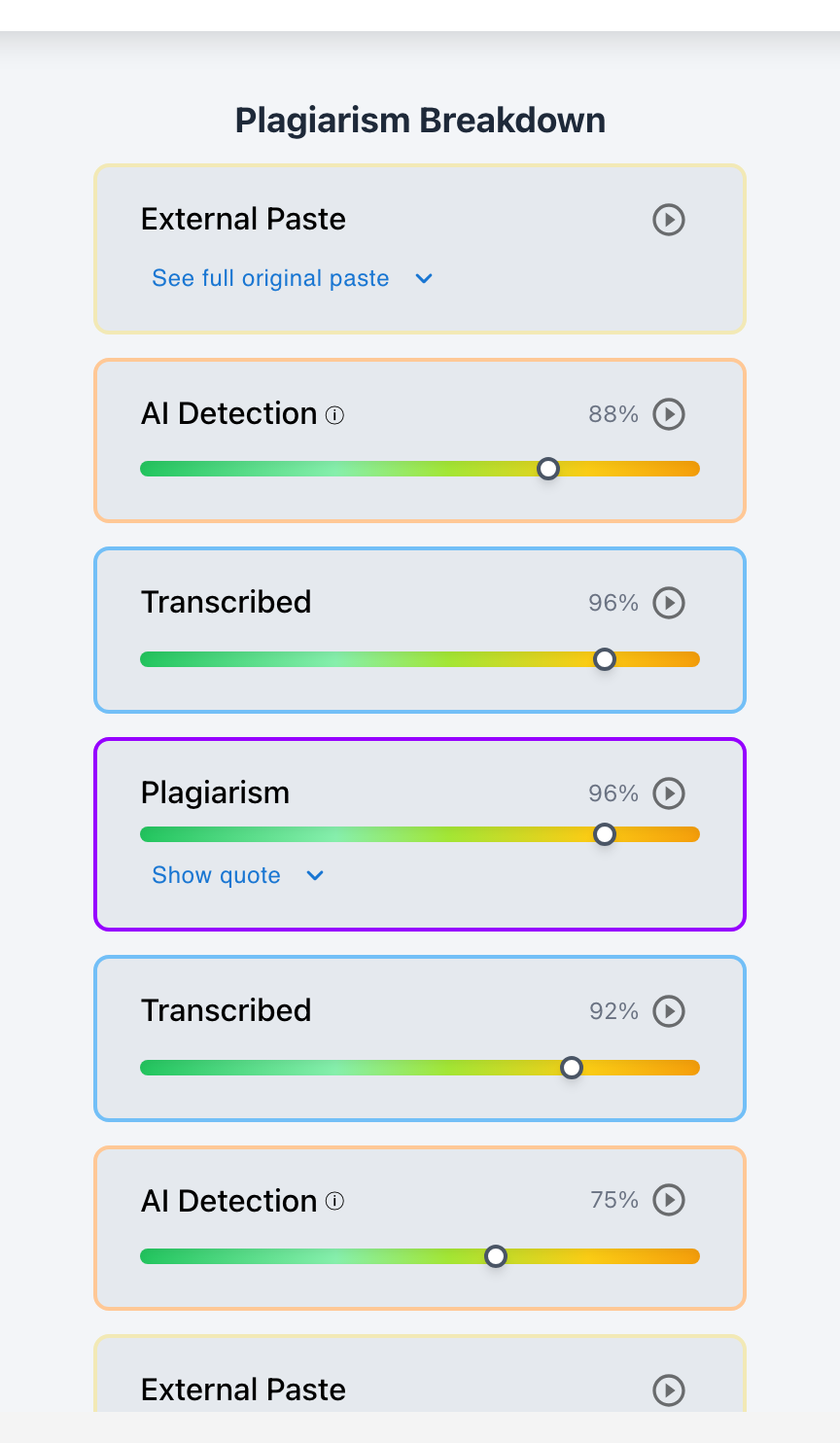
Yes. AI detectors can give false positives. A false positive happens when a detector identifies human-written text as likely AI-generated. That possibility is important for teachers and schools to understand because an AI detection result can have serious consequences for a student. A paper flagged by a detector may lead to questions about cheating, academic-integrity reviews, or disciplinary action.
For that reason, an AI detection score should generally be treated as one piece of evidence rather than proof that a student used ChatGPT or another AI tool.
A stronger approach combines AI detection with other information, such as the student's previous writing, the content of the assignment, writing history, source verification, and a conversation with the student.
Checkmark Plagiarism supports this broader approach through AI detection, essay writing playback, static AI detection, plagiarism detection, autograding, and integrations with Canvas and Google Classroom.
What Is a False Positive in AI Detection?
A false positive occurs when an AI detector incorrectly identifies human-written text as AI-generated.
For example, imagine that a student writes an essay entirely on their own. The student researches the topic, creates an outline, drafts the paper, revises it several times, and submits the final assignment. An AI detector then analyzes the essay and indicates that some or all of the text may have been generated by AI.
If the student genuinely wrote the essay, that result is a false positive.
The important point is that an AI detector is not observing the student write. It is analyzing characteristics of the finished text and estimating whether those characteristics resemble AI-generated writing. An estimate can be useful, but it can also be wrong.
Why Can AI Detectors Produce False Positives?
Human and AI writing are not completely separate categories. AI systems are trained to produce text that resembles human language. At the same time, some human writing naturally contains patterns that may resemble AI-generated text.
For example, human writing can be:
- Highly structured
- Grammatically consistent
- Predictable
- Formal
- Repetitive
- Concise
- Written with similar sentence lengths
- Organized into consistent paragraphs
Those characteristics may occur in AI-generated writing, but they can also appear in completely legitimate student work. That overlap makes perfect AI detection extremely difficult.
A Polished Essay Is Not Proof of AI Use
One common concern is that an essay suddenly seems unusually polished. The grammar may be excellent, the transitions smooth, and the paragraphs well organized. That can make a teacher suspicious, particularly when the assignment is stronger than the student's previous work.
But polished writing alone does not mean the student used AI. The student may have spent more time revising, received tutoring, worked with a writing center, used an approved grammar tool, asked another person for feedback, improved their writing skills, or taken the assignment more seriously than previous work.
This is why teachers should avoid treating either writing style or an AI detection result as conclusive by itself.
Can Human Writing Look Like AI Writing?
Yes. Some students naturally write in styles that may be more difficult for an AI detector to classify.
Consider a student who writes:
"Renewable energy can provide several important benefits. First, it can reduce dependence on fossil fuels. Second, it may help reduce greenhouse gas emissions. Finally, it can support the development of new industries and technologies."
The paragraph is clear, predictable, grammatically consistent, and highly structured. It may resemble the type of response a generative AI system could produce. But a student could easily have written it themselves.
The difficulty is that an AI detector generally sees the final paragraph—not the hours of reading, thinking, drafting, and revising that came before it.
Does a High AI Detection Score Mean a Student Cheated?
Not necessarily. A high AI detection result can be a reason to investigate an assignment more closely. It should not automatically become: "The detector says AI, therefore the student cheated."
Instead, it should lead to additional questions. Read our deep dive into score interpretation in what an AI score can and cannot tell you.
Why AI Detection Should Be Considered a Signal
It can be useful to think about AI detection like a warning light. A warning light tells you that something may deserve attention. It does not necessarily tell you exactly what happened.
Scenario One: Detector Is Only Concern
- Writing matches past student work
- Gradual multi-day drafting in history
- Student explains arguments & sources
- Interpret detection result cautiously
Scenario Two: Multi-Signal Warning
- Dramatically altered writing voice
- Instant 900-word paste block
- Citations cannot be located
- Detection is part of larger evidence
Can AI Detectors Produce False Negatives Too?
Yes. The opposite problem can also occur. A false negative happens when AI-generated writing is identified as human-written.
For example, a student might generate an essay with an AI tool and then rewrite several sentences, change vocabulary, rearrange paragraphs, add personal examples, or edit the response extensively. The final text may be more difficult for an AI detector to identify.
This means AI detection can make mistakes in both directions: a human-written essay may be flagged, and an AI-generated essay may not be flagged.
Can an AI Detector Tell Whether ChatGPT Specifically Was Used?
Usually, a detector analyzing final text cannot reliably establish which specific AI system produced it. A student might have used ChatGPT, Gemini, Claude, Copilot, or multiple tools.
For schools, the more practical question is: "Does the available evidence suggest unauthorized AI assistance?" That is usually more relevant than trying to identify the exact product used.
What Should a Teacher Do If an AI Detector Flags a Student?
If an AI detector raises concerns, avoid immediately issuing a penalty. Instead, conduct a broader review:
- 1. Read the assignment yourself to identify what seems unusual.
- 2. Compare previous writing to review earlier student assignments.
- 3. Review the writing process if history is available.
- 4. Verify sources and citations.
- 5. Talk to the student and ask them to explain their work.
For a detailed breakdown, read our step-by-step guide on what should I do if I suspect a student used AI?
Writing History Can Help Reduce Reliance on Detector Scores
One of the biggest limitations of static AI detection is that it evaluates the finished text. Writing-history evidence provides a different perspective.
Imagine a detector flags an essay, but the teacher can see that the student started with an outline, wrote paragraphs gradually, revised sentences repeatedly, deleted and rewrote passages, and added evidence over time. That writing process provides additional information that the detector alone does not have. Learn more in how Checkmark writing process analysis works.
How Checkmark Plagiarism's Essay Writing Playback Helps
Checkmark Plagiarism's essay writing playback allows educators to examine how an assignment developed over time. This helps educators move beyond asking "What percentage did the AI detector give?" and ask: "What does the student's actual writing process show?"
Does a Large Paste Mean the AI Detector Was Correct?
Not necessarily. Pasted text shows that content was inserted, but it does not establish where the text came from. The student might have pasted their own earlier draft, research notes, a quotation, or AI-generated content. Ask the student to explain the source of the text.
What If There Is No Writing History?
Sometimes teachers receive only the finished document (PDF, Word doc, uploaded file). In these cases, Checkmark Plagiarism's static AI detection provides a way to analyze these completed submissions alongside previous work, source verification, and student conversations.
What If a Student Says the AI Detector Is Wrong?
Take the possibility seriously—the student may be telling the truth. Ask the student to walk you through how they started the paper, where they researched, how they developed the thesis, which sections they revised, and what tools they used.
Should Teachers Tell Students That AI Detectors Can Make Mistakes?
Schools should avoid presenting AI detection as infallible. Students should understand what role AI detection plays in the school's academic-integrity process.
AI Detection and Plagiarism Detection Are Different
AI detection and plagiarism detection answer different questions. Traditional plagiarism detection looks for similarities against existing web sources. AI-generated writing may be new text with zero web database matches. Read our full comparison in AI detection vs. plagiarism detection.
How Checkmark Plagiarism Helps Teachers Avoid Overreliance on AI Detection
Checkmark Plagiarism combines **AI detection, essay writing playback, static AI detection, plagiarism detection, autograding, and Canvas/Google Classroom integrations** so educators do not have to base important academic-integrity decisions entirely on an AI score.
Frequently Asked Questions
Can AI detectors falsely accuse students?
An AI detector can incorrectly flag human-written text as likely AI-generated. That is why detection results should be reviewed alongside additional evidence before an academic-integrity decision is made.
What is an AI detection false positive?
A false positive occurs when a detector identifies human-written content as AI-generated even though the student wrote the material themselves.
Can an AI detector be 100% accurate?
AI detection should not be treated as perfectly accurate. Both false positives and false negatives are possible.
What should a teacher do if a paper is flagged as AI?
Review the assignment, compare it with previous student work, examine writing history when available, verify sources, and ask the student to explain the writing process before reaching a conclusion.
Can writing history help determine whether an AI detector is wrong?
Writing history can provide important additional context. A gradual drafting and revision process may support a student's explanation, while unusual text additions may justify further questions.
Does a high AI score prove that ChatGPT wrote an essay?
No. A high detection result may provide a reason for further review, but it generally does not establish that ChatGPT specifically produced the assignment.
Can AI-generated text avoid detection?
It can. AI-generated text may be difficult to identify, particularly when it has been substantially edited or combined with human writing.
Should teachers punish students based only on an AI detector?
Academic-integrity decisions are stronger when teachers consider multiple forms of evidence rather than relying entirely on a detector result.
How does Checkmark Plagiarism help with false positives?
Checkmark Plagiarism combines AI detection with essay writing playback, static AI detection, plagiarism detection, autograding, and Canvas and Google Classroom integrations. This gives teachers additional context when reviewing a detection result.
AI Detection Should Start the Investigation, Not End It
AI detectors can be useful tools for educators, but they can also produce false positives. That means the most responsible question is not: "Did the detector flag the paper?" It is: "What does all of the available evidence show?"
Checkmark Plagiarism supports this evidence-based approach with AI detection, essay writing playback, static AI detection, plagiarism detection, autograding, and integrations with Canvas and Google Classroom.
See how Checkmark helps teachers evaluate AI detection flags with complete evidence context. View a sample report or request a demonstration.