
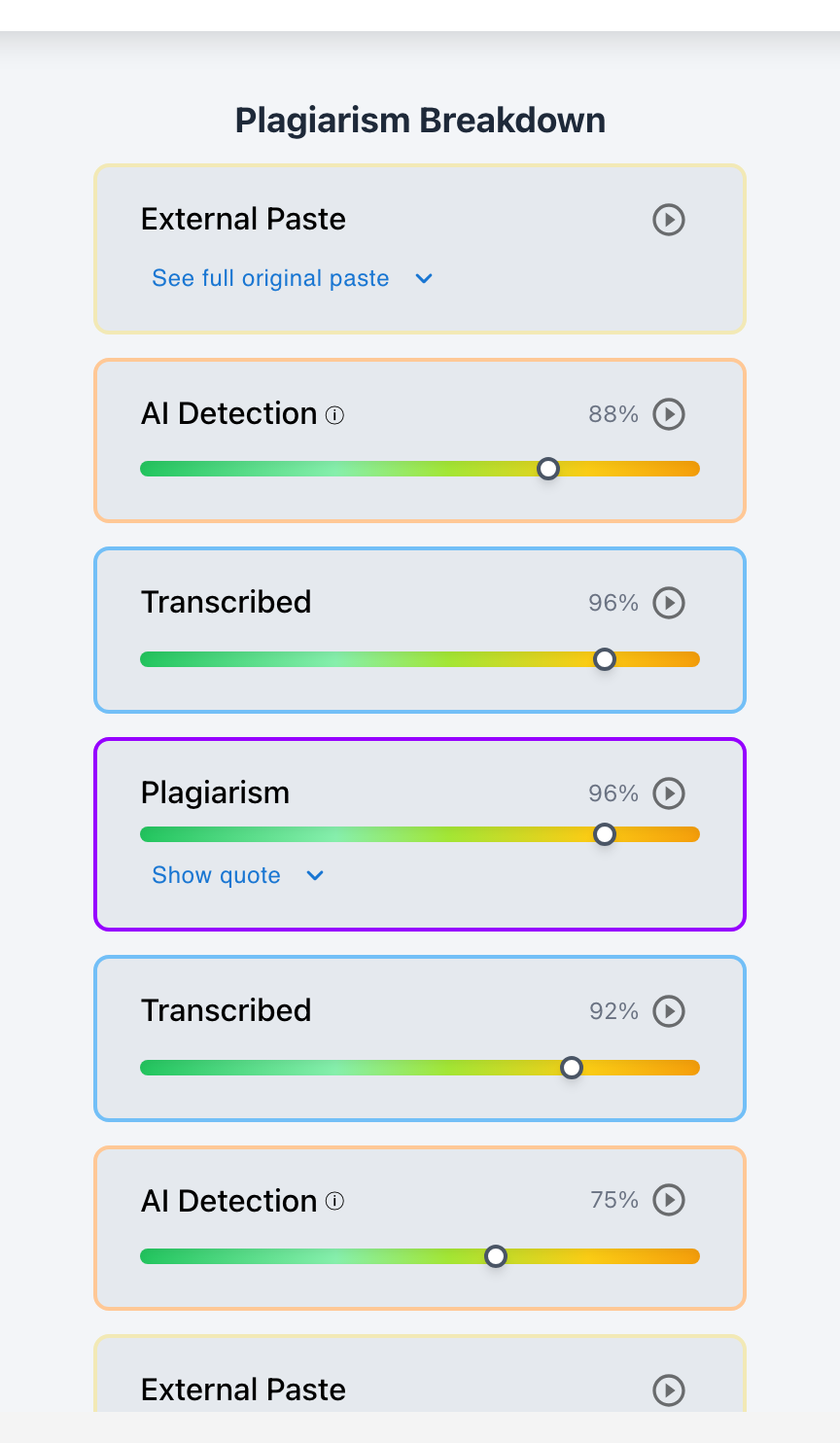
A student submits a polished essay, but something about it feels off: the writing style is different from previous work, the vocabulary is unusually advanced, the essay contains ideas the student struggles to explain, or the document history shows large sections of text appearing all at once. So how can a teacher tell whether the student actually wrote the essay?
There is usually no single piece of evidence that proves authorship. Instead, teachers can look at the writing process, previous student work, source use, student understanding, and AI detection results together.
The goal is not to find a single "gotcha." It is to determine whether the student's explanation of how the essay was created is consistent with the available evidence.
Checkmark Plagiarism helps teachers examine that broader picture through AI detection, essay writing playback, static AI detection, plagiarism detection, autograding, and integrations with Canvas and Google Classroom.
Start With the Writing Process
One of the most useful questions is: How did this essay actually get written? An authentic drafting process typically involves brainstorming, outlining, rough drafting, paragraph revisions, sentence rewriting, source integration, and proofreading.
Authentic Writing Process Timeline vs. Sudden Paste Block:
Organic Student Development
- Early outline and thesis notes
- Initial introduction & first draft
- Iterative sentence rewriting & deletions
- Integration of quotes & citations
- Reorganization and multi-pass proofreading
Unverified External Insertion
- Document remains completely empty
- 1,200 finished words appear in one instant
- Minimal or zero subsequent revisions
- Prompts teacher to ask: "Where was this draft created?"
Use Essay Writing Playback
Checkmark Plagiarism's essay writing playback allows teachers to examine how an assignment developed over time: gradual drafting, larger text additions, revisions, deleted material, and editing activity. If a student claims they drafted an essay in the document over three days, writing playback gives educators the evidence to verify that account directly. Read more in how Checkmark writing process analysis works.
A Large Paste Does Not Prove Someone Else Wrote the Essay
A large paste tells you that text was inserted, but it could come from a student's earlier draft in Microsoft Word or Google Docs, research notes, or quotes. The next step is a question: "I noticed this section was added all at once. Can you show me where you drafted it?"
Compare the Essay With Previous Student Writing
Compare vocabulary, sentence structure, grammar, tone, organization, citation habits, and depth of analysis across multiple prior assignments. Dramatic simultaneous shifts across all characteristics provide concrete evidence to explore. Read our comprehensive guide on how can I compare a student's assignment to their previous writing?
Ask the Student to Explain the Essay
A student who authored the essay should understand its major ideas. Ask:
- What is your central thesis?
- Why did you choose this specific argument?
- What does this paragraph mean in your own words?
- How does this source support your conclusion?
- Which section was hardest to write, and what did you revise?
Look for general conceptual ownership rather than expecting flawless recall from a nervous student.
Ask About Specific Passages
If particular sentences or terminology stand out (e.g., "institutional power structures" or "epistemological limitations"), ask the student what those phrases mean in the context of their argument. Inability to explain major concepts provides meaningful context.
Ask the Student How They Wrote the Essay
Ask: "Can you walk me through how you completed this assignment from beginning to end?" Inquire about where they drafted, what tools were used, and whether they received tutoring or brainstorming assistance.
Verify the Sources
Generative AI systems frequently invent convincing but nonexistent references. Check whether cited journal articles exist in academic databases, whether author names match, and whether quotations appear in the cited text.
Does a Sudden Improvement Mean the Student Did Not Write It?
No. Students improve through writing center visits, tutor feedback, thorough outlining, or approved grammar tools. Ask: "This paper is much stronger than your previous one. What did you do differently?" Read more in what should I look for when a student's writing suddenly improves?
Can AI Detection Help Determine Authorship?
AI detection provides one signal, but it is not a direct authorship test—it evaluates statistical text patterns, not keyboard activity. It is most valuable when combined with writing playback, source checks, and student conferences. Read more in is an AI detector enough evidence for academic misconduct?
What If the AI Detector Flags the Essay?
Treat detection flags as a signal for inquiry rather than automatic proof of cheating. False positives happen, especially on formal or highly structured student essays. Read more in can AI detectors give false positives?
What If the AI Detector Says the Essay Is Human-Written?
A low AI score does not prove human authorship—edited or hybrid AI text frequently avoids detection. Learn why in can ChatGPT writing pass an AI detector?
Does Grammarly or a Writing Assistant Mean the Student Did Not Write the Essay?
Fixing typos is very different from using generative features to rewrite entire paragraphs. Ask what the tool actually did, and compare the response to course policy. Read more in can AI detectors detect Grammarly or AI writing assistants?
What If the Student Used AI but Still Wrote Most of the Essay?
Modern student work often involves hybrid workflows (brainstorming, outline feedback, sentence rephrasing). The essential question is: Did the student's use of outside assistance violate the assignment requirements?
What Does Strong Evidence Look Like?
Strong Evidence of Ownership
- Writing fits established student baseline
- Playback shows gradual drafting over days
- Student has outlines, notes, and early drafts
- Citations and quotes are real and accurate
- Student fluently explains all arguments and revisions
Strong Evidence of Outside Assistance
- Writing style shifts dramatically across all metrics
- AI detection raises severe flags on key sections
- Playback shows instant wholesale paste event
- Multiple citations do not exist in academic indices
- Student cannot explain the thesis, terms, or sources
What If There Is No Writing History?
When students submit PDFs or Word files, Checkmark Plagiarism's static AI detection provides an objective analysis of completed submissions to pair with baseline comparisons, citation checks, and student conferences.
A Practical Authorship Review Process
- 1. Read the assignment carefully and identify what specifically seems unusual.
- 2. Compare the essay with several previous assignments to establish a baseline.
- 3. Review vocabulary, syntax, grammar, tone, and depth of analysis.
- 4. Check whether the essay addresses specific classroom prompt instructions.
- 5. Verify sources, author names, article titles, and direct quotes.
- 6. Review AI detection as one signal among many.
- 7. Examine essay writing playback when available to evaluate drafting progression.
- 8. Ask the student to explain specific passages and key concepts.
- 9. Ask the student to describe their writing and revision process.
- 10. Inquire about digital tools or tutoring assistance used.
- 11. Determine whether any tool use violated course policies.
- 12. Evaluate all of the evidence together before reaching a conclusion.
How Checkmark Plagiarism Helps Teachers Understand Who Wrote an Essay
Checkmark Plagiarism combines **AI detection, essay writing playback, static AI detection, plagiarism detection, autograding, and Canvas/Google Classroom integrations** to give educators complete visibility into how an essay was produced.
Frequently Asked Questions
How can a teacher tell whether a student wrote an essay?
Teachers can compare the essay with previous work, review the writing process, verify sources, ask the student to explain the argument, and consider AI detection results alongside other evidence.
Can writing history prove a student wrote an essay?
Writing history provides strong evidence about how an assignment developed, but it should be interpreted in context alongside drafts and student explanations.
Can I ask a student to explain their essay?
Yes. Asking the student to explain their thesis, evidence, vocabulary, sources, and writing process provides valuable insight into their authorship.
What if a student cannot explain their own essay?
Repeated difficulty explaining major ideas throughout an essay provides important evidence of outside assistance.
Does a different writing style mean someone else wrote the essay?
No. Students improve, receive tutoring, and revise more carefully. A style change is a reason to ask questions, not proof.
Does a large paste prove ChatGPT wrote the essay?
No. A large text addition may come from an earlier draft in another application or research notes.
Can AI detection prove who wrote an essay?
AI detection identifies statistical patterns associated with AI writing, but it does not directly identify who operated the keyboard.
What if the student admits using ChatGPT?
Ask how it was used: brainstorming, grammar checking, and full essay generation have different implications under course policy.
What if I only have a PDF or completed Word file?
Static AI detection analyzes completed submissions when writing-process evidence is unavailable, which teachers pair with source checks and student conferences.
How does Checkmark Plagiarism help determine whether a student wrote an essay?
Checkmark Plagiarism combines AI detection, essay writing playback, static AI detection, plagiarism detection, autograding, and Canvas and Google Classroom integrations.
Do Not Judge Authorship From the Final Essay Alone
The final essay shows what was submitted; writing playback and student conversations reveal how it was created. By evaluating the complete drafting process and verifying comprehension, educators can make fair, evidence-based academic integrity decisions.
Checkmark Plagiarism supports that process with AI detection, essay writing playback, static AI detection, plagiarism detection, autograding, and integrations with Canvas and Google Classroom.
See how Checkmark provides educators with essay writing playback to verify authentic student authorship. View a sample report or request a demonstration.