
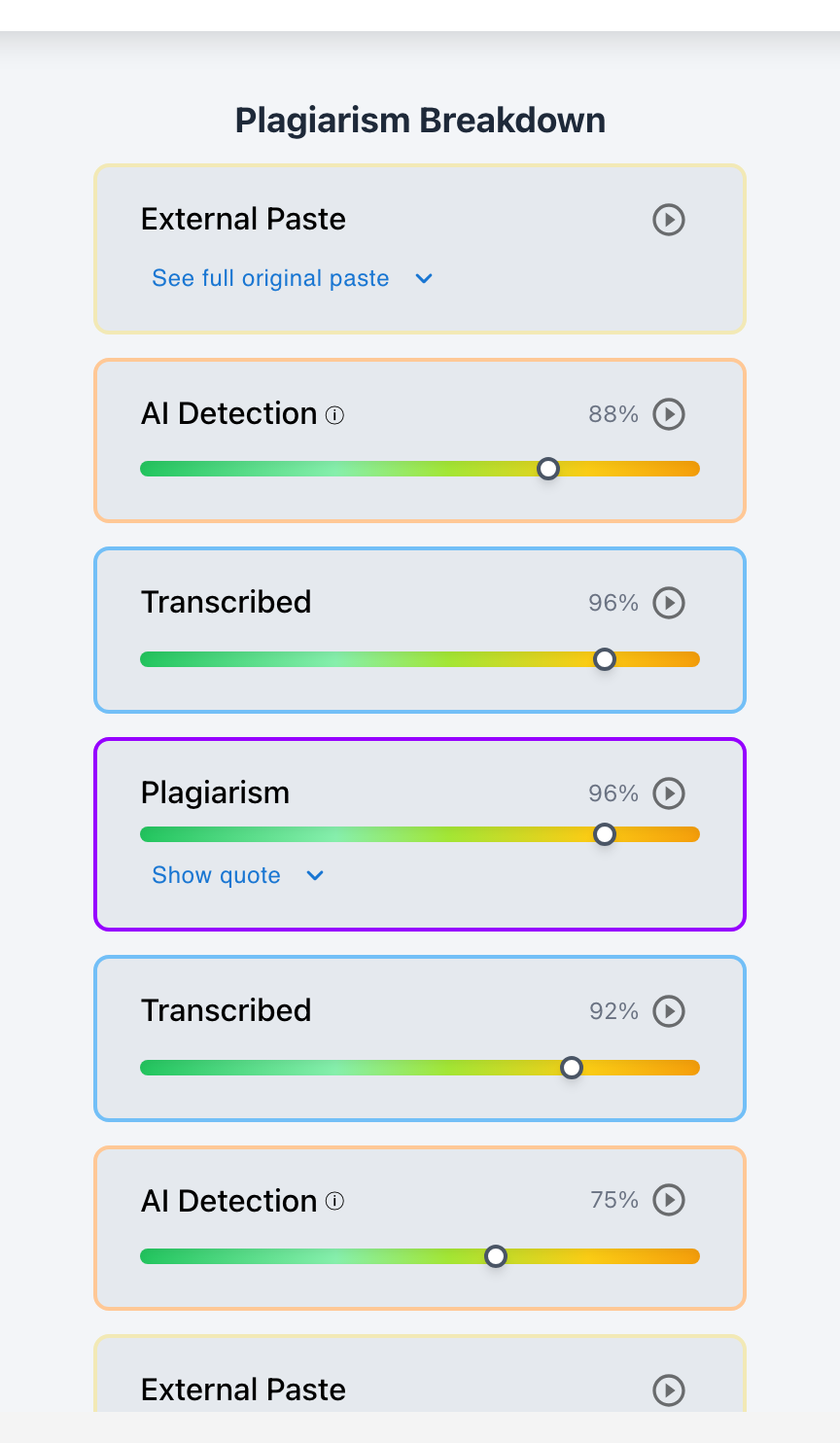
Initiating a formal academic integrity referral for suspected AI writing should always be the final step of a thorough investigation—never an initial reaction.
Prematurely filing a report based solely on an automated detector score (e.g., "Detector flagged 85% AI") or a general feeling that an essay sounds "too polished" creates severe risks: it can falsely penalize innocent students, strain classroom trust, and lead to dismissed cases when administrative review panels find insufficient evidence.
Before submitting a formal referral to department chairs, honor councils, or school administrators, educators should complete a structured pre-reporting protocol. This process ensures that course policies were unambiguous, process evidence has been audited, citations have been verified, and the student has been given a fair opportunity to explain their work.
Checkmark Plagiarism streamlines this pre-reporting workflow by integrating AI detection, essay writing playback, static AI detection, plagiarism detection, autograding, and integrations with Canvas and Google Classroom.
The 8-Step Pre-Reporting Verification Protocol
1. Policy & Prompt Check
Verify that the syllabus AI policy explicitly defined prohibited tools and that prompt instructions were clear.
2. Process & Playback Audit
Examine document drafting history, active typing duration, and wholesale paste events in writing playback.
3. Citation & Source Verification
Audit cited journals, book titles, and quotes in academic databases to check for non-existent or hallucinated sources.
4. Student Conference & Review
Hold a supportive, question-driven meeting to evaluate oral comprehension and review any external drafts provided.
Step 1: Revisit Course Policy & Assignment Guidelines
Before alleging a violation, confirm what rules were published and enforced:
- Was generative AI completely prohibited, or was brainstorming and outlining permitted?
- Were automated grammar checkers (e.g., Grammarly) permitted, and did the policy differentiate between grammar correction and generative rewriting?
- Were students required to compose directly within a specific platform or preserve version histories?
If the course policy was ambiguous, an educational conversation or a resubmission opportunity is often more appropriate than a formal disciplinary referral.
Step 2: Inspect Document Writing Playback & Timelines
Rather than judging the final static text alone, review how the document developed over time. When utilizing Checkmark Plagiarism's essay writing playback, examine:
- Active Drafting Duration: Did the student spend hours actively typing, or did a 1,500-word essay appear in 12 minutes of document activity?
- Wholesale Paste Timestamps: Did large blocks of polished prose appear in a single paste event without prior incremental drafting?
- Subsequent Revisions: Did the student revise, restructure, or edit the pasted text, or was it submitted immediately?
Read more in can writing history show whether a student used AI?
Step 3: Run Dual AI Detection and Plagiarism Scans
Generate comprehensive scans to evaluate language predictability and source overlap:
- Statistical AI Analysis: Note specific paragraphs with elevated language predictability. Read more in what does an AI detection percentage actually mean?
- Plagiarism Matching: Determine whether flagged sections match internet databases or peer submissions, distinguishing traditional plagiarism from AI generation.
Step 4: Audit Citations & Direct Quotations
Search academic databases (e.g., JSTOR, Google Scholar, WorldCat) to verify cited references:
- Do the cited authors, journal titles, volume numbers, and publication years exist?
- Do direct quotations accurately match the source text, or do they reflect hallucinated paraphrasing?
Hallucinated or fabricated citations provide objective, irrefutable evidence that can be clearly documented in a formal report.
Step 5: Compare Against Verified Student Writing Baselines
Retrieve 2–3 historical samples (e.g., proctored in-class essays, previous homework) to evaluate stylistic continuity:
- Does the submission feature an abrupt departure in sentence structure, vocabulary sophistication, or analytical depth?
- Did long-standing grammatical patterns or ESL characteristics suddenly disappear?
Read our complete guide in how can I compare a student's assignment to their previous writing?
Step 6: Conduct a Neutral, Question-Driven Student Conference
Meet with the student privately before filing any paperwork. Focus on open-ended inquiries:
- "Can you walk me through your research and writing process for this paper?"
- "I noticed paragraphs 3 and 4 appeared at once in the document history. Did you write those in another program?"
- "Can you explain the main argument in Section 2 in your own words?"
- "Did you use any writing tools or AI assistants during your drafting process?"
Read our guide on what questions should I ask a student about a suspicious assignment?
Step 7: Provide an Artifact Submission Window
If the student claims they drafted in Microsoft Word, another Google Doc, or offline notes, provide a reasonable deadline (e.g., 24–48 hours) for them to provide the draft file with version logs. A fair investigation must allow exculpatory evidence to resolve concerns.
Step 8: Consult with a Department Chair or Integrity Officer
Before submitting the formal report, conduct an informal peer review with a trusted colleague or department chair. Review the compiled evidence packet to ensure the findings are objective, cohesive, and compliant with school board policies.
When to Report vs. When to Resolve Internally
When to File a Formal Misconduct Report
- Multi-signal alignment: wholesale paste events, hallucinated citations, and comprehension failure.
- Student admits to unauthorized full-text generation in violation of clear course policy.
- Student cannot produce external drafts and explanation contradicts document logs.
- Repeated or egregious integrity violations across multiple assignments.
When to Resolve Internally / Educationally
- Student demonstrates strong oral conceptual comprehension and provides rough notes.
- Misunderstanding over permitted grammar assistant features (e.g., basic proofreading).
- Ambiguous syllabus wording regarding AI brainstorming or research assistance.
- First-time policy confusion where an educational rewrite with a penalty is appropriate.
A 10-Point Pre-Reporting Checklist for Educators
Educator Pre-Reporting Verification Checklist:
- [ ] Re-read the syllabus AI policy to confirm the observed behavior violates published rules.
- [ ] Review essay writing playback to document active typing time and paste timestamps.
- [ ] Run AI detection and plagiarism scans to map statistical predictability.
- [ ] Search academic indices to audit cited sources, author names, and direct quotes.
- [ ] Compare submission against 2–3 verified historical student writing samples.
- [ ] Schedule and conduct a private, supportive, non-accusatory student conference.
- [ ] Test oral conceptual mastery of the thesis, arguments, and advanced terminology.
- [ ] Provide 24–48 hours for the student to submit external drafts or notes.
- [ ] Compile all objective evidence into a standardized Academic Integrity Report.
- [ ] Conduct a peer check with department leadership before formal submission.
How Checkmark Plagiarism Supports the Pre-Reporting Workflow
Checkmark Plagiarism combines **AI detection, essay writing playback, static AI detection, plagiarism detection, autograding, and Canvas/Google Classroom integrations** to automate evidence compilation, ensuring educators only submit reports that are objective, thorough, and fully corroborated.
Frequently Asked Questions
Why shouldn't I report a student based on an AI detector score alone?
AI detectors measure statistical language probabilities and can produce false positives on formal human writing. Reporting without process playback or citation verification risks penalizing innocent students.
What is the single most important step before filing a report?
Holding a private student conference to evaluate oral comprehension and inspect document writing playback timelines.
What if a student refuses to attend a conference?
Document the meeting requests, notify your department chair or student affairs office, and compile the report based on observable playback logs and citation audits.
How much time should I give a student to provide external drafts?
A standard window of 24 to 48 hours provides sufficient time for students to locate and share external files without delaying administrative timelines.
What if the student claims they used Grammarly?
Clarify what features were used. Basic spelling/grammar checks rarely violate policy, whereas generative rewriting features may exceed permitted boundaries.
Should I inform parents before submitting a formal report?
In K–12 settings, communicating with parents after completing the preliminary conference and compiling evidence is standard practice. In higher education, follow FERPA privacy protocols.
What if my department has no formal AI policy?
Consult with your department head to establish baseline expectations. If policies were unclear, handle the situation educationally rather than punitively.
How do hallucinated citations impact the reporting decision?
Non-existent or fabricated sources provide concrete, verifiable physical evidence that strongly supports a formal academic integrity referral.
Can a student be reported if writing playback shows gradual drafting?
If playback shows authentic, gradual drafting over multiple sessions, the student likely authored the text, strongly weighing against a formal misconduct report.
How does Checkmark Plagiarism simplify the pre-reporting process?
Checkmark Plagiarism automatically captures writing playback timelines, provides dual AI/plagiarism scans, and compiles exportable evidence packages directly within your LMS.
Thorough Verification Ensures Fair and Defensible Outcomes
By conducting a structured pre-reporting review—auditing document playback, verifying citations, comparing baselines, and engaging students in dialogue—educators maintain the highest standards of academic integrity while ensuring every student receives fair and equitable treatment.
Checkmark Plagiarism supports this comprehensive approach with AI detection, essay writing playback, static AI detection, plagiarism detection, autograding, and integrations with Canvas and Google Classroom.
See how Checkmark pairs essay writing playback with multi-signal detection to streamline pre-reporting verification and generate comprehensive evidence packets. View a sample report or request a demonstration.