
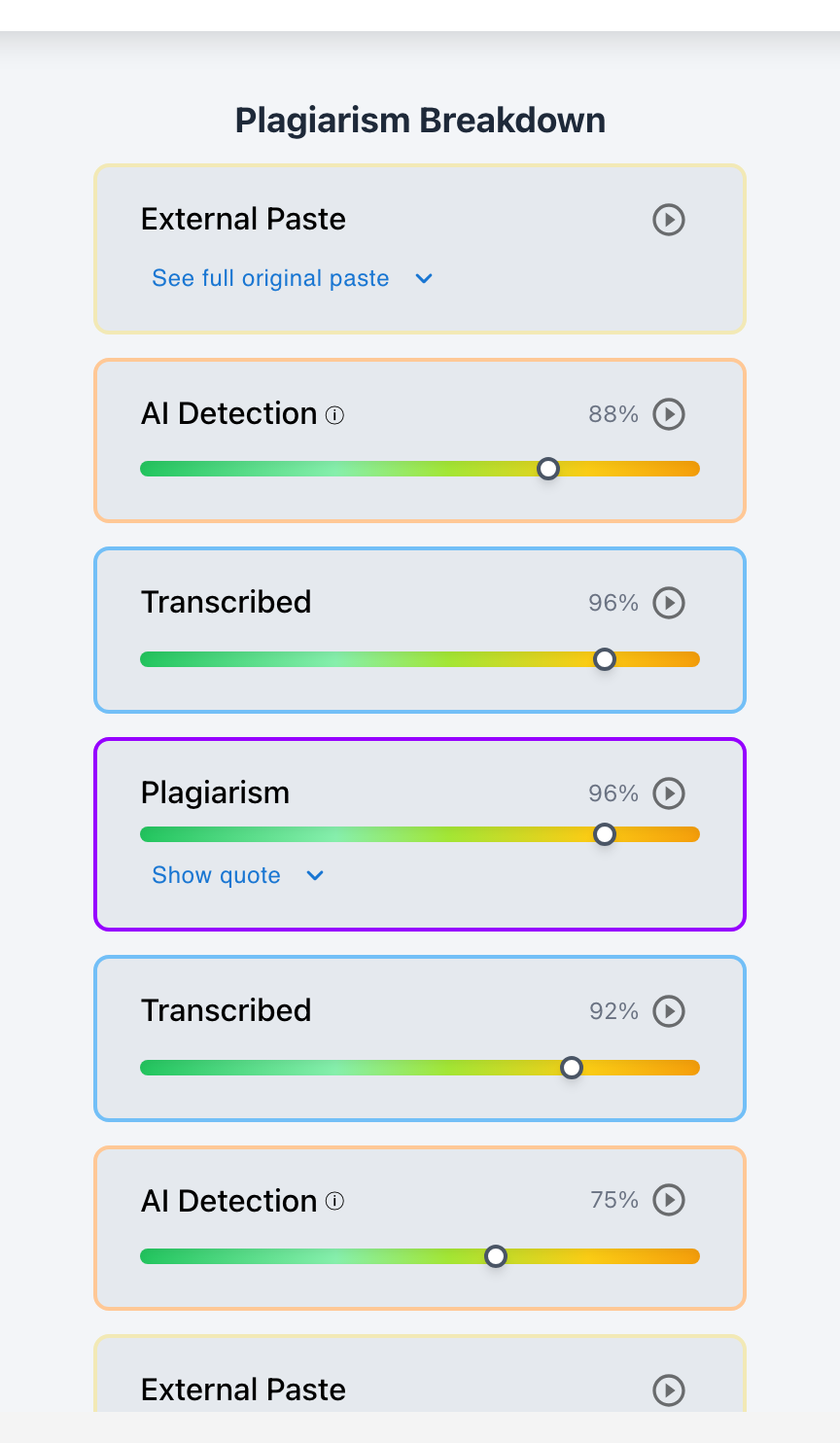
When an assignment raises concerns, the questions a teacher asks can make a major difference. A student may have submitted work that is dramatically different from their previous writing, an AI detector may have flagged portions of the text, document history may show large sections appearing at once, citations may be difficult to verify, or the student may struggle to explain the language used in the paper.
None of those signals automatically proves that the student used ChatGPT, another AI tool, or someone else's work. The next step is usually to ask specific, evidence-based questions about the assignment and how it was created.
Instead of beginning with "Did you cheat?" or "Did ChatGPT write this?" teachers can ask students to explain their thesis, sources, writing process, revisions, unusual passages, and any digital tools used.
Checkmark Plagiarism helps teachers prepare for these conversations with AI detection, essay writing playback, static AI detection, plagiarism detection, autograding, and integrations with Canvas and Google Classroom.
Start With an Open-Ended Question
One of the best initial questions is: "Can you walk me through how you completed this assignment?" This gives the student an open opportunity to explain their brainstorming, research, drafting, tools, tutoring assistance, and revision workflow before specific concerns are introduced.
Questions About the Writing Process
Inquire into the concrete mechanics of how the paper came together:
- Where did you start when you received the prompt?
- Did you create an outline or brainstorm notes first?
- Where did you write your first draft?
- Which section was most challenging to write?
- Which paragraph did you revise the most?
- Did you write any portions in another document before pasting them here?
- Did anyone provide feedback or editing help?
Questions About the Thesis
Ask: "What is the main argument you are making in this paper?" The student does not need to recite the exact formal thesis statement verbatim. Explaining the core thesis in everyday conversational language is strong evidence of authentic conceptual ownership.
Questions About Specific Paragraphs
Select central argumentative paragraphs and ask: "Can you explain what you're saying in this paragraph and how it supports your main argument?" Specific questions give students concrete ideas to explain rather than demanding abstract defenses.
Questions About Advanced Vocabulary
If the paper uses terminology not previously seen in the student's work (e.g., "socioeconomic stratification," "institutional marginalization," "cognitive dissonance," or "epistemological limitations"), ask: "What does this term mean in the context of your argument?" Look for contextual comprehension rather than dictionary definitions.
Questions About Evidence and Examples
Ask: "Why did you choose this specific quotation? What did this example demonstrate? How did this source shape your conclusion?" Authentic writers are familiar with the evidence supporting their claims.
Questions About Sources
Ask: "Where did you find this source, and what did it contribute to your paper?" If a citation cannot be located in academic databases, ask neutrally: "I wasn't able to locate this article. Can you show me where you found it?" This allows the student to clarify whether it was an innocent formatting error or a larger issue.
Questions About Revision
Ask: "What changed between your initial rough draft and your final submission? Was there an argument you ended up removing?" Authors almost always remember major structural revisions.
Questions About a Large Text Addition
If document history shows hundreds of words appearing simultaneously, ask neutrally: "I noticed that this section was added all at once. Can you explain where it came from?" The student may have drafted it in Microsoft Word, Google Docs, or research notes.
How Checkmark Plagiarism's Essay Writing Playback Helps
Checkmark Plagiarism's essay writing playback allows teachers to examine drafting, large additions, revisions, and editing activity over time. This enables educators to anchor their questions in observable writing history events rather than vague subjective impressions. Read more in how Checkmark writing process analysis works.
Questions About Previous Writing
If the writing style differs dramatically from past assignments, ask: "This paper uses more advanced vocabulary and syntax than your earlier assignments. What did you do differently during your writing and revision process?" Read more in how can I compare a student's assignment to their previous writing?
Questions About Writing Tools & AI Writing Assistants
Ask: "What software, tools, or extensions did you use while writing or revising?" If the student mentions Grammarly or similar tools, ask what the tool actually did: basic spellcheck vs. automated paragraph rewriting. Read more in can AI detectors detect Grammarly or AI writing assistants?
Questions About ChatGPT or Generative AI
When relevant, ask directly and neutrally: "Did you use ChatGPT or another AI tool while working on this assignment? What specifically did you use it for?" Distinguish brainstorming from full essay generation.
Do Not Treat Any AI Use as Automatic Cheating
Student A (Permitted Ideation)
"I asked ChatGPT for 5 research topics, chose one, outlined it, and wrote the essay myself."
Permitted exploratory use under many course policies.
Student B (Prohibited Generation)
"I pasted the prompt into ChatGPT and copied the generated paragraphs into my submission."
Violates assignment authorship requirements.
What Questions Should I Avoid?
- Avoid accusatory demands: "Why did you cheat?" or "Why don't you just admit you used ChatGPT?"
- Avoid attacking student capability: "How could you possibly have written this?"
- Avoid treating software scores as verdicts: "The detector says AI, so what do you have to say for yourself?"
How Should I Bring Up an AI Detection Result?
Frame the score as a prompt for review: "The assignment raised some questions, including an AI detection result, so I wanted to understand how you completed it." Read more in what does an AI detection percentage actually mean?
What If There Is No Writing History?
When students submit PDFs or Word files, Checkmark Plagiarism's static AI detection provides an objective analysis of completed submissions to pair with baseline comparisons, citation checks, and student conferences.
A Practical Question Sequence
A Practical 10-Step Question Sequence for Student Conferences:
- 1. Start Broadly: "Can you walk me through how you completed this assignment?"
- 2. Ask About the Thesis: "What is the main point or argument you're making?"
- 3. Discuss the Process: "Where did you draft the paper, and what did you revise most?"
- 4. Inquire About Specific Passages: "Can you explain what you're arguing in this paragraph?"
- 5. Verify Sources: "Where did you find this source, and how did it shape your claim?"
- 6. Address Writing History: "I noticed this large section appeared at once. Where did it come from?"
- 7. Ask About Digital Tools: "What writing tools, extensions, or tutoring assistance did you use?"
- 8. Ask Directly About AI: "Did you use ChatGPT or another AI tool? How specifically was it used?"
- 9. Request Supporting Materials: "Do you have earlier drafts, outlines, or research notes?"
- 10. Outline Next Steps: Explain the school's review procedure transparently if concerns persist.
How Checkmark Plagiarism Helps Teachers Prepare for Student Conversations
Checkmark Plagiarism combines **AI detection, essay writing playback, static AI detection, plagiarism detection, autograding, and Canvas/Google Classroom integrations** so educators can ask precise, evidence-based questions grounded in complete drafting and analysis context.
Frequently Asked Questions
What is the best first question to ask about a suspicious assignment?
A useful opening is: "Can you walk me through how you completed this assignment?" It allows the student to describe their writing process before specific concerns are introduced.
Should I ask the student whether they used ChatGPT?
Yes, if AI use is relevant. Ask neutrally whether ChatGPT or another AI tool was used, then ask how it contributed to the assignment.
What should I ask about a suspicious paragraph?
Ask the student what the paragraph means, why they included it, how it supports the thesis, and how they developed the idea.
What questions can help determine whether a student understands their essay?
Ask about the thesis, major arguments, sources, terminology, evidence, and writing decisions. Focus on understanding rather than memorization.
What if a student cannot explain their own sources?
Ask where the sources came from and verify them. Several unexplained or nonexistent sources may justify further review.
What should I ask if a large amount of text was pasted?
Ask where the text came from. Do not assume that a large paste automatically came from ChatGPT.
What if the student says they used Grammarly?
Ask what Grammarly did. Basic grammar correction and generative paragraph rewriting represent different levels of assistance.
Should I show the student their AI detection score?
You can discuss the result, but present it as one source of concern rather than definitive proof.
What if the student provides a convincing explanation?
Consider it. A fair review should allow new evidence to resolve the concern.
How does Checkmark Plagiarism help investigate a suspicious assignment?
Checkmark Plagiarism combines AI detection, essay writing playback, static AI detection, plagiarism detection, autograding, and Canvas and Google Classroom integrations, giving teachers more specific evidence to discuss with students.
Ask Questions That Help Explain the Evidence
The goal of questioning a student is not to secure a confession—it is to understand the authentic drafting process behind the paper. By pairing targeted inquiries with writing playback, citation verification, and AI detection, teachers can reach fair and defensible academic integrity outcomes.
Checkmark Plagiarism supports that process with AI detection, essay writing playback, static AI detection, plagiarism detection, autograding, and integrations with Canvas and Google Classroom.
See how Checkmark equips educators with writing playback and multi-signal reports to conduct constructive, evidence-based student conferences. View a sample report or request a demonstration.