
A student submits a polished essay. The argument is sophisticated, the vocabulary is advanced, and the paper appears much stronger than their previous work. Then you ask a simple question: "Can you explain what you mean in this paragraph?" The student struggles to answer. What should you do?
A student's inability to explain their own essay can be a meaningful warning sign, but it should not automatically be treated as proof that the student used ChatGPT, another AI tool, or someone else's work.
Students may be nervous, forget details, or understand an idea in writing better than verbally. At the same time, repeated difficulty explaining central arguments, sources, vocabulary, or the writing process can justify a closer review.
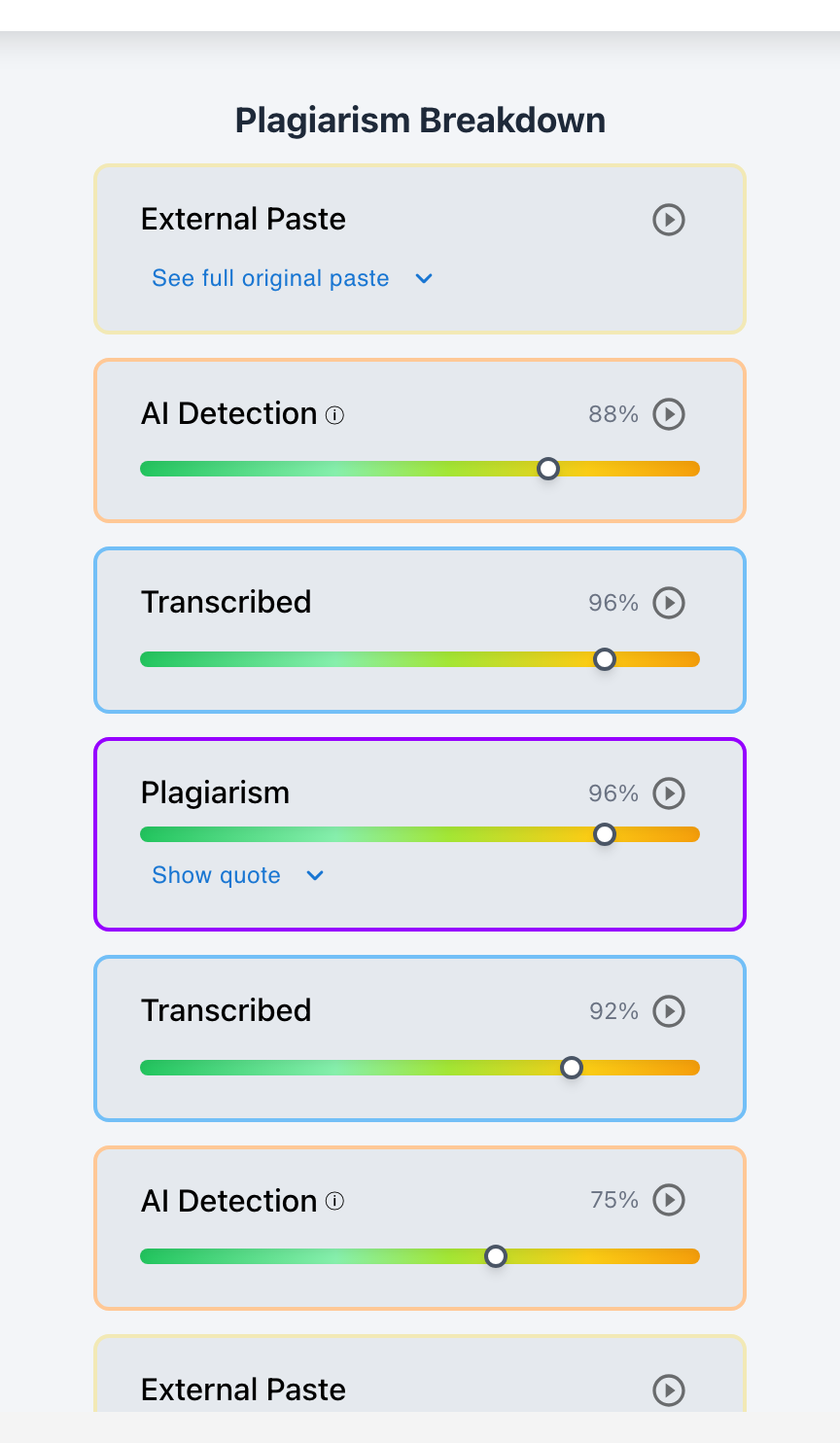
Checkmark Plagiarism can support that review with AI detection, essay writing playback, static AI detection, plagiarism detection, autograding, and integrations with Canvas and Google Classroom.
Don't Treat One Bad Answer as Proof
Students often struggle when put on the spot: nervousness, public speaking anxiety, or completing an assignment several days earlier can cause hesitation. Look for an overall pattern of comprehension across the entire paper rather than treating a single stumbling response as a confession.
Start With the Main Argument
Begin broadly: "What is the main argument of your essay?" The student does not need to recite their thesis verbatim. Explaining the core idea in simple, conversational language is a strong sign of genuine conceptual ownership.
Ask Them to Explain a Specific Paragraph
Choose a central paragraph and ask: "What are you saying in this paragraph, and how does it support your thesis?" A student who authored the paper should recognize the reasoning behind major arguments.
Ask About Advanced Vocabulary
If the paper uses specialized terms such as "institutional inequality," "cognitive dissonance," or "socioeconomic stratification," ask: "What does that phrase mean in the context of your argument?" You are looking for understanding in context, not a dictionary definition.
Ask Why They Chose Particular Evidence
Ask: "Why did you choose this quotation? How did this source shape your thinking?" Students who conducted authentic research can usually explain why certain evidence was selected.
Verify the Sources
If a student struggles to identify where a citation came from, check whether the source, author, and quotes actually exist in databases. Generative AI tools frequently invent fake references that look persuasive on the page.
Ask About the Writing Process
Ask: "Can you walk me through how you wrote this assignment from start to finish?" Inquire about outlining, rough drafting, hard sections, revisions, tools used, and tutoring support.
Ask What They Revised
Ask: "Which paragraph changed the most while you were drafting?" Authors almost always remember sections they struggled to write, shortened, or rewrote.
Compare the Essay With Previous Writing
Compare vocabulary, sentence structure, grammar, tone, and depth of analysis across multiple earlier assignments. Read our full guide on how can I compare a student's assignment to their previous writing?
Look at How the Essay Was Created
Situation A: Genuine Drafting
- Student hesitates on one paragraph
- Playback shows gradual multi-day drafting
- Student has notes, outlines, & rough drafts
- Fluently explains the rest of the essay
Situation B: Multiple Concerns
- Student cannot explain major arguments
- Entire essay appeared suddenly in document
- Multiple citations do not exist in databases
- Writing style diverges completely from past work
How Checkmark Plagiarism's Essay Writing Playback Helps
Checkmark Plagiarism's essay writing playback allows teachers to examine drafting, large additions, revisions, and editing activity over time. When a student struggles to explain a section, writing playback reveals whether those paragraphs developed gradually through revisions or appeared instantly as a finished block. Read more in how Checkmark writing process analysis works.
A Large Paste Does Not Prove AI Use
If hundreds of words appear at once, ask where the text was drafted. The student may have written it in Word or Google Docs. Give the student an opportunity to provide earlier version histories or drafts.
Ask About AI Directly
Ask neutrally: "Did you use ChatGPT or another AI tool while completing this assignment? What did you use it for?" Brainstorming, outlining, grammar checking, sentence rewriting, and full essay generation have different policy implications.
What If the Student Says They Only Used Grammarly?
Ask what the tool actually did: fixing punctuation is very different from using AI rewriting features on every paragraph. Read more in can AI detectors detect Grammarly or AI writing assistants?
Use AI Detection as One Additional Signal
Use AI detection as one piece of evidence alongside comprehension, writing playback, and citation verification. Read more in is an AI detector enough evidence for academic misconduct?
Avoid Asking the Student to Reproduce the Essay From Memory
Do not demand that a student reproduce paragraphs word-for-word from memory under pressure. Focus on core conceptual familiarity, arguments, and drafting choices.
Do Not Say "This Is Too Good for You"
Avoid attacking student ability. Instead, focus on specific, observable differences: "This assignment differs substantially from your previous writing, and I want to understand what changed in your process."
What If There Is No Writing History?
When students submit PDFs or Word files, Checkmark Plagiarism's static AI detection provides an objective analysis of completed submissions to pair with baseline comparisons, citation checks, and student conferences.
A Practical Process When a Student Can't Explain Their Essay
Practical 14-Step Sequence When a Student Can't Explain Their Essay:
- 1. Do not treat one hesitant or difficult answer as automatic proof of misconduct.
- 2. Ask the student to summarize the central thesis in their own conversational words.
- 3. Discuss one or two important paragraphs rather than obscure isolated sentences.
- 4. Ask them to explain key terminology and vocabulary in the context of their argument.
- 5. Ask why they chose specific sources, quotations, or illustrative examples.
- 6. Ask them to describe their writing and drafting process from beginning to end.
- 7. Compare the essay against multiple previous writing baselines.
- 8. Verify suspicious sources, author names, and direct quotes in academic databases.
- 9. Review essay writing playback when available to check drafting progression.
- 10. Use AI detection as one additional signal rather than a definitive verdict.
- 11. Inquire neutrally about AI assistance, writing tools, or tutoring support.
- 12. Give the student an opportunity to provide earlier drafts, notes, or version history.
- 13. Evaluate whether all gathered evidence tells a consistent and plausible story.
- 14. Apply established school academic-integrity policies if significant concerns remain.
How Checkmark Plagiarism Helps When a Student Can't Explain Their Work
Checkmark Plagiarism combines **AI detection, essay writing playback, static AI detection, plagiarism detection, autograding, and Canvas/Google Classroom integrations** to give educators complete context when an assignment's authorship is in question.
Frequently Asked Questions
Does it mean a student cheated if they cannot explain their essay?
No. Students may be nervous, forget details, or have difficulty explaining ideas verbally. Repeated inability to explain major parts of the work can justify further review but should be considered alongside other evidence.
What should I ask a student who cannot explain their paper?
Ask about the thesis, key arguments, important vocabulary, sources, specific paragraphs, and the writing process. Focus on major ideas rather than asking them to reproduce exact sentences.
Can I ask a student whether they used ChatGPT?
Yes. A neutral question about whether AI was used and what role it played can be appropriate when AI use is relevant to the assignment.
What if the student knows the topic but not the wording in the essay?
That may still be consistent with authorship, especially if the student can explain the argument in their own language. The goal is understanding, not memorization.
What if the student cannot identify their own sources?
That can justify closer review. Verify the references and ask the student where they found them.
What if the student says they drafted somewhere else?
Give them an opportunity to explain or provide the earlier draft when appropriate. A large addition in writing history does not automatically mean AI was the source.
Can essay writing playback help?
Yes. Writing playback can provide evidence about drafting, revisions, larger additions of text, and how the document developed.
Does AI detection prove that an unexplained essay was generated by AI?
No. AI detection can provide another signal, but it should be considered alongside the writing process, previous work, sources, and the student's explanation.
How does Checkmark Plagiarism help investigate questionable authorship?
Checkmark Plagiarism combines AI detection, essay writing playback, static AI detection, plagiarism detection, autograding, and Canvas and Google Classroom integrations.
An Inability to Explain the Essay Is a Question, Not the Answer
A student struggling with one question does not prove they cheated. But when conceptual unfamiliarity aligns with sudden wholesale paste blocks, hallucinated sources, and dramatic baseline shifts, educators have actionable evidence to protect academic integrity.
Checkmark Plagiarism supports this evidence-based approach with AI detection, essay writing playback, static AI detection, plagiarism detection, autograding, and integrations with Canvas and Google Classroom.
See how Checkmark pairs essay writing playback with multi-signal detection to resolve authorship questions fairly. View a sample report or request a demonstration.