
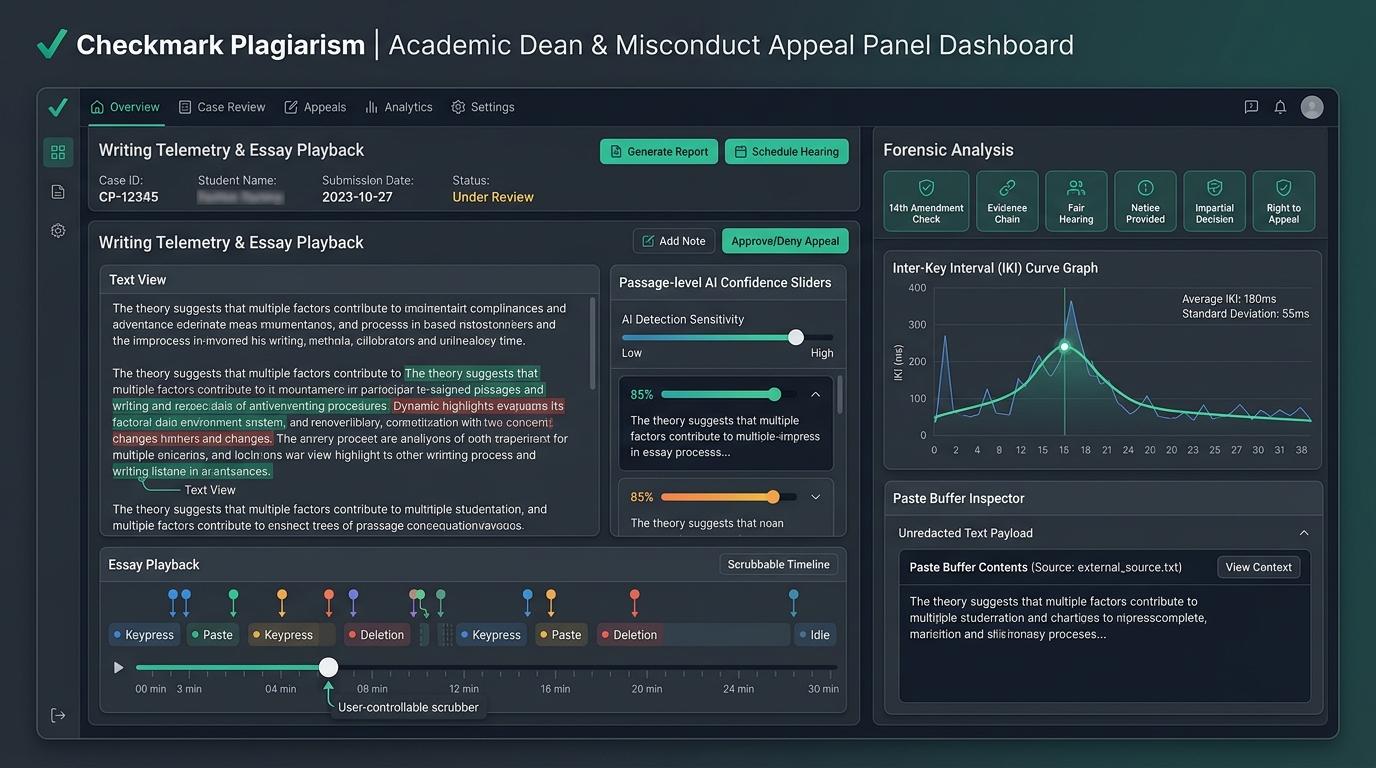
When a student files a formal appeal against an academic integrity sanction—such as a failing course grade, academic probation, loss of scholarship, suspension, or expulsion referral—the institutional responsibility shifts directly to the Academic Dean, Associate Provost, Judicial Affairs Officer, or Appellate Honor Board. Historically, appellate adjudicators were trapped in an unresolvable evidentiary deadlock: an instructor presenting an opaque, probabilistic commercial AI detection score (e.g., “87% Probability of AI”) versus a student vehemently asserting original authorship.
In modern administrative law and higher education jurisprudence, relying on monolithic, non-reproducible black-box scores violates constitutional due process (Goss v. Lopez, Board of Curators v. Horowitz) and statutory student record inspection rights under FERPA (34 CFR Part 99 § 99.10). Checkmark Plagiarism resolves this institutional vulnerability by replacing statistical guesswork with the Multi-Evidence Dossier Architecture. By analyzing patent-pending Essay Playback™ keystroke dynamics, bimodal Inter-Key Intervals (IKIs), immutable external clipboard logs, passage-level linguistic distributions, and synchronized side-by-side source matching, Deans can audit the complete temporal chronology of an essay. This guide details the legal and evidentiary standards governing student appeals, provides a step-by-step 4-Phase Keystroke Telemetry Review Protocol, presents real-world case studies, and delivers an objective adjudication rubric to ensure fair, defensible, and restorative institutional justice.
Checkmark Plagiarism equips Academic Deans, Associate Provosts, Judicial Affairs Officers, and Misconduct Appeal Panels with high-resolution writing process telemetry and LMS integrations across Canvas LMS, Agilix Buzz, and Google Classroom.
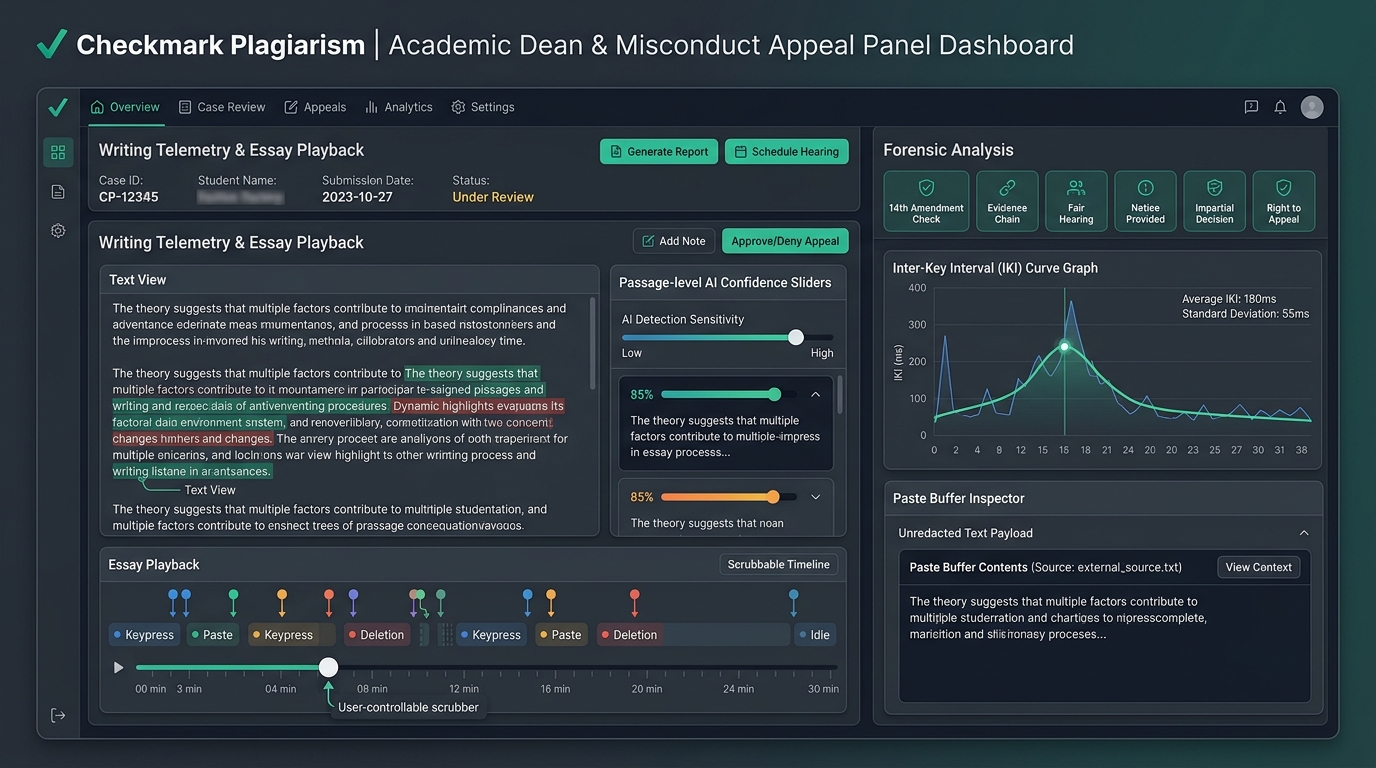
1. The Appellate Dilemma: When Opaque AI Scores Collide with Institutional Due Process
In higher education and secondary school administration, the Dean’s appellate desk is the final firewall against arbitrary disciplinary action. When an academic misconduct accusation reaches the appeal stage, the dynamics of the inquiry change fundamentally. What began as a classroom-level grading dispute transforms into a formal institutional proceeding with profound legal, financial, and reputational ramifications for the student and the institution alike.
- Board dismisses valid charge due to lack of corroborating proof
- Legitimate contract cheating or AI substitution goes unpunished
- Faculty academic standards and departmental morale collapse
- Board upholds sanction purely on faith in third-party software
- Innocent student suffers transcript notation, scholarship loss, or expulsion
- Institution faces OCR complaints, FERPA violations, and civil litigation
When an appeal panel attempts to adjudicate an allegation supported solely by a commercial AI detector’s percentage or a raw similarity score, the panel operates without primary factual evidence. To establish a legally defensible appellate process, Deans must understand the constitutional, contractual, and evidentiary standards that govern misconduct proceedings.
Constitutional Due Process & Contractual Fairness Standards
The procedural safeguards required during an academic integrity appeal depend upon the institutional classification of the school or university, yet both public and private institutions face stringent legal boundaries:
1. Public Institutions (Fourteenth Amendment Constitutional Due Process)
Under the Fourteenth Amendment to the United States Constitution, students attending public colleges, universities, and public school districts possess established property and liberty interests in their continued education, academic standing, and professional reputation.
- Landmark Precedents (Goss v. Lopez, 419 U.S. 565; Board of Curators of the University of Missouri v. Horowitz, 435 U.S. 78): While academic evaluations are afforded institutional deference, disciplinary sanctions (such as suspensions, expulsions, or transcript disciplinary notations for dishonesty) require procedural due process: timely written notice of specific charges, an impartial hearing body, and a meaningful opportunity to inspect and rebut all primary evidence.
- Arbitrary and Capricious Standard: If a public institution deprives a student of credit or standing based solely on an unexplainable, proprietary AI detector score—without corroborating factual proof of unauthorized generation—courts may overturn the sanction as arbitrary, capricious, and an abuse of administrative discretion.
2. Private Institutions (Contractual Fair Hearing Doctrines)
While private colleges and independent academies are not state actors directly bound by the Fourteenth Amendment, they are legally bound by their published student handbooks, course catalogs, and honor codes under the doctrine of express and implied contract:
- When an institution’s handbook promises “a fair and impartial review,” “the right to examine the evidence against the accused,” or “sanctions grounded in clear evidence,” relying on an opaque third-party probability score breaches the institution’s contractual covenant of good faith and fair dealing.
- Retained student counsel routinely file breach-of-contract and promissory estoppel lawsuits when private universities enforce severe sanctions without disclosing the forensic foundation of the software’s output.
The Burden of Proof in Misconduct Adjudication
In civil courts and administrative tribunals, disciplinary proceedings operate under defined evidentiary standards. Deans and appeal boards must evaluate whether the evidence presented satisfies the applicable institutional standard:
| Evidentiary Standard | Mathematical Threshold | Institutional Context | Suitability of Static AI Scores | Suitability of Keystroke Telemetry |
|---|---|---|---|---|
| Preponderance of the Evidence | >50% probability (“More likely than not”) | Standard undergraduate honor council hearings, minor assignment disputes, first-time infractions. | Insufficient: High baseline false-positive rates, model instability, and non-reproducibility create reasonable doubt exceeding 50%. | Definitive: Establishes continuous active typing, multi-hour drafting sessions, and micro-revisions proving authentic human composition. |
| Clear and Convincing Evidence | ~75%–80% certainty (“Substantially more likely true”) | High-stakes appeals: course failure, academic suspension, degree revocation, expulsion, loss of clinical placement. | Legally Inadmissible: Black-box probabilities cannot provide the clear, high-certainty factual foundation required by administrative boards. | Definitive: Directly captures unedited external clipboard dumps or mechanical transcription rhythms with microsecond-level timestamps. |
| Beyond a Reasonable Doubt | ~95%+ near certainty | Formal criminal proceedings (e.g., criminal degree fraud, identity theft). | Wholly Inadmissible | Corroborative Forensic Evidence: Serves as timestamped digital audit trail in institutional and civil depositions. |
The 4 Fatal Flaws of Commercial AI Classifiers in Appeal Hearings
Why must Deans reject standalone commercial AI detection percentages during appeal deliberations? Forensic analysis demonstrates four structural vulnerabilities that make static scores legally and scientifically indefensible:
Scanning identical text across consecutive weeks yields wildly diverging scores (e.g., 85% → 12%). Proprietary vendor backends update neural weights continuously without audit logging, failing the Daubert scientific evidentiary standard.
Stanford University empirical research (Liang et al., 2023) proves non-native English essays are falsely flagged at rates exceeding 61.2% due to constrained lexical perplexity, exposing institutions to Title VI civil rights liability.
Autistic and ADHD writers frequently employ repetitive, hyper-logical, and uniform phrasing. Standardized genres (lab methods, legal briefs, literature reviews) naturally exhibit low perplexity, triggering false alarms.
Students hold a statutory federal right to inspect all data forming the basis of their disciplinary record. Proprietary vendors refuse to release model weights, feature activations, or source training sets, violating disclosure mandates.
To establish true evidentiary integrity, academic appeals must transition from speculative product classification to empirical process verification.
2. The Evidentiary Paradigm Shift: Static Scores vs. Temporal Writing Telemetry
The philosophy of Checkmark Plagiarism is captured in a single operational directive: “Stop guessing, start trusting.”
Rather than treating a submitted essay as an isolated, static artifact to be analyzed by a statistical neural network, Checkmark records the entire temporal drafting lifecycle as it occurs natively inside the writing environment.
Embedded editor securely captures active composition events with zero disruption to student workflow.
Forensic Comparison: Evidentiary Value Matrix
When an Academic Dean evaluates evidence in a contested appeal, the differences between legacy tools and Checkmark’s writing telemetry become starkly apparent:
| Evidentiary Dimension | Legacy Commercial AI Scanners | Basic Cloud Version History (Google Docs / Word) | Checkmark Multi-Evidence Dossier & Essay Playback™ |
|---|---|---|---|
| Primary Data Source | Static completed document text; token sequence probability. | Periodic document snapshots (every 5–15 minutes). | Continuous, microsecond-accurate keystroke, pause, and paste event streams. |
| Granularity | Single document-level percentage (e.g., “78% AI”). | Macro-block text differences between snapshot saves. | Character-by-character replay, word-level pause topography, and passage-level confidence sliders. |
| Clipboard Tracking | None. Cannot determine whether text was typed or pasted. | Shows text appearing suddenly between snapshots; cannot prove source. | 100% Raw Text Preservation: Captures original external clipboard payload even if completely edited later. |
| Cognitive Drafting Proof | Zero. Confuses structured human writing with AI output. | Minimal. Shows edit timestamps but cannot differentiate manual transcription from drafting. | Definitive: Distinguishes authentic bimodal drafting pauses from linear, pause-free transcription. |
| Short-Text Protection | High false positives on short answers and abstracts. | Ineffective. | Honest Guardrails: Reports N/A on passages under 150 words to prevent statistical hallucinations. |
| Legal Admissibility | Highly vulnerable under Due Process and FERPA challenges. | Weak circumstantial evidence; easily disputed. | Legally Defensible: Unassailable digital audit trail with cryptographic session binding. |
3. The Dean’s 4-Phase Keystroke Telemetry Review Protocol
To ensure procedural fairness, eliminate bias, and reach an objective evidentiary finding, Academic Deans and appellate boards should execute the following 4-Phase Keystroke Telemetry Review Protocol for every contested appeal.
- Pull unredacted Checkmark Multi-Evidence Dossier directly from Canvas / Buzz LMS / Google Classroom
- Verify LTI 1.3 session tokens, client IPs, browser metadata, and submission timestamps
- Calculate Macro-Metrics: Total Active Composition Time vs. Total Elapsed Duration
- Transmit complete unredacted dossier to the student and faculty member (FERPA § 99.10 compliance)
- Execute 1x–8x scrubbable Essay Playback™ review across all drafting sessions
- Audit Inter-Key Interval (IKI) distribution (Bimodal drafting curve vs. Flat transcription)
- Quantify Formulative Pause Topography (Inter-sentence vs. Intra-word hesitation pauses)
- Measure Editing & Deletion Ratios (Natural revision churn: 15%–35% vs. Transcription: <3%)
- Audit 100% unredacted raw paste payloads in the Paste Telemetry Inspector
- Cross-reference pasted passages against assignment syllabus, sources, and rough notes
- Use “Jump-to-Playback” to examine immediate post-paste editing and critical synthesis
- Differentiate: Legitimate Quote Inserts vs. AI Output vs. Contract Cheating Payloads
- Conduct structured Cognitive Alignment Interview anchored in specific playback timestamps
- Score evidence against Dean’s Objective Deliberation Rubric
- Issue Formal Written Appellate Decision with specific telemetry justifications
- Execute direct LMS Grade Passback to Canvas / Buzz LMS / Google Classroom Gradebook
Phase 1: Evidentiary Dossier Intake & Pre-Hearing Verification
Before scheduling the formal appeal hearing, the Dean or Judicial Affairs Officer must verify the digital authenticity of the submission and establish the macro-parameters of the writing session:
- Direct LTI 1.3 Dossier Extraction: Extract the unredacted Checkmark Multi-Evidence Dossier directly from the Learning Management System (Canvas LMS, Buzz LMS, Google Classroom, or Moodle). Verify that the submission hash matches the LMS timestamp to ensure no intermediary tampering or file substitution occurred.
- Session and Environmental Validation: Inspect the client-side metadata:
- User Authentication & Session Tokens: Confirm that the writing session was conducted under the student’s authenticated institutional SSO account.
- Browser and Device Continuity: Verify that the IP ranges, user agent strings, and operating system profiles remain consistent throughout multi-hour drafting sessions. Sudden switches between geographically distant IPs during active drafting indicate unauthorized remote-access contract cheating.
- Macro Drafting Time Ratios: Examine the relationship between Total Elapsed Time (the calendar duration the document was open) and Active Composition Time (the aggregate time the student spent actively typing, backspacing, or executing cursor navigations):
- Healthy Academic Metric: A 3,500-word research essay typically requires 6 to 25 hours of active composition time, distributed across multiple sessions over several days or weeks.
- Anomalous Metric 1 (Sudden Dump): 3,500 words appearing in less than 5 minutes of active time (indicates external copy-paste).
- Anomalous Metric 2 (Optical Retyping): 3,500 words typed continuously in 60 to 75 minutes with zero drafting pauses (indicates manual transcription from an off-screen source).
- Mandatory Reciprocal Pre-Hearing Disclosure (FERPA Compliance): In strict accordance with FERPA § 99.10, transmit the full, unredacted Checkmark Dossier (including the interactive Essay Playback link) to the student at least 5 business days prior to the hearing. Giving the student access to their own writing telemetry eliminates adversarial ambush tactics, reduces anxiety, and enables honest, constructive dialogue.
Phase 2: Keystroke Telemetry & Chronological Composition Audit
During Phase 2, the Dean analyzes the micro-behavioral dynamics of the writing session using Checkmark’s patent-pending Essay Playback™ engine.
1. Inter-Key Interval (IKI) Distribution Analysis
The Inter-Key Interval measures the exact time elapsed between consecutive keystrokes:
- Authentic Human Drafting Curve (Bimodal Distribution): Genuine human composition produces two distinct mathematical peaks. Peak 1 (100ms–250ms) reflects automatic neuro-motor typing speed within individual words. Peak 2 (1,000ms–5,000ms+) reflects cognitive formulation pauses—moments when the student pauses to retrieve a concept, evaluate syntax, consult an outline, or structure an argument before typing the next clause.
- Optical Transcription Curve (Unimodal Distribution): When a student copies text manually while reading off a secondary monitor, smartphone screen, or printed generative AI output, the cognitive drafting load is removed. The IKI collapses into a tight, single peak (mean ~180ms–240ms with minimal variance). The writer types continuously at a mechanical, metronomic cadence without conceptual hesitation pauses.
2. Formulative Pause Topography
Deans must evaluate where pauses occur within the document hierarchy:
- In authentic drafting, long pauses occur at syntactic and conceptual boundaries: paragraph transitions, complex thesis statements, and before analytical synthesis sentences.
- In transcription or contract retyping, pauses are sporadic, brief, and occur randomly (often mid-word or at line breaks where the student’s eye shifts back to the second screen).
3. Macro-Revision Churn and Deletion Ratios
Human writing is inherently non-linear and iterative:
- Healthy Revision Churn: Authentic student writing displays a 15% to 35% editing churn rate. For every 1,000 final words, an authentic writer typically types 1,200 to 1,500 total keystrokes, deleting weak adjectives, reorganizing sentence clauses, restructuring paragraphs, and correcting typos.
- Transcription Lack of Revision: Transcribed AI text displays an editing churn rate under 3%. The text flows strictly top-to-bottom, line-by-line, with virtually zero backspacing, rephrasing, or structural deletions.
Phase 3: External Clipboard & Paste Buffer Cross-Examination
One of the most common student defenses during appeal hearings is: “I wrote the entire paper in Microsoft Word / Apple Notes / Google Docs on my laptop, and then copied and pasted it into Canvas right before the deadline.”
Checkmark’s Immutable Paste Buffer Technology provides Deans with complete forensic clarity to evaluate this claim.
“Certainly! Here is a comprehensive 4-paragraph analysis of the geopolitical ramifications of the 1648 Treaty of Westphalia on modern state sovereignty. In conclusion, it is crucial to note that national borders...”
- [21:42:15] Student highlights & deletes: “Certainly! Here is a comprehensive 4-paragraph...”
- [21:42:40] Student deletes: “In conclusion, it is crucial to note that...”
- [21:43:10] Student changes 3 transition words and clicks “Submit Assignment”
- 100% Raw Payload Inspection: Checkmark captures and permanently preserves the full unredacted text copied from the external clipboard at the precise millisecond of insertion. Even if the student subsequently edits, rephrases, or deletes the pasted block, the raw payload remains accessible to the Dean.
- Detection of Erased Conversational Artifacts: Students utilizing ChatGPT, Claude, or Gemini often inadvertently paste the model’s introductory conversational preamble (e.g., “Sure, here is an essay analyzing...”) and subsequently delete it. Standard LMS submission logs only see the final clean text; Checkmark’s paste buffer captures the initial conversational artifact, providing conclusive, unassailable evidence of unauthorized generation.
- Pasted Payload Categorization Protocol: The Dean should classify every pasted block into one of four distinct categories:
- Category A: Authorized Direct Quotations: Legitimate quotes matching cited works in the bibliography. (Playback confirms student immediately placed quotation marks and parenthetical citations around the insert).
- Category B: Documented Rough Notes / Outlines: Student notes corroborated by external timestamps (e.g., draft files or handwritten brainstorming images submitted during pre-hearing intake).
- Category C: Unauthorized AI-Generated Payloads: Large blocks displaying synthetic sentence structure, hallucinated citations, or conversational framing.
- Category D: Peer Collusion / Contract Sourced Blocks: Blocks matching other student submissions within the institution’s internal Checkmark repository.
- The “Jump-to-Playback” Post-Paste Behavioral Audit: By clicking the “Jump-to-Playback” button on any paste card, the Dean can watch the student’s exact behavior immediately following the paste:
- Authentic Synthesis: The student spends 20 minutes reading the pasted excerpt, breaking it apart, inserting citations, and writing original commentary around it.
- Cheating Concealment: The student rapidly runs a synonym-replacement routine or deletes conversational framing and immediately submits without engaging with the text.
Phase 4: Restorative Viva Voce & Adjudication Determination
The final phase of the review protocol transitions from digital telemetry to human pedagogical engagement. Rather than holding an adversarial interrogation, the Dean conducts a structured, restorative Cognitive Alignment Interview (Viva Voce).
“Walk the panel through your overall thesis evolution between your first outline and final draft.”
(Assesses deep cognitive ownership vs. memorized summary).“At timestamp 14:22 in Session 3, you paused for 6 minutes, deleted your second argument, and completely restructured your paragraph on economic sanctions. What prompted that change?”
“In paragraph 4, you utilized the concept of ‘hermeneutic injustice.’ Define that in your own words and explain how it connects to the primary source cited in footnote 7.”
(Differentiates authentic high-level vocabulary from AI hallucinated citations).Panel applies Deliberation Rubric → Issues Written Ruling with telemetry citations → Syncs directly to Canvas / Buzz LMS Gradebook.
4. Checkmark Plagiarism's Multi-Evidence Dossier Suite
To support Academic Deans, judicial officers, and instructors in executing defensible reviews, Checkmark Plagiarism provides an integrated, five-pillar forensic suite:
Microsecond-level keystroke recording capturing active typing, pauses, deletions, and structural reorganizations.
- 1x–8x scrubbable video replay
- Bimodal IKI curve analytics
- Optical transcription alerts
- Formulation pause topography
Evaluates token predictability and syntactic variation without monolithic document-level percentages.
- Passage-level granularity
- Calibrated confidence spectrum
- Honest <150w N/A guardrails
- Private educator flag statuses
Dual-pane side-by-side comparison across live web indexes, scholarly archives, and internal institutional repositories.
- Synchronized two-pane viewer
- Live clickable DOI/web URLs
- Quad-badge categorization
- Cross-section peer matching
Preserves instructor rubric criteria, quote-anchored justifications, and teacher override history directly from LMS gradebooks.
- Direct Canvas/Buzz LMS rubric sync
- Quote-anchored feedback cards
- 1-click grade passback to LMS
Zero commercial LLM training on student intellectual property. AES-256 data encryption at rest and TLS 1.3 in transit.
- Zero student data retention
- Single-tenant higher-ed isolation
- Full FERPA § 99.10 export compliance
5. Real-World Appellate Case Studies
The following case studies illustrate how Academic Deans utilize Checkmark's Multi-Evidence Dossier to resolve complex, high-stakes student appeals.
- 28.4 hours active composition across 16 writing sessions over 4 weeks.
- Classic bimodal IKI curve with 4.2s mean conceptual pauses before synthesis junctions.
- 2,400+ deleted words (27.2% revision churn) proving iterative drafting.
- Paste buffer showed only raw PubMed clinical data tables and chemical nomenclature.
- 48 minutes total active time for 3,200 words (~67 WPM continuous unbroken velocity).
- Extreme unimodal IKI curve (Mean: 188ms ± 14ms) with zero cognitive formulation pauses.
- 0.6% deletion churn (only 8 backspaces in the entire 3,200-word essay).
- Strictly linear top-to-bottom typing with zero cursor repositioning.
- Checkmark side-by-side identified 14 matched phrases from open-access historical archives.
- Essay Playback revealed student spent 85 minutes actively struggling to rephrase archaic 18th-century text.
- Hundreds of micro-edits and synonym swaps proved classic developmental patchwriting.
- Zero deceptive intent; student lacked mastery of academic paraphrase register.
6. The Academic Dean’s Deliberation Rubric & Written Ruling Framework
To standardize misconduct appeals across departments and divisions, Deans and appeal boards should utilize this objective Appellate Deliberation Rubric.
Formal Written Appellate Decision Template
When issuing a formal appeal disposition, Deans must document their findings with specific factual references to the Checkmark Multi-Evidence Dossier:
- LTI Verification: Active composition spanned [X] hours across [N] sessions with single SSO continuity.
- Keystroke Telemetry & IKI: Telemetry demonstrated a [bimodal / unimodal] IKI distribution (Mean IKI: [X]ms; Formulation pause: [Y]ms; Revision churn: [Z]%).
- Paste Buffer: Review of [N] paste events confirmed [100% cited research / unauthorized external payloads].
- Viva Voce Defense: Appellant [demonstrated deep cognitive ownership / exhibited cognitive dissonance] regarding formulation pivots at Playback timestamps [HH:MM:SS].
2. Gradebook Directive: Registrar and Instructor are directed to record [Final Grade] via direct Checkmark LTI Passback.
3. Disciplinary File: Appellant’s record shall reflect [Full Expungement / Formative Remediation / Disciplinary Notation].
7. Enterprise Compliance, FERPA Zero-Training, and Institutional Policy
To safeguard the institution against legal exposure and protect student privacy, Academic Deans and Technology Directors must embed four core policy principles into faculty handbooks and student codes of conduct:
No academic penalty or disciplinary sanction may be levied based solely on a single-point AI detection percentage or uncontextualized similarity score. All integrity allegations must be substantiated by a verified Checkmark Multi-Evidence Dossier.
Students must receive full, unredacted access to their Essay Playback™ timeline, paste logs, and passage-level cards at least 5 business days prior to any formal disciplinary hearing, eliminating “trial by ambush.”
Institutional contracts must explicitly prohibit vendors from caching, indexing, or training commercial LLMs on submitted student intellectual property. Checkmark enforces a strict zero-retention architecture.
Institutional policies must explicitly differentiate developmental citation errors (patchwriting) from malicious, intentional fraud (contract cheating / full-essay generation). First-time citation errors trigger targeted pedagogical coaching.
8. Frequently Asked Questions (FAQ) for Academic Deans & Appeal Boards
1. What if a student claims they wrote their entire essay offline in Microsoft Word or Apple Notes and pasted it into the LMS right before the deadline?
This is the most common student defense in academic appeals. When a student drafts externally and pastes the completed document, Checkmark’s Paste Buffer Inspector captures the raw payload with 100% fidelity. The Dean should request the original local .docx file or local application history. By uploading the local file into Checkmark’s secondary file audit engine, the Dean can inspect the underlying file metadata, creation timestamps, and revision logs. Furthermore, the Dean should conduct the Phase 4 Viva Voce: if the student genuinely spent 20 hours drafting the essay in Word, they will effortlessly explain their thesis progression and define complex terminology during the cognitive interview.
2. Can a student claim their pause-free, 70-WPM typing speed is due to competitive gaming or professional transcription skills?
While competitive gamers and touch-typists achieve high intra-word speeds (low IKI in Peak 1, ~100ms–140ms), no human writer composes original analytical prose without cognitive formulation pauses (Peak 2). The cognitive acts of retrieving evidence, formulating sentence syntax, and organizing logic inherently generate pauses of 1.5 to 5+ seconds between clauses and sentences. A typing session that exhibits unbroken, metronomic velocity across thousands of words with zero cognitive pauses and a <1% deletion rate is the definitive biological signature of transcription (reading off an external screen or notes), not original composition.
3. How does keystroke telemetry protect English Language Learners (ELL / ESL) from biased AI detection?
Stanford University studies demonstrate that commercial AI detectors falsely flag non-native English writers in over 61% of cases due to their predictable vocabulary and uniform syntax. Keystroke telemetry provides absolute protection against this bias. An ELL student’s Essay Playback stream will show extensive active composition time, frequent dictionary and thesaurus lookups, high backspace/editing churn (often 25%–40%), and prolonged formulation pauses as they translate and structure complex ideas. This rich behavioral telemetry immediately disproves the false AI flag, ensuring ELL students are evaluated on their authentic effort rather than biased linguistic algorithms.
4. Is keystroke telemetry and Essay Playback legally admissible in formal administrative and civil court proceedings?
Yes. Unlike black-box AI scores that fail the Daubert standard due to non-reproducibility, keystroke telemetry is an objective, deterministic digital audit trail. It records microsecond-level timestamps, raw character insertions, client IP tokens, and browser session headers. This deterministic event log satisfies the business records exception to hearsay (Federal Rule of Evidence 803(6)) and provides unassailable physical evidence in institutional hearings, Title IX / Title VI appeals, and civil breach-of-contract depositions.
5. How should appeal panels evaluate hybrid drafting where authorized AI brainstorming was permitted by the syllabus?
When an instructor permits AI for ideation or outlining, the Dean can use Checkmark’s Passage-Level Confidence Sliders combined with Essay Playback™. The playback timeline will show whether the student used AI as an authorized scaffolding springboard (e.g., pasting an outline into their rough notes and then spending 10 hours actively composing original paragraphs around those concepts) or whether they committed unauthorized authorship fraud by pasting completed generative paragraphs directly into the final submission.
6. Does Checkmark store, biometricize, or expose student typing patterns to external third parties?
No. Checkmark adheres to the highest global educational data privacy standards. Keystroke telemetry is captured solely for the specific assignment session, bound to the institution’s secure LMS environment, and encrypted using AES-256 at rest and TLS 1.3 in transit. Checkmark never creates permanent biometric profiles across unrelated courses, never sells behavioral data, and strictly enforces a zero-model-training policy under FERPA and COPPA.
7. How quickly can a Dean or Appeal Panel generate and review an Essay Playback dossier during a scheduled hearing?
Checkmark’s Multi-Evidence Dossier is generated instantly upon assignment submission. During an appeal hearing, the Dean does not need to spend hours watching real-time typing. The Scrubbable Playback Engine allows adjudicators to review a 15-hour writing session in under 3 to 5 minutes by utilizing 8x speed scrubbing, automated jump markers to paste events, and highlighted formulation pause nodes. The interactive dossier can be reviewed collaboratively on-screen with the student and board members in real time.
9. Conclusion: Restoring Trust and Integrity to Academic Adjudication
The emergence of generative artificial intelligence has permanently altered the landscape of student writing and academic assessment. However, the institutional response to this challenge must not be a retreat into arbitrary black-box surveillance, fearmongering, or punitive guesswork.
When Academic Deans, Associate Provosts, and Honor Boards replace opaque probability scores with Checkmark Plagiarism's Multi-Evidence Dossier Architecture, they uphold the highest standards of constitutional due process, protect vulnerable students from algorithmic bias, and establish clear, defensible evidence of authentic learning.
By grounding student misconduct appeals in objective keystroke telemetry, transparent paste buffer tracking, and restorative cognitive dialogue, institutions fulfill their core educational mission: stopping the guessing, and starting to trust.
Empower Your Campus with Multi-Evidence Academic Integrity
Discover how Checkmark Plagiarism, Essay Playback™, and Multi-Evidence Dossiers protect student due process and deliver unassailable evidentiary clarity for academic appeals.