
The rapid proliferation of generative artificial intelligence and legacy plagiarism scanners has triggered an unprecedented institutional crisis across secondary and higher education: the surge of contested academic integrity allegations and adversarial student appeal hearings. When institutional honor boards, department chairs, and judicial affairs officers rely on monolithic, probabilistic numbers—such as a single "82% AI Detected" or "34% Similarity Index"—they expose their institutions to severe legal vulnerabilities, procedural due process violations under the Fourteenth Amendment, and compliance breaches under FERPA (34 CFR Part 99 § 99.10).
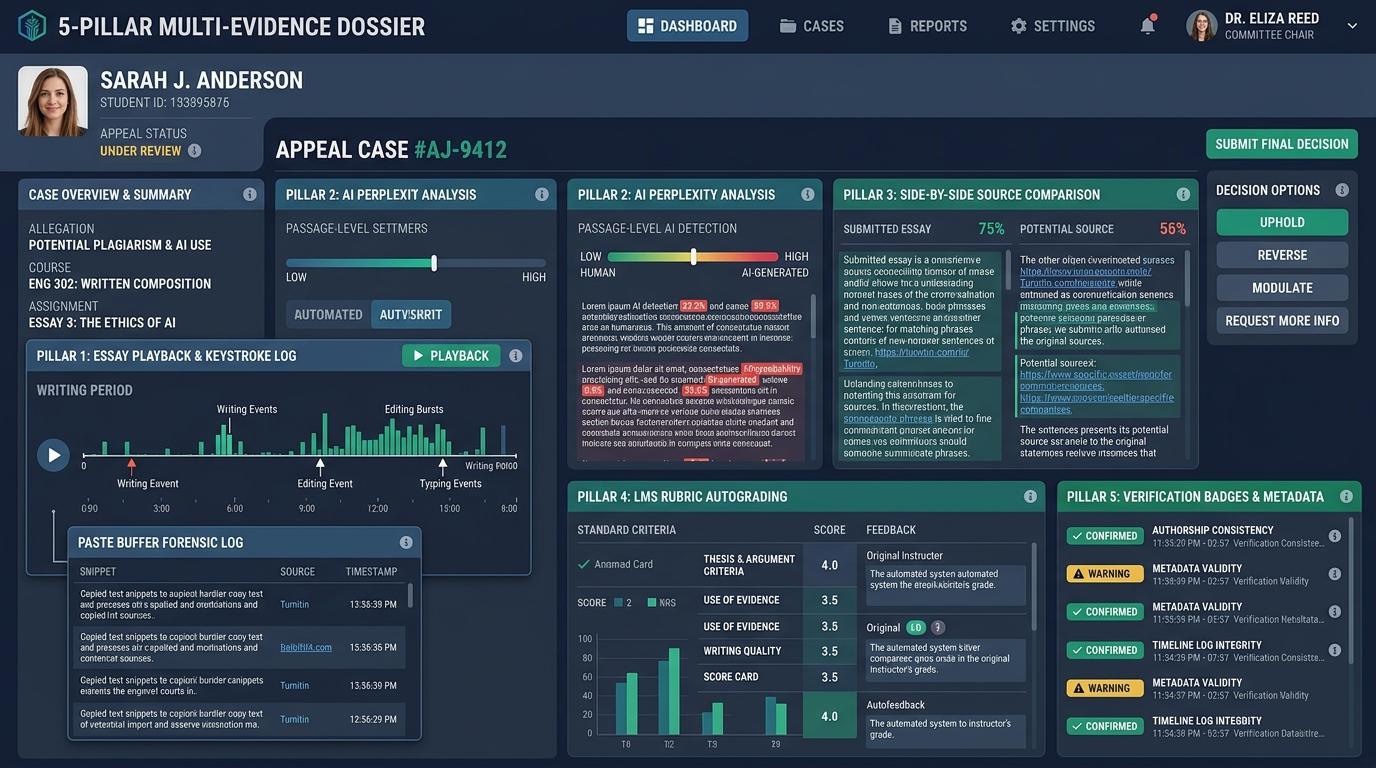
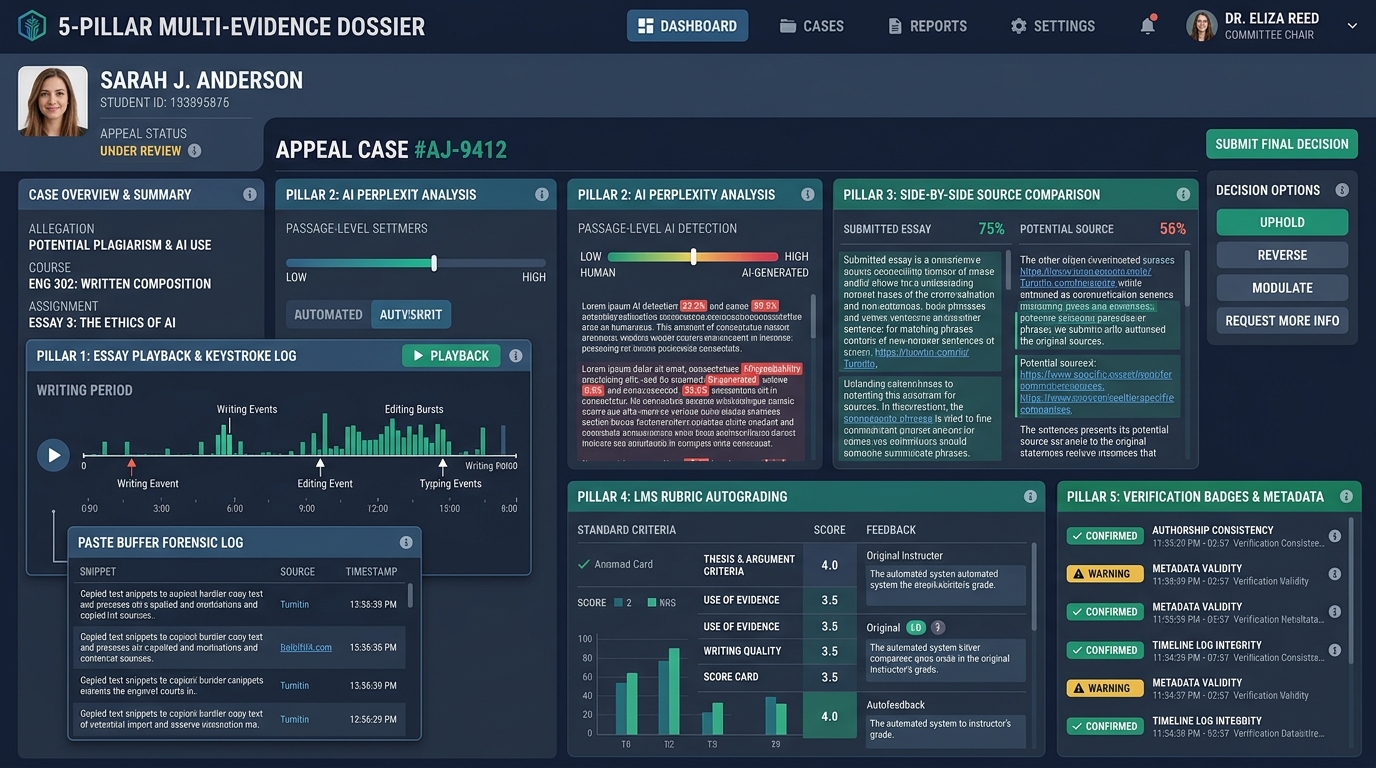
A single probabilistic score is neither evidence nor an explanation; it is a mathematical guess. Checkmark Plagiarism resolves this systemic crisis by replacing opaque black-box scores with the 5-Pillar Multi-Evidence Dossier Architecture. By synthesizing patent-pending Essay Playback™ keystroke dynamics, immutable external paste buffer records, granular passage-level linguistic distributions with calibrated confidence sliders, synchronized two-pane side-by-side plagiarism matching, and teacher-in-the-loop rubric autograding histories, Checkmark provides defensible, unassailable evidentiary records (“receipts”). This guide outlines the legal imperatives of academic hearings, deconstructs the multi-evidence dossier architecture, presents real-world case studies, and provides hearing boards with a comprehensive 4-Phase Adjudication Protocol to replace punitive guesswork with restorative, transparent justice.
Checkmark Plagiarism equips academic integrity committees, honor councils, department chairs, and judicial officers with forensic writing telemetry and enterprise LMS integrations across Canvas LMS, Agilix Buzz, and Google Classroom.
1. The High-Stakes Adjudication Crisis: Why Monolithic Scores Fail Legal & Ethical Scrutiny
Across university honor councils, collegiate academic integrity boards, high school administrative tribunals, and school district hearing panels, the adjudication of academic misconduct has reached a breaking point.
For decades, academic integrity inquiries followed a relatively straightforward investigative path: a teacher identified an uncredited block of text, cross-referenced it against a textbook or published journal article, and presented the physical or digital source to the student. Today, however, academic integrity committees are inundated with complex, contested allegations stemming from automated, black-box artificial intelligence classifiers and uncontextualized similarity indices.
- Lacks primary source text or behavioral telemetry
- Cannot explain how or why the score was computed
- Relies on opaque third-party software score
- Faces genuine student distress and vehement denial
- High risk of catastrophic false accusation
- Student files formal administrative appeal
- Retained legal counsel alleges Due Process breach
- Board cannot produce unredacted evidentiary record
- Hearing deadlocks on “Student Word vs. Black Box”
- Severe reputational, academic, and financial fallout
When an instructor brings an accusation supported solely by a statement such as “Turnitin assigned this paper an 84% AI score” or “The similarity checker returned 38%”, academic integrity committees find themselves trapped in an unresolvable evidentiary standoff.
A single probability number is legally, ethically, and pedagogically indefensible in formal appeal proceedings due to three fundamental institutional vulnerabilities:
1. Unreliability of Single-Point Probabilistic Classifiers
Commercial AI writing detectors operate as probabilistic neural classifiers. They compute the mathematical likelihood that a sequence of tokens was generated by a large language model based on statistical metrics such as perplexity (word choice predictability) and burstiness (sentence length and syntactic variation).
However, probabilistic classifiers exhibit structural limitations that render them unfit as sole arbiters of student culpability:
- Non-Reproducibility and Model Drift: Minor document formatting changes, character encoding variances, or subsequent vendor model updates routinely cause identical student text to fluctuate between high and low AI confidence scores across consecutive scans.
- Severe Bias Against Non-Native English Writers (ESL/ELL): Empirical research (including landmark studies from Stanford University, Liang et al., 2023) has established that non-native English speakers are disproportionately flagged as “AI-generated” because their authentic writing tends to exhibit lower lexical perplexity and more predictable grammatical structures.
- Neurodivergent Writing Variations: Students with Autism Spectrum Disorder (ASD), ADHD, or specific learning disabilities often utilize structured, repetitive, or highly systematic phrasing that closely matches the statistical profile of generative models.
- Formulaic Academic and Technical Prose: Standard scientific methodologies, legal case briefs, literary analyses, and capstone research formats inherently demand standardized academic phraseology, triggering elevated false-positive rates.
2. Procedural Due Process Violations (Constitutional & Contractual)
In formal academic disciplinary hearings, students are entitled to meaningful procedural protections:
- Public Institutions (Constitutional Due Process): Under the Fourteenth Amendment of the United States Constitution, students at public colleges, universities, and public secondary school districts possess protected property and liberty interests in their education, academic standing, and reputation (Goss v. Lopez, 419 U.S. 565; Board of Curators of the University of Missouri v. Horowitz, 435 U.S. 78). Depriving a student of course credit, suspending them, or expelling them based on an unexplainable algorithmic output without providing access to the underlying primary evidence constitutes a severe procedural due process violation.
- Private Institutions (Contractual Fair Hearing Rights): While private universities and independent schools are not directly bound by the Fourteenth Amendment, they are legally bound by their published student handbooks, honor codes, and institutional policies under the doctrine of express and implied contract. When an institution guarantees an accused student “a fair hearing” and the opportunity “to examine all evidence presented against them,” presenting a proprietary black-box percentage breaches that contractual obligation.
3. FERPA (34 CFR Part 99 § 99.10) Student Inspection Rights
Under the Family Educational Rights and Privacy Act (FERPA, 34 CFR Part 99 § 99.10), students (and parents of eligible secondary students) possess an absolute federal right to inspect and review their complete education records, including all disciplinary files, evidentiary documents, algorithmic logs, and investigative notes maintained by the educational institution.
When an academic integrity committee uses a third-party black-box AI detection tool, the institution cannot produce the underlying weights, decision trees, or feature activations that generated the score. If the vendor withholds the forensic data behind proprietary trade-secret claims, the school cannot fulfill its statutory FERPA disclosure obligations, exposing the district or university to federal compliance sanctions and civil liability.
To conduct fair, transparent, and legally defensible appeal hearings, academic integrity committees must abandon the reliance on single-score classifiers and adopt a Multi-Evidence Dossier approach that substantiates claims through authentic writing process telemetry.
2. The 5-Pillar Multi-Evidence Dossier Architecture
The philosophy of Checkmark Plagiarism is grounded in a simple, foundational principle: “Stop guessing, start trusting.”
Academic integrity investigations should never resemble a criminal prosecution based on statistical suspicion; rather, they should provide an objective, transparent, and multi-dimensional factual record—providing educators, students, and appeal boards with definitive “receipts.”
The Multi-Evidence Dossier replaces monolithic scores by compiling five synchronized forensic layers into a unified, interactive investigative report:
Continuous keystroke recording capturing every letter, pause, deletion, and structural revision from first draft to submission.
100% preservation of all clipboard text insertions with exact millisecond timestamps and character lengths.
- Full raw text preservation
- Cursor position index tracking
- Jump-to-playback sync
Granular perplexity & burstiness metrics evaluated sentence-by-sentence with calibrated confidence sliders.
- Perplexity & burstiness cards
- Calibrated confidence scale
- <150w guardrail (Displays N/A)
Synchronized two-pane comparison viewer with live resolved URLs and quad-badge classification.
- Dual-pane aligned view
- Live clickable DOI/web URLs
- Quad-badge category tags
Full alignment with assignment parameters, formative milestones, and quote-anchored instructor justifications synced from Canvas LMS, Buzz LMS, or Google Classroom.
Pillar 1: Temporal Writing Process Telemetry (Essay Playback™)
The most definitive proof of authorship is not the static linguistic arrangement of words on a page, but the temporal physical history of how those words were created.
Checkmark’s patent-pending Essay Playback™ captures native writing telemetry from Google Docs, Microsoft Word (via OneDrive and Checkmark plugins), Canvas LMS, and Buzz LMS embedded editors. It reconstructs the entire drafting journey keystroke-by-keystroke, allowing appeal boards to scrub through the writing session like a high-definition video at speeds ranging from 1x to 8x.
Key Telemetric Metrics Examined by Integrity Boards:
- Inter-Key Intervals (IKI): Human typing exhibits an organic, log-normal distribution. The time elapsed between individual keystrokes varies naturally depending on word complexity, cognitive formulation, and motor execution (typically 120ms to 350ms during active bursts, punctuated by 2,000ms to 15,000ms cognitive pauses at syntactic boundaries). In contrast, automated macro-injection or transcription from a secondary screen produces unnatural, flat, or rigidly mechanical IKI profiles.
- Drafting Velocity Profiling: Real-time tracking of words-per-minute (WPM) and characters-per-minute (CPM) identifies genuine human drafting peaks and valleys.
- Non-Linear Revision Bursts: Genuine human writing is messy and iterative. Authentic students frequently draft out of order, jump back to earlier paragraphs to refine arguments, delete awkward sentences, and rephrase transitions.
- Active vs. Idle Composition Timestamps: Distinguishes between time spent actively typing/editing versus passive idle time when a document was left open in a browser tab.
Pillar 2: Immutable External Paste Buffer Records
In contested hearings, one of the most common student defenses is: “I wrote the essay in another window (or Apple Notes / a personal notebook app) and pasted it into the LMS submission box all at once.” Conversely, instructors often suspect that large pasted blocks represent generated AI text or illicit essay mill content.
Checkmark’s External Paste Buffer Tracking provides objective, incontrovertible resolution by capturing every clipboard insertion event with complete, immutable data integrity:
| Paste ID | Timestamp | Length | Words | DOM Position | Stored Raw Content Preview | Action |
|---|---|---|---|---|---|---|
| #01 | 14:22:08 | 412 chars | 62 words | Index 1,420 (P2) | “The socioeconomic stratification of urban centers...” | Jump to Playback → |
| #02 | 15:04:19 | 1,840 chars | 285 words | Index 3,890 (P5) | “Furthermore, the macroeconomic ramifications of...” | Jump to Playback → |
| #03 | 15:42:55 | 95 chars | 14 words | Index 5,120 (Ref) | “https://doi.org/10.1016/j.jclinepi.2021.08.012” | Jump to Playback → |
Forensic Capabilities of Paste Tracking:
- 100% Original Text Preservation: Even if a student pastes a 1,000-word generated passage and subsequently spends an hour rewriting, synonymizing, or editing every single word, Checkmark permanently archives the raw, original pasted string in the dossier.
- Context Insertion Indices: Pinpoints the exact cursor position and DOM node where the clipboard content was inserted.
- Synchronized “Jump-to-Playback”: Hearing panel members can click any paste record in the dossier table to instantly jump the Essay Playback™ video to the exact millisecond before and after the paste occurred.
- Differential Telemetry Analysis: Evaluates what happened immediately following the paste. Did the student format and integrate a legitimate research quote, or did they perform cosmetic surface paraphrasing to disguise external text?
Pillar 3: Granular Passage-Level AI & Linguistic Analysis
Rather than stamping a whole document with a single opaque percentage (e.g., “78% AI”), Checkmark’s Multi-Factor AI Writing Engine evaluates essays at the sentence and passage level.
Flags are displayed as individual, interactive evidence cards in the sidebar, directly linked to visual underlines within the student's text.
Core Components of Passage-Level AI Analysis:
- Perplexity & Burstiness Distributions: Visualizes the exact mathematical variance across sentences. Human writing displays high burstiness (short, punchy sentences interspersed with complex, compound structures) and localized perplexity spikes.
- Calibrated Confidence Sliders: Replaces arbitrary binary accusations with an evidentiary spectrum, allowing committees to see whether a passage reflects dense academic vocabulary or genuine synthetic generation.
- Honest Guardrails (<150 Words N/A): Short answers, discussion forum replies, and brief introductory paragraphs below ~150 words display
N/Arather than generating speculative probabilities on inadequate sample sizes. - Immunity to “AI Humanizers” & Paraphrasers: While tools like QuillBot, Undetectable AI, and BypassGPT can alter surface word choice to fool standard NLP detectors, they cannot fabricate authentic typing dynamics. When paired with Pillar 1, the absence of human drafting telemetry immediately unmasks paraphrased AI text.
- Educator-Only Flag Statuses: Flag statuses (Flagged, Resolved, Not Flagged) remain private to instructors and committees, preventing premature automated accusations from reaching students before human review.
Pillar 4: Synchronized Side-by-Side Plagiarism & Source Matching
When traditional plagiarism or uncredited copying is in dispute, monolithic similarity scores fail because they lump together legitimate cited quotations, standard bibliographies, and uncredited copying.
Checkmark’s Synchronized Plagiarism Matching Engine presents a dual-pane document comparison with live resolved URLs, scanning billions of indexed web pages, open-access academic publications, and internal institutional repositories.
“In analyzing the post-war industrial decline, the regional manufacturing sector experienced a severe downward trajectory, causing widespread urban blight and economic stagnation across the rust belt. (Smith, 2021).”
“In analyzing the post-war industrial decline, the regional manufacturing base underwent a rapid contraction, precipitating widespread urban decay and municipal insolvency across the rust belt.” — Dr. Arthur Smith, Industrial Economics (2021)
Key Capabilities for Appeal Committees:
- Quad-Badge Categorization: Instantly separates deliberate plagiarism (🔴 Red / 🟣 Purple) from developmental patchwriting (🟡 Amber) and unquoted citations (🟢 Green). This enables committees to prescribe citation coaching rather than academic suspension when students struggle with academic conventions.
- Two-Way Linked Evidence Cards: Clicking any highlighted sentence in the student’s essay immediately scrolls the source pane to the exact matched paragraph, and clicking a source card in the sidebar highlights the corresponding passage in the essay.
- Live Resolved Links & DOI Matching: Committee members do not have to rely on truncated text snippets; they can click directly to the live journal article, government archive, or website to verify context.
Pillar 5: Teacher-in-the-Loop Rubric Autograding History & LMS Parameters
Academic integrity disputes rarely exist in a vacuum; they are intrinsically tied to assignment expectations, rubric standards, and pedagogical milestones.
Checkmark’s Teacher-in-the-Loop Rubric Engine syncs directly with Canvas LMS, Buzz LMS, and Google Classroom, embedding the complete pedagogical context into the dossier:
“While the student effectively synthesizes theoretical frameworks in Paragraph 3 (‘The intersection of cognitive load and digital pedagogy...’), Paragraphs 5–7 rely heavily on a single uncredited secondary review rather than synthesizing primary research.”
Evidentiary Value for Hearing Boards:
- Verification of Pedagogical Scaffolding: Proves whether the student submitted required formative milestones (topic proposals, outlines, peer reviews) prior to the final submission.
- Quote-Anchored Justifications: Provides objective written rationales tied directly to student sentences, demonstrating that grading and integrity determinations were based on published academic criteria rather than instructor bias.
- Audit Trail of Teacher Edits: Documents when the instructor reviewed the submission, what rubric modifications were made, and whether the student was provided formative opportunities to revise before formal escalation.
3. Comprehensive Comparison Matrices & Visual Frameworks
To visualize how the Multi-Evidence Dossier transforms academic integrity adjudication, the following comparison matrices contrast legacy detection tools with Checkmark’s integrated architecture.
Matrix 1: Monolithic AI Classifiers vs. Multi-Evidence Dossier Architecture
| Forensic Dimension | Legacy Black-Box AI Detectors | Checkmark Multi-Evidence Dossier |
|---|---|---|
| Primary Output | Single aggregate percentage (“82% AI”) | 5-Pillar Multi-Evidence Dossier with granular telemetry |
| Evidentiary Granularity | Document-level probability | Sentence-by-sentence perplexity & burstiness evidence cards |
| Writing Process Verification | None (Static text inspection only) | Patent-pending Essay Playback™ (1x–8x keystroke video replay) |
| Clipboard Paste Telemetry | None (Pastes are invisible in final text) | 100% immutable paste buffer logs with stored original text |
| Legal Defensibility | Indefensible (Violates Fourteenth Amendment Due Process) | Legally unassailable (Empirical, reproducible primary data) |
| FERPA § 99.10 Compliance | Non-compliant (Proprietary black-box cannot be audited) | 100% FERPA-compliant exportable student evidentiary records |
| Resistance to AI Paraphrasers | Easily bypassed by QuillBot / Undetectable AI | 100% immune (Absence of human keystroke telemetry unmasks AI) |
| Source Matching Depth | Opaque similarity index with truncated snippets | Synchronized two-pane viewer with live URLs & quad-badges |
| Short-Text Protection | Generates speculative scores on 50-word inputs | Strict short-text guardrail (<150w displays N/A) |
| Pedagogical Integration | Standalone punitive score | LMS-synced rubric autograding with teacher-in-the-loop |
Matrix 2: Standard LMS Version History vs. Patent-Pending Essay Playback™
| Telemetric Capability | Standard Cloud Version History (Docs / Word) | Checkmark Essay Playback™ |
|---|---|---|
| Snapshot Granularity | Periodic snapshots every 5–15 minutes | Millisecond-level keystroke-by-keystroke replay |
| Inter-Key Interval (IKI) Data | Not recorded | Full temporal IKI distribution (120ms–350ms tracking) |
| External Paste Preservation | Overwritten text is lost across revisions | Full preservation of original pasted string forever |
| Transcription Detection | Cannot distinguish retyping from drafting | Identifies unnatural typing rhythm lacking formulation pauses |
| Playback Velocity Controls | None (Manual clicking through static revisions) | Scrubbable timeline with 1x, 2x, 4x, and 8x playback speeds |
| Cognitive Pause Identification | Invisible (Idle periods blend into snapshots) | Identifies sentence-boundary and within-word pauses |
| LMS Direct Embedding | Requires external document sharing links | Embedded natively within Canvas LMS & Buzz LMS SpeedGrader |
4. Real-World Case Studies in Academic Integrity Appeals
The following case studies illustrate how academic integrity committees, honor councils, and school district boards utilize Checkmark Multi-Evidence Dossiers to adjudicate complex disputes.
The University Honor Council Capstone Appeal
Senior undergraduate biology honors thesis (8,500 words). Course instructor submitted paper to a legacy detector which returned 84% AI Detected. Degree conferral placed on hold; referred for suspension.
Student testified the paper represented 9 months of independent wet-lab research. Instructor claimed dense terminology and smooth syntax were proof of LLM writing.
- Essay Playback™: 38 hours and 14 minutes of active drafting across 18 sessions; authentic log-normal mean IKI of 215ms; Section 3 restructured 4 times over two weeks (1,200 words rewritten).
- Paste Buffer Log: 8 discrete pastes consisting entirely of raw spectrometer numerical lab tables and PubMed DOI citations. Zero narrative text pasted.
- Passage AI Calibration: Flag caused by standard scientific collocations (‘histone deacetylase inhibition’). Calibrated slider proved sentence perplexity aligned with human biomedical corpus.
The AP Seminar False-Positive Legal Challenge
High school junior AP policy brief (2,200 words). Automated LMS scanner flagged 88% AI Probability. Teacher issued zero and disciplinary probation. Parents retained counsel threatening due process litigation.
Teacher cited formal tone compared to in-class journals. Student maintained they drafted the paper over two weeks using the teacher’s scaffolded outline.
- Drafting Progression: 11 hours active writing across 8 days. Dossier proved student composed directly into scaffolded outline milestones.
- Cognitive Pause Dynamics: 64 formulating pauses >10 seconds at paragraph transitions; 18% character churn with active word-level backspacing.
- Short-Text Guardrail: Legacy detector heavily penalized the 110-word hook; Checkmark engine displayed
[N/A: Insufficient Sample Size].
Commercial Contract Cheating Exposed via Paste Telemetry
Executive MBA strategic management paper (4,000 words). Legacy scanners reported 0% Plagiarism and 12% AI Score. Student could not explain valuation models during oral defense.
Student claimed they drafted the paper on an offline personal computer in MS Word and pasted the finished work into the LMS.
- Paste Buffer Audit: Total document creation time was 4 minutes and 12 seconds. Three massive turnkey pastes (890 words, 1,750 words, 1,360 words) inserted sequentially.
- Drafting Velocity: Computed typing speed was 57,000 words per hour with zero active keyboard input, zero backspaces, and zero post-paste edits.
5. The 4-Phase Hearing Adjudication Protocol for Integrity Committees
To ensure procedural due process, institutional consistency, and pedagogical integrity, academic institutions should implement the following standardized 4-Phase Adjudication Protocol for all contested hearings.
- Export complete Checkmark Multi-Evidence Dossier.
- Cross-reference Playback, Paste Logs, AI cards, and Sources.
- Perform triage review to dismiss ungrounded flags early.
- Provide unredacted dossier copy to student/parents.
- Guarantees FERPA 34 CFR § 99.10 student inspection rights.
- Student prepares defense referencing specific timestamps.
- Screen-share interactive Essay Playback™ video (1x–8x).
- Review objective keystroke IKI and paste logs as a panel.
- Student delivers oral explanation of research methodology.
- Score case against Standardized Hearing Rubric.
- Apply evidentiary standards (Preponderance vs Clear & Convincing).
- Issue restorative or disciplinary finding with written record.
6. Hearing Board Deliberation Rubric & Evidentiary Standard Matrix
To eliminate subjective bias and ensure institutional equity, hearing panels should score appeals across five standardized forensic criteria.
| Evidentiary Domain | Level 1: Substantial Misconduct | Level 2: Developmental / Patchwrite | Level 3: Verified Authenticity |
|---|---|---|---|
| 1. Writing Process Telemetry (Playback) | Flat, mechanical typing; instant generation; 0 pauses; 0 revisions. | Condensed drafting time; uneven bursts; minor drafting pauses. | Organic log-normal IKI; heavy revision churn (>15%); multi-session. |
| 2. External Paste Buffer Log Audit | Massive uncredited blocks (>500w) pasted with zero editing. | Frequent source pastes with incomplete parenthetical citation. | Documented pastes limited to quotes, lab data, and URLs. |
| 3. Passage-Level AI & Linguistic Profile | Clustered low perplexity & uniform burstiness across core claims. | Isolated flags in formulaic sections; slider indicates human voice. | High perplexity & burstiness; normal stylistic cadence. |
| 4. Plagiarism Source Matching & Badges | Direct verbatim uncredited matches (🔴 Red / 🟣 Peer match). | Developmental patchwriting; syntactic borrowing with citation (🟡). | Fully attributed citations; properly enclosed quotation marks (🟢). |
| 5. Student Oral Defense & Voice | Inability to explain core concepts, methods, or vocabulary used. | Understands concepts but struggles with disciplinary citation rules. | Seamless conceptual mastery; articulates drafting choices fluently. |
Standards of Proof in Academic Disciplinary Proceedings
Preponderance of Evidence
Applicable to undergraduate and secondary honor board proceedings. Requires corroborated telemetry proving misconduct was more likely than not.
Requires: Corroborated TelemetryClear & Convincing Evidence
Required for severe sanctions (expulsion, suspension, degree revocation). Requires conclusive temporal proof and undeniable telemetry records.
Requires: Conclusive TelemetrySpeculative Suspicion
Manifested by unverified black-box percentage scores (e.g. “75% AI Detected”). Legally fatal under judicial review.
Status: Legally Fatal7. FERPA, Data Privacy, and Legal Defensibility Standards
When evaluating academic integrity platforms, institutional leadership—including Chief Information Officers, School District Technology Directors, and General Counsel—must audit vendor architectures for compliance with federal student privacy mandates.
FERPA Compliance (34 CFR Part 99)
Under FERPA’s School Official Exception (34 CFR § 99.31(a)(1)(i)(B)), educational institutions may only share student education records with third-party software vendors if the vendor:
- Performs an institutional service for which the school would otherwise use employees;
- Operates under the direct control of the institution regarding the use and maintenance of education records;
- Is strictly prohibited from using student education records for secondary commercial purposes (such as training machine learning models).
Student writing and telemetry are NEVER cached or used to train commercial LLMs or AI classifiers.
Multi-tenant encryption keys (AES-256 at rest, TLS 1.3 in transit) ensure strict institutional data segregation.
Generates instant, transparent, unredacted student inspection files for due process compliance.
8. Frequently Asked Questions (FAQ)
1. Why is a single AI probability percentage (e.g., “82% AI”) legally indefensible in a formal academic appeal hearing?
A single probability percentage is a mathematical inference generated by an opaque, probabilistic classifier—it is not direct evidence of human or machine authorship. In formal appeal hearings, students are entitled to procedural due process (Goss v. Lopez), which requires institutions to present clear, explainable, and verifiable evidence of misconduct. Because black-box detectors suffer from high false-positive rates on non-native English (ESL) writers, neurodivergent students, and technical writing, and because their scores cannot be independently audited or reproduced, relying on an aggregate number as the sole basis for disciplinary action exposes institutions to immediate legal liability and due process challenges.
2. How does Checkmark's patent-pending Essay Playback™ protect honest students from false-positive AI accusations?
Essay Playback™ captures the continuous, millisecond-level writing process telemetry directly from Google Docs, Microsoft Word, Canvas LMS, and Buzz LMS. When an honest student is falsely flagged by a legacy detector, the integrity committee does not have to guess: they can scrub through the complete writing session at 1x to 8x speed. The playback displays authentic human drafting behaviors—such as natural Inter-Key Interval (IKI) distributions, extended formulating pauses, sentence-level restructuring, dynamic deletions, and organic outline progression—providing undeniable, empirical proof of authentic authorship.
3. Can students bypass paste telemetry by typing out an AI-generated essay while reading from a second screen or phone?
No. Checkmark’s telemetric engine specifically analyzes typing velocity, pause mechanics, and transcription dynamics. When a student manually transcribes text from a secondary screen, phone, or paper printout, their keystroke dynamics exhibit distinct mechanical anomalies: a flat, rhythmic Inter-Key Interval without natural cognitive pauses, the complete absence of paragraph restructuring, and near-zero word-level revision churn. Genuine cognitive drafting involves frequent pauses at syntactic boundaries, backspacing, and non-linear editing. Checkmark visualizes these transcription patterns, allowing committees to easily distinguish authentic composing from manual transcription.
4. How does the Multi-Evidence Dossier comply with FERPA § 99.10 inspection requirements for student records?
Under FERPA (34 CFR Part 99 § 99.10), students and parents possess the federal right to inspect all educational and disciplinary records used to make academic determinations. Unlike black-box vendors that conceal their decision-making algorithms, Checkmark allows institutions to export the complete, unredacted Multi-Evidence Dossier—including full keystroke playback logs, timestamped paste buffer records, sentence-by-sentence linguistic evidence cards, and rubric justification histories—as a standardized, shareable document that fully satisfies federal transparency mandates.
5. What happens if a student claims they composed their essay offline in another word processor before pasting it into the LMS?
Checkmark directly addresses this scenario through Pillar 2 (Immutable External Paste Buffer Records) and Pillar 1 (Essay Playback™). If an entire essay is pasted in a single action, Checkmark records the exact timestamp, character count, and preserved pasted string. The integrity committee can then review what occurred immediately after the paste: did the student engage in extensive structural revision and editing, or was the document submitted immediately without review? Furthermore, Checkmark offers native desktop and web integrations for Microsoft Word and Google Docs, enabling students to maintain authentic keystroke telemetry regardless of where they compose.
6. How do passage-level calibrated confidence sliders prevent false accusations on technical or ESL writing?
Legacy detectors evaluate entire documents using a rigid global threshold, which frequently misclassifies technical terminology and ESL prose as “AI-generated.” Checkmark’s engine evaluates text on a sentence-by-sentence basis, displaying calibrated confidence sliders alongside linguistic perplexity and burstiness metrics on individual evidence cards. This enables committees to isolate specialized scientific vocabulary or formulaic methodology sections without penalizing the student’s entire paper, ensuring that standard disciplinary phrasing is evaluated in proper context.
7. How can academic integrity committees integrate Checkmark dossiers directly with Canvas, Buzz, and Google Classroom workflows?
Checkmark integrates natively with major Learning Management Systems via standard LTI 1.3 protocols and API connectors. Instructors and committee members can access Multi-Evidence Dossiers directly within Canvas SpeedGrader, Buzz LMS grading views, and Google Classroom. When an appeal is filed, integrity officers can export the complete interactive dossier or generate secure, role-restricted review links with a single click, eliminating administrative friction and ensuring seamless institutional workflow integration.
9. Conclusion: Moving from Adversarial Suspicion to Defensible Integrity
The advent of generative artificial intelligence has fundamentally altered the landscape of educational assessment. However, responding to technological transformation with punitive, black-box algorithmic detection has proven to be an institutional failure—eroding student trust, creating unmanageable administrative backlogs, and exposing schools and universities to severe legal and ethical vulnerabilities.
Academic integrity committees, honor councils, and educational leaders must champion a higher standard of institutional justice. By transitioning from opaque single-percentage scores to the Checkmark 5-Pillar Multi-Evidence Dossier Architecture, educational institutions can:
- Uphold Procedural Due Process: Provide students and hearing panels with transparent, empirical, and unassailable factual records.
- Exonerate Honest Students: Safeguard neurodivergent learners, ESL writers, and diligent researchers from devastating false accusations.
- Decisively Identify Authentic Misconduct: Unmask contract cheating, turnkey AI generation, and copy-paste fraud with definitive keystroke and paste telemetry.
- Foster Restorative Learning: Distinguish developmental citation lapses (such as patchwriting) from deliberate fraud, transforming disciplinary crises into opportunities for scholarly growth.
Transform Your Academic Integrity Hearing Process
Equip your honor councils, department chairs, and judicial affairs officers with patent-pending Essay Playback™, granular passage-level analysis, and unassailable 5-Pillar Multi-Evidence Dossiers.