
When an automated similarity scanner highlights a student paragraph with an 80%+ match to an external source, educators face a critical pedagogical crossroads: Is the student guilty of deliberate academic deception, struggling with the cognitive demands of developmental synthesis (patchwriting), or simply a victim of a clerical formatting error (accidental missing quotation marks)? Legacy plagiarism tools flatten these fundamentally distinct behaviors into a single punitive percentage, damaging student-teacher trust and misdirecting disciplinary interventions. Grounded in the empirical research of Rebecca Moore Howard and the multi-institutional Citation Project, this guide details the exact forensic, linguistic, and behavioral evidence needed to differentiate these writing patterns. By combining Checkmark Plagiarism’s two-pane synchronized source verification workbench, discrete visual citation badges (Quoted & Cited, Cited but Unquoted, Uncited External Match, Peer Cohort Match), patent-pending Essay Playback™ keystroke telemetry, granular passage-level AI detection, and teacher-in-the-loop rubric autograding, educators can replace punitive guesswork with transparent, defensible “receipts” that nurture authentic student growth.
Checkmark Plagiarism equips educators with an integrated, enterprise-grade integrity suite uniting multidimensional plagiarism detection, keystroke writing process replay, passage-level AI writing detection, and quote-anchored rubric autograding with seamless grade passback for Canvas LMS, Buzz LMS, and Google Classroom.
1. The High-Stakes Educator Dilemma: Beyond the 80% Similarity Trap
Every secondary and post-secondary writing instructor has experienced the jarring moment: opening a newly submitted student research essay and seeing a prominent, bright-red 84% Similarity Match flagged on a central body paragraph.
Under legacy academic integrity workflows, this blunt percentage triggers an immediate, adversarial disciplinary protocol:
How monolithic scoring algorithms collapse valid scholarship, formatting errors, and subtle fraud into a single blunt percentage
Dense Disciplinary Literature • Multiple Secondary Citations • In-Text Works Cited Page
One-Dimensional Aggregate Metric • Treats all lexical overlap as intentional dishonesty
- Student cited source properly in-text:
(Kahneman, 2011, p. 74) - Source present in Works Cited bibliography
- Student inadvertently omitted quotation punctuation
- Outcome: Disciplinary referral, F grade, destroyed student-teacher relationship
- Student copied mosaic clauses from 4 unindexed blogs
- Used AI paraphrasers / synonym spinners to evade string match
- Zero source attribution or signal phrases provided
- Outcome: Intentional academic fraud evades detection entirely
When an automated tool outputs an aggregate similarity score without granular context, it collapses three completely different cognitive, developmental, and ethical writing behaviors into a single category:
The student conducted genuine research, intended to attribute exact wording, cited the author parenthetically (e.g., (Kahneman, 2011, p. 74)), and included the source in their bibliography—yet inadvertently omitted opening and closing quotation marks during drafting or final editing.
The student encountered dense, authoritative disciplinary prose in their Zone of Proximal Development (ZPD), lacked the conceptual or linguistic fluency to synthesize the idea independently, and copied the source’s syntactic skeleton while swapping select words with thesaurus synonyms—failing to provide proper in-text citations.
The student systematically cut and pasted clauses from multiple disparate websites, deliberately stripped author names, concealed transitions with generic filler words, and used paraphrasing tools to disguise intellectual theft.
The Pedagogical Cost of Misdiagnosis
Confusing these three scenarios carries severe institutional and human costs:
- Criminalizing the Learning Process: Accusing a novice writer of intentional plagiarism when they are struggling with the cognitive load of academic synthesis causes severe writing anxiety, alienates emerging scholars, and disproportionately penalizes first-generation, English Language Learner (ELL), and neurodivergent students.
- Trivializing Real Dishonesty: When academic integrity boards spend dozens of hours adjudicating missing quotation marks as honor code violations, they exhaust institutional resources and fail to develop robust forensic protocols for contract cheating, second-screen transcription, and deceptive mosaic cloaking.
- Eroding the Instructional Alliance: The foundational philosophy of Checkmark Plagiarism is “Stop guessing, start trusting.” When educators possess transparent, multi-dimensional evidence—the “receipts”—they can hold supportive, formative conferences rather than hostile interrogations.
2. Theoretical Foundations: Rebecca Moore Howard and the Citation Project
To build an objective, evidence-based diagnostic framework, educational institutions must ground their integrity policies in composition theory and empirical research.
How cognitive working memory constraints produce divergent textual phenomena requiring differentiated pedagogical responses
- Parenthetical citation present
- Full bibliography entry listed
- 100% Verbatim source text
- Note-taking clerical slip
- Sentence syntax copied
- Synonym “rogeting” substitutions
- Disciplinary scaffolding in ZPD
- Cognitive overload failure
- Multi-source fragment collage
- Zero source attribution
- Intentional author concealment
- Cloaking & evasion techniques
The Discovery of Patchwriting
In her landmark 1992 and 1993 publications, composition scholar Rebecca Moore Howard challenged the prevailing binary that viewed all non-standard source integration as deliberate theft. Howard coined the term “patchwriting” to define a distinct, developmental writing behavior:
“Patchwriting: Copying from a source text which may be acknowledged or unacknowledged, deleting some words, altering grammatical structures, or substituting select synonyms while retaining the original syntactic architecture and semantic cadence.”
Howard argued that patchwriting is not an act of deception; rather, it is an essential linguistic scaffold through which novice writers enter complex academic discourse communities.
When students read texts that exceed their current vocabulary or conceptual mastery, they cannot summarize or paraphrase from memory because they do not yet fully comprehend the disciplinary logic. Consequently, they borrow the author’s sentence structure as a training wheel while substituting individual words.
The Citation Project: Empirical Realities
The Citation Project (Howard, Serviss, & Rodrigue, 2010; Jamieson & Howard, 2011)—a multi-institution empirical research study analyzing 1,911 citations across 174 student research papers from 16 colleges and universities—uncovered startling realities about how students use sources:
| Citation Project Finding | Empirical Percentage | Pedagogical Meaning |
|---|---|---|
| Direct Copying or Patchwriting | 52% of all citations | Over half of all student citations rely on close syntactic mimicry or copying rather than original synthesis. |
| Verbatim Text Without Quotation Marks | 16% of all citations | Students frequently attempt attribution by providing author names or citations while omitting quotation punctuation. |
| Engagement Beyond Page 2 of Source | < 23% of citations | Students rarely read entire monographs or journal articles, extracting isolated quotes from the opening pages. |
| True Synthesis / Full-Source Summary | < 6% of all citations | Fewer than 6% of students summarize an author’s overarching argument across multiple paragraphs. |
The empirical data is unequivocal: Novice writers overwhelmingly struggle with the mechanics of citation and the cognitive demands of synthesis. When schools treat patchwriting as an automatic violation of academic integrity rather than a pedagogical milestone, they penalize students for attempting to engage with challenging scholarship.
3. The Forensic Triad: Classifying the Three Distinct Patterns
To distinguish accidental missing quotation marks from uncited patchwriting and deceptive mosaic plagiarism, educators must evaluate three interlocking forensic dimensions:
- Attribution Integrity: Are author signal phrases, parenthetical citations, or Works Cited entries present?
- Linguistic & Syntactic Architecture: Is the text 100% verbatim, synonym-substituted (“rogeted”), or fragmented across multiple sources?
- Drafting Telemetry & Keystroke Dynamics: Did the student type the passage with authentic drafting pauses, transcribe from notes, or paste in bulk from the clipboard?
| Pattern Type | Linguistic / Textual Proof | Attribution & Telemetry Signals |
|---|---|---|
|
1. Accidental Missing Quotation Marks (Clerical / Mechanical) |
• 90%–100% Verbatim Match • Source syntax identical • No synonym substitutions • Isolated single source |
• In-text citation present & valid • Bibliographic entry complete • Essay Playback: Natural typing or paste from cited note buffer |
|
2. Uncited Patchwriting (Developmental / ZPD Scaffolding) |
• 50%–85% Syntactic Match • Heavy synonym swapping (“rogeting”) • Source sentence cadence retained • Single passage focus |
• In-text citation missing or vague • May appear in bibliography • Essay Playback: Extended pauses, thesaurus lookups, high backspaces |
|
3. Deceptive Mosaic Plagiarism (Intentional Theft / Authorship Fraud) |
• Interleaved multi-source clauses • Syntactic fragmentation • Deliberate cloaking filler words • 3+ external web domains |
• Zero citations across all sources • Omitted from Works Cited • Essay Playback: Rapid clipboard pastes, minimal editing bursts |
Deep Dive: Pattern 1 — The “Accidental Missing Quotes” Pattern
In this scenario, a student quotes an expert source verbatim but neglects the quotation marks. Crucially, the student does not attempt to hide the source.
“The brain is not a static organ, but a dynamic, plastic structure that remodels its neural circuitry in direct response to environmental stimuli and cognitive demand.”
Neuroscientists have proven that the brain is not a static organ, but a dynamic, plastic structure that remodels its neural circuitry in direct response to environmental stimuli and cognitive demand (Doidge, 2007, p. 45).
Deep Dive: Pattern 2 — The “Uncited Patchwriting” Pattern
In uncited patchwriting, the student attempts to paraphrase a complex idea but cannot escape the original syntactic gravity. They substitute words without grasping how to restructure the sentence, and they omit the parenthetical citation—often because they mistakenly believe their word changes made the idea “theirs.”
“Every time a student sits down to write for us, he has to invent the university for the occasion—that is, or he has to learn to speak our language, to speak as we do, to try on the peculiar ways of knowing, selecting, evaluating, reporting, concluding, and arguing.”
Whenever an emerging writer sits down to compose an academic paper, they must create the academic world for that moment. They need to figure out how to talk in our specialized discourse, using unique methods of understanding, choosing, assessing, communicating, and defending claims.
Deep Dive: Pattern 3 — The “Mosaic Fraud” Pattern
Mosaic plagiarism (also known as “patchwork theft” or “textual cloaking”) is an intentional effort to assemble an essay from multiple uncredited sources while disguising the theft through deliberate syntactic splicing.
Many historians forget that an intricate network of shifting caravan trails traversing central Eurasian steppes formed early commerce, but navigational compasses and Chinese junk ships revolutionized sea voyages, making overland transit obsolete.
4. Checkmark Plagiarism’s Side-by-Side Source Proof & Badge Architecture
To eliminate the ambiguity of single-percentage scores, Checkmark Plagiarism provides a granular, multi-layered visual architecture that automatically triages text matches into four discrete pedagogical categories.
Enclosed within valid quotation marks (“...”), accompanied by recognized citation format (APA, MLA, Chicago), and cross-referenced with bibliography. Automatically excluded from similarity calculations.
Lexical overlap exceeds 70% verbatim match, author signal phrase or parenthetical citation is present within 30 words, but quotation marks are missing. Flags passage for restorative citation coaching.
High lexical or syntactic overlap with live web pages, journal articles, or repositories with no corresponding in-text citation. Triggers process telemetry audit.
Text matches an assignment submitted by another student within the same school district, LMS section, or multi-school consortium—without exposing student PII externally.
Synchronized Two-Pane Source Verification Workbench
When reviewing an essay in Checkmark, educators do not receive a static PDF report. Instead, they interact with an active, two-pane synchronized forensic workbench:
...Recent organizational studies prove that transformational leadership behaviors significantly amplify team psychological safety during high-stress corporate restructuring events (Bass, 2023, p. 114)...
“Transformational leadership behaviors [significantly amplify] team psychological safety during high-stress corporate restructuring events...”
5. Writing Process Dynamics: Patent-Pending Essay Playback™
Text on a page represents only the final static artifact of writing. Surface text cannot reveal how the essay came into existence.
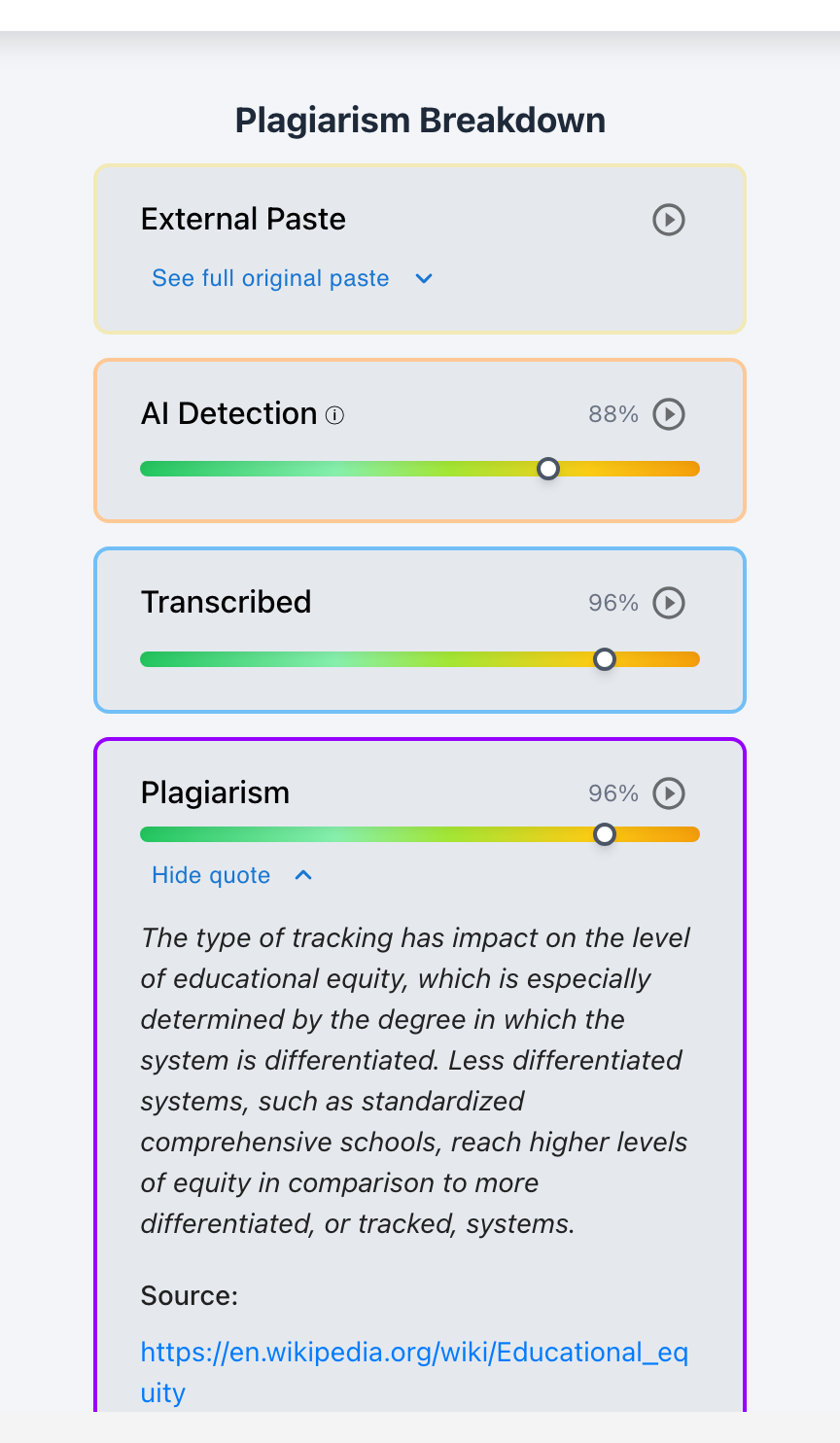
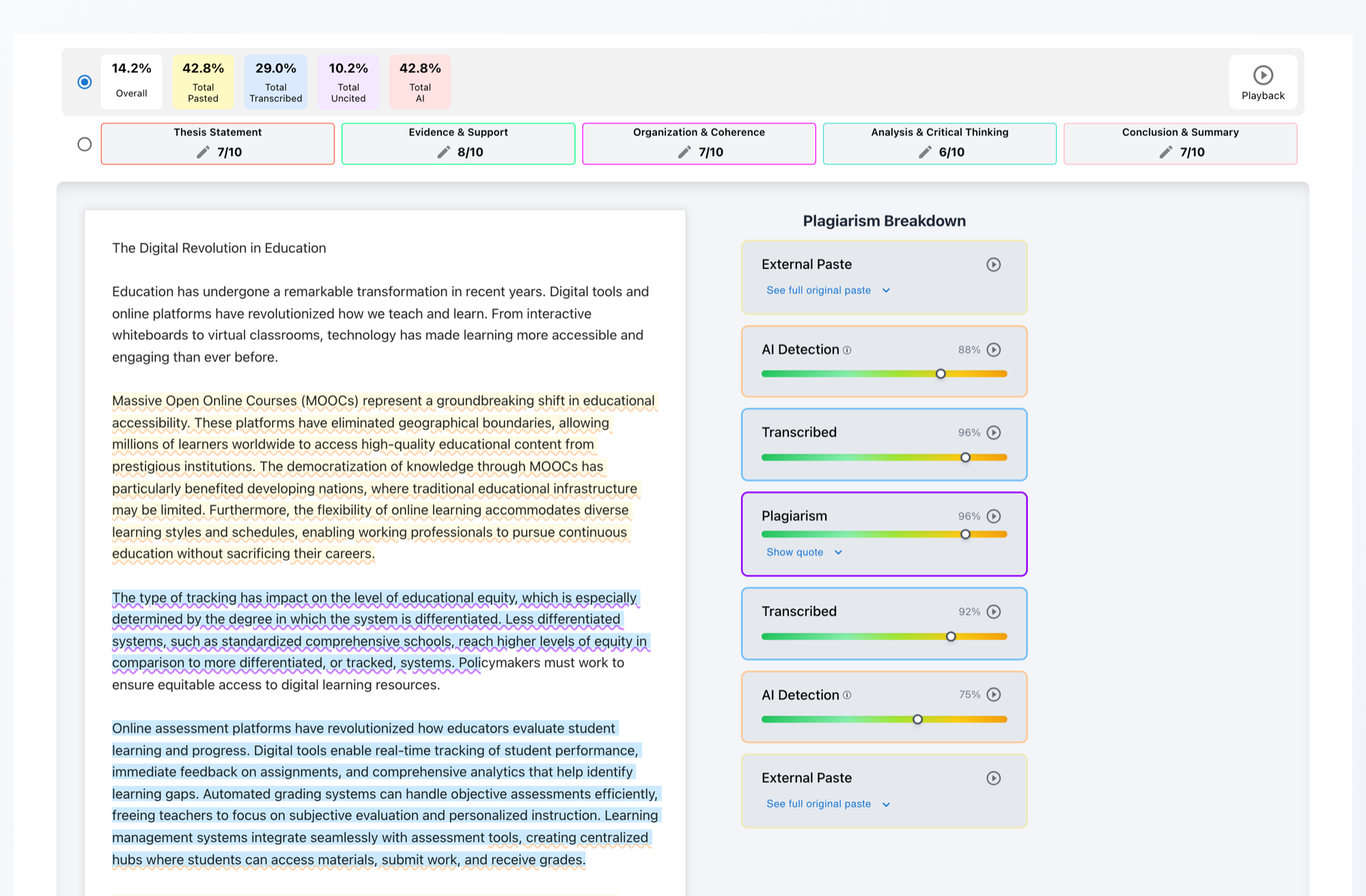
To definitively prove whether an uncited passage is the result of developmental struggling, a note-taking copy error, or intentional copy-paste fraud, Checkmark Plagiarism provides its flagship innovation: Patent-Pending Essay Playback™.
Keystroke-by-keystroke temporal reconstruction revealing authentic drafting vs clipboard dumps vs transcription
Keystroke Telemetry Signatures: Three Divergent Behaviors
| Telemetry Metric | Accidental Missing Quotes | Uncited Patchwriting | Deceptive Mosaic Fraud |
|---|---|---|---|
| Typing Velocity | Steady (40–65 WPM) or cited note paste | Irregular bursts with long intra-sentence pauses | Artificial bursts (0 → 800 WPM clipboard dump) |
| Cognitive Pauses | Brief pause prior to citation entry | Prolonged pauses (30–120s); frequent lookups | Negligible composing pauses; rapid consecutive pastes |
| Backspace / Revision | Low revision within quote; normal formatting | Extremely high backspaces (30–80 per paragraph) | Minimal revision; superficial synonym swaps only |
| External Paste Buffer | Single paste from research notes with cite | Zero paste OR single source + 30m rewrite | Multiple pastes from uncredited URLs cached in log |
| Diagnostic Verdict | Clerical Note-Taking Slip | Developmental Synthesis Struggle | Intentional Mosaic Theft / Cloaking |
1. External Paste Buffer Tracking with Full Text Preservation
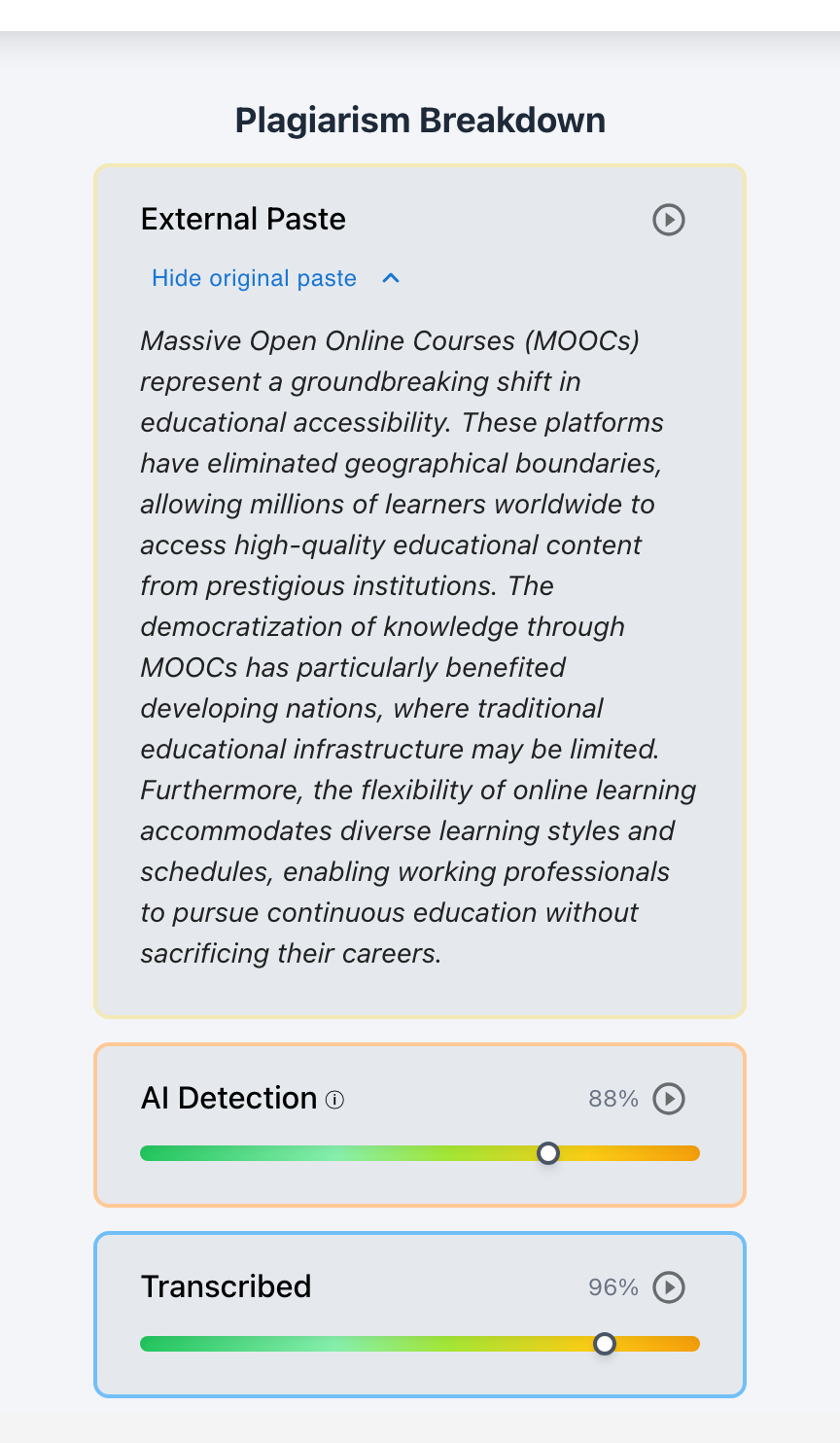
When a student pastes text from an external website or unindexed document into their essay, legacy tools only see the final text. If the student subsequently rewrites every sentence to evade string detection, traditional checkers lose the trail.
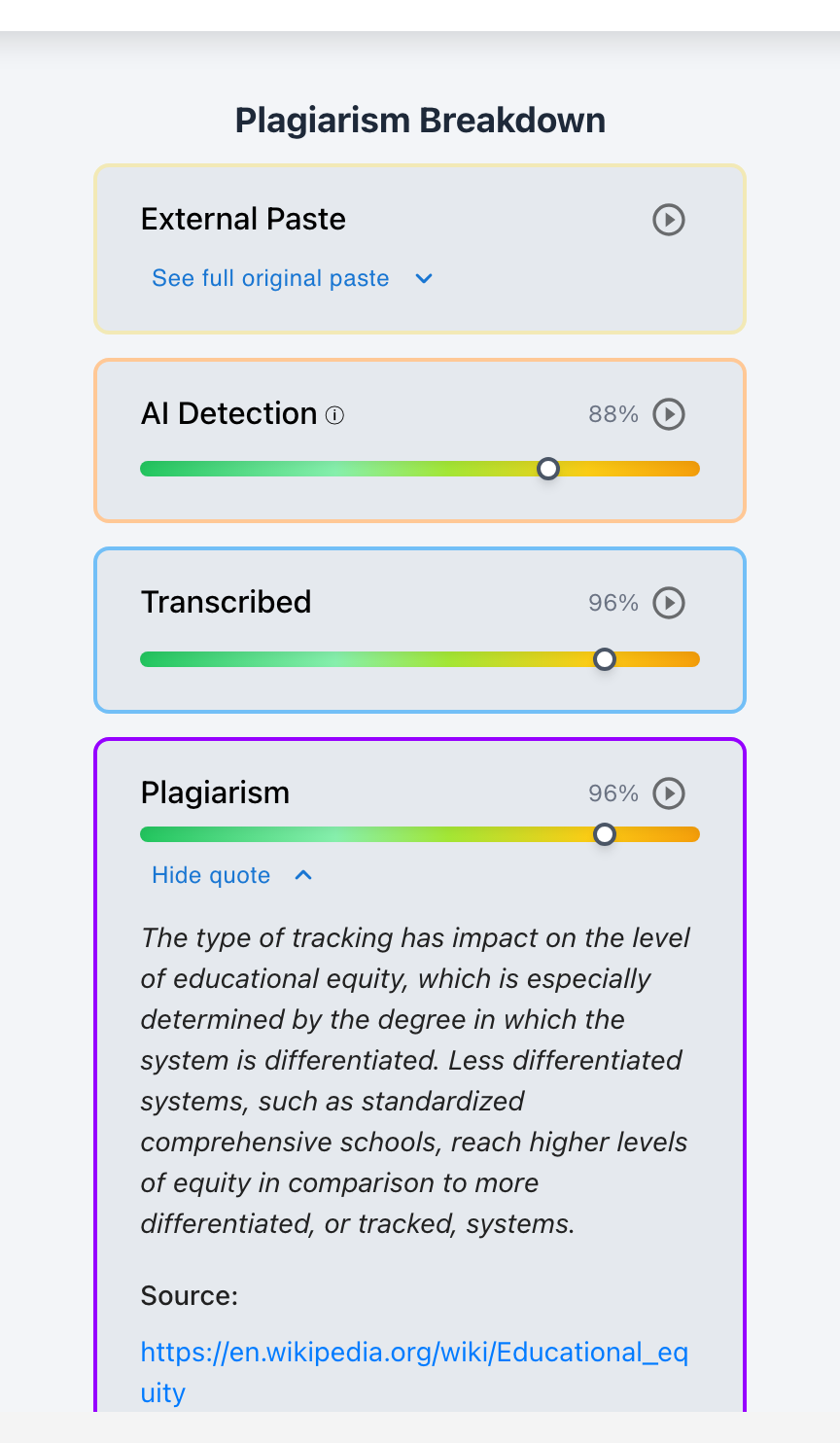
Checkmark Plagiarism stores the complete original pasted clipboard text, timestamped to the millisecond. Even if the student deletes, rephrases, or rearranges every single word over the next two hours, the instructor can click “Jump to Playback” and view the raw clipboard payload that initiated the paragraph.
2. Transcription Detection (Second-Screen / Phone Retyping)
When students attempt to bypass clipboard detection by placing an essay on their smartphone or a second monitor and manually typing it out, they produce a distinct biometric signature:
- Mechanical, Constant Keystroke Cadence: Typing at a flat, rhythmic velocity (e.g., 55 WPM without variation).
- Absence of Composing Pauses: Normal authentic writing involves recursive composing pauses where the writer stops for 5 to 45 seconds at clause boundaries to plan their next thought. Transcription writing exhibits zero planning pauses.
- Low Revision Entropy: The student types from beginning to end with virtually zero backspaces or structural reorganization. Checkmark’s telemetry engine flags this anomalous pattern as Potential Transcription.
6. Multi-Factor AI Detection & Teacher-in-the-Loop Rubric Autograding
Modern student writing frequently combines external source borrowing with generative AI assistance. Checkmark provides an integrated suite that bridges plagiarism detection, AI writing analysis, and formative grading.
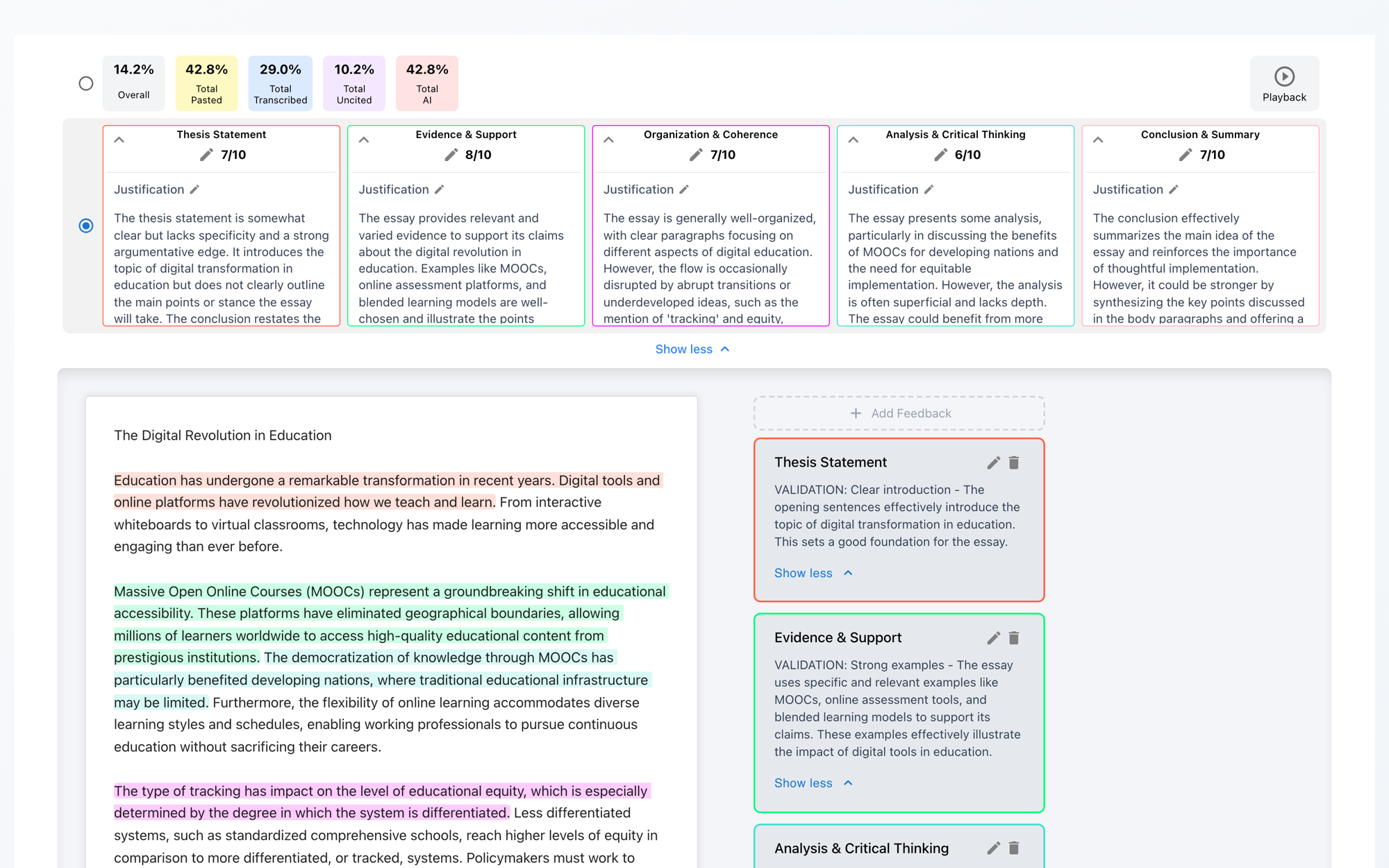
Calibrated confidence sliders underline specific paragraphs; measures perplexity and burstiness; includes <150 word guardrail (N/A) to prevent false positives.
Quote-anchored rubric justifications substantiate draft point recommendations; generates formative sentence-level revision prompts for patchwriting.
Educators maintain 100% final authority. Once approved, final rubric scores and narrative feedback sync to Canvas LMS SpeedGrader and Buzz LMS with 1 click.
7. Real-World Classroom Case Studies
To illustrate how this multi-dimensional evidentiary framework operates in real educational settings, examine three authentic classroom scenarios:
Furthermore, it is clear).8. The 4-Phase Restorative Citation Adjudication Protocol
To operationalize these forensic capabilities across classrooms, departments, and academic integrity committees, institutions should implement Checkmark’s 4-Phase Restorative Citation Adjudication Protocol.
A structured protocol separating mechanical citation coaching from disciplinary adjudication
Checkmark automatically classifies matches into 🟢, 🟡, 🔴, 🟣 badges. Automated screening separates cited formatting slips from uncited borrowing.
Instructor opens Two-Pane Synchronized Workbench. Reviews inline diffs (Verbatim vs Rogeted vs Spliced). Cross-references student bibliography with identified source URLs.
Teacher and student review Essay Playback™ timeline together. Non-accusatory inquiry: “Walk me through your drafting process here.” Review keystroke pauses, paste logs, and drafting struggle in real time.
Accidental Missing Quotes → 15-Minute Formatting Fix. Developmental Patchwriting → Reverse-Outlining Coaching. Intentional Mosaic Fraud → Academic Integrity Hearing with Defensible Proof.
Phase 3 Dialogue Scripts for Restorative Conferences
“I see you referenced Professor Smith here, and your draft shows you typed this from your notes. Did you intend for this to be an exact quote, or were you trying to summarize in your own words? Let’s look at quotation mechanics so you can format this correctly.”
“I noticed in Essay Playback that you spent 40 minutes working through this paragraph and looking up alternative words. You were working so hard on synonyms that you lost your own voice. Let’s practice explaining this concept out loud without looking at the source.”
“The playback shows seven large text blocks pasted into the document in under two minutes from these three external websites. Can you explain where these notes originated and why no citations were included?”
9. Comprehensive Diagnostic Decision Flowchart
For department chairs, writing program administrators, and honor council officers, this diagnostic flowchart establishes an objective standard for adjudicating similarity reports:
Step-by-step diagnostic pathway from similarity match to pedagogical action
Cited but Unquoted
• Action: Formative citation coaching & rapid resubmit
Quoted & Cited
• Action: Award full synthesis credit
Single source scaffold, high pauses, backspaces
• Action: Reverse-outlining & rewrite
3+ web pastes, rapid 6m dump, no pauses
• Action: Integrity conduct referral
10. Institutional Policy Templates for Syllabi and Handbooks
School districts and universities must modernize their academic integrity policies to clearly distinguish between formatting errors, developmental writing stages, and intentional academic dishonesty.
Ready-to-adopt policy language distinguishing developmental synthesis from academic dishonesty
“In this course, learning to write means learning to enter academic conversations. We recognize that engaging with complex scholarship is challenging, and our goal is to help you develop authentic synthesis and citation skills.
- Deceptive Plagiarism (submitting uncredited work, using essay mills, pasting unauthorized content, or concealing sources) is a serious integrity violation.
- Accidental Formatting Errors (omitting quotation marks around a cited source) and Developmental Patchwriting (over-relying on source sentence structures while learning to paraphrase) are treated as pedagogical milestones supported by citation coaching.
This course uses Checkmark Plagiarism to provide transparent, multi-dimensional writing feedback. Rather than relying on black-box similarity scores, Checkmark analyzes side-by-side source alignment, citation badges, and Essay Playback™ drafting history. If a citation issue is detected, we will review the playback telemetry together in a supportive conference to help you master source synthesis.”
11. Frequently Asked Questions (FAQs)
1. How does Checkmark detect missing quotation marks if a student uses an uncommon citation style?
Checkmark’s citation parsing engine is trained on all major international citation styles (APA 7th, MLA 9th, Chicago/Turabian 17th, Harvard, IEEE, and AMA), as well as narrative signal phrases (e.g., “According to Johnson (2022)...” or “As noted by the World Health Organization...”). If an author signal phrase or parenthetical marker appears within 30 words of an unquoted verbatim match, the system automatically assigns a 🟡 Cited but Unquoted (Amber Badge) and cross-checks the student’s bibliography.
2. Can Essay Playback™ distinguish between speech-to-text dictation and copied AI text?
Yes. Speech-to-text dictation generates continuous, natural-language sentence streams characterized by rapid word bursts followed by periodic conversational pauses, phonetic transcription corrections, and punctuation insertions. In contrast, pasted AI text appears as a single instantaneous clipboard dump (0 ms elapsed time for hundreds of words). Furthermore, Checkmark’s external paste buffer captures the raw clipboard contents immediately upon injection.
3. How does Checkmark protect student privacy under FERPA and COPPA?
Checkmark Plagiarism operates under a strict Zero Data Retention for AI Training architecture. Student submissions are encrypted in transit and at rest using enterprise-grade AES-256 encryption. Student essays are never used to train public or commercial large language models (LLMs). When cross-referencing peer matches across schools or districts (🟣 Peer Cohort Match), Checkmark displays text alignment without ever disclosing student names, student IDs, or institutional affiliations.
4. What happens if a student claims they wrote their essay in another program and pasted it in?
If a student drafts their essay in an external tool (such as an offline desktop editor) and pastes the full text into the LMS, Essay Playback™ will flag a single bulk paste event. Checkmark provides clear workflows for this scenario: instructors can request the student upload the original .docx file or Google Doc version history. Checkmark’s multi-platform integrations can parse native Google Docs revision history and Microsoft Word track changes to verify the external composing timeline.
5. Why does Checkmark display N/A for AI detection on short text under 150 words?
Statistical AI writing detection requires sufficient linguistic sample sizes to measure perplexity and burstiness accurately. Analyzing text samples below 150 words produces unacceptably high false-positive rates because short answers naturally exhibit low syntactic variance. Rather than presenting misleading probability percentages, Checkmark enforces an honest <150 Word Guardrail (N/A) to protect students from unwarranted accusations.
6. Can students bypass Essay Playback™ by manually retyping text from a phone or second screen?
No. Manual transcription produces a distinct, unnatural keystroke signature: a flat, mechanical typing velocity with virtually zero recursive composing pauses, no structural outlining transitions, and an abnormally low backspace count. Checkmark’s telemetry engine compares the student’s typing dynamics against natural cognitive composing models and alerts the instructor to Potential Manual Transcription.
7. How does Checkmark integrate with Canvas LMS and Buzz LMS gradebooks?
Checkmark features seamless LTI 1.3 enterprise integrations with Canvas LMS, Buzz LMS, Google Classroom, and Moodle. When an instructor completes a rubric evaluation on Checkmark’s platform, the autograded rubric scores, quote-anchored justifications, and formative feedback comments sync directly back to Canvas SpeedGrader or the Buzz gradebook with a single click, eliminating duplicate grading and manual data entry.
12. Conclusion: Moving from Punitive Policing to Restorative Growth
The traditional paradigm of academic integrity—relying on blunt, single-percentage similarity scores that treat novice learning struggles identically to intentional fraud—has failed students and educators alike. It creates an adversarial classroom climate, triggers unwarranted disciplinary tribunals, and fails to teach students how to synthesize scholarly research.
By implementing Checkmark Plagiarism’s multi-dimensional evidentiary suite:
- Side-by-Side Synchronized Source Verification provides transparent, line-by-line textual proof with live links and inline diffs.
- Four Discrete Citation Badges (🟢, 🟡, 🔴, 🟣) automatically triage compliant citations, formatting slips, developmental patchwriting, and cohort sharing.
- Patent-Pending Essay Playback™ reconstructs the complete temporal drafting session, preserving original paste buffers and capturing keystroke dynamics.
- Teacher-in-the-Loop Rubric Autograding converts integrity analysis into formative, quote-anchored revision prompts synchronized with LMS gradebooks.
When educators possess objective, multi-factor evidence, they no longer have to guess about student intent. They can protect innocent students, address developmental synthesis hurdles with empathy, and uphold institutional standards with total confidence.
Stop Guessing, Start Trusting
Equip your faculty and academic integrity officers with transparent, multi-dimensional receipts that nurture authentic, confident student writers.