
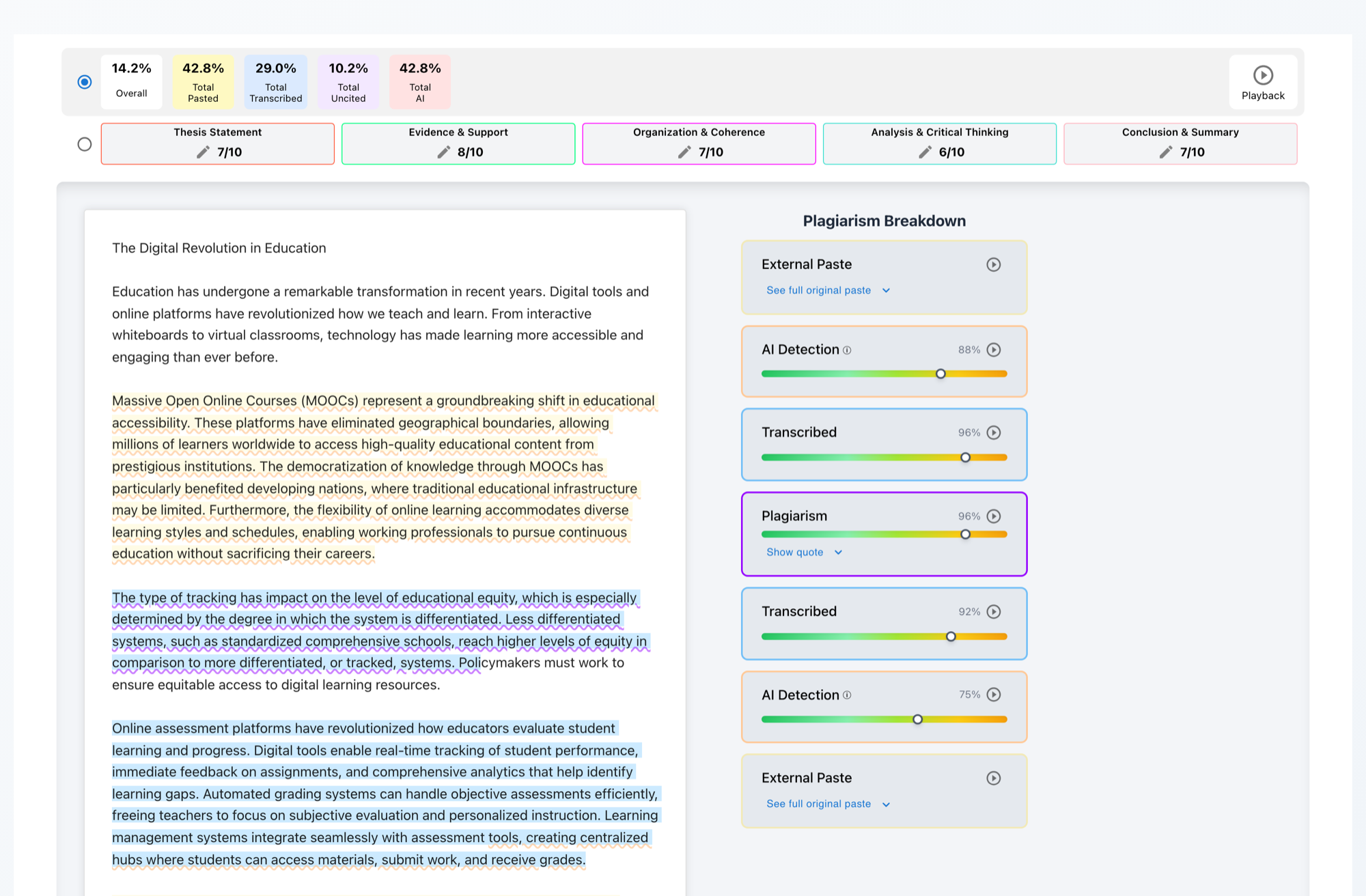
For more than two decades, educational institutions have relied on single, one-dimensional aggregate scores—such as a blunt “38% Similarity” or “85% AI”—to evaluate the authenticity of student writing. These reductive metrics create catastrophic pedagogical blind spots: they treat a missing set of quotation marks, an unformatted bibliography, disciplinary terminology, and developmental patchwriting identically to intentional cut-and-paste fraud and outsourced contract cheating. Checkmark Plagiarism resolves this crisis through a Multidimensional Integrity Report Architecture. By unifying passage-level AI detection with calibrated confidence sliders, side-by-side plagiarism source verification with verbatim quote alignment, patent-pending Essay Playback™ keystroke dynamics, and quote-anchored rubric autograding, Checkmark provides educators with transparent, defensible “receipts.” This multidimensional approach enables teachers, department chairs, and academic integrity boards to protect honest students, coach emerging writers through citation mechanics, and accurately identify deliberate deception without relying on punitive black-box scores.
Checkmark Plagiarism provides the pedagogical and technical foundation for modern writing assessment, unifying side-by-side source verification with patent-pending Essay Playback™, passage-level AI writing detection, quote-anchored rubric autograding, and direct LTI 1.3 integrations for Canvas LMS and Agilix Buzz LMS.
1. The Breakdown of One-Dimensional Scores: Why Single Percentages Poison Pedagogy
In secondary English classrooms, AP Capstone seminars, and university writing programs, the submission of a major research paper is too often followed by a destructive ritual: the panic of the aggregate score.
- Stares at an ominous red badge in Canvas LMS
- Faces 140 essays to grade over the weekend
- Spends 45 minutes manually hunting down false matches
- Lacks granular drafting timeline or keystroke context
- Forced into an adversarial “police” role
- Receives an automated zero notification & disciplinary threat
- “I cited every single book in my Works Cited—why am I a cheater?”
- Suffers acute anxiety; academic trust permanently shatters
- Driven toward synonym spinners & cloaking tools out of fear
When an automated plagiarism checker flags a student’s essay with a 41% Similarity Index, or an AI detector returns an 82% AI Probability, what does that number actually prove?
Mathematically, a traditional similarity score is merely a crude ratio of overlapping character n-grams relative to total document length:
This simple formula collapses fundamentally different textual and pedagogical realities into one undifferentiated integer:
- Properly attributed block quotations from historical documents, case law, or literary texts.
- Standardized assignment headers and prompts (e.g., “AP European History Document-Based Question 2: The Industrial Revolution”).
- Established disciplinary collocations (e.g., “statistically significant difference at the p < 0.05 level” or “mitochondria generate adenosine triphosphate through oxidative phosphorylation”).
- Institutional bibliography and Works Cited entries formatted according to APA, MLA, or Chicago standards.
- Clerical citation formatting mistakes (e.g., providing an author attribution and parenthetical page number but inadvertently omitting quotation marks around a 12-word clause).
- Developmental patchwriting by English Language Learners (ELL) or novice researchers struggling to summarize complex scholarship.
- Wholesale academic dishonesty (e.g., pasting stolen paragraphs from commercial blogs, purchasing essays, or utilizing generative AI models).
The Human Toll of Single-Score Thresholds
To manage overwhelming grading queues, many school districts and university departments instituted administrative policies mandating disciplinary review for any submission exceeding a fixed percentage threshold (such as 20% Similarity or 30% AI).
These arbitrary cutoff policies trigger severe institutional failures:
Punishing Diligent Researchers
A high-achieving student who analyzes three constitutional amendments and incorporates five extensive legal citations will naturally trigger a 35% to 45% similarity score.
Overlooking Sophisticated Fraud
A student who copies an entire essay, passes it through a commercial paraphrasing tool (e.g., QuillBot), or instructs ChatGPT to insert typos returns an aggregate similarity score of 4% and an AI score of 12%.
Systemic Harms of Percentage-Only Enforcement
- • Disproportionate Harm to Vulnerable Populations: Empirical linguistic studies demonstrate that non-native English speakers and neurodivergent students rely more heavily on formulaic syntactic frames and standardized transitional phrases. One-dimensional AI detectors flag ESL/ELL writing at rates up to 60% higher than native writing due to lower vocabulary burstiness and predictable grammatical structures.
- • Educator Cognitive Overload & Cynicism: Teachers are forced into the role of forensic detectives, spending dozens of unpaid hours cross-referencing broken search links and defending grading decisions against angry parents and administrators.
To restore pedagogical sanity and ethical fairness to writing assessment, academic institutions must transition from one-dimensional aggregate scores to Multidimensional Integrity Reports.
2. The Taxonomy of Textual Overlap: Distinguishing Mechanics from Malice
When an educator notices overlapping text between a student’s submission and an existing source, that overlap represents one of four distinct categories. Treating all four identically destroys the learning process.
Mapping student intent against mechanical writing competence to guide ethical evaluation
Paraphrased & Cloaked Fraud
- Synonym-spun articles & translated foreign text
- Commercial paraphrasing tool exports (QuillBot)
- Intentional citation masking & character cloaking
Wholesale Plagiarism & AI Generation
- Direct verbatim cut-and-paste without credit
- Second-screen manual transcription of AI answers
- Unacknowledged LLM generation & contract cheating
Developmental Patchwriting
- Vocabulary scaffolding & novice source synthesis
- ELL / ESL syntax mimicry with thesaurus pauses
- Cognitive struggle with dense disciplinary concepts
Legitimate Academic Overlap & Quotes
- Fully cited primary block quotes & footnotes
- Disciplinary collocations & scientific formulas
- Accurate Works Cited entries & minor punctuation lapses
Understanding this taxonomy allows educators to apply targeted pedagogical coaching rather than inappropriate disciplinary penalties:
Quadrant 1: Wholesale Plagiarism & AI Generation (Intentional Deception + High Competence)
- Characteristics: Direct cut-and-paste of full paragraphs from websites, journals, or peer papers without attribution; submitting text generated entirely by large language models (LLMs) while claiming personal authorship.
- Student Intent: High. The objective is to circumvent the cognitive effort of writing and research to obtain unearned credit.
- Appropriate Action: Formal academic integrity review, zero grade on the assignment, mandatory revision with reflective writing, or disciplinary referral per institutional policy.
Quadrant 2: Legitimate Academic Overlap (Zero Deception + High Competence)
- Characteristics: Properly formatted and cited direct quotations, common disciplinary phraseology, standardized methodology descriptions, and bibliographic entries.
- Student Intent: None. The student adheres to scholarly conventions.
- Appropriate Action: None. Software should automatically isolate and visually verify these elements without inflating suspicion metrics.
Quadrant 3: Developmental Patchwriting (Zero Deception + Low Competence)
- Characteristics: Coined by composition scholar Rebecca Howard, patchwriting occurs when a student copies from a source text, deletes a few words, changes grammatical tense, or swaps minor synonyms while retaining the original syntax and rhythm.
- Student Intent: None to low. Extensive research confirms patchwriting is a natural developmental stage for novice researchers and ELL students engaging with difficult, unfamiliar disciplinary material. The student understands the overarching concept but lacks the specialized academic vocabulary to restate it independently.
- Appropriate Action: Instructional intervention. The student does not belong in front of an honor board; they need targeted instruction in summarizing, analyzing, and synthesizing academic evidence.
Quadrant 4: Mechanical Citation & Formatting Lapses (Zero Deception + Moderate Competence)
- Characteristics: The student provides parenthetical citations
(Morrison, 1987, p. 114)and includes the source in the bibliography, but omits quotation marks around verbatim clauses, transposes author names, or misplaces page references. - Student Intent: None. The student transparently signaled the intellectual origin of the ideas but committed clerical errors in execution.
- Appropriate Action: Targeted formative feedback on MLA/APA punctuation rules and minor rubric deductions under “Writing Conventions,” never an accusation of academic fraud.
3. Checkmark Plagiarism’s Multidimensional Integrity Report Architecture
Checkmark Plagiarism (checkmarkplagiarism.com) replaces the flawed single-score paradigm with a unified, four-pillar evidence architecture. Instead of asking teachers to guess what an ambiguous percentage means, Checkmark delivers a multidimensional dossier of transparent, verifiable “receipts.”
Passage-Level AI
- Sentence-by-sentence highlights
- Calibrated confidence scale
- Perplexity & burstiness metrics
- Strict <150w N/A guardrail
Side-by-Side Sources
- Billions of live web pages
- Verbatim matching highlights
- Intra-school peer repository
- Two-way linked evidence cards
Essay Playback™
- Keystroke-by-keystroke time
- 1x to 8x scrubbable video
- External paste buffer cache
- Typing latency & bursts
Rubric Autograder
- Criterion-level point scoring
- Quote-anchored justifications
- Teacher final edit authority
- LMS gradebook passback
Pillar 1: Passage-Level AI Detection with Calibrated Confidence Sliders
Generic AI detectors assign a single, sweeping probability score (e.g., “78% AI”) to an entire document, providing zero insight into which specific sentences were generated by machine and which were authored by the student.
Checkmark’s AI detection engine operates with surgical granularity:
- Passage-Level Highlighting: Underlines individual sentences and paragraphs directly within the submission text, color-coded by linguistic predictability.
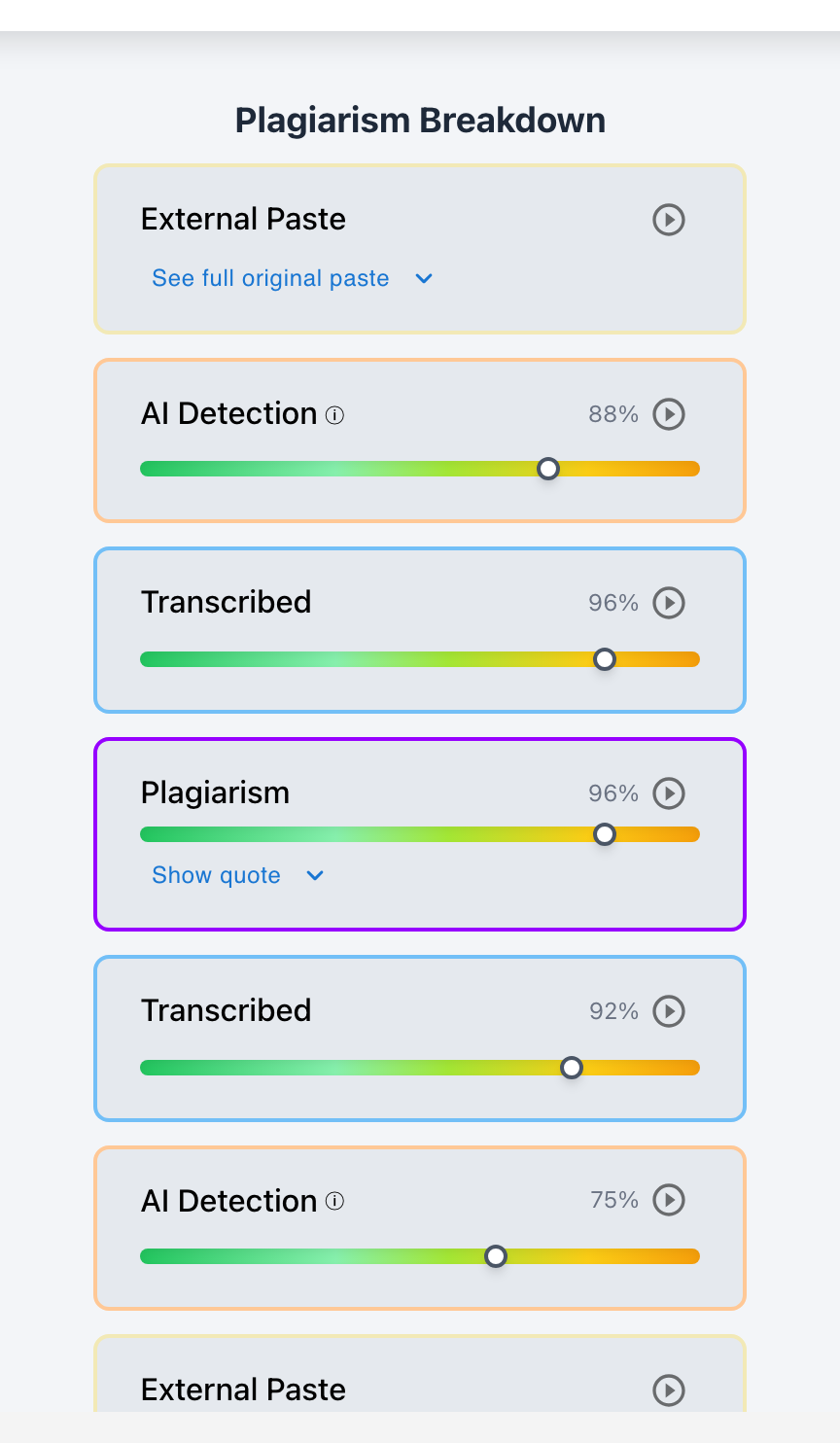
- Calibrated Confidence Sliders: Rather than a binary “AI vs. Human” verdict, each flagged passage features an evidence card displaying a calibrated continuum between typical human writing style and typical AI patterns.
- Linguistic Architecture Analysis: Measures sentence burstiness (variation in sentence length and rhythm), perplexity (statistical unexpectedness of word sequences), and transition predictability.
- Strict Short-Text Guardrails: For passages or submissions below ~150 words, Checkmark displays
N/Arather than generating unreliable guesses on statistically insufficient sample sizes. - Educator-Only Flag Privacy: Flag statuses (
Flagged,Resolved,Not Flagged) are strictly confidential to teachers, preventing unverified automated flags from appearing on student portals. - Paraphraser & Humanizer Resistance: While tools like QuillBot or Undetectable AI manipulate surface vocabulary to bypass legacy scanners, they cannot alter underlying structural cadence or replicate authentic keystroke patterns.
Pillar 2: Side-by-Side Plagiarism Source Verification & Peer Matching
A similarity score without source context is useless. Checkmark provides an intuitive, split-screen verification interface:
The rapid proliferation of generative AI tools in secondary classrooms has triggered significant pedagogical debates surrounding authentic student authorship and evaluation.
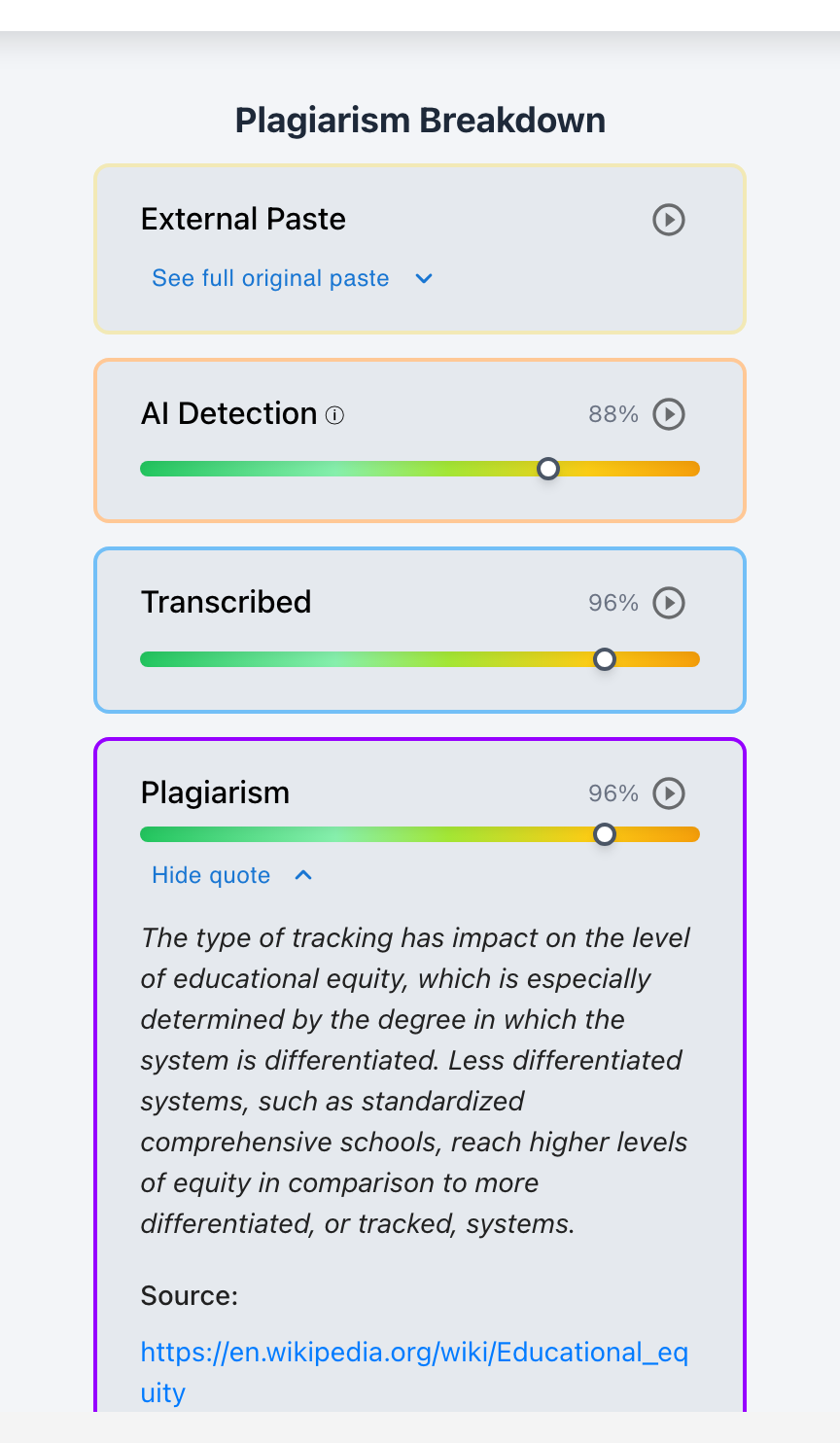
- Comprehensive Live Web & Academic Indexing: Scans billions of indexed web pages, open-access scholarly journals, digital repositories, and public archives.
- Live Clickable URLs: Every identified match includes a direct, active hyperlink to the original source, allowing teachers to verify context in one click.
- Uncited Source Differentiation: Matches lacking proper citation formatting receive distinct visual indicators, separating simple citation omissions from intentional text theft.
- Intra-School Peer Matching: Detects verbatim copying across class sections, student cohorts, and historical term repositories within the school or district without exposing student data externally.
- Two-Way Linked Evidence Cards: Clicking any highlighted sentence in the essay automatically scrolls the right sidebar to its matched source card, and clicking a source card highlights the corresponding prose in the document.
Pillar 3: Patent-Pending Essay Playback™ & Keystroke Dynamics
Textual analysis alone cannot reveal how an essay was produced. Checkmark’s flagship technology, Essay Playback™, captures the complete temporal drafting journey.
- 00:14:22 4-minute composing pause (Brainstorming thesis statement)
- 00:48:10 Paragraph 2 drafted; 14 backspaces; 3 sentence restructurings
- 01:12:05 External Paste Event: 38 words from clipboard (Preserved in Paste Buffer)
- 02:04:19 Extensive vocabulary revisions and transition refinement in conclusion
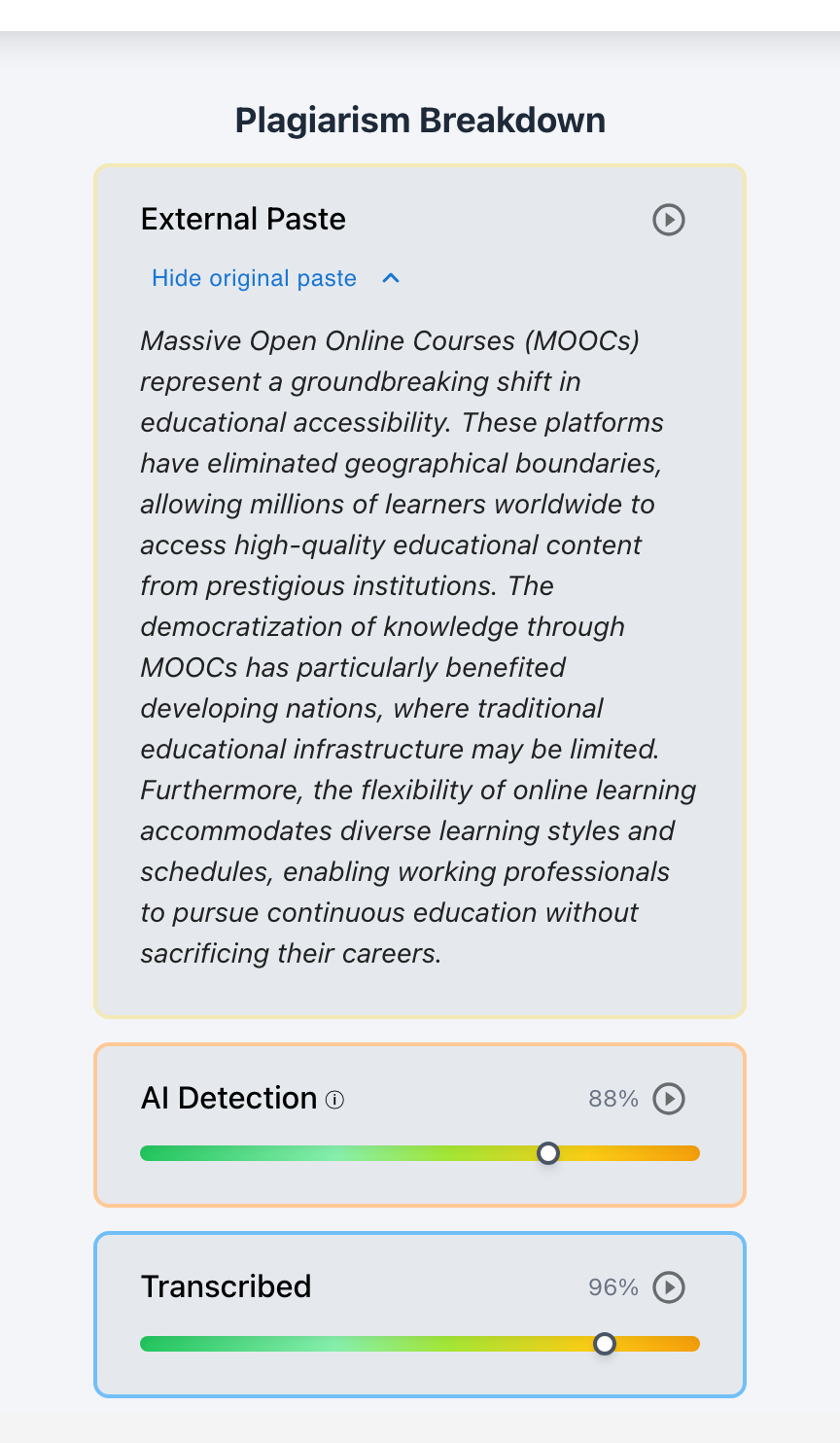
- Keystroke-by-Keystroke Reconstruction: Records every character insertion, deletion, backspace, cursor movement, and pause, allowing educators to watch the paper come together like a video at 1x to 8x speed.
- External Paste Buffer with Permanent Text Preservation: When a student pastes text from an external application, Checkmark logs the exact timestamp and preserves the full pasted content in an isolated buffer—even if the student subsequently rewrites or edits every single word. A single click jumps directly to that moment in the timeline.
- Typing Latency & Burst Analysis: Identifies authentic human writing rhythms (bursts of 5–15 words followed by 3–8 second reflection pauses) versus artificial generation.
- Transcription Detection: Flags steady, mechanical typing at high speeds (e.g., 85+ WPM with zero composing pauses, zero backspaces, and zero outline restructuring), exposing instances where a student manually retypes text from a second monitor, smartphone, or dictation feed.
- Native LMS & Office Ecosystem Capture: Seamlessly integrates with Google Docs, Microsoft Word/OneDrive, Canvas LMS SpeedGrader, and Buzz LMS embedded editors.
- The Ultimate Shield for Honest Students: When an external detector generates a false positive AI flag, Essay Playback provides incontrovertible proof of authentic human authorship, exonerating the student immediately.
Pillar 4: AI Autograder & Quote-Anchored Rubric Feedback
Integrity analysis must connect directly to assessment. Checkmark’s AI Autograder pairs integrity data with rubric scoring:
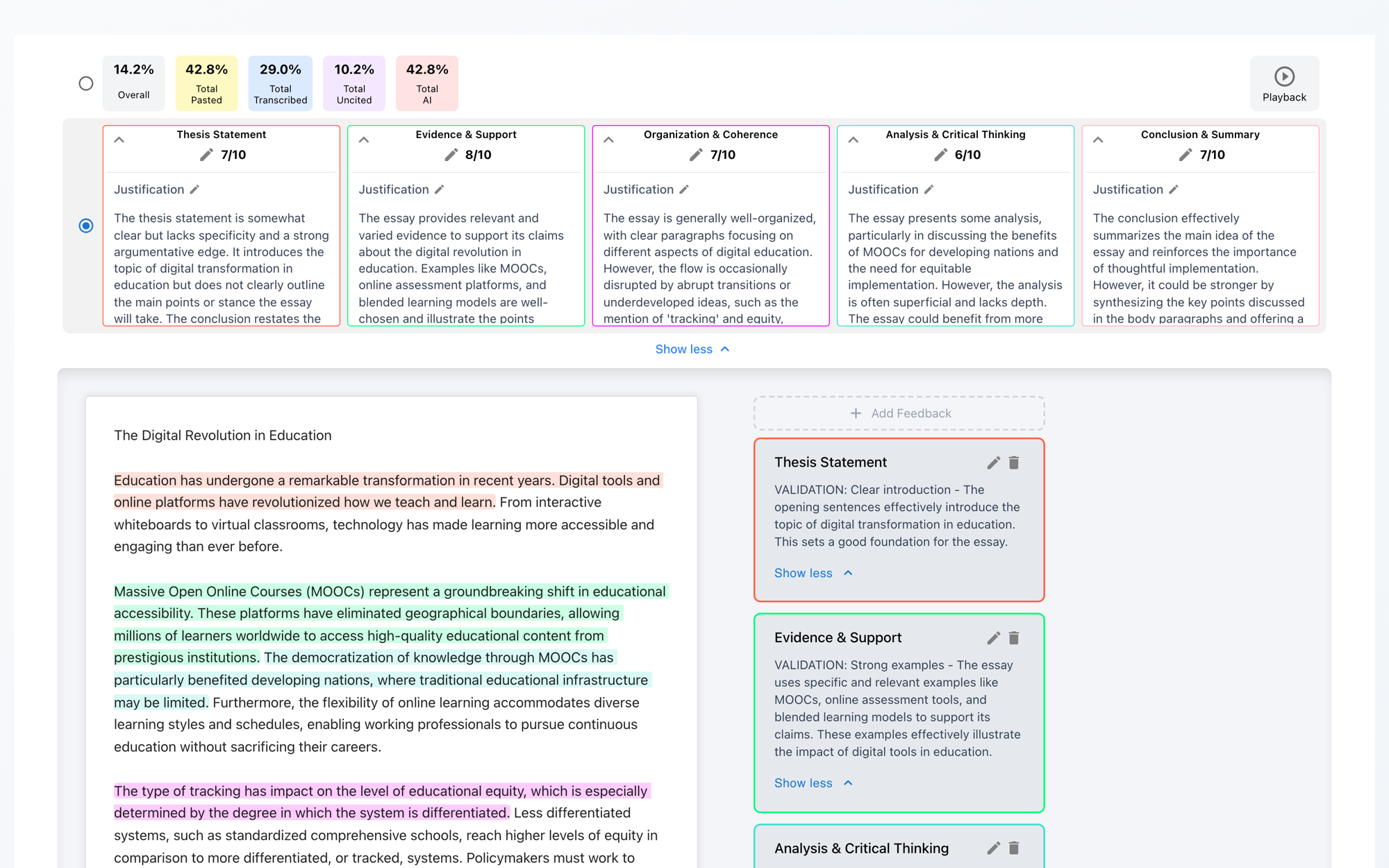
- Teacher-in-the-Loop Architecture: Autograded assessments remain private drafts until the educator reviews, edits, and approves them. The teacher maintains final grading authority.
- Quote-Anchored Justifications: Every criterion score (e.g., Thesis Development: 4/5) includes specific, quote-anchored citations from the student’s text justifying the rating.
- Flexible Rubric Ingestion: Create rubrics within the platform, upload PDF/image rubrics, or import existing rubrics directly from Canvas LMS, Buzz LMS, or Google Classroom.
- Bi-Directional Gradebook Passback: With one click, finalized rubric scores, criterion breakdowns, and written comments push directly into the LMS gradebook.
4. Master Diagnostic Matrix: Citation Mechanics vs. Intentional Fraud
To assist teachers and honor committees in evaluating submissions systematically, this master diagnostic matrix maps textual symptoms to behavioral evidence, linguistic patterns, and appropriate pedagogical responses.
| Textual Characteristic | Legacy 1D Scanner Output | Essay Playback™ Dynamics | Passage AI & Source Analysis | Diagnostic Classification | Pedagogical / Disciplinary Action |
|---|---|---|---|---|---|
| Missing Quotation Marks on Cited Sentence | 35% Similarity (Flagged as Plagiarism) | Student typed sentence slowly (24 WPM), made 4 backspace revisions, added parenthetical citation (Smith, 2023). |
Matches source verbatim for 18 words; source listed in Works Cited; 0% AI pattern. | Mechanical Citation Error (Quadrant 4) | No disciplinary action. Deduct minor formatting points under Conventions rubric; assign citation punctuation exercise. |
| Developmental Patchwriting (Novice Synthesis) | 42% Similarity (Flagged as High Risk) | Active drafting over 2.5 hours; frequent pauses; student repeatedly edited synonyms while looking at reference notes. | Syntax matches scholarly article; 40% synonym substitution; 0% AI pattern; source present in bibliography. | Developmental Patchwriting (Quadrant 3) | No disciplinary action. Conduct one-on-one writing conference on evidence synthesis, paraphrasing rules, and independent argumentation. |
| Standard Disciplinary Phraseology | 28% Similarity (Flagged as Moderate Risk) | Fluent, rhythmic typing (45 WPM) with natural sentence transitions; no external paste events. | Overlaps with multiple medical/scientific journals on standard protocol phrases (e.g., PCR amplification parameters). | Legitimate Disciplinary Collocation (Quadrant 2) | No disciplinary action. Verify scientific accuracy; ignore standard disciplinary phrasing. |
| Direct Wholesale Copy-Paste | 55% Similarity (Flagged as High Risk) | Instantaneous insertion of 450 words at 00:12:04; 0 backspaces; no prior outline drafting. | Exact 100% verbatim match to commercial essay site; unlisted in bibliography; 0% AI pattern. | Intentional Plagiarism (Quadrant 1) | Disciplinary referral. Zero grade on assignment; formal academic integrity conference; required revision under supervision. |
| Second-Screen Manual Transcription of LLM Text | 6% Similarity, 18% AI (Passed as “Original”) | Flat, unvarying typing speed (92 WPM) for 40 minutes straight; 0 composing pauses; 0 backspaces; 0 structural rewrites. | 0% web plagiarism match; elevated perplexity uniformity across full document. | Intentional Transcription Fraud (Quadrant 1) | Academic review. Present Essay Playback timeline in supportive conference; assign in-class oral defense or supervised rewrite. |
| Synonym Spinner / Paraphraser Cloaking | 12% Similarity, 22% AI (Passed as “Original”) | Large external paste event followed by erratic word-by-word substitution pattern matching automated tool exports. | Syntax mirrors Wikipedia article exactly; vocabulary features unnatural synonym anomalies (“infinitesimal” for “small”). | Masked Academic Fraud (Quadrant 4 / 1) | Academic review. Examine preserved External Paste Buffer to reveal original source text before spinning; require authentic revision. |
5. Classroom Case Studies: Multidimensional Diagnostics in Practice
The following realistic classroom case studies illustrate how Checkmark’s multidimensional reporting resolves complex integrity dilemmas across different academic disciplines.
The Missing Quotation Marks in AP Literature
Legacy Checker Output: 44% Similarity Index (Automatic red flag in Canvas SpeedGrader)
Initial Teacher Reaction: Feared Maya had copied extensive literary criticism from an online scholarly journal.
Maya’s Essay Playback™ Telemetry:
• Total Drafting Time: 4 hrs 12 mins | Backspaces: 342 | Pastes: 0
• Organic thesis development (45m) with natural typing pauses
Multidimensional Investigation
- Side-by-Side Source Alignment: Checkmark revealed 36% of overlap stemmed from properly cited primary block quotes from Toni Morrison’s Beloved and William Faulkner’s As I Lay Dying. Another 8% matched an article by Dr. Valerie Smith. Maya wrote: “Sethe’s maternal instinct functions as both an act of ultimate resistance and a devastating psychological trauma (Smith 48).”
- Citation Diagnostics: Maya accurately credited Dr. Smith in her parenthetical citation and Works Cited page, but omitted quotation marks around the nine-word phrase “act of ultimate resistance and a devastating psychological trauma.”
- Essay Playback™ Verification: Scrubbing through the 4-hour timeline revealed that Maya spent 45 minutes constructing her thesis, made 68 backspace revisions across three paragraphs, and manually typed the cited sentence while referencing printed notes.
Developmental Patchwriting in AP Biology
Legacy Checker Output: 39% Similarity Index (Flagged for plagiarism)
Initial Teacher Reaction: Suspected Jin-Woo copied descriptions directly from Nature Biotechnology without understanding the science.
Jin-Woo’s Essay Playback™ Telemetry:
• Total Drafting Time: 5 hrs 08 mins | Average Speed: 14 WPM
• 84 composing pauses (>15s) & 26 bilingual dictionary lookups
Multidimensional Investigation
- Passage-Level AI & Plagiarism Scan: Checkmark flagged three paragraphs describing the guide RNA cleavage mechanism. The text closely tracked the sentence structure of a 2022 Nature review, with Jin-Woo substituting synonyms (e.g., changing “cleaves the target DNA sequence” to “cuts the specific DNA strand”).
- Side-by-Side Source View: The source was cited in Jin-Woo’s bibliography, confirming zero intent to conceal the origin of the concepts.
- Essay Playback™ Dynamics: Playback showed authentic cognitive effort by an ELL student scaffolding complex biochemical vocabulary through developmental patchwriting.
Second-Screen Transcription in AP European History
Legacy Checker Output: 8% Similarity, 14% AI Score (Clean bill of health on legacy tools)
Initial Teacher Reaction: Noted sophisticated historical vocabulary that did not match Brandon’s previous in-class writing performance.
Brandon’s Essay Playback™ Telemetry:
• 2,100 words typed in 24m 18s at steady 88 WPM flat velocity
• 0 backspaces, 0 structural rewrites, 0 pauses > 5s
6. Step-by-Step Diagnostic Workflow for Educators
To eliminate guesswork and ensure fair, standardized evaluation, educators should adopt this four-phase investigative protocol when reviewing writing submissions:
- Open Checkmark report in Canvas/Buzz
- Review Passage AI breakdown
- Inspect Source Match overview
- Check automated process alerts
- Click flagged passages for cards
- Verify Works Cited & in-text cites
- Separate quotes from uncredited text
- Identify patchwriting vs. fraud
- Scrub Playback at 2x/4x speed
- Inspect External Paste Buffer
- Analyze typing burstiness & pauses
- Detect manual transcription signs
- Mechanics → Citation coaching
- Patchwriting → Revision conference
- Intentional Fraud → Restorative review
- Update Checkmark flag to Resolved
7. Departmental Policy Blueprint: Modernizing Integrity Guidelines
Department chairs, curriculum directors, and school district administrators must modernize institutional honor codes to reflect the realities of AI writing assistants and process-based integrity reports.
1. Ban Arbitrary Percentage Thresholds
Explicitly prohibit automated grade deductions based solely on similarity or AI probability numbers. Mandate that all integrity inquiries reference multidimensional evidence.
2. Establish the “Presumption of Authentic Effort”
Treat writing as an iterative learning process. Classify developmental patchwriting and citation formatting errors as instructional opportunities under “Writing Conventions” rather than disciplinary offenses.
3. Require Process-Level Evidence for Formal Proceedings
Disciplinary referrals must include verifiable process receipts: Essay Playback™ timelines, external paste logs, or side-by-side source comparisons. Protect students against unverified black-box detector accusations.
4. Standardize Restorative Integrity Conferences
Provide teachers with structured conference protocols focused on dialogue, evidence review, and skill remediation.
5. Mandate Zero Model Training Data Privacy Standards
Require all educational technology vendors to comply with FERPA and COPPA. Prohibit vendors from training commercial AI models on student submissions.
Key Policy Clauses for Student Handbooks & Course Syllabi
Clause A: Definition of Authentic Authorship:
“Academic writing requires that all submitted prose represents the student’s original intellectual synthesis and drafting effort. While authorized digital tools (such as spelling checkers, digital library catalogs, and approved brainstorming assistants) may support research, the final prose must be authored directly by the student. All external ideas, quotations, and paraphrases must be credited in accordance with disciplinary citation standards.”
Clause B: Distinction Between Formatting Lapses and Academic Fraud:
“Our department distinguishes between mechanical citation errors (e.g., misplaced quotation marks, imperfect bibliographic formatting, or developmental patchwriting) and deliberate academic dishonesty (e.g., submitting uncredited external text, using unauthorized AI generation, or purchasing work). Mechanical citation errors will be addressed through formative instruction and standard rubric scoring. Academic fraud will be subject to formal departmental review.”
Clause C: Evidentiary Standards for Integrity Inquiries:
“No student will be accused of academic dishonesty based on an aggregate similarity percentage or automated AI probability score alone. All academic integrity inquiries must be grounded in multi-factor evidence, including side-by-side source comparisons and verified writing process history.”
8. Frequently Asked Questions (FAQ)
How does a multidimensional integrity report differ from a traditional similarity score?
A traditional similarity score produces a single aggregate percentage representing the proportion of matching characters in a paper, without explaining context, intent, or drafting history. A multidimensional integrity report combines four distinct evidentiary layers: passage-level AI detection, side-by-side source alignment with live web links, patent-pending keystroke drafting playback (Essay Playback™), and quote-anchored rubric autograding. This enables educators to evaluate student writing with complete context.
What is developmental patchwriting, and why should it not be punished as plagiarism?
Developmental patchwriting is a well-documented stage in writing acquisition where students copy source material while altering a few words, tenses, or synonyms because they are still developing the specialized vocabulary needed to articulate complex concepts independently. Research in composition studies shows patchwriting stems from cognitive overload rather than an intent to deceive. It requires formative instruction in summarizing and synthesis, not punitive disciplinary action.
Can Essay Playback™ prove a student is innocent if an external AI detector flags their essay?
Yes. Essay Playback™ serves as the ultimate protective shield for honest students. If a generic AI detector generates a false positive flag, the student’s Essay Playback report provides an immutable, keystroke-by-keystroke video timeline showing authentic human drafting, composing pauses, backspace revisions, and structural rewrites, definitively disproving the automated false accusation.
How does Checkmark detect when a student retypes an AI-generated essay from a phone or second screen?
Checkmark analyzes keystroke dynamics, typing latency, and velocity curves. Authentic human drafting exhibits high burstiness: writers type short phrases, pause for several seconds to reflect, make frequent backspace corrections, and reorganize sentences. Second-screen manual transcription exhibits an unnatural, flat typing velocity (e.g., a steady 85+ WPM without composing pauses, zero backspaces, and zero structural revisions).
What happens to text pasted from external sources in Checkmark?
When text is pasted into the editor, Checkmark immediately timestamps the event and saves the complete pasted content in an isolated External Paste Buffer. Even if the student subsequently edits or re-types every single word in that paragraph, the teacher can view the original pasted text with a single click and jump directly to that moment in the playback timeline.
How does Checkmark protect student data privacy and comply with FERPA/COPPA?
Checkmark adheres to strict enterprise privacy standards: student submissions are never used to train commercial AI models. All data is encrypted in transit and at rest, and the platform complies fully with FERPA, COPPA, and state student privacy regulations.
Does the AI Autograder replace teacher grading?
No. Checkmark operates on a strict Teacher-in-the-Loop model. The AI Autograder generates draft rubric scores, criterion-level point breakdowns, and quote-anchored justifications tied directly to the student’s text. All grades remain private drafts until the educator reviews, edits, and approves them before syncing back to the LMS gradebook.
9. Conclusion: Moving From Suspicion to Trust in Writing Assessment
The future of academic integrity cannot be built on opaque percentages, adversarial accusations, or arbitrary threshold policies. When educators rely on one-dimensional metrics, honest students are falsely accused, emerging writers are penalized for normal learning curves, and sophisticated academic fraud slips through unnoticed.
By adopting Multidimensional Integrity Reports, educational institutions can finally fulfill the promise of modern writing pedagogy: “Stop guessing, start trusting.”
With transparent side-by-side source verification, passage-level AI analysis, patent-pending keystroke playback, and quote-anchored rubric feedback, educators gain the defensible receipts needed to hold fair, restorative conversations, uphold uncompromising academic standards, and celebrate authentic student growth.
Transform Writing Integrity in Your School or District
Discover how Checkmark Plagiarism unifies side-by-side source alignment, Essay Playback™ keystroke dynamics, and passage-level AI detection directly inside Canvas LMS, Buzz LMS, and Google Classroom.