
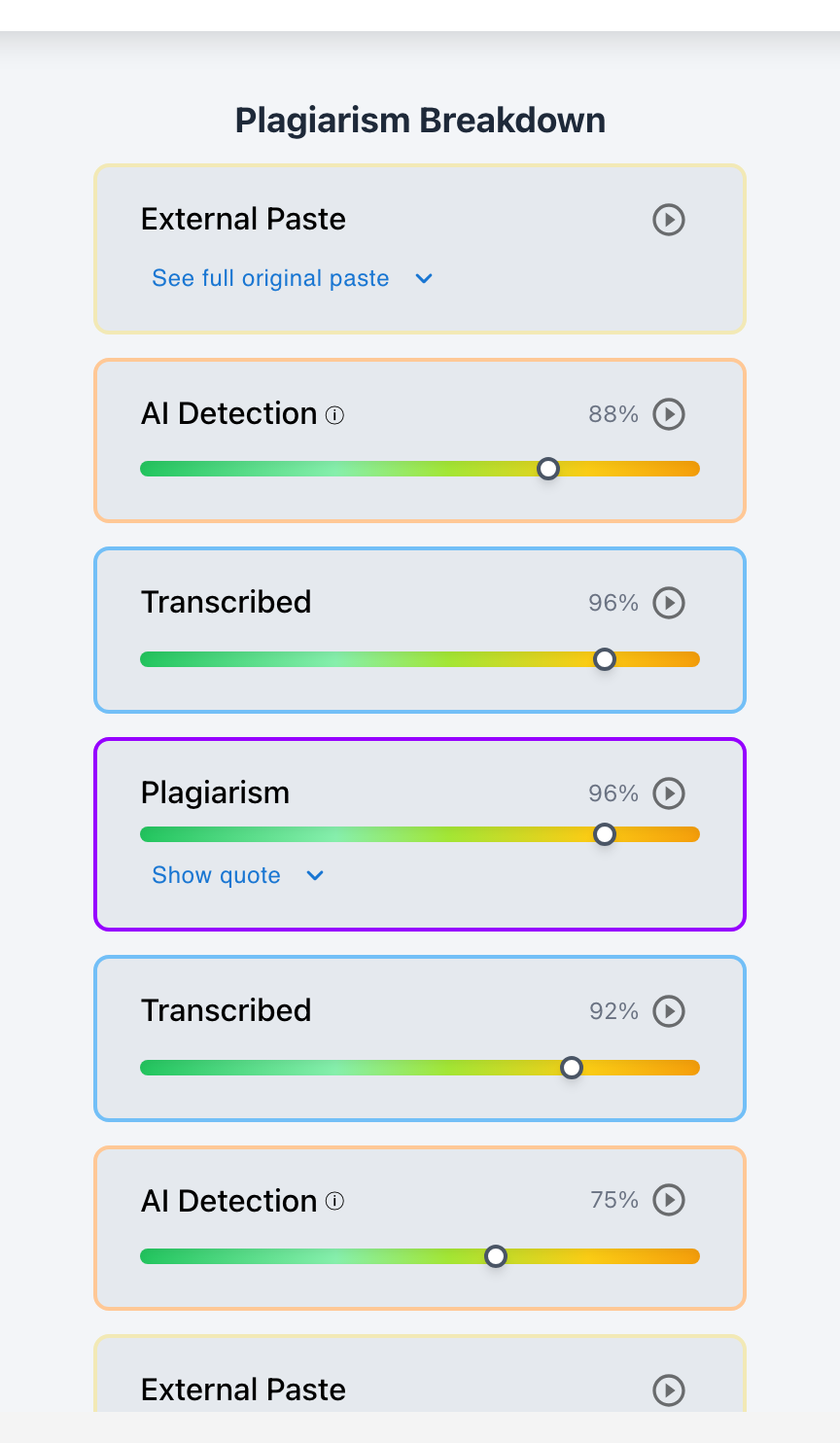
To ensure fair, evidence-based academic governance, modern schools must track a balanced portfolio of 4 multi-signal integrity metrics: Textual Similarity Rates, Generative AI Linguistic Scores, Behavioral Writing Process Analytics (active hours, backspaces, paste volumes), and Pedagogical Due Process Outcomes.
For decades, institutional academic integrity tracking was limited to a single crude data point: the average plagiarism similarity percentage. In the era of generative AI and digital word processors, that single metric is obsolete. An effective institutional integrity framework requires a multi-dimensional view of student writing—evaluating not just the words submitted on the page, but how those words were created, how much active effort was invested, and how teachers resolve integrity inquiries.
Below is the definitive framework of academic integrity Key Performance Indicators (KPIs) that school and district leaders should track.
Checkmark Plagiarism powers multi-metric tracking by pairing AI detection with essay writing playback, plagiarism detection, autograding, and integrations with Canvas and Google Classroom.
The 4 Essential Integrity Metric Categories
1. Textual Similarity & Source Metrics
Tracks average uncited similarity rates, matches against the web, and peer-to-peer copying across internal institutional course sections.
2. Generative AI Linguistic Indices
Monitors synthetic language probability distributions, paragraph-level AI heatmaps, and discrepancies caused by automated AI humanizer tools.
3. Behavioral Writing Process Analytics
Measures true student effort: average active typing hours per 1,000 words, backspace/revision rates (15–30%), and external clipboard paste volume percentages.
4. Due Process & Resolution Metrics
Tracks the percentage of AI false flags successfully cleared via writing playback, student appeal resolution times, and rubric feedback turnaround speeds.
Why Behavioral Metrics Are the Gold Standard for Schools
While textual scores indicate what was turned in, behavioral metrics reveal how learning actually happened:
- Active Drafting Duration: Shows whether a 10th-grade class is spending an average of 4.1 hours drafting major essays or completing them in 8-minute paste sessions.
- Revision Depth (Backspace Rate): A healthy school-wide backspace rate of 20–25% proves that students are actively struggling, refining, and developing their ideas.
- Clipboard Paste Percentage: Tracking the percentage of pasted words across departments immediately highlights which assignments need prompt redesign.
Read more in how Checkmark writing process analysis works.
Comparison: Legacy Single-Metric Tracking vs. Modern Multi-Signal Portfolio
Legacy Single-Metric Tracking (Incomplete)
- Tracks only a raw plagiarism similarity percentage.
- Blind to generative AI text and ChatGPT shortcuts.
- Zero insight into active typing hours or revision effort.
- Treats false positives and genuine cheating identically.
Checkmark Multi-Signal Metrics (Comprehensive)
- Tracks plagiarism, AI probability, and paste volumes.
- Quantifies active typing hours and backspace revision depth.
- Monitors false positive exoneration rates via playback.
- Provides complete, defensible data for school leadership.
A 5-Step Administrator Protocol for Managing Integrity Metrics
District Integrity KPI Management Checklist:
- 1. Establish school-wide baseline metrics across all 4 categories during the first marking period.
- 2. Review monthly departmental dashboards in Checkmark Analytics with department heads.
- 3. Identify courses with abnormal paste volumes or low active drafting hours for curriculum support.
- 4. Monitor false positive resolution rates to ensure student due process is actively upheld.
- 5. Publish an annual Academic Integrity Health Report for the school board and accreditation teams.
How Checkmark Plagiarism Powers Institutional Metrics
Checkmark Plagiarism combines **AI detection, essay writing playback, static AI detection, plagiarism detection, autograding, and Canvas/Google Classroom integrations** to provide school and district leaders with complete multi-metric intelligence.
Frequently Asked Questions
What are the most important academic integrity metrics to track?
The 4 most critical metrics are: (1) Active drafting hours, (2) Backspace/revision rates, (3) Clipboard paste volumes, and (4) Peer-to-peer similarity matching.
Why is tracking active drafting time better than tracking similarity scores alone?
Because drafting time measures physical student labor, proving whether an essay was composed over hours of thought or pasted from an external tool in seconds.
What is a healthy school-wide backspace rate?
A healthy human writing baseline exhibits a 15% to 30% backspace/edit rate, reflecting active self-editing and cognitive struggle.
How does tracking metrics help protect honest students?
By tracking false positive resolution rates and requiring process evidence, schools ensure that articulate writers are not unfairly penalized by static AI scores.
Can department chairs track metrics across different course sections?
Yes. Checkmark provides granular dashboards that allow department heads to compare metrics across different teachers and grade levels.
How does Checkmark Plagiarism integrate with Canvas LMS?
Checkmark provides district-wide LTI 1.3 deployment, SpeedGrader sidebar embeds, two-way grade passback, and centralized administrator dashboards.
Does tracking integrity metrics violate student privacy?
No. Checkmark's administrative dashboards display aggregated, anonymized trend data in full compliance with FERPA and student privacy laws.
How often should school leaders review integrity metrics?
Administrators should review metrics monthly to identify emerging trends and conduct a comprehensive review at the end of each semester.
Can these metrics help evaluate teacher professional development?
Yes. If research skills PD leads to an increase in active drafting hours and a decrease in uncited text, leaders have tangible proof of PD impact.
Why is a multi-metric portfolio essential for accreditation?
Because accreditation boards require evidence of institutional academic standards, continuous improvement, and fair student due process policies.
Transforming Integrity from Policing to Evidence-Based Leadership
Modern academic integrity is about understanding the complete story of student learning. By tracking a comprehensive portfolio of multi-signal metrics with Checkmark Plagiarism, school leaders can ensure fair evaluations, celebrate genuine student effort, and build an enduring culture of scholarship.
Checkmark Plagiarism supports this comprehensive approach with AI detection, essay writing playback, static AI detection, plagiarism detection, autograding, and integrations with Canvas and Google Classroom.
See how Checkmark pairs multi-signal metrics with institutional analytics to track academic integrity across your school. View a sample report or request a demonstration.