
Yes. Asking a student to explain their writing can be a useful part of investigating possible AI use, especially when the conversation is handled as a request for clarification rather than an accusation.
A student who wrote an assignment should generally be able to discuss its main argument, sources, terminology, and writing process. That does not mean they need to remember every sentence or defend the paper like an oral examination.
The purpose is to determine whether the student's understanding is reasonably consistent with the work they submitted.
If a teacher is concerned about possible ChatGPT or other AI use, a student conversation can be considered alongside other evidence such as previous writing, document history, source verification, and AI detection results.
Checkmark Plagiarism helps teachers gather that broader evidence through AI detection, essay writing playback, static AI detection, plagiarism detection, autograding, and integrations with Canvas and Google Classroom.
Why Ask the Student About Their Writing?
The finished text cannot always distinguish between human writing, tutor revisions, Grammarly sentence rewrites, or ChatGPT generation. Talking with the student provides qualitative insight into their familiarity with the ideas, research, and drafting process behind the submission.
Asking for an Explanation Is Not the Same as Accusing the Student
Avoid opening with: "I know you used ChatGPT." A more constructive starting point is: "I had a few questions about your assignment and wanted to understand how you approached it." This frames the dialogue as evidence gathering rather than an interrogation.
What Should I Ask the Student?
Begin with broad thematic questions before drilling down into specific passages:
- What is your central thesis?
- How did you decide on this topic?
- Which section was most difficult to write?
- What sources were most influential to your argument?
- What tools did you use while drafting and revising?
Ask the Student to Explain the Thesis
Ask: "What are you arguing in this essay?" The student does not need to recite the exact thesis statement. Explaining the core idea in plain, conversational language is a strong sign of genuine conceptual ownership.
Ask About Specific Paragraphs
Select a major argumentative paragraph and ask: "Can you explain what you're saying in this paragraph and how it connects to your thesis?" Look for understanding of the reasoning rather than word-for-word memorization.
Ask About Advanced Vocabulary
If an essay contains specialized terminology like "socioeconomic stratification," "cognitive dissonance," or "epistemological framework," ask: "What does this term mean in your argument?" The student should be able to explain the concept in context.
Ask About Sources
Ask: "Why did you choose this source? Where did you find it? Can you show me the passage you quoted?" Inability to explain citations justifies verifying whether the cited papers and authors actually exist.
Ask About the Writing Process
Ask: "Can you walk me through how you wrote the assignment from beginning to end?" Inquire about outlining, drafting location, revision cycles, and digital tools utilized.
Why Writing Process Matters
Student A (Multi-Session Growth)
- Outline and rough notes in playback
- Paragraphs drafted gradually over several days
- Sentence rewriting & structural revisions
- Fluently explains the thesis and sources
Student B (Unverified Shift)
- Empty document receives 1,000 words instantly
- Zero subsequent editing or revision
- Several citations do not exist in databases
- Cannot explain key terminology used
How Checkmark Plagiarism's Essay Writing Playback Helps
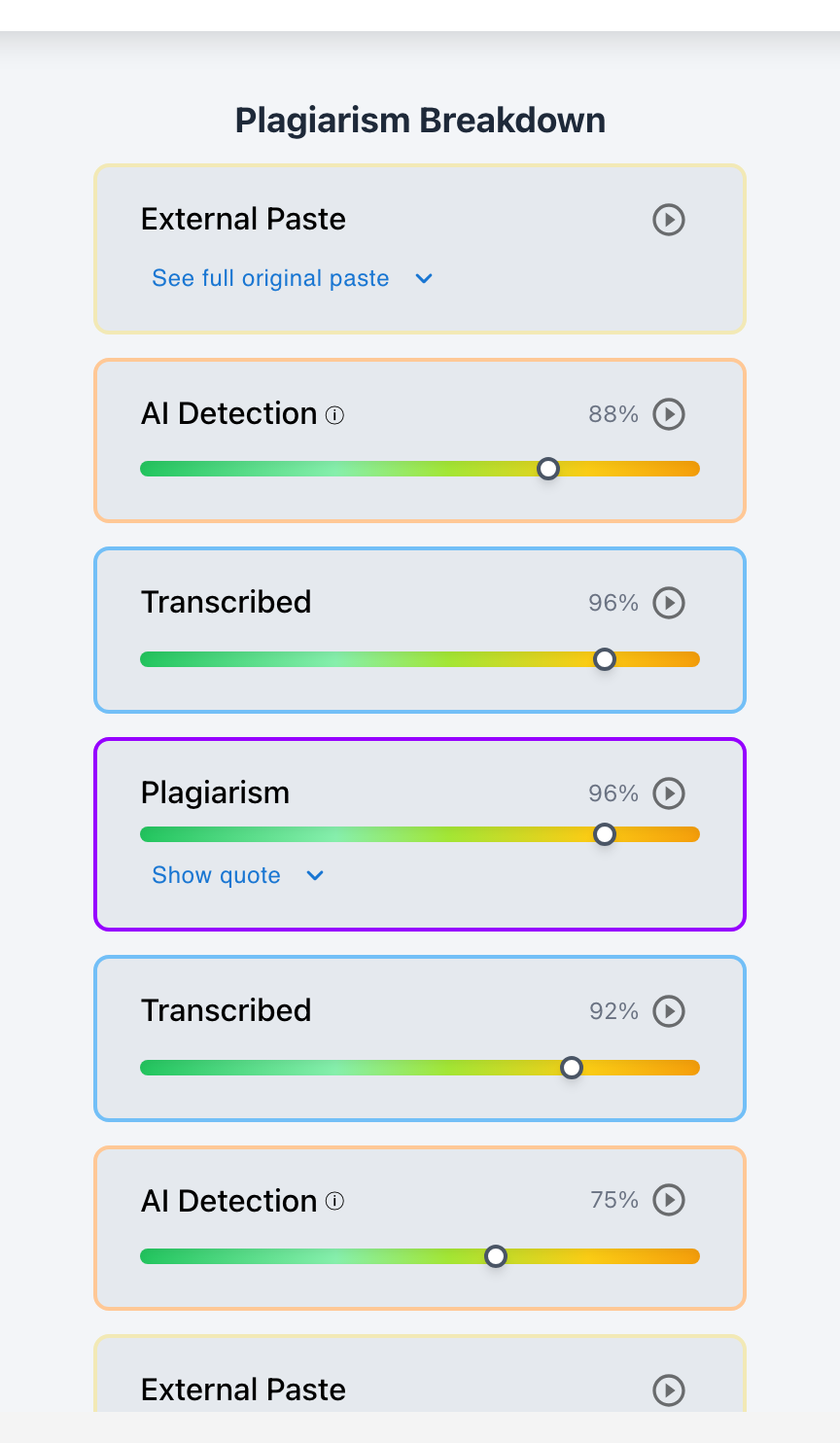
Checkmark Plagiarism's essay writing playback allows teachers to examine drafting, large additions, revisions, and editing patterns over time. Instead of saying "This essay sounds like AI," a teacher can ask: "I noticed these paragraphs appeared all at once. Can you explain how you created that section?" Read more in how Checkmark writing process analysis works.
A Large Paste Does Not Automatically Mean AI
A large paste could come from a student drafting in Word, Google Docs, or research notes. Ask where the text came from and allow the student to show their earlier draft or version history.
Should I Tell the Student an AI Detector Flagged Their Essay?
Discuss the result neutrally: "The assignment raised a few questions, including an AI detection score, and I'd like to understand your drafting process." Read more about interpreting detector scores in what does an AI detection percentage actually mean?
What If the Student Can't Explain the Essay?
Do not base decisions on one nervous answer. Look for consistent unfamiliarity across the thesis, terminology, sources, and writing process. Read our full guide in what should I do if a student can't explain their own essay?
What If the Student Explains the Essay Well?
If the student fluently explains their thesis, research, revision choices, and notes, that evidence supports their authorship and helps resolve initial suspicions.
What If the Student Says They Used Grammarly?
Distinguish between spelling correction and automated paragraph rewriting. Read more in can AI detectors detect Grammarly or AI writing assistants?
Should I Ask Directly About ChatGPT?
Ask neutrally: "Did you use ChatGPT or another AI tool while completing this assignment? How did you use it?" Brainstorming, outlining, grammar checking, and full text generation carry different policy implications.
What Should I Avoid Asking?
- Avoid aggressive demands: "Why don't you just admit you used ChatGPT?"
- Avoid attacking student ability: "This is too good for you."
- Avoid unreasonable memory tests: "Recite the entire third paragraph right now."
What If There Is No Writing History?
When students submit PDFs or Word files, Checkmark Plagiarism's static AI detection provides an objective analysis of completed submissions to pair with baseline comparisons, citation checks, and student conferences.
A Practical Conversation Process
A Practical 14-Step Conversation Framework:
- 1. Review the assignment carefully prior to scheduling the conference.
- 2. Identify specific passages, vocabulary, or citations that raise concern.
- 3. Review previous student work baselines for style and syntax comparisons.
- 4. Check AI detection results as one signal among several.
- 5. Review essay writing playback to examine drafting progression over time.
- 6. Begin the conversation neutrally: "Help me understand how you approached this."
- 7. Ask the student to summarize their central thesis in conversational terms.
- 8. Inquire about specific paragraphs, evidence, and research citations.
- 9. Ask the student to describe their step-by-step drafting and revision process.
- 10. Inquire about editing tools, writing assistants, or tutoring support utilized.
- 11. Ask neutrally about AI tools if relevant to the assignment policy.
- 12. Provide the student an opportunity to share earlier drafts or version notes.
- 13. Synthesize the student's explanation with writing history and baseline evidence.
- 14. Follow established school academic-integrity procedures if concerns remain.
How Checkmark Plagiarism Helps Teachers Ask Better Questions
Checkmark Plagiarism combines **AI detection, essay writing playback, static AI detection, plagiarism detection, autograding, and Canvas/Google Classroom integrations** to provide educators with actionable evidence before and after student writing conferences.
Frequently Asked Questions
Should teachers ask students to explain essays suspected of being AI-generated?
Yes. Asking students to explain their arguments, sources, terminology, and writing process provides essential context when AI use is suspected.
What should I ask a student about their essay?
Ask about the thesis, major arguments, sources, specific passages, revision choices, and the process used to create the assignment.
Does a student have to remember every sentence?
No. The goal is to evaluate familiarity with important ideas and the drafting process, not exact memorization.
What if the student cannot explain a paragraph?
One difficult answer does not prove misconduct. Ask about other parts of the paper and consider the overall pattern.
Can I ask directly whether they used ChatGPT?
Yes. If AI use is relevant, ask neutrally whether ChatGPT or another AI tool was used and what role it played.
What if the student admits using AI?
Ask how it was used. Brainstorming, editing, sentence rewriting, and full essay generation may be treated differently under the assignment policy.
What if the student says they wrote the essay somewhere else?
Give them an opportunity to explain or provide the earlier draft. Large pasted sections do not automatically prove AI use.
Should I tell the student about an AI detection result?
You can, but present the result as one reason for reviewing the assignment rather than definitive proof that the student cheated.
Can essay writing playback help during the conversation?
Yes. Writing playback can identify specific drafting, revision, or text-addition events that teachers can ask students to explain.
How does Checkmark Plagiarism help with suspected AI writing?
Checkmark Plagiarism combines AI detection, essay writing playback, static AI detection, plagiarism detection, autograding, and Canvas and Google Classroom integrations.
Ask the Student to Explain the Work—Keep the Conversation About Evidence
A student conference shifts the focus from accusatory guesswork to evidence-based verification: "Help me understand how you created this assignment." By combining student explanations with writing playback, source verification, and AI detection, educators can uphold academic integrity with clarity and fairness.
Checkmark Plagiarism supports this evidence-based approach with AI detection, essay writing playback, static AI detection, plagiarism detection, autograding, and integrations with Canvas and Google Classroom.
See how Checkmark pairs essay writing playback with multi-signal detection to support constructive student conversations. View a sample report or request a demonstration.