
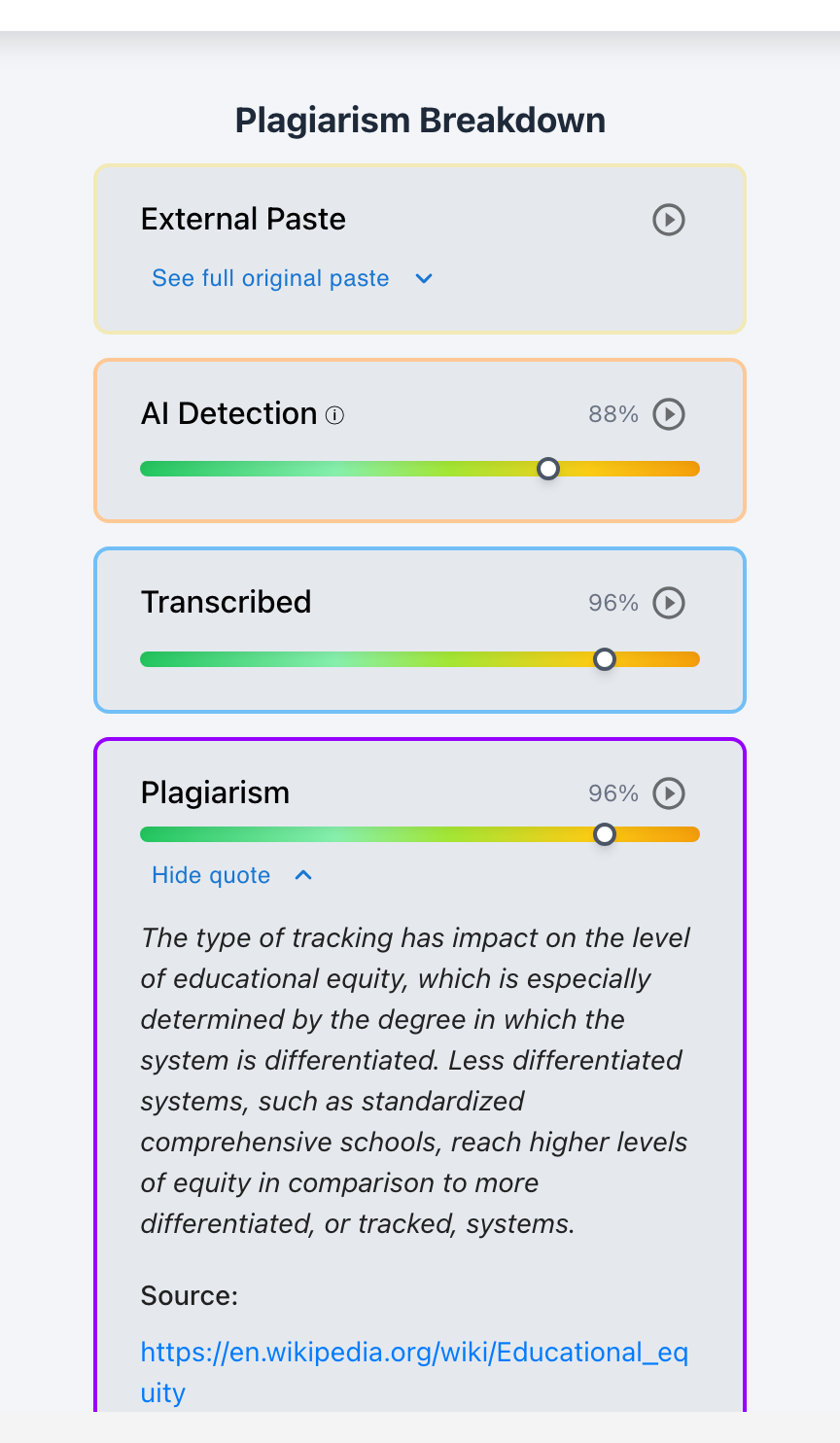
For more than two decades, secondary and post-secondary education has relied on aggregate “similarity percentages” to evaluate academic honesty. A single, ominous number—such as 34% Similarity—flashes across an LMS dashboard, triggering automated grade deductions, disciplinary referrals, and student panic. Yet aggregate percentages are inherently blunt instruments: they fail to distinguish between legitimate block quotes, disciplinary terminology, developmental patchwriting, formatting errors, and genuine academic fraud. Side-by-side source quotations fundamentally transform this dynamic by replacing opaque percentages with transparent, bidirectional textual evidence. By pairing verbatim side-by-side text alignment with Checkmark Plagiarism’s patent-pending Essay Playback™ keystroke dynamics, passage-level AI detection, and quote-anchored rubric feedback, educators can eliminate false accusations, uphold rigorous standards, and shift academic integrity from punitive policing to evidence-backed student growth.
Checkmark Plagiarism empowers educators with comprehensive authorship verification, uniting side-by-side source comparison with keystroke process playback, passage-level AI writing detection, quote-anchored rubric autograding, and direct LTI 1.3 integrations for Canvas LMS and Agilix Buzz LMS.
The Tyranny of the Aggregate Percentage: Why “34% Similarity” Is Pedagogy’s Most Dangerous Metric
In secondary English classrooms, AP capstone seminars, and university humanities departments, the submission of a major research paper is frequently followed by a familiar, distressing ritual: the appearance of the “Red Number.”
- Extreme anxiety, confusion, and panic
- “Did I cite incorrectly? Am I being expelled?”
- Scrambles to use synonym spinners out of desperation
- Erosion of trust in the academic writing process
- Overwhelmed grading queue of 120+ essays
- Triggered by district “20% maximum threshold” rule
- Under pressure to threaten zero grade or academic referral
- Spends 45 minutes manually hunting down obscure URLs
When an automated checker flags an essay with a 38% Similarity Index, what does that number actually communicate? To a stressed educator grading 140 essays over a weekend, it looks like more than a third of the paper was stolen. To an anxious student, it feels like an indictment of their moral character.
In reality, an aggregate percentage communicates nothing about student intent, ethical authorship, or citation legitimacy. It merely represents the mathematical quotient of matching character sequences divided by total character count:
This crude mathematical calculation collates entirely disparate textual elements into a single composite score:
- Properly cited block quotations from historical speeches, legal briefs, or literary works.
- Standardized academic prompts and assignment headers (e.g., “AP English Literature and Composition: Question 3 – Free Response”).
- Common disciplinary phraseology (e.g., “According to the Centers for Disease Control and Prevention,” or “The data demonstrates a statistically significant correlation”).
- Institutional cover pages and Works Cited entries (e.g., standard MLA/APA bibliographies containing publication titles, DOIs, and author lists).
- Legitimate paraphrasing with imperfect citation punctuation (e.g., a missing quotation mark around a single clause).
- Deliberate copy-paste plagiarism or purchased essays.
When all six categories are blended into one number, the metric becomes pedagogically useless and ethically dangerous.
The Fallacy of Arbitrary Departmental Thresholds
To cope with crushing grading volumes, many academic departments, high schools, and university faculties have instituted rigid “similarity score thresholds”—policies stating that any paper with a similarity score exceeding 15%, 20%, or 25% is automatically flagged for disciplinary review, penalized with a grade deduction, or returned for mandatory rewriting.
These arbitrary thresholds produce two severe systemic failures:
A student writes an exemplary 10-page History paper analyzing the Lincoln-Douglas Debates with extensive verbatim block quotations, full Chicago citations, and original thesis defense.
A student uses an AI generator, buys a bespoke paper from an essay mill, or heavily spins a stolen article with automated synonym replacement tools.
Arbitrary thresholds disproportionately punish diligent, thorough researchers who engage deeply with primary texts, as well as English Language Learners (ELL) who utilize standard syntactic frames to construct academic arguments.
To restore fairness and pedagogical validity to writing instruction, educational institutions must abandon aggregate score thresholds in favor of granular, contextual, side-by-side evidence.
The Four Quadrants of Textual Overlap: Unpacking Student Writing Realities
Not all matching text is created equal. When an educator encounters overlapping prose between a student’s submission and an external source, that overlap represents one of four distinct pedagogical phenomena.
Mapping student intent against mechanical writing competence to guide ethical evaluation
Covert Mosaic & Contract Cheating
Stitched internet blogs, synonym spinner hacks, and cut-and-paste patches masked by automated rephrasing tools.
Intentional Academic Fraud
Direct wholesale copy-paste without credit, fabricated citations, purchasing ghostwritten papers, and deliberate evasion tactics.
Developmental Patchwriting
Novice vocabulary scaffolding, ELL/ESL syntax mimicry, and cognitive struggle with dense, unfamiliar academic discourse.
Legitimate Disciplinary Overlap & Quotes
Properly cited primary source block quotes, standard methodology formulas, field phraseology, and minor punctuation lapses.
To respond fairly to student writing, educators and academic integrity boards must evaluate each submission through a clear pedagogical taxonomy:
1. Intentional Academic Fraud (Unethical Authorship)
- What It Is: The deliberate presentation of another person’s or entity’s work as one’s own. This includes copying entire paragraphs from online articles without citation, purchasing papers from essay mills, or submitting work completed by another student.
- Intent: High deceptive intent. The student actively attempts to circumvent learning and receive unearned academic credit.
- Pedagogical Response: Disciplinary referral, formal honor council review, assignment zero with restorative reflection, or academic probation in accordance with institutional policy.
2. Developmental Patchwriting (Transitional Learning)
- What It Is: Coined by composition scholar Rebecca Howard, patchwriting is the practice of copying from a source text, deleting a few words, altering grammatical structures, or substituting synonyms while retaining the core syntax and sentence rhythm of the original.
- Intent: Low/Zero deceptive intent. Extensive research demonstrates that patchwriting is a normal, developmental phase for novice writers, first-generation college students, and ELL/ESL learners grappling with dense, unfamiliar academic discourse. Students patchwrite when they understand the core concept but lack the sophisticated academic vocabulary required to articulate it in their own words.
- Pedagogical Response: Instructional intervention. The student does not belong in front of an honor council; they require targeted coaching on summarizing, synthesizing, and integrating evidence.
3. Common Disciplinary Phraseology (Standard Field Terminology)
- What It Is: Formulaic linguistic strings, standardized methodology descriptions, and technical definitions that are universally used within specific disciplines.
- Examples:
- Biology/Medicine: “Samples were incubated at 37°C for 24 hours under standard atmospheric conditions.”
- Social Sciences: “A double-blind, placebo-controlled study was conducted to evaluate...”
- Literary Analysis: “The protagonist undergoes an internal conflict that highlights the theme of...”
- Intent: Zero deceptive intent. These phrases represent established academic fluency, not plagiarism.
- Pedagogical Response: None required. Software should intelligently ignore or visually isolate standard disciplinary collocations.
4. Mechanical Citation & Formatting Lapses (Clerical Errors)
- What It Is: Instances where the student properly attributes the author and source (e.g., provides a parenthetical citation
(Smith, 2024, p. 45)and includes the entry in the Works Cited), but omits quotation marks around a 10-word verbatim phrase or incorrectly formats a block quote. - Intent: Zero deceptive intent. The student transparently signaled where the ideas originated but made a mechanical punctuation mistake.
- Pedagogical Response: Targeted formative feedback on citation mechanics and rubric point adjustments under “Conventions,” rather than an accusation of academic dishonesty.
Comparative Evaluation Matrix
| Category | Textual Characteristics | Student Intent | Checkmark Evidence Profile | Recommended Teacher Action |
|---|---|---|---|---|
| Intentional Academic Fraud | Multi-sentence verbatim blocks with zero citations; sudden vocabulary shift. | Deliberate deception; avoidance of effort. | External paste event detected in Essay Playback™; zero typing history; live URL match. | Academic integrity conference; institutional policy review; assignment resubmission or penalty. |
| Developmental Patchwriting | Source sentence structure maintained with synonym swaps; adjacent citations present. | Cognitive struggle with complex material. | Continuous typing with frequent dictionary/thesaurus pauses; side-by-side reveals structural mimicry. | Formative citation coaching; paraphrasing exercises; revision opportunity without penalty. |
| Disciplinary Phraseology | Common technical collocations, methodology phrases, standard formulas. | Authentic discipline fluency. | Natural keystroke rhythm; high phrase frequency across thousands of academic publications. | No penalty; recognize as appropriate disciplinary conventions. |
| Mechanical Citation Lapse | Verbatim text attributed in bibliography/in-text cite, but missing quotation marks. | Carelessness or formatting confusion. | Steady drafting and revision; in-text citation present; sidebar indicates source attribution. | Formative feedback on quotation mechanics; minor formatting deduction on rubric. |
The Architecture of Truth: How Checkmark Plagiarism’s Side-by-Side Source Engine Works
To replace the flawed single-percentage model with transparent, defensible evidence, Checkmark Plagiarism engineered a multi-layered verification engine. Instead of handing teachers an intimidating red score, Checkmark presents an intuitive, interactive two-way evidence environment.
Madison expands upon the volatility of popular passions in representative assemblies. The concept of factionalism is defined as a number of citizens, whether amounting to a majority or a minority of the whole, who are united and actuated by some common impulse of passion, or of interest, adverse to the rights of other citizens. This division poses the primary risk to republican stability.
1. Verbatim Text Alignment & Two-Way Linked Evidence Cards
The core of Checkmark’s interface is the bidirectional interactive link:
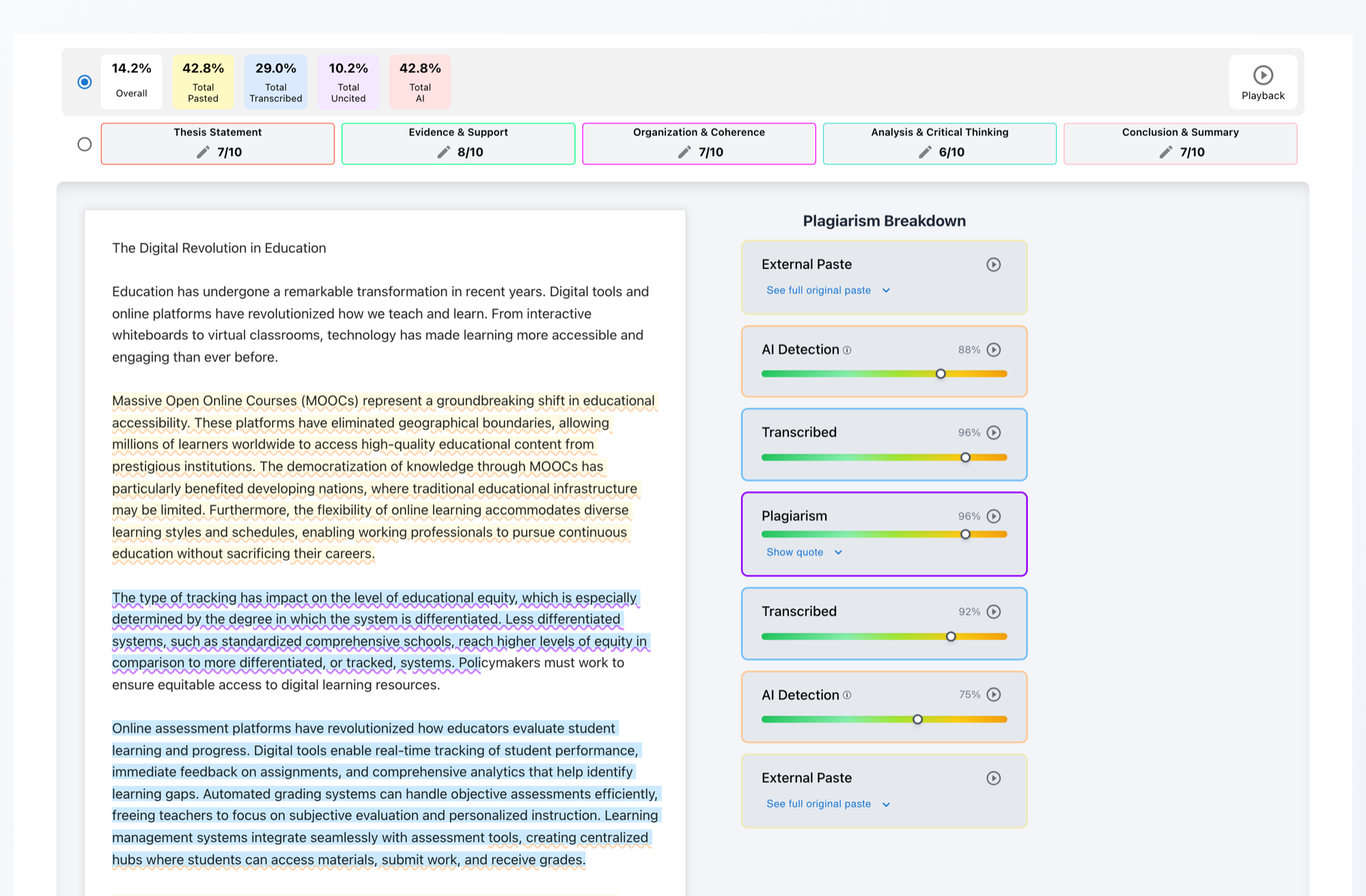
- Interactive Manuscript Highlighting: When an educator views a student’s submission, matching passages are highlighted with distinct, meaningful color-coding based on the match type (Direct Web Match, Peer Repository Match, Uncited Source, or Quoted/Cited Material).
- Two-Way Synchronization: Clicking any highlighted passage in the essay instantly scrolls the right sidebar to the corresponding Evidence Card. Conversely, clicking an Evidence Card in the sidebar scrolls the essay directly to the exact paragraph, line, and character offset where the text appears.
- Granular Text Comparison: The Evidence Card displays the student’s prose side-by-side with the original source text, highlighting exact word matches, substituted synonyms, inserted words, and omitted clauses.
2. Live Web Source URL Resolution
Many legacy plagiarism tools display vague source labels (e.g., “Matched to 12% Internet Source” or obscure internal database codes) without providing working links. Checkmark Plagiarism crawls billions of active web pages, digital encyclopedias, open-access academic publications, government archives, and digital media outlets in real time.
Every web-based Evidence Card includes a direct, live clickable URL. An educator can click the link and immediately inspect the source document in its native digital context, verifying whether the source is a primary historical text, a Wikipedia article, a blog post, or a peer-reviewed research study.
3. Dedicated Uncited Source Differentiation
Checkmark’s engine automatically cross-references matching passages against the student’s in-text citations and Works Cited page:
- If matching text is accompanied by an in-text citation and bibliography entry, the system tags the match as “Cited Material” and visually differentiates it from uncredited text.
- If a passage matches an external source but contains zero attribution within the document, the system highlights the passage in “Uncited Source” amber/red styling.
This automated distinction enables teachers to see at a glance whether an essay’s similarity score is driven by legitimate research citations or uncredited borrowing.
Verbatim text enclosed in quotation marks or formatted as block quotes with valid in-text citation. Excluded from uncredited overlap calculations.
In-text citation or footnote present, but quotation marks are omitted around verbatim prose (Mechanical citation lapse).
Verbatim or near-verbatim match against external internet sources with zero citation or attribution anywhere in the manuscript.
Overlap detected against another student in the institutional or course repository (Privacy-isolated with zero student PII exposed).
4. Peer-to-Peer Repository Matching with Zero-PII Isolation
Collusion and cross-student copying within the same school or course section represent significant integrity challenges. However, sharing student work across databases often raises severe privacy and FERPA concerns.
Checkmark Plagiarism solves this through Privacy-Isolated Peer Matching:
- Submissions are indexed securely within the school district or institution’s private repository.
- When a match occurs between Student A and Student B, the educator sees the verbatim overlapping text side-by-side.
- Student Privacy Safeguard: Student personal identifiable information (PII), names, student ID numbers, and external coursework are never exposed across institutional boundaries or used to train public commercial AI models. School administrators retain complete sovereignty over their institutional data.
The Full Verification Suite: Process, AI, and Rubric Integration
Textual comparison represents only one pillar of comprehensive writing evaluation. To provide educators with indisputable “receipts” that protect honest students and identify genuine misconduct, Checkmark Plagiarism integrates source verification into a complete four-part ecosystem:
Side-by-Side Engine
Verbatim source alignment, clickable URLs, peer matching, and uncited source tagging.
Essay Playback™
Keystroke dynamics, active typing duration, 1x–8x video replay, and clipboard paste buffer tracking.
Passage-Level AI
Perplexity and burstiness scans with calibrated confidence sliders and <150w safety guardrails.
Quote-Anchored Rubrics
Criterion scoring justified by verbatim student prose with 1-click Canvas/Buzz LMS passback.
1. Patent-Pending Essay Playback™: Keystroke Dynamics & Process Evidence
The ultimate defense against false accusations is authentic writing history. When a student is wrongly accused of plagiarism or AI generation based on a high similarity score or a false AI detector reading, traditional tools leave the student powerless to prove their innocence.
Checkmark’s Essay Playback™ captures the complete temporal drafting process directly from Google Docs, Microsoft Word, Canvas SpeedGrader, and Buzz LMS:
- Timeline Scrubbing (1x to 8x Speed): Teachers and academic review boards can watch the essay being written keystroke by keystroke, observing authentic pauses for reflection, organic sentence deletions, structural reorganization, and real-time revisions.
- External Paste Buffer Preservation: When text is pasted into the document from an external application, Checkmark logs the exact timestamp and preserves the full original pasted text—even if the student later edits, rephrases, or deletes every single word.
- Transcription Detection: Identifies abnormal, robotic typing patterns (such as typing at a constant 85 words per minute with zero backspaces or structural pauses), which indicates that a student is manually transcribing text from a secondary monitor, smartphone, or printed AI output.
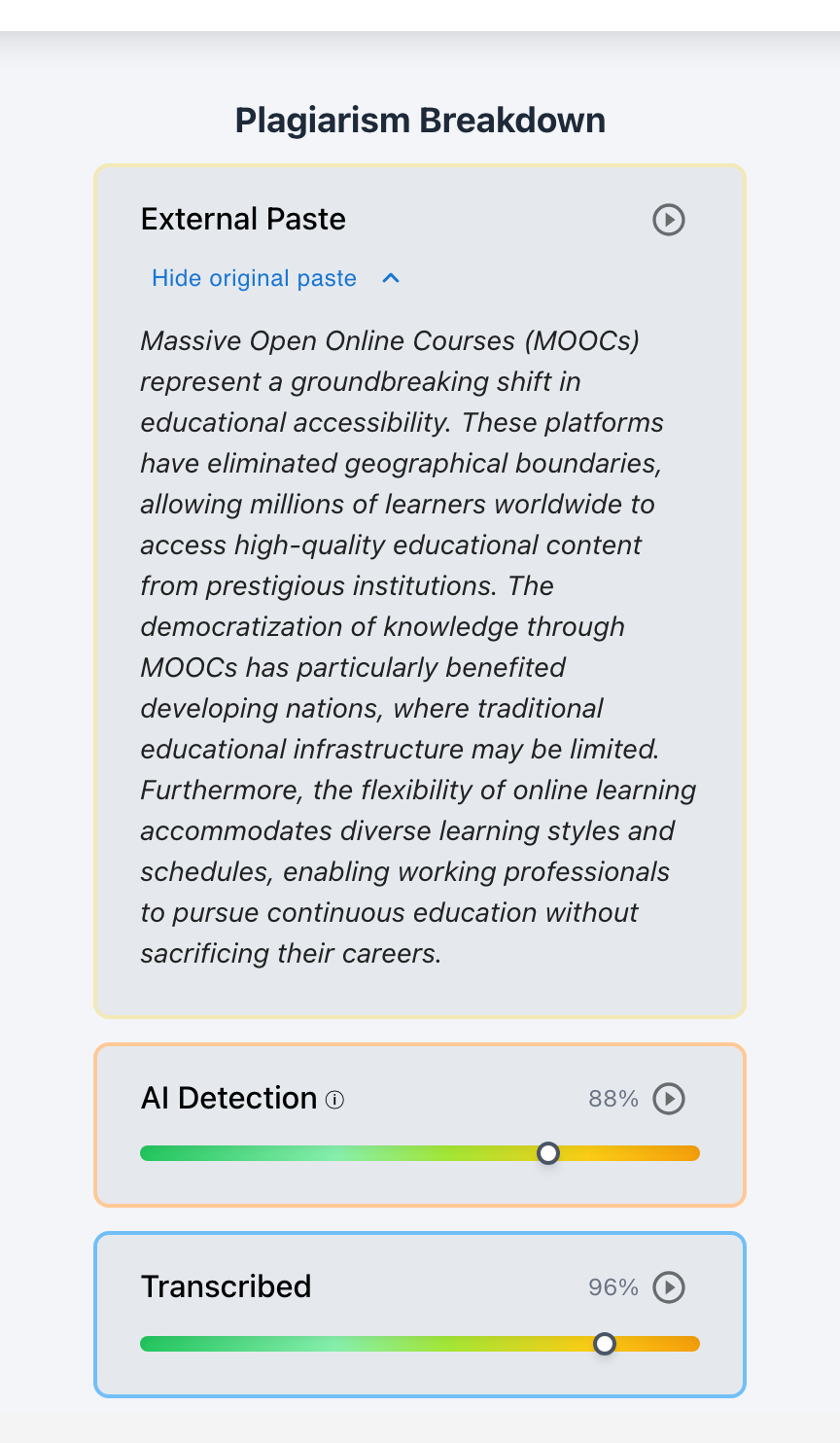
• Original Clipboard Text: “James Madison argues in Federalist No. 10 that...”
• Telemetry Action: Primary source quote pasted directly from Avalon Project URL
2. Passage-Level AI Detection (Calibrated Linguistic Analysis)
Rather than slapping an arbitrary “65% AI Generated” score across the entire document, Checkmark analyzes text at the individual sentence and paragraph level:
- Linguistic Perplexity & Burstiness: Evaluates word choice predictability and sentence length variance. Human writing naturally varies between short, punchy sentences and complex compound-complex structures, whereas LLM text exhibits hyper-consistent, uniform sentence cadence.
- Sidebar Confidence Sliders: Every flagged passage features a confidence breakdown indicating whether the style reflects typical human drafting or statistical AI signatures.
- Honest Guardrails (<150 Words): Checkmark enforces an explicit safety rule: for text excerpts under 150 words, the AI detector displays
N/Arather than guessing on insufficient statistical sample sizes. - Immunity to AI “Humanizers”: While paraphrasers (e.g., QuillBot, Undetectable AI) alter surface vocabulary to trick generic pattern detectors, they cannot fake authentic, multi-hour keystroke dynamics in Essay Playback™.
3. Quote-Anchored Rubric Autograding
Integrity analysis should not exist in an isolated silo away from curriculum and grading. Checkmark connects integrity findings directly to standard rubric criteria:
- Teacher-in-the-Loop Authority: AI-generated rubric evaluations remain preliminary drafts until reviewed, modified, and approved by the teacher.
- Quote-Anchored Justifications: Every criterion score is tied to specific highlighted quotes from the student’s text, providing clear evidence for point deductions (e.g., “Score 2/4 in Evidence: Paragraph 3 asserts historical causation without citing supporting data”).
- Direct LMS Grade Passback: With one click, finalized rubric scores and evidence-anchored feedback synchronize directly into Canvas LMS SpeedGrader, Buzz LMS, and Google Classroom.
Real-World Case Scenarios: How Side-by-Side Evidence Resolves Disputes
To understand how side-by-side quotations and multi-factor evidence operate in daily educational practice, let us examine four realistic classroom scenarios.
Student: Marcus T. (11th Grade AP U.S. History) • Assignment: 2,500-word historiographical analysis of the Anti-Federalist debates.
Traditional Tool Result: 38% Overall Similarity Score (FLAGGED AS HIGH RISK). District policy mandated automatic zero and disciplinary referral for any submission over 25%.
Outcome: Marcus was completely exonerated without facing an adversarial hearing. The instructor toggled “Exclude Quoted Material,” adjusting the uncredited similarity score to 0% and affirming Marcus’s exemplary scholarship.
Student: Jin-Woo K. (1st Year Undergraduate, English Language Learner) • Assignment: Literature review on CRISPR-Cas9 mechanisms in eukaryotic cells.
Traditional Tool Result: 29% Overall Similarity Score. Professor initially suspected intentional cut-and-paste plagiarism from Nature Reviews.
(Doudna & Charpentier, 2014) was clearly present at the paragraph end.Outcome: The professor recognized developmental patchwriting rather than deceptive intent. Instead of filing an honor code infraction, the professor held a 15-minute coaching session on synthesizing technical concepts and referred Jin-Woo to the writing center.
Assignment: Synthesis and Purification of Acetylsalicylic Acid (Aspirin) • Cohort: 28 students working in 14 lab pairs.
Traditional Tool Result: 18 out of 28 students received similarity flags between 35%–50%, triggering a massive queue of suspected peer collusion.
Outcome: The instructor excluded the shared “Methods” protocol via section-level filtering, resolving all 18 flags in under 3 minutes and confirming individual analytical authenticity.
Student: Brandon R. (12th Grade Senior English) • Assignment: Comparative thematic essay on 1984 and Brave New World.
Traditional Tool Result: 11% Similarity Score (Passed traditional threshold check, but teacher intuition flagged unnatural voice).
Outcome: Faced with undeniable timestamped keystroke playback and side-by-side alignment, the student acknowledged the violation. The evidence was transparent and defensible, eliminating hours of subjective confrontation.
The Educator’s 5-Stage Verification Protocol
When an educator or academic review board evaluates a submission flagged for similarity, following a standardized, evidence-based triage workflow ensures fairness, protects student trust, and eliminates grading disputes.
Step-by-Step Triage Checklist
Stage 1: Automated Triage & Filter Calibration
- Open the submission within Checkmark Plagiarism or your integrated LMS SpeedGrader.
- Enable automated exclusion toggles:
- Exclude Quoted Text: Removes all text enclosed in quotation marks or formatted as block quotes.
- Exclude Bibliography: Removes the Works Cited / References section.
- Exclude Small Matches (<8 words): Filters out incidental 4- to 7-word common idioms.
- Observe the recalculated Uncredited Match Rate. If the score drops to zero or negligible levels, the submission is immediately cleared.
Stage 2: Granular Side-by-Side Source Inspection
- For remaining flagged passages, click each highlighted block in the essay to inspect the corresponding Sidebar Evidence Card.
- Examine the matched URL:
- Is the source a primary text assigned in class?
- Is it an institutional document, lab protocol, or assignment prompt?
- Is it a peer submission from another section?
- Is it an uncited third-party website, essay bank, or commercial article?
- Check for nearby in-text citations: Did the student credit the author in the preceding or following sentence, indicating an inadvertent punctuation omission rather than intentional deception?
Stage 3: Process Evidence Audit (Essay Playback™)
- Scrub through the Essay Playback™ timeline:
- Did drafting occur over hours/days with normal revision pauses, or did the entire 2,000-word essay appear in 4 minutes?
- Inspect any Paste Events: Click the jump-to-playback button and view the exact text that was pasted. Was it an authorized quote, the student’s own rough notes, or an uncredited article?
- Check Typing Cadence: Does the keystroke velocity reflect organic composition (with backspaces, deletions, and sentence rewrites) or mechanical transcription?
Stage 4: Supportive, Inquiry-Based Student Conference
If uncredited borrowing or developmental patchwriting is confirmed, conduct a restorative conference using supportive, inquiry-based language:
“The plagiarism software gave you a 34% score, so you failed this assignment and I’m reporting you to the Dean of Students for cheating.”
“Let’s look at your draft together in Checkmark. I noticed that in Section 2, the sentence structure matches this academic article very closely side-by-side, even though you cited the author at the end. Can you walk me through how you took notes and integrated this research? Let’s look at how to put these complex ideas into your own voice.”
Stage 5: Defensible Documentation & Grade Passback
- If disciplinary action or formal grade deduction is required, export Checkmark’s Evidence Audit Report, which bundles the side-by-side comparison, source URLs, and timestamped Playback receipts into an unassailable PDF.
- Enter quote-anchored rubric feedback tied directly to the relevant criteria.
- Sync finalized grades seamlessly back into your gradebook (Canvas LMS, Buzz LMS, or Google Classroom).
Institutional Blueprint: Modernizing District Academic Integrity Policies
To protect students from arbitrary penalties and provide faculty with consistent guidelines, school district boards, department chairs, and university provosts must modernize academic integrity policy language.
“Any essay receiving a similarity index higher than 20% on automated software shall receive an automatic grade of zero and be forwarded to the Honor Committee for disciplinary review.”
“Similarity percentage scores are diagnostic tools, not determinations of dishonesty. No student shall be penalized or accused of an academic integrity violation based solely on an automated percentage score. Disciplinary actions require verified side-by-side textual alignment and writing process verification.”
Model Syllabus & Policy Language
ACADEMIC INTEGRITY & EVIDENCE-BASED AUTHORSHIP POLICY
- Purpose of Writing Tools: Academic integrity tools in this course are utilized as pedagogical instruments to support ethical research, effective citation, and authentic writing growth.
- No Automated Penalties: Automated percentage scores (including similarity indices and AI detection ratings) do not constitute evidence of misconduct. All evaluations are conducted by human instructors using multi-factor evidence, including side-by-side source comparisons, contextual citation analysis, and authentic drafting history via Checkmark Essay Playback™.
- Distinction Between Formatting and Fraud: Incomplete citations, missing quotation marks around cited sources, and developmental patchwriting are treated as instructional learning opportunities subject to rubric-based writing feedback, rather than disciplinary violations.
- Student Right to Process Defense: Students have the explicit right to demonstrate the authenticity of their work through their documented writing history, revision logs, and keystroke playback timelines in the event of an evaluation dispute.
- Privacy & Data Security: Student submissions are protected under FERPA and district data privacy agreements. Student intellectual property will never be sold, commercialized, or utilized to train general external artificial intelligence models.
Frequently Asked Questions (FAQs)
1. Why do traditional plagiarism checkers give such high similarity percentages on papers with legitimate citations?
Traditional plagiarism checkers calculate similarity through raw string-matching algorithms that count every matching sequence of characters, regardless of whether the text is enclosed in quotation marks, formatted as a block quote, or cited in a footnote. If a student quotes a 200-word historical document and properly cites it, legacy tools still count those 200 words toward the total similarity index, creating artificially inflated scores that alarm teachers and students alike.
2. How does Checkmark Plagiarism distinguish between a cited quotation and an uncited match?
Checkmark’s engine scans both the body of the essay and the surrounding syntax for standard citation conventions (such as quotation marks, block-indent formatting, MLA/APA/Chicago parenthetical citations, and numbered footnotes). When matching text contains proper attribution, Checkmark tags it as “Quoted & Cited” and visually separates it from uncredited matches in the Plagiarism Breakdown sidebar, allowing teachers to filter out legitimate citations with a single click.
3. What is “developmental patchwriting,” and why shouldn’t it be punished as academic dishonesty?
Patchwriting is a transitional writing strategy where developing writers or English Language Learners retain the sentence structure and syntax of an authoritative source while substituting synonyms or altering verb forms. Research in composition studies (notably by Dr. Rebecca Moore Howard) shows that patchwriting occurs when students are struggling to comprehend complex academic texts and lack the domain-specific vocabulary to restate the concepts in their own words. Because patchwriting stems from cognitive growth rather than an intent to deceive, the appropriate pedagogical response is citation and paraphrasing instruction, not disciplinary punishment.
4. How does Essay Playback™ prove a student didn’t cheat if their similarity score is high?
Essay Playback™ reconstructs the entire drafting process keystroke by keystroke. If a student’s paper has a high similarity score due to extensive primary source analysis, an educator can scrub through the Playback timeline to see how the student composed the essay. The teacher will see the student organically typing their thesis, drafting analytical paragraphs with authentic pauses and backspaces, and intentionally pasting or typing in the primary source quotes. This indisputable process evidence proves that the student authored the paper honestly.
5. Can a student fool the side-by-side source engine by using synonym swappers or paraphrasing tools?
No. When students run text through synonym swappers (such as QuillBot or automated spinners), the underlying syntactic structure and character sequences still align closely with the original source. Checkmark’s side-by-side engine highlights matching phrase sequences while flagging substituted synonyms. Furthermore, Checkmark’s Essay Playback™ detects the external paste of the spun text into the document and flags abnormal typing cadences, completely exposing the evasion attempt.
6. How does Checkmark protect student data privacy when checking for peer-to-peer plagiarism?
Unlike legacy vendors that pool student essays into global commercial databases or use student submissions to train generative AI models, Checkmark maintains strict Zero-PII Isolation. Peer-to-peer repository checks are performed within secure, encrypted institutional boundaries. Student names, student IDs, and personal metadata are never exposed across schools, and student intellectual property is never used for external AI model training, ensuring complete compliance with FERPA, COPPA, and state data privacy regulations.
7. How does Checkmark’s side-by-side source engine integrate with LMS platforms like Canvas and Buzz?
Checkmark integrates natively into Canvas LMS, Buzz LMS, and Google Classroom. Teachers can launch the Checkmark verification suite directly inside Canvas SpeedGrader or the Buzz grading portal. The side-by-side source comparison, Essay Playback™ timeline, and passage-level AI detection appear directly within the instructor’s grading workflow. Once grading is complete, quote-anchored rubric feedback and finalized scores synchronize back to the LMS gradebook with a single click.
Conclusion: Stop Guessing, Start Trusting
Academic writing instruction cannot thrive in an environment governed by fear, suspicion, and arbitrary percentages. When schools rely on opaque single-percentage scores, they inevitably inflict emotional harm on diligent students, penalize emerging language learners, and burden educators with hours of contentious, unguided investigations.
True academic integrity requires transparent, defensible evidence. By pairing verbatim side-by-side source quotations with Essay Playback™ keystroke dynamics, passage-level AI detection, and quote-anchored rubric justifications, Checkmark Plagiarism provides educators and administrators with the comprehensive receipts needed to evaluate student writing with complete confidence.
When teachers have the full picture, they can stop guessing, protect honest students from unfair accusations, and transform academic integrity into a restorative, empowering foundation for student growth.
Empower Your School With Defensible Writing Evidence
Discover how Checkmark Plagiarism replaces flawed percentage scores with side-by-side source verification, keystroke replay, and quote-anchored grading.