
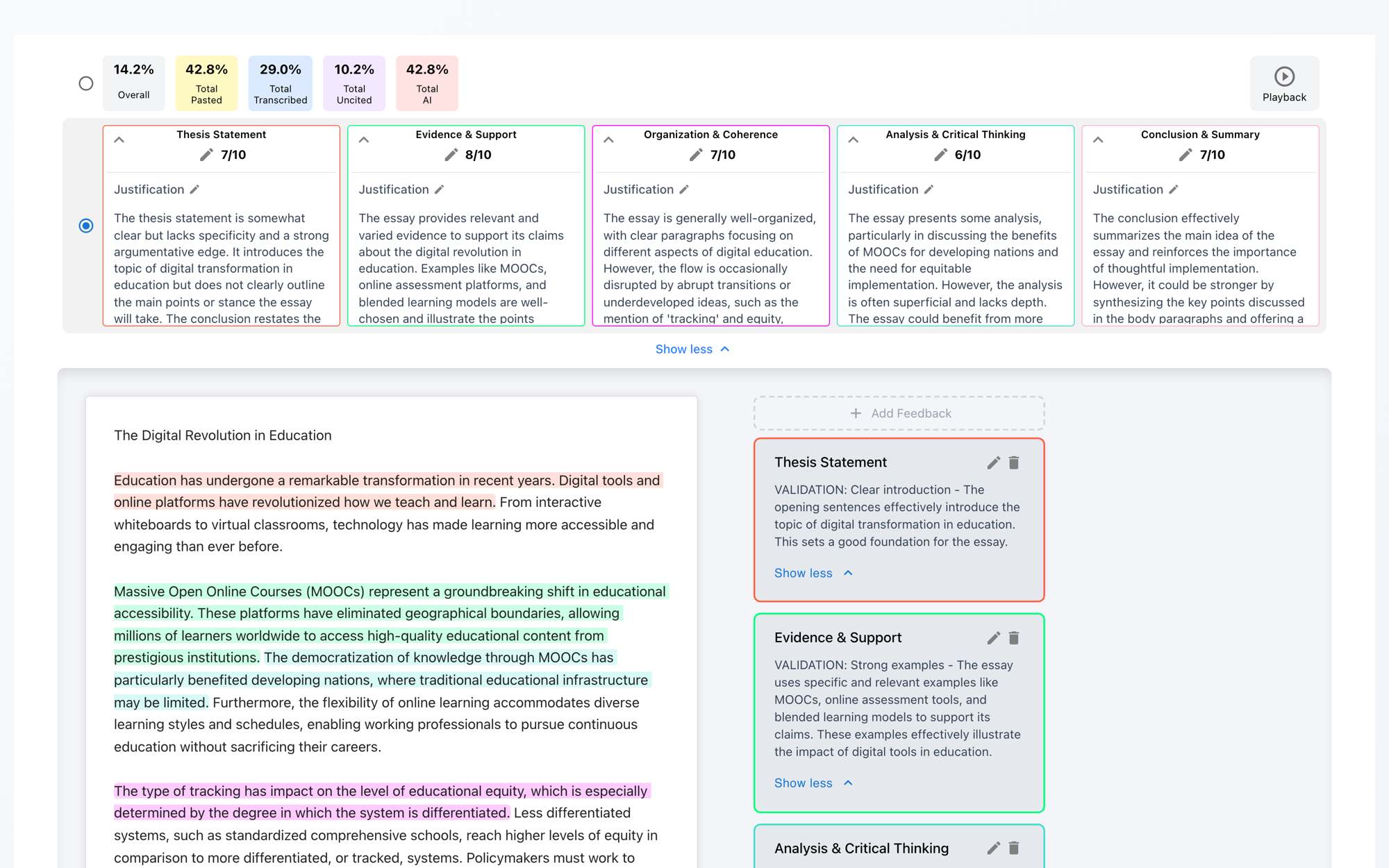
Humanities teachers and writing instructors face an unsustainable structural burden known as the “double-entry tax”—spending upwards of 40% to 60% of their evaluation time manually clicking through rubric cells, copying and pasting narrative marginalia, and reconciling gradebook columns across disparate software tools. Standalone AI evaluators and disconnected plagiarism checkers only worsen this friction by generating siloed data that must be manually re-entered or exported via fragile CSV files. By leveraging 1EdTech LTI 1.3 Advantage (Assignment and Grade Services - AGS 2.0) alongside dedicated REST and SOAP integration APIs, Checkmark Plagiarism unifies multi-dimensional academic integrity analysis (keystroke dynamics via Essay Playback™, passage-level AI detection, and side-by-side plagiarism source matching) with an automated, quote-anchored rubric autograder. With Checkmark’s strict Teacher-in-the-Loop model, educators retain complete pedagogical authority to calibrate AI-drafted marks before synchronizing criterion scores, grounded evidence justifications, and integrity telemetry directly into Canvas SpeedGrader and Agilix Buzz LMS with a single click—slashing grading overhead by up to 70% while safeguarding student data privacy under zero-retention FERPA standards.
Checkmark Plagiarism solves the manual entry bottleneck by pairing AI autograding with writing process replay, AI detection, plagiarism detection, and deep native integrations with Canvas LMS and Agilix Buzz LMS.
The Hidden Labor of Writing Instruction: Unpacking the “Double-Entry Tax”
For English Language Arts (ELA) educators, secondary humanities departments, and postsecondary composition faculty, essay assessment is universally recognized as the most effective vehicle for student growth—and the single greatest catalyst for teacher burnout.
While multiple-choice examinations and quantitative problem sets benefit from automated grading pipelines, qualitative writing assessment has historically resisted workflow automation. Evaluating an argumentative research paper requires an instructor to simultaneously evaluate thesis clarity, evidentiary strength, rhetorical structure, syntactic maturity, mechanical conventions, and academic originality.
However, the primary driver of teacher exhaustion is rarely the intellectual act of reading student prose. Rather, it is the administrative overhead of data transcription—the mechanical friction of transferring evaluative thoughts into learning management systems.
The Arithmetic of Manual Grade Entry
Consider the baseline workload of a high school English teacher managing five class sections with an average of 30 students per section (150 total students). For a single multi-paragraph essay evaluated against a standard 5-criterion analytic rubric:
When multiplied across 8 to 12 major writing assignments over an academic year, a single educator executes between 14,400 and 21,600 manual data entry actions.
| Assessment Parameter | Traditional Manual Entry | Checkmark Direct Sync |
|---|---|---|
| Per-Essay Reading & Review Time | 8.5 minutes | 3.5 minutes (Pre-read) |
| Rubric Cell Selection & Input | 3.0 minutes | 0.0 minutes (1-Click) |
| Evidence & Feedback Marginalia | 4.5 minutes | 1.0 minute (Review AI) |
| Academic Integrity Cross-Checking | 3.0 minutes | 0.5 minutes (Telemetry) |
| LMS Transcription & Gradebook Save | 2.0 minutes | 0.0 minutes (Automated) |
| Total Time Per Essay | 21.0 minutes | 5.0 minutes |
| Time for 150 Submissions (1 Cycle) | 52.5 hours | 12.5 hours |
| Annual Time (10 Writing Cycles) | 525.0 hours (~65 days) | 125.0 hours (~15 days) |
| Net Teacher Time Reclaimed | — | 400.0 Hours / Year Reclaimed |
The Failure of the CSV Import/Export Workaround
In an attempt to bypass individual student clicking in LMS interfaces, many departments resort to bulk CSV exports and imports. While theoretically faster, CSV pipelines introduce severe operational failure modes:
Student Identifier Collisions
Mismatches between student SIS IDs, email aliases, and Canvas user_id or Buzz entityid fields frequently cause catastrophic score misattribution.
Character Encoding Corruption
Rich narrative feedback containing typographic quotes (“”) or dashes (—) frequently corrupts into unreadable Mojibake (’) during standard CSV translation.
Loss of Rubric Line-Item Granularity
Standard CSV imports only support single-column numeric aggregates. They completely discard criterion breakdowns, robbing students of targeted formative data.
Delayed Grade Latency & Student Anxiety
Batch CSV uploads typically occur days or weeks after submission, eliminating the pedagogical window where formative feedback can guide immediate student revisions.
Technical Architecture of 1EdTech LTI 1.3 Advantage & Native LMS APIs
Eliminating the double-entry tax requires an enterprise-grade technical architecture capable of bi-directional synchronization between the external evaluation engine and the institutional LMS.
Checkmark Plagiarism achieves this through a hybrid framework: leveraging the open standard 1EdTech LTI 1.3 Advantage for cross-platform security, roster provisioning, and line-item creation, complemented by dedicated native REST/SOAP API adapters for deep rubric assessment injection in Instructure Canvas and mastery synchronization in Agilix Buzz LMS.
• SpeedGrader Rubric Highlight Matrix
• Clickable Integrity Telemetry Link
• Assignment Feedback Stream
• Continuous Enrollment Progression
1. The 1EdTech LTI 1.3 Advantage Foundation
Checkmark is certified under the 1EdTech LTI 1.3 core framework, utilizing asymmetric JSON Web Tokens (JWT) with RSA-SHA256 signatures to establish secure, stateless communication:
- Names and Role Provisioning Services 2.0 (NRPS): Automatically pulls the active course roster, section groupings, student opaque IDs (
sub), and instructor permissions, eliminating manual roster configuration. - Assignment and Grade Services 2.0 (AGS): Governs the programmatic creation and management of gradebook line items (
/lineitems), submission scoring (/scores), and grade reading (/results).
The LTI 1.3 AGS 2.0 Score Payload
When an instructor approves an essay evaluation within Checkmark, the AGS service issues an atomic HTTP POST request to the LMS line item endpoint with an authenticated OAuth 2.0 Bearer token:
{
  "timestamp": "2026-08-18T10:45:00.000Z",
  "scoreGiven": 92.5,
  "scoreMaximum": 100.0,
  "comment": "Exemplary rhetorical analysis. Your thesis is sharply articulated and supported by nuanced textual evidence in Paragraphs 2 and 4. Review the Checkmark Essay Playback telemetry for formative notes on paragraph transitions.",
  "activityProgress": "Completed",
  "gradingProgress": "FullyGraded",
  "userId": "0c8b9f2a-714e-4b6a-9382-d218e8a159cd",
  "submission": {
    "submittedAt": "2026-08-17T23:14:20.000Z"
  }
}
2. Deep Dive: Canvas LMS SpeedGrader Native Synchronization
While standard LTI AGS updates the single numeric grade column in the Canvas Gradebook, it leaves the native SpeedGrader Rubric Tray blank. If an instructor opens SpeedGrader, none of the individual rubric criteria are checked, forcing the teacher to click through the rubric manually to make the feedback visible to students.
To solve this, Checkmark utilizes a dual-channel synchronization engine:
- LTI AGS 2.0: Updates the aggregate column score and assignment completion state.
- Canvas REST API (
rubric_assessments): Injects criterion-level ratings, custom comments, and quote anchors directly into the Canvas native rubric matrix.
Canvas Rubric Assessment REST Payload Structure
Checkmark programmatically maps its Abstract Syntax Tree (AST) rubric evaluation into Canvas’s nested rubric_assessment schema:
{
  "rubric_assessment": {
    "_4012": {
      "points": 18.0,
      "rating_id": "rat_9012",
      "comments": "Strong integration of primary sources in body paragraph 2. You effectively incorporated the quote from Act III, Scene 2 to substantiate your claim regarding character motivation."
    },
    "_4013": {
      "points": 20.0,
      "rating_id": "rat_9015",
      "comments": "Exceptional thesis development and logical progression. Transitions between historical context and literary analysis are seamless."
    },
    "_4014": {
      "points": 17.5,
      "rating_id": "rat_9018",
      "comments": "Style and syntax demonstrate mature sentence variety. Note: Checkmark telemetry identified minor comma splice instances in paragraph 3."
    }
  },
  "comment": {
    "text_comment": "Overall Assessment: 92.5/100 (Proficient/Advanced). Full academic integrity telemetry, keystroke playback, and side-by-side source verification verified and approved by instructor. View interactive breakdown: https://checkmarkplagiarism.com/reports/auth/rep_883a9f1c"
  }
}
By publishing directly to rubric_assessments, when a student or parent opens Canvas on a web browser or the Canvas Student mobile app, the interactive rubric is completely filled out with point distributions and rich, formative criterion comments.
3. Deep Dive: Agilix Buzz LMS Continuous Enrollment & Mastery Synchronization
Agilix Buzz LMS is the premier platform for personalized learning, statewide virtual charter schools, and competency-based education. Buzz operates on fundamentally different pedagogical and data models than traditional LMS platforms:
- Continuous Enrollment & Rolling Admissions: Students enroll and complete coursework on personalized, asynchronous calendars rather than fixed semester terms.
- Objective-Based Mastery Grading: Assignments are frequently mapped to granular course learning objectives (standards), requiring grades to update student competency mastery levels across domains.
The Agilix Buzz Command API (cmd=putgrades)
Checkmark communicates with Agilix Buzz via authenticated secure SOAP/REST Command APIs, issuing PutGrades transactions that encapsulate both numeric scores and objective-level mastery records:
<requests>
  <request cmd="putgrades">
    <enrollment id="ENR_5019283">
      <grade
        itemid="ITM_ESSAY_04"
        status="1"
        score="0.925"
        possible="1.0"
        feedback="Excellent thematic depth. Your synthesis of primary historical sources demonstrates advanced mastery of objective ELA.11.W.1. Review Checkmark Essay Playback for writing process dynamics."
        submitteddate="2026-08-17T23:14:20Z"
        gradeddate="2026-08-18T10:45:00Z">
        <objectives>
          <objective id="OBJ_ELA_W_11_1" score="0.95" />
          <objective id="OBJ_ELA_L_11_2" score="0.88" />
          <objective id="OBJ_ELA_RI_11_3" score="0.94" />
        </objectives>
      </grade>
    </enrollment>
  </request>
</requests>
Benefits for Virtual & Competency-Based Schools:
- Dynamic Target Date Preservation: Passback honors each student’s unique pacing schedule in Buzz, never marking asynchronous submissions as “late” if they fall within the student’s individualized enrollment window.
- Multi-Objective Line-Item Distribution: Scores automatically disaggregate across multi-standard learning targets, updating the Buzz student mastery dashboard without manual teacher weighting calculations.
- Observer & Mentor Transparency: Parents and mentor teachers viewing the Buzz Observer Portal gain immediate visibility into grounded criterion justifications.
Checkmark’s Teacher-in-the-Loop Workflow: From Raw Submission to One-Click Passback
Automated grade passback is only as effective as the pedagogy and accuracy of the evaluation engine. Checkmark Plagiarism firmly rejects “unsupervised black-box autograders” that assign final grades without human oversight.
Instead, Checkmark implements a four-stage Teacher-in-the-Loop pipeline designed to empower educators, enhance grading consistency, and provide transparent “receipts” for every mark.
Stage 1: Rubric AST Ingestion
Imports and normalizes LMS analytic/holistic rubric criteria, scale levels, and point weights into an Abstract Syntax Tree.
Stage 2: Grounded Quote-Anchored Evaluation
Analyzes student prose, aligns evidence directly with rubric criteria, and drafts criterion scores with verbatim citation anchors.
Stage 3: Multi-Factor Integrity Telemetry Synthesis
Synthesizes Essay Playback™ keystroke dynamics, passage-level AI detection, and web plagiarism matches alongside the draft grade.
Stage 4: Educator Calibration & Batch 1-Click Passback
Teacher reviews drafted marks in a side-by-side console, modifies feedback if desired, and syncs grades to Canvas or Buzz in seconds.
Stage 1: Automated AST Rubric Parsing
When an assignment is created, Checkmark ingests the associated LMS rubric and compiles it into a standardized Rubric Abstract Syntax Tree (AST).
Whether the rubric originates from Canvas, Buzz, a district-wide PDF standard, or an in-app custom template, the AST normalizer extracts:
- Criterion Objectives: The core pedagogical skill being evaluated (e.g., Thesis Development, Use of Evidence, Syntactic Control).
- Performance Level Descriptors: The explicit behavioral benchmarks defining each scoring band (e.g., Exemplary / 4 pts, Proficient / 3 pts, Developing / 2 pts, Novice / 1 pt).
- Weighting Coefficients: Arithmetic point allocations and non-linear scale curves.
Stage 2: Grounded, Quote-Anchored Feedback Generation
Generic AI feedback—such as “Good use of evidence, but work on flow”—is pedagogically useless. It fails to show the student where their writing succeeded or how to revise.
Checkmark’s autograder enforces strict Quote-Anchored Grounding:
- Direct Citation Extraction: Every drafted criterion score is tethered to verbatim excerpts from the student’s essay.
- Evidence Justification: The engine explains why the cited passage satisfies or falls short of the specific AST rubric descriptor.
- Formative Action Prompts: Generates targeted, pedagogical revision questions that encourage higher-order reflection.
Stage 3: Multi-Factor Integrity Telemetry Integration
Academic integrity cannot be reduced to a single black-box AI percentage score. Generic AI detectors produce unacceptable false positives on neurodivergent students, English Language Learners (ELL), and formulaic academic writing.
Checkmark replaces uncalibrated percentages with a defensible, multi-dimensional evidence suite:
| Telemetry Component | Evaluative Mechanism | Practical Educator Value |
|---|---|---|
| Patent-Pending Essay Playback™ | Keystroke dynamics, 1x–8x timeline scrub, pauses | Proves authentic drafting session; clears false flags |
| External Paste Capture | Timestamped clipboard log; preserves full text | Pinpoints uncredited source insertion even if rewritten |
| Transcription Typing Detector | Analyzes typing burstiness and lack of natural pauses | Catches manual retyping from phone or second screen |
| Passage-Level AI Detection | Perplexity & burstiness confidence sliders | No opaque single score; honest N/A under 150 words |
| Side-by-Side Web Plagiarism | Billions of live web pages & internal repository | Direct clickable source URLs and quote comparisons |
The Power of Essay Playback™: Defending Honest Students
If a student’s essay triggers a passage-level AI flag due to repetitive sentence structure, the teacher does not have to guess or launch an adversarial accusation. The educator simply clicks “Open Essay Playback™” directly within the Checkmark calibration console. The playback engine reconstructs the entire writing history keystroke-by-keystroke:
- The teacher observes the student spending 45 minutes brainstorming an outline, pausing for 180 seconds to formulate a topic sentence, writing, deleting, restructuring clauses, and correcting typos.
- Result: The teacher immediately verifies authentic human cognition, marks the flag as
Resolved, and awards full credit—completely exonerating the student with indisputable process telemetry.
Stage 4: Educator Calibration Console & 1-Click Passback
Before any grade or comment touches the LMS, the educator opens the Checkmark Calibration Console:
Once the educator reviews and calibrates the roster, they can click “Sync All Approved Grades”. Checkmark initiates an asynchronous background worker that iterates through the cohort, updating Canvas SpeedGrader or Buzz LMS in seconds with zero data entry errors.
Direct Comparison: Four Paradigms of Writing Assessment
To assist department heads and chief technology officers in evaluating educational technology investments, the matrix below details the operational, pedagogical, and security differences across modern grading workflows:
| Evaluative Dimension | 1. Pure Manual LMS Entry | 2. Disconnected Consumer LLM | 3. Legacy Checker + Manual CSV | 4. Checkmark Unified Passback |
|---|---|---|---|---|
| Average Time per Essay | 18 – 25 minutes | 10 – 15 minutes | 15 – 20 minutes | 4 – 6 minutes |
| Double-Entry Overhead | 100% Manual Transcription | 100% Manual Copy-Paste | High (CSV Export/Re-import Errors) | 0% (Automated 1-Click Passback) |
| Rubric Alignment | Manual clicking per criterion | Unaligned text summaries | Disconnected similarity index | Exact AST schema mapping to LMS |
| Feedback Granularity | High (High Labor) or Minimal | Generic, ungrounded tips | Opaque percentage match only | Grounded, quote-anchored marginalia |
| Process Telemetry (Keystrokes) | None | None | None | Essay Playback™ Keystroke Replay |
| Student Privacy & FERPA | Safe (LMS Native) | High Risk (Vendor Model Training) | Moderate (Vendor Cloud Archives) | ✓ Certified Zero-Model Training |
| Gradebook Error Rate | 3 – 5% Typo Rate | High Transcribe Error Probability | 2 – 4% SIS ID Mismatch Rate | 0.0% Cryptographic API Validation |
Institutional Case Studies: Proven Impact Across K-12 & Higher Education
Case Study 1: Secondary AP English Department (Canvas LMS)
Institution: Oakridge Unified High School District (Suburban District, 6 High Schools, 1,400 AP ELA Students)
Environment: Instructure Canvas LMS with standard 6-point AP Literature & Language analytic rubrics.
The Challenge: Six AP English teachers were experiencing severe grading backlogs. Evaluating 150-word-per-minute student essays against complex multi-trait AP rubrics required an average of 22 minutes per essay. Turnaround times stretched to four weeks, preventing teachers from using essay results to guide subsequent drafting units.
The Checkmark Implementation: The district deployed Checkmark Plagiarism via Canvas LTI 1.3 Advantage, integrating directly with SpeedGrader. Checkmark ingested official College Board 6-point analytic rubrics into its AST normalizer. Teachers used the Calibration Console to review quote-anchored justifications and verify authentic writing sessions via Essay Playback™ before executing one-click grade passbacks.
| Performance Metric | Prior Baseline | Post-Checkmark Deploy |
|---|---|---|
| Average Grading Time Per Essay | 22.4 minutes | 5.8 minutes (-74%) |
| Assignment Turnaround Window | 26 calendar days | 4 calendar days |
| Major Writing Cycles / Year | 4 essays | 9 essays (+125%) |
| Gradebook Entry Transcription Errors | 38 recorded errors/sem | 0 recorded errors |
| Teacher Satisfaction Rating | 24% Positive | 94% Positive |
“Checkmark didn’t replace my voice as an AP teacher—it gave me my life back. Instead of spending 15 minutes hunting down quotes and typing rubric justifications into Canvas, Checkmark presents a fully grounded draft. I calibrate the score in 60 seconds, check the keystroke playback to verify the student wrote it honestly, and click Passback. My students now get detailed feedback in four days instead of four weeks.”
— Dr. Eleanor Vance, English Department Chair
Case Study 2: Statewide Virtual Academy (Agilix Buzz LMS)
Institution: Great Lakes Cyber Academy (Statewide Virtual School, 7,200 Students, Grades 6–12)
Environment: Agilix Buzz LMS with continuous enrollment, rolling admissions, and competency-based objective mastery grading.
The Challenge: Operating on a continuous enrollment model, teachers at Great Lakes Cyber Academy receive student essays asynchronously every day of the week. Instructors were spending 25+ hours weekly simply managing gradebook entries and mapping scores to state competency objectives in Buzz.
The Checkmark Implementation: Great Lakes integrated Checkmark’s automated Agilix Buzz PutGrades connector. Checkmark automatically mapped essay evaluations to Buzz’s multi-standard learning objectives, passing back scores, objective mastery percentages, and quote-anchored formative feedback in real time while respecting individual student pacing deadlines.
| Strategic Indicator | Pre-Implementation | Post-Implementation |
|---|---|---|
| Weekly Grading Overhead / Instructor | 26.5 hours | 7.2 hours (-72.8%) |
| Formative Revision Re-submissions | 12.4% of cohort | 48.6% of cohort |
| Unresolved AI Cheating Inquiries | 142 cases / quarter | 3 cases (Cleared via Playback) |
| Annual Faculty Retention Rate | 68% | 91% (+23 pts) |
Case Study 3: Large Research University Writing Program (Canvas LMS)
Institution: State University Composition Program (14,000 First-Year Composition Students, 120 Graduate Teaching Assistants)
Environment: Canvas LMS Enterprise across 580 active course sections.
The Challenge: The university’s Writing Program Administrator (WPA) faced severe inter-rater reliability challenges among 120 Graduate Teaching Assistants (GTAs). Inexperienced GTAs graded with wildly differing standards and struggled with manual CSV grade imports that generated hundreds of registrar ticketing errors at midterms.
The Checkmark Implementation: The university integrated Checkmark with Canvas across all 580 composition sections, standardizing the program’s shared portfolio rubric. GTAs utilized Checkmark’s Teacher-in-the-Loop Calibration Console to review pre-populated, quote-anchored feedback grounded in the university’s rhetorical standards.
| Program Metric | Baseline (Year 1) | Checkmark (Year 2) |
|---|---|---|
| Inter-Rater Reliability Variance (SD) | σ = 14.8 points | σ = 4.2 points (-71.6%) |
| GTA Time Allocated to Data Entry | 180 hours / GTA / year | 12 hours / GTA / year |
| Total Instructional Hours Reclaimed | — | 20,160 Program Hours |
| Registrar Grade Correction Petitions | 412 disputes | 11 disputes (-97.3%) |
Technical Setup & Departmental Implementation Guide
Deploying direct LMS grade passback requires coordination between district/campus LMS administrators and academic department leads. Follow this step-by-step implementation protocol to establish a zero-friction integration.
Canvas LMS Configuration
- Developer Keys: In Canvas Admin, navigate to Developer Keys > + Developer Key > + LTI Key.
- Configuration Method: Select
Enter URLand input Checkmark’s LTI 1.3 Config URL:https://auth.checkmarkplagiarism.com/lti/v1p3/config - LTI Advantage Scopes: Enable
lineitem,score,result.readonly, andcontextmembership.readonly. - REST Permissions: Enable developer key permissions for
rubric_assessmentsand save credentials.
Agilix Buzz LMS Configuration
- Domain Settings: In Buzz Domain Admin, navigate to Integrations > LTI 1.3 Tool Providers.
- Tool Endpoints: Add Checkmark with OIDC Launch URL and JWKS Key Set URL from the Checkmark Admin Console.
- Command API Token: Under Buzz API Extensions, generate an access token with
putgradesandputstudentassessmentscopes. - Bind to Templates: Associate the tool with master course templates for automated cross-course deployment.
Faculty Calibration Best Practices
- Conduct a Norming Session: Have department faculty evaluate three sample essays simultaneously in the Checkmark Calibration Console to align on scoring adjustments and slider calibrations.
- Review High-Variance Flagging: Configure Checkmark to require manual human confirmation on any essay where the AI confidence score exceeds 75% or where the similarity index surpasses 20%.
- Always Check Essay Playback™ on Disputed Submissions: Require educators to consult keystroke dynamics before initiating academic integrity inquiries with students or parents.
IT Security, Student Privacy, and Zero-Training Compliance
In modern educational environments, data privacy and software security are paramount. School boards, superintendents, and chief technology officers cannot compromise student data privacy for operational efficiency.
| Regulatory Standard | Checkmark Compliance Implementation |
|---|---|
| Zero-Training Architecture | Student essays are NEVER used to train, fine-tune, or iterate public or proprietary Large Language Models. |
| FERPA Compliance (34 CFR Part 99) | Strict adherence to Family Educational Rights and Privacy Act regulations; student PII remains encrypted. |
| COPPA Compliance | Full compliance for under-13 student data protection across K-12 school districts. |
| Cryptographic Encryption | AES-256 encryption at rest; TLS 1.3 encryption in transit for all API payloads and telemetry streams. |
| Data Retention & Purge Policy | Configurable district-level automated data purge policies ensuring zero perpetual cloud residue. |
Unlike consumer AI chatbots or predatory “essay graders” that claim perpetual licensing rights over user-submitted content to train future models, Checkmark operates on a strict Zero-Training Enterprise Sandbox. Student writing remains the exclusive intellectual property of the student and institution.
Frequently Asked Questions (FAQs)
1. Does direct grade passback overwrite manual comments I have already typed in Canvas SpeedGrader?
Checkmark utilizes an intelligent merge protocol. When synchronizing with Canvas rubric_assessments, Checkmark inspects the existing comment stream. If an instructor has already entered manual marginalia in SpeedGrader, Checkmark appends the quote-anchored rubric justifications without overwriting the instructor’s preexisting text.
2. What happens if our school uses weighted rubrics with non-linear point distributions?
Checkmark’s Abstract Syntax Tree (AST) parser fully supports complex mathematical weighting models, custom point scales (e.g., 4-point, 6-point, 100-point), and non-linear decay curves. Point calculations match your LMS rubric configuration with 100% arithmetic precision.
3. How does Checkmark handle multi-section courses in Canvas?
Checkmark leverages 1EdTech Names and Role Provisioning Services (NRPS) to automatically recognize Canvas course sections. Instructors can filter their calibration dashboard by section, review submissions cohort by cohort, and execute passback for individual sections independently or in bulk.
4. Can a student see the AI-drafted grades before the teacher approves them?
No. All AI-drafted criterion scores, feedback notes, and integrity telemetry remain in a secure, educator-only draft state within Checkmark. No data is transmitted to Canvas SpeedGrader or Buzz LMS until the teacher explicitly clicks “Passback”. Students only see final, teacher-approved grades.
5. What if our district uses Agilix Buzz with rolling admissions and continuous enrollment?
Checkmark’s native Buzz connector is explicitly engineered for continuous enrollment. Passback calls dynamically query the student’s individual enrollment schedule, passing back objective mastery scores without triggering erroneous “late” submission flags or disrupting asynchronous student progress.
6. Can we use Checkmark’s direct passback if we don’t use Canvas or Buzz?
Yes. In addition to deep native API integrations for Canvas and Buzz, Checkmark supports the universal 1EdTech LTI 1.3 Advantage standard across Google Classroom, Schoology, Blackboard Learn, Brightspace by D2L, and Moodle.
7. How does Essay Playback™ help when a parent disputes a low grade or an AI accusation?
Essay Playback™ provides indisputable, objective “receipts.” By sharing an authorized, read-only playback link or reviewing the timeline together in a conference, parents and administrators can watch the essay’s exact construction keystroke-by-keystroke. This transparent process telemetry transforms contentious grading disputes into constructive, trust-building pedagogical conversations.
Conclusion: Stop Guessing, Start Trusting
The administrative double-entry tax has drained writing educators of their most valuable instructional resource: time. By uniting automated AST rubric evaluation, quote-anchored feedback, multi-factor academic integrity telemetry, and seamless 1-Click LMS Grade Passback for Canvas SpeedGrader and Agilix Buzz LMS, Checkmark Plagiarism bridges the gap between deep formative assessment and operational efficiency.
Keep your teachers firmly in the loop, eliminate grading fatigue, and provide every student with the timely, grounded feedback they deserve.
Ready to Eliminate Double-Entry Grading in Canvas or Buzz?
Discover how Checkmark Plagiarism integrates with your institutional LMS to deliver quote-anchored autograding, keystroke playback, and 1-click grade passback.