
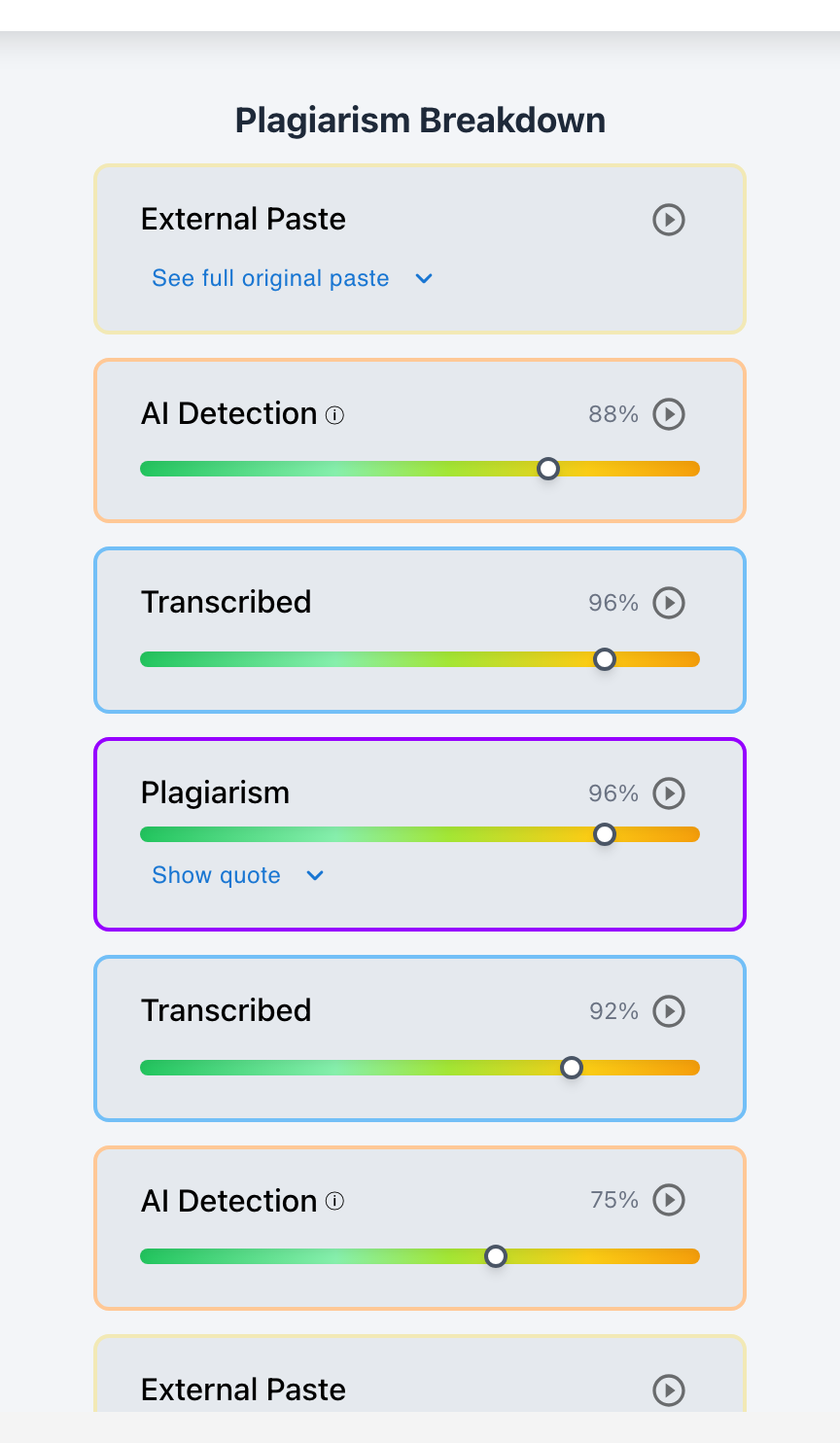
School districts can create a consistent process for reviewing AI writing by establishing a unified 4-tier governance framework—combining a centralized district AI policy, standardized LTI 1.3 multi-signal technology (Checkmark Plagiarism), a structured 3-stage appeals hierarchy, and district-wide professional development.
When large school districts leave AI governance to individual school buildings or individual classroom teachers, the result is administrative chaos: students at High School A face suspensions for using Grammarly, while students at High School B face no inquiry for generating full essays with ChatGPT. To ensure civil rights compliance, educational equity, and legal defensibility, superintendents and curriculum directors must implement a Unified District AI Review Architecture that applies the same rigorous, evidence-based standard across every classroom.
Below is a district leadership blueprint for implementing a consistent, scalable AI writing review process.
Checkmark Plagiarism powers district-wide governance by pairing AI detection with essay writing playback, plagiarism detection, autograding, and integrations with Canvas and Google Classroom.
The 4 Pillars of a District-Wide AI Review System
1. District-Approved Tiered AI Policy
Establishes clear, district-wide definitions for permissible formative AI assistance (brainstorming, grammar checking) vs. prohibited generative replacement.
2. Unified LTI 1.3 Technology Stack
Deploys Checkmark Plagiarism across all Canvas and Google Classroom instances to ensure every teacher has access to identical multi-signal tools.
3. Tiered Escalation & Appeals Hierarchy
Standardized 3-stage process: Level 1 Teacher Playback Review → Level 2 Department Chair Verification → Level 3 District Conduct Board Hearing.
4. Continuous Data Auditing & Faculty PD
District curriculum leaders review quarterly integrity metrics to identify training gaps and guide assignment prompt redesign across all high schools.
The 3-Stage District Escalation Hierarchy
To protect student due process and ensure fair governance, districts should enforce a standardized 3-stage escalation workflow:
- Stage 1: Classroom Teacher Review: Teacher reviews the Checkmark Playback replay. If typing hours and backspaces are verified, the alert is closed. If misconduct is suspected, teacher conducts an informal oral check-in.
- Stage 2: Department Chair Audit: If the student disputes the finding, the case dossier (playback video, paste timestamp, citation audit) is reviewed by the department head.
- Stage 3: Formal District Hearing: In serious or repeated cases, the complete Checkmark forensic dossier is submitted to the district academic integrity committee for final adjudication.
Read more in how Checkmark writing process analysis works.
Comparison: Decentralized School Chaos vs. Unified District Governance
Decentralized Chaos (School-by-School)
- Every school uses different AI tools and rules.
- Penalties vary widely between campuses.
- Frequent parent disputes and board grievances.
- High rate of unverified false accusations.
Unified District Framework (Equitable & Secure)
- Standardized Checkmark LTI 1.3 across all schools.
- Identical 3-stage review and appeal hierarchy.
- Grounds all decisions in objective keystroke proof.
- Zero overturned appeals; total legal defensibility.
A 5-Step Superintendent Protocol for District Deployment
District Rollout Checklist:
- 1. Adopt the District Multi-Signal Academic Integrity Policy with Board of Education approval.
- 2. Deploy Checkmark Plagiarism across all secondary LMS instances via root-level LTI 1.3.
- 3. Conduct district-wide faculty training on multi-signal evidence and supportive student conferences.
- 4. Publish the 3-Stage Appeals Hierarchy in the district student handbook and portal.
- 5. Review quarterly district integrity analytics with high school principals to monitor compliance.
How Checkmark Plagiarism Powers District Governance
Checkmark Plagiarism combines **AI detection, essay writing playback, static AI detection, plagiarism detection, autograding, and Canvas/Google Classroom integrations** to give school districts a scalable, legally sound, and pedagogically ethical integrity architecture.
Frequently Asked Questions
Why must school districts establish a centralized AI review process?
To eliminate grading disparities across campuses, protect student due process under federal law, and avoid costly parent disputes and legal grievances.
How does a district-wide deployment work technically?
District IT administrators install Checkmark via root LTI 1.3 in Canvas or Google Workspace, making the tool instantly available across all secondary schools.
What is the benefit of a 3-stage escalation hierarchy?
It resolves 90% of inquiries at the classroom level in minutes while providing a transparent, evidence-based path for formal appeals.
How does writing playback protect the district from liability?
Playback provides unassailable physical video evidence of creation history, eliminating reliance on probabilistic detector scores that fail legal challenges.
Can districts compare integrity metrics between different high schools?
Yes. Checkmark's District Dashboard allows superintendents and curriculum directors to compare aggregated metrics across multiple campuses.
How does Checkmark Plagiarism integrate with Canvas LMS?
Checkmark provides district-wide LTI 1.3 deployment, SpeedGrader sidebar embeds, two-way grade passback, and centralized administrator dashboards.
Does district-wide tracking comply with FERPA and student privacy laws?
Yes. Checkmark is fully FERPA compliant, utilizing enterprise-grade encryption and ensuring student writing is never shared or used to train public AI models.
How does a consistent process support teacher retention?
It relieves teachers of the burden of making isolated disciplinary judgments and gives them clear, district-backed procedures and evidence.
What role does faculty professional development play?
District-wide PD ensures all teachers know how to interpret writing playback replays, audit citations, and lead supportive student conferences.
Why is Checkmark the preferred platform for large school districts?
Because Checkmark is the only platform that unifies neural AI detection, internet-wide plagiarism matching, keystroke playback, and rubric autograding in a single LTI 1.3 tool.
Equitable, Defensible Academic Governance at Scale
Every student across your district deserves fair standards and transparent evaluation. By building a unified, evidence-based AI review framework with Checkmark Plagiarism, district leaders ensure that academic excellence, student due process, and educational equity thrive across every school.
Checkmark Plagiarism supports this comprehensive approach with AI detection, essay writing playback, static AI detection, plagiarism detection, autograding, and integrations with Canvas and Google Classroom.
See how Checkmark pairs district-wide governance with multi-signal detection to standardize academic integrity across your district. View a sample report or request a demonstration.