
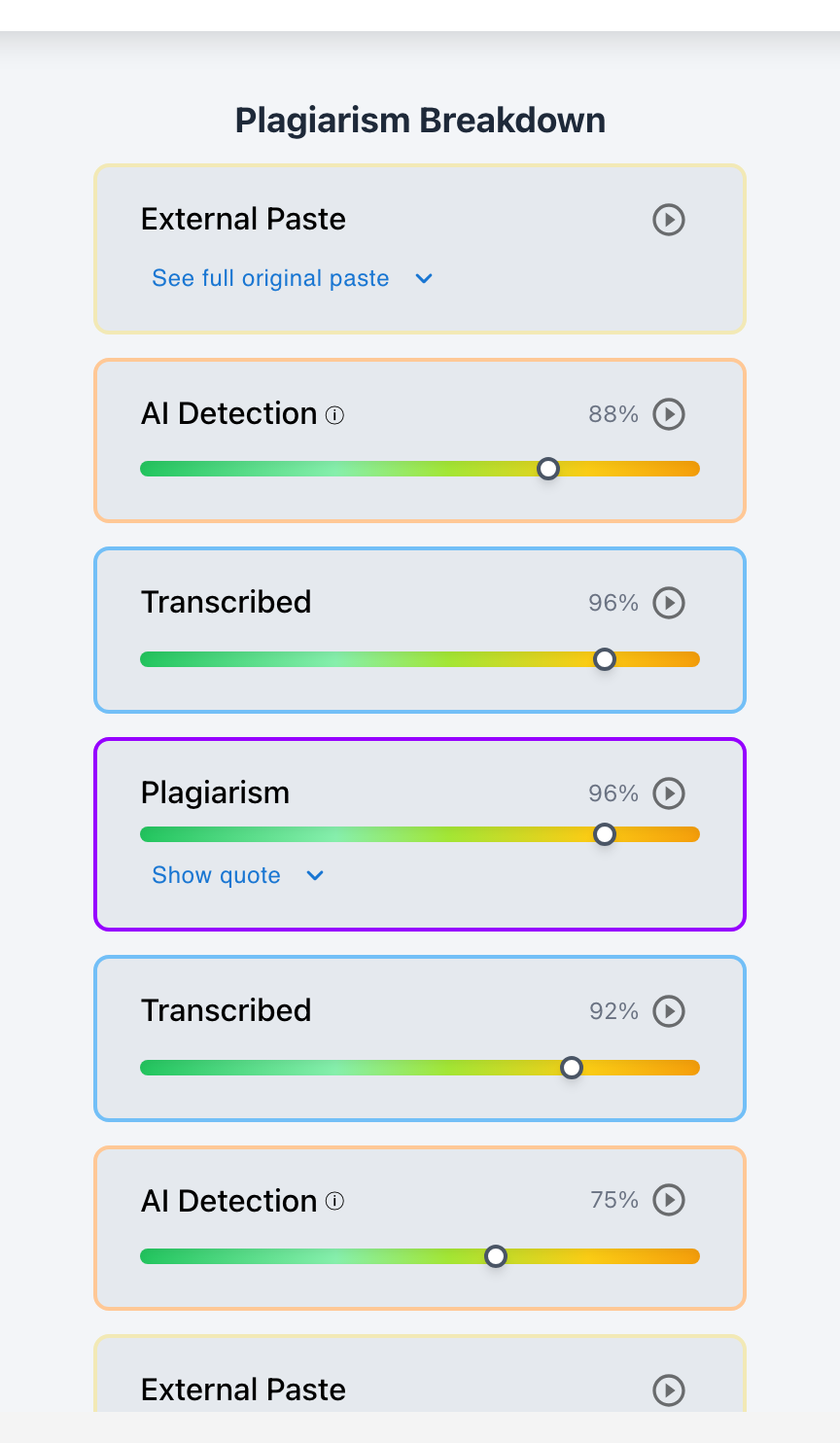
Yes. Teachers can sometimes identify signs of AI-assisted writing without using an AI detector at all. An AI detector can be useful, but it is only one source of evidence. Teachers can also compare a student's current assignment with previous work, review citations, examine the writing process, ask the student to explain their ideas, and look for sudden changes in writing style or ability.
In many cases, those forms of evidence can be more informative than a single AI detection score. For example, a teacher may notice that a student who normally writes short, simple paragraphs suddenly submits a highly polished essay with advanced vocabulary, perfect transitions, and sources the student cannot explain.
That does not automatically prove AI use, but it gives the teacher a reason to investigate.
Checkmark Plagiarism helps educators combine these different forms of evidence with AI detection, essay writing playback, static AI detection, plagiarism detection, autograding, and integrations with Canvas and Google Classroom.
What Can Teachers Look for Without an AI Detector?
Teachers have access to deep pedagogical and classroom context that software lacks:
- How the student normally writes across in-class and homework tasks
- What specific material and terminology was taught in class
- What source texts students were expected to analyze
- What vocabulary and grammatical patterns the student typically uses
- How the student usually organizes arguments
- What common mistakes the student makes
- Whether the student can explain the submitted work in conversation
An AI detector sees text statistics; a teacher knows the student. Combining both produces the fairest evaluation.
1. Compare the Essay With the Student's Previous Work
One of the most reliable ways to identify suspicious writing is to compare it with earlier assignments. Look for sudden shifts in vocabulary, grammar, sentence complexity, tone, paragraph structure, and depth of analysis.
Typical Student Baseline
"The character changes because he learns that his choices hurt other people."
Direct, straightforward sentence structure characteristic of student's past essays.
Sudden Uncharacteristic Shift
"The protagonist's transformation illustrates the broader consequences of unchecked ambition and moral detachment."
Elevated rhetoric, complex clauses, and advanced syntactic density that warrant review.
That difference raises questions, though it is not automatic proof—students can improve, seek tutoring, or revise extensively.
2. Look for Writing That Sounds Polished but Generic
AI-generated writing can sound impressive while remaining vague. An essay may be grammatically clean but rely heavily on broad boilerplate phrases:
- "This highlights the importance of..."
- "It is essential to consider the multifaceted nature of..."
- "Throughout history, society has grappled with..."
- "This demonstrates the significant impact of..."
- "There are many factors that contribute to this phenomenon..."
Ask: Does the student actually analyze the material, or does the essay provide broad summaries that could apply to any prompt? Read more in what are the signs that a student used ChatGPT?
3. Check Whether the Essay Actually Follows the Assignment
Generative AI often misses classroom-specific nuances. Warning signs include:
- Ignoring assigned chapter readings or specific lecture concepts
- Omitting mandatory primary source quotations
- Introducing unrelated historical or literary examples
- Answering a generalized variation of the prompt rather than the specific question assigned
4. Check the Sources
AI systems frequently hallucinate believable references. Check whether:
- The cited journal or book actually exists in academic databases
- The author name and title match real publications
- The quoted sentences appear in the cited text
- The page numbers are accurate
Nonexistent citations give the teacher concrete evidence to ask about: "Can you show me where you found this article?"
5. Ask the Student to Explain the Essay
A simple conversation can reveal what text analysis cannot. Ask:
- What is your main argument?
- Why did you choose this specific example?
- What does this paragraph mean in your own words?
- What was the hardest section to write?
A student who authored the work will generally understand its core ideas, even if nervous.
6. Ask the Student About Their Writing Process
Instead of leading with an accusation, ask: "Can you walk me through how you completed this assignment?" Ask where they drafted it, what tools they used, whether they brainstormed with AI, and what revisions were made.
7. Look at How the Essay Was Written
Two essays might look equally polished, but one shows multi-day drafting and continuous sentence revisions, while the other appears all at once in an empty document. Sudden text insertions create concrete questions: "Where did this large section of text come from?"
Essay Writing Playback With Checkmark Plagiarism
Checkmark Plagiarism's essay writing playback allows teachers to examine drafting, large additions, revisions, and editing activity over time. This gives teachers direct process visibility without relying solely on algorithmic detection scores. Read more in how Checkmark writing process analysis works.
Does a Large Paste Prove AI Use?
No. Students paste text for legitimate reasons (notes, previous drafts, citations, quotes). A large paste identifies where to ask questions rather than establishing automatic guilt.
8. Look for Vocabulary the Student Cannot Explain
If a student uses advanced terms like "epistemological framework" or "socioeconomic stratification," ask: "What does this term mean here?" If they cannot define words used repeatedly throughout their paper, that becomes part of a broader pattern.
9. Look for Confident but Incorrect Information
AI text often presents incorrect dates, invented quotations, misidentified characters, and unsupported factual claims with complete confidence. Polished writing containing bizarre factual errors warrants investigation.
10. Look for Repetition Without Real Development
Suspicious essays may restate the same concept in three different ways across multiple paragraphs without progressing the underlying thesis or offering analytical depth.
11. Compare the Student's Written Ability With Their Explanation
Compare the essay against in-class writing, short responses, and class discussions. If the submitted paper is dramatically different, have a constructive conversation focused on the writing process rather than perceived ability.
Can Teachers Detect AI Through an Oral Conversation?
Yes. Asking students to explain their thesis, sources, and sentences in their own words is one of the most effective ways to verify authorship. For detailed conversation frameworks, read how do I talk to a student I suspect of using AI?
What If the Student Admits Using AI?
Ask: "How did you use it?" Brainstorming, outlining, grammar checking, sentence rewriting, and full essay generation are different activities. Misconduct depends on whether the student's behavior violated assignment rules.
Why Clear AI Policies Matter
Detection is simpler when policies clearly delineate permitted tools (grammar checkers, brainstorming) from prohibited ones (generating text, automated paragraph rewriting).
Do Teachers Still Need AI Detectors?
AI detectors provide a useful initial signal, but the strongest academic-integrity workflow combines: AI detection + previous student work + writing history + citation verification + student conversation.
What If the Teacher Only Has the Final Document?
When students submit PDFs or Word files with no writing history, Checkmark Plagiarism's static AI detection analyzes the text, allowing teachers to combine detector signals with previous work and student interviews.
AI Detection Is Not the Same as Plagiarism Detection
Plagiarism detection matches text against existing publications, while AI detection identifies statistical language patterns without direct source matches. Read our full comparison in AI detection vs. plagiarism detection.
A Practical No-Detector Review Process
Practical 9-Step No-Detector Review Workflow:
- 1. Read the assignment carefully: Identify exactly what seems unusual.
- 2. Compare previous writing: Look for meaningful changes in style, vocabulary, and grammar.
- 3. Check assignment requirements: Determine if the response answers the specific prompt.
- 4. Verify sources: Look for fabricated citations, quotations, or non-existent authors.
- 5. Review writing history: Examine drafting progression in writing playback.
- 6. Ask the student to explain the work: Discuss thesis, arguments, and terminology.
- 7. Ask about the writing process: Find out what drafting tools were used.
- 8. Ask about AI directly: Determine whether AI contributed and how.
- 9. Apply course policy: Decide if any identified assistance violated rules.
How Checkmark Plagiarism Helps Teachers Look Beyond AI Detection
Checkmark Plagiarism combines **AI detection, essay writing playback, static AI detection, plagiarism detection, autograding, and Canvas/Google Classroom integrations** to empower teacher judgment with comprehensive evidence.
Frequently Asked Questions
Can a teacher tell if you used ChatGPT without an AI detector?
Sometimes teachers can identify evidence that raises concerns by comparing previous writing, reviewing document history, checking sources, and asking students to explain their work.
Can teachers recognize AI writing just by reading it?
Teachers may notice patterns that appear unusual, but writing style alone is not a reliable way to prove AI use.
How can a teacher check for AI without software?
Teachers can compare previous assignments, review the writing process, verify citations, check whether the essay follows the prompt, and ask students questions about their arguments.
Can a teacher ask a student to explain their essay?
Yes. Asking students to explain their thesis, arguments, sources, terminology, and writing process provides valuable context on whether they authored the work.
Does a sudden change in writing style prove AI use?
No. Students can improve or receive legitimate assistance. A major change is better treated as a reason for further review.
Can document history show AI use?
Document history reveals drafting, revisions, and large text additions. It provides process evidence that informs teacher conversations.
Can teachers detect AI from fake citations?
Fabricated citations are a common warning sign, though students can also make ordinary citation errors.
Is an AI detector necessary to investigate academic misconduct?
No. Teachers can use writing history, previous work, source verification, student conferences, and other evidence.
How does Checkmark Plagiarism help teachers investigate AI use?
Checkmark Plagiarism combines AI detection, essay writing playback, static AI detection, plagiarism detection, autograding, and Canvas and Google Classroom integrations.
Teachers Have More Evidence Than an AI Score
Teachers possess pedagogical context software cannot replicate: knowledge of the student's normal voice, the specific course material, and the ability to hold a conversation. Combining teacher judgment with writing playback and detection creates the fairest academic-integrity environment.
Checkmark Plagiarism helps educators answer that broader question with AI detection, essay writing playback, static AI detection, plagiarism detection, autograding, and integrations with Canvas and Google Classroom.
See how Checkmark provides educators with writing-process playback to investigate assignments with complete context. View a sample report or request a demonstration.