
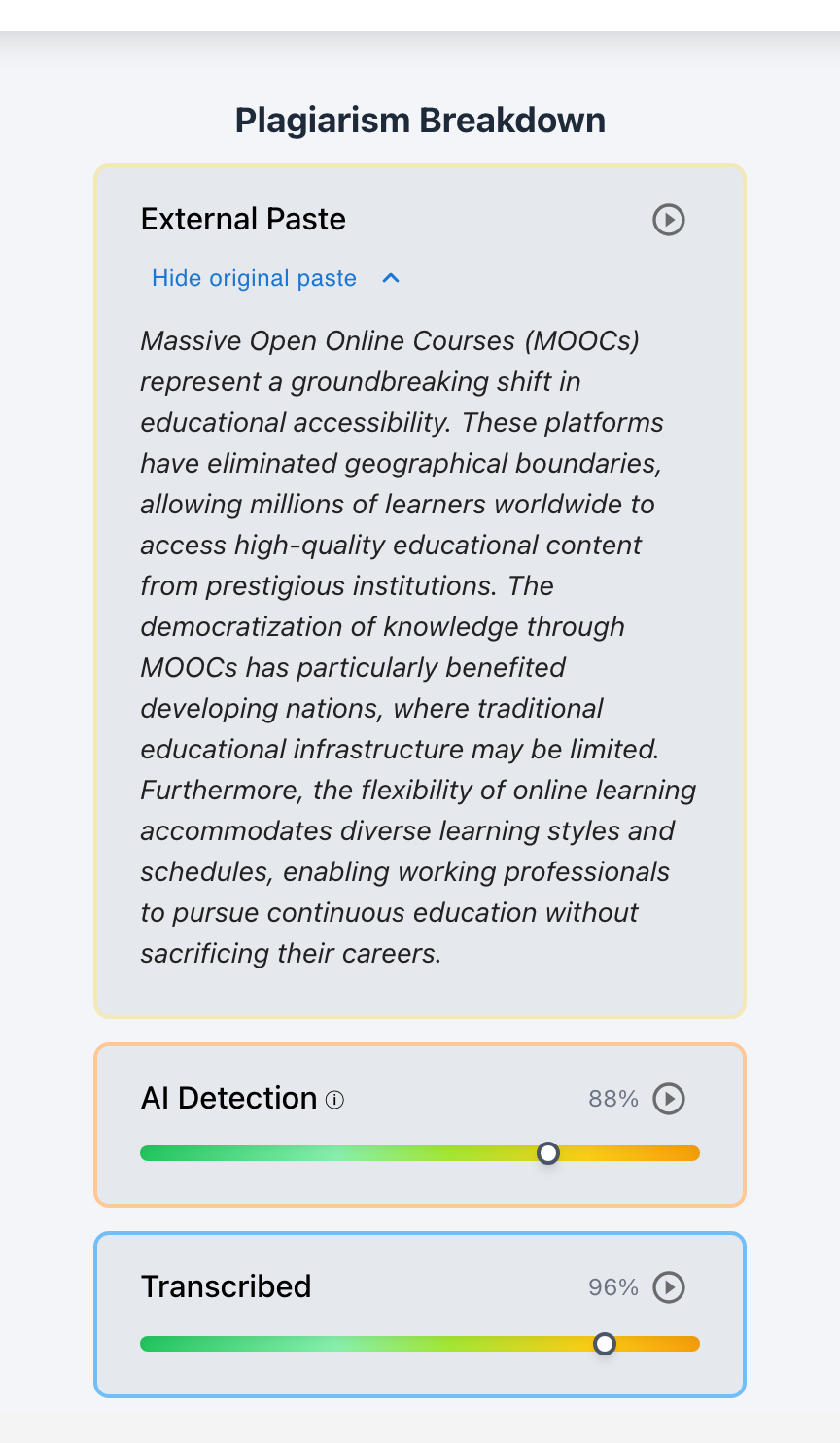
ChatGPT can produce essays, short-answer responses, discussion posts, and research summaries that sound polished and convincing. That can make it difficult for teachers to determine whether a student completed an assignment independently. There is no single writing pattern that proves a student used ChatGPT, but there are several warning signs that may justify a closer look-including sudden style shifts, generic responses, fabricated citations, and unusual document history.
AI-generated writing can resemble human writing, and students may also use AI in different ways-from brainstorming ideas to generating an entire assignment.
Tools such as Checkmark Plagiarism can help teachers investigate these signals with AI detection, essay writing playback, static AI detection, plagiarism checking, autograding, and integrations with Canvas and Google Classroom.
1. The Student's Writing Style Suddenly Changes
One of the first things teachers may notice is that an assignment sounds very different from the student's previous work.
A student who normally writes short, straightforward sentences may suddenly submit an essay filled with sophisticated vocabulary, complex transitions, and highly structured arguments.
For example, a student's earlier assignments might contain simple sentences such as:
"The character changes because he learns from what happened."
A later assignment might suddenly contain language like:
"The protagonist's transformation reflects a broader examination of personal accountability and the consequences of unchecked ambition."
The second sentence is not automatically evidence of AI use. Students improve. They receive tutoring. They revise. They use dictionaries and grammar tools.
But a dramatic change in writing style can be a reason to compare the assignment more carefully with the student's previous work.
Look for differences in:
- Vocabulary
- Sentence length
- Grammar
- Organization
- Tone
- Writing sophistication
- Use of transitions
- Typical mistakes
The more familiar a teacher is with a student's normal writing, the easier it may be to recognize unusual changes.
2. The Writing Sounds Polished but Generic
ChatGPT is often very good at producing writing that sounds professional while saying relatively little.
An AI-generated paragraph may contain grammatically correct sentences, clear transitions, and an organized structure but still feel vague.
For example, an essay might repeatedly use phrases such as:
- "This highlights the importance of..."
- "It is important to consider..."
- "This demonstrates how..."
- "In today's rapidly changing world..."
- "There are several factors that contribute to..."
None of these phrases is inherently suspicious. Human writers use them too.
The concern is when an entire assignment relies on broad statements without demonstrating the specific knowledge, examples, or interpretation expected from the student.
A polished paper that avoids engaging directly with class discussions, assigned readings, or specific instructions may deserve additional review.
3. The Assignment Does Not Fully Answer the Prompt
ChatGPT can produce a strong-looking response while still misunderstanding part of an assignment.
A paper may discuss the general topic correctly but fail to address an important instruction.
For example, an assignment might ask students to:
- Compare two characters.
- Use evidence from Chapter 6.
- Connect the comparison to a concept discussed in class.
An AI-generated response might provide an excellent general comparison while ignoring Chapter 6 or the classroom concept entirely.
Teachers should look for assignments that are polished but strangely disconnected from the details of the prompt.
Possible warning signs include:
- Ignoring required readings
- Failing to use assigned sources
- Missing specific instructions
- Discussing the topic broadly instead of answering the question
- Referencing concepts that were not part of the course
- Using examples unrelated to classroom material
A response that sounds strong but does not actually complete the assigned task can indicate that the student relied too heavily on a general-purpose AI tool.
4. The Student Uses Vocabulary They Cannot Explain
Advanced vocabulary alone does not mean a student used ChatGPT.
However, teachers may become suspicious when a student uses terminology correctly in an assignment but cannot explain what those terms mean.
Suppose an essay includes phrases such as "systemic socioeconomic inequality" or "the epistemological implications of the argument."
A teacher might simply ask: "What do you mean by that?"
If the student can explain the concept naturally, there may be little reason for concern.
If the student cannot explain the language they submitted, that may suggest the wording came from another source.
The same principle applies to arguments and conclusions. Students should generally be able to explain the ideas presented under their name.
5. The Writing Contains Confident but Incorrect Information
One characteristic of generative AI systems is that they can produce incorrect information in a confident tone.
A response may sound authoritative while containing:
- Incorrect dates
- Invented historical events
- Misrepresented facts
- Incorrect quotations
- False claims about a source
- Confused character names
- Events that never happened in the assigned text
These mistakes can be particularly noticeable when the prose surrounding them is unusually polished.
Of course, students also make factual mistakes. The warning sign is the combination of highly confident language and information that appears to have been invented or misunderstood.
Teachers should verify unusual claims before drawing conclusions.
6. Citations Do Not Exist
Fabricated sources can be another warning sign. Generative AI tools may sometimes produce references that look legitimate but do not correspond to real publications.
A citation may include:
- A believable author
- A plausible article title
- A realistic journal name
- A year of publication
- Page numbers
But when the teacher searches for the source, it does not exist.
Teachers reviewing suspicious assignments can check whether:
- The source exists
- The author wrote the cited work
- The publication information is accurate
- The cited page contains the claim
- The quotation actually appears in the source
A fabricated citation does not prove ChatGPT use, but several invented or inaccurate references can be a strong reason to investigate further.
7. The Essay Repeats the Same Ideas in Different Words
AI-generated writing can sometimes become repetitive.
A paragraph introduces an idea. The next paragraph restates it. The conclusion explains essentially the same point again.
The writing may be grammatically correct while adding very little new information.
Teachers may notice repeated patterns such as:
"Technology has changed education in many ways."
followed by: "Education has been significantly affected by technological advancements."
and later: "The impact of technology on modern education cannot be overlooked."
Each sentence sounds reasonable, but the argument may not actually be progressing.
Repeated ideas without deeper analysis can be one signal of AI-assisted writing.
8. Every Paragraph Is Unusually Structured
ChatGPT often generates highly organized responses. That is not necessarily a problem. Organization is good writing.
However, a student's work may become suspicious when every paragraph follows nearly the same pattern:
The essay may also contain unusually consistent paragraph lengths and transitions.
Human writing is often less uniform. Students change direction, revise sentences, emphasize some points more than others, and make small structural mistakes.
Extremely consistent structure is not proof of AI use, but it can be another signal when combined with other evidence.
9. The Introduction and Conclusion Sound Especially Generic
AI-generated introductions often begin with broad statements about society, history, education, or the importance of a topic.
For example: "Throughout history, literature has played an important role in helping people understand the human experience."
A conclusion might end with something similarly broad: "Ultimately, this demonstrates why these issues remain important in today's society."
Both sentences could easily be written by a student. The concern is not the sentence itself-it is when an essay relies heavily on generic statements instead of showing the student's own interpretation of the specific assignment.
Teachers can ask whether the introduction and conclusion actually contribute to the argument or merely make the essay sound complete.
10. The Student Cannot Explain Their Own Argument
One of the most useful ways to investigate suspicious writing is to ask the student about it.
Teachers do not necessarily need to confront the student by asking: "Did you use ChatGPT?"
Instead, ask questions about the content:
- What is your main argument?
- Why did you choose this example?
- What does this sentence mean?
- How does this source support your conclusion?
- What was the hardest part of the assignment?
- Which part did you revise the most?
- Can you explain this paragraph in your own words?
A student who wrote an assignment should usually have some understanding of the decisions behind it.
If a student cannot explain key arguments, vocabulary, sources, or examples in their submission, teachers may want to investigate further.
11. Large Sections of the Essay Appear Suddenly
The final text is only one source of evidence. How the assignment was created can sometimes provide much more useful information.
Consider two essays that contain nearly identical-quality writing:
Student A (Gradual Drafting)
- Writes an outline
- Drafts paragraphs over time
- Deletes sentences
- Reorganizes ideas & adds evidence
- Revises the conclusion
Student B (Instant Paste Block)
- Document remains mostly empty
- Several hundred words appear at once
- Zero drafting or revision history
- Submitted shortly after creation
Those writing histories are very different. Large blocks of text appearing suddenly may indicate that content was pasted from another location-which could be ChatGPT, another AI system, a website, notes, or another document.
Pasting alone does not prove misconduct, but it provides valuable context when combined with other evidence.
Reviewing Writing History With Checkmark Plagiarism
Checkmark Plagiarism's essay writing playback allows teachers to review how an assignment developed over time. Instead of looking only at the finished essay, teachers can examine the writing process and identify activity such as large additions of text, gradual drafting, editing patterns, revisions, and deleted passages. Read more in how Checkmark writing process analysis works.
This helps answer a more useful question than simply: "Does this essay sound like ChatGPT?" Educators can also ask: "How did this student actually create the assignment?"
12. An AI Detector Flags the Assignment
AI detection can provide another signal. AI detectors analyze patterns in text and estimate whether portions of the writing may have been generated by an AI system.
Checkmark Plagiarism provides AI detection that teachers can use when reviewing student assignments.
However, an AI detection result should not automatically be treated as proof. AI detectors can make mistakes-human-written text may sometimes be flagged, and AI-generated text can sometimes avoid detection. For details on detector limits, see what an AI score can and cannot tell you.
For that reason, teachers should consider an AI detection result alongside other evidence:
- A dramatic change in student writing
- Unusual document history
- Fabricated citations
- Large pasted sections
- A student who cannot explain the work
The goal should be to build context rather than rely on one percentage.
What If There Is No Writing History?
Sometimes teachers receive a completed document without access to how it was written, such as a PDF, Microsoft Word document, completed essay written elsewhere, text pasted into an LMS, or a file created outside the school's normal writing environment.
In these cases, writing playback may not be available.
Checkmark Plagiarism's static AI detection allows teachers to analyze submitted documents even when the complete writing process is unavailable. That gives educators another way to review assignments that were created outside monitored classroom workflows.
Can You Tell Exactly Which AI Tool a Student Used?
Usually, no. Looking at a submitted essay may provide reasons to suspect AI-assisted writing, but it generally cannot establish that a specific tool such as ChatGPT was responsible.
A student could have used ChatGPT, Gemini, Claude, Microsoft Copilot, another generative AI system, multiple AI systems, or AI-generated text that was rewritten manually.
That is why schools may be better served by focusing on whether the assignment reflects the student's own work and whether the student's use of AI complies with course policy. The exact product used may matter less than how AI contributed to the submission.
Do AI Writing Signs Prove That a Student Cheated?
No. Individual warning signs should not automatically be treated as proof of misconduct.
A sophisticated vocabulary word does not prove AI use. A polished introduction does not prove AI use. Pasted text does not prove AI use. Even an AI detection result does not necessarily prove that a student violated a school's policy.
Multi-Signal Evidence Review:
Writing style + AI detection + writing history + citation verification + student conversation
Together, these signals provide much more context than any one indicator alone.
How Checkmark Plagiarism Helps Teachers Investigate Possible AI Use
Identifying suspicious writing is only the beginning. Teachers also need a practical way to review assignments without manually investigating every submission across multiple systems.
Checkmark Plagiarism helps schools evaluate student work using multiple forms of evidence:
- AI detection for identifying writing that may contain AI-generated content
- Essay writing playback for reviewing how an assignment developed
- Static AI detection for analyzing submitted documents without writing-history data
- Plagiarism detection for identifying potential source matches
- Autograding to help streamline assignment review
- Canvas integration
- Google Classroom integration
Rather than asking teachers to make a decision based entirely on an AI detector score, Checkmark Plagiarism helps educators review both the final submission and evidence surrounding how the assignment was produced.
What Should a Teacher Do After Seeing Several Warning Signs?
If an assignment contains multiple signs of possible ChatGPT use, a teacher can follow a simple review process:
- 1 Compare the assignment with the student's previous writing.
- 2 Review assignment instructions and identify anything the response missed.
- 3 Verify suspicious facts, quotations, and citations.
- 4 Review AI detection results.
- 5 Examine writing playback or document history when available.
- 6 Ask the student to explain important parts of the assignment.
- 7 Compare the evidence with the school's AI-use policy.
This approach gives students an opportunity to explain their work while giving teachers more information before making an academic-integrity decision.
Frequently Asked Questions
What does ChatGPT writing usually look like?
ChatGPT-generated writing may appear polished, organized, grammatically consistent, and sometimes generic or repetitive. However, human writing can share all of those characteristics, so style alone cannot reliably prove AI use.
What is the biggest sign that a student used ChatGPT?
There is no single definitive sign. A sudden change in writing style, unusual writing history, fabricated citations, AI detection results, and inability to explain the submitted work may become more significant when several appear together.
Does copying and pasting prove a student used ChatGPT?
No. Students may paste quotations, notes, citations, or writing created elsewhere. Large amounts of polished text appearing at once can justify further review, but teachers should consider the context.
Can ChatGPT make up sources?
Generative AI systems can produce incorrect or fabricated references. Teachers should verify sources that appear unusual or that cannot easily be located.
Can an AI detector prove a student used ChatGPT?
An AI detector can identify patterns that may be associated with AI-generated writing, but the result should generally be considered one piece of evidence rather than definitive proof.
How can teachers see whether a student actually wrote an essay?
Writing-process evidence can help. Checkmark Plagiarism's essay writing playback allows teachers to review how an assignment developed, including drafting, revisions, and larger additions of text.
Can Checkmark Plagiarism check documents written outside an LMS?
Yes. Static AI detection can be used to analyze submitted documents when complete writing-history information is not available.
Does Checkmark Plagiarism integrate with school LMS platforms?
Checkmark Plagiarism integrates with Canvas and Google Classroom, allowing schools to incorporate AI detection and assignment review into existing classroom workflows.
Look for Patterns, Not a Single "Gotcha"
The most important thing for teachers to remember is that there is no magic sentence structure, vocabulary word, or AI score that proves a student used ChatGPT.
Instead, look for patterns.
A sudden writing change may be interesting. A fabricated citation may be interesting. An unusual AI detection result may be interesting. A document that suddenly gains 1,000 polished words may be interesting.
When several of those signals appear together, teachers have a stronger reason to investigate.
Checkmark Plagiarism helps educators bring those signals together with AI detection, essay writing playback, static AI detection, plagiarism checking, autograding, and Canvas and Google Classroom integrations.
For schools adapting to generative AI, the goal should not be to guess based on how an essay sounds. It should be to give teachers enough evidence to understand how the work was created and make a fair, informed decision.
See how Checkmark helps teachers evaluate possible ChatGPT use with more context than an AI score alone. View a sample report or request a demonstration.