
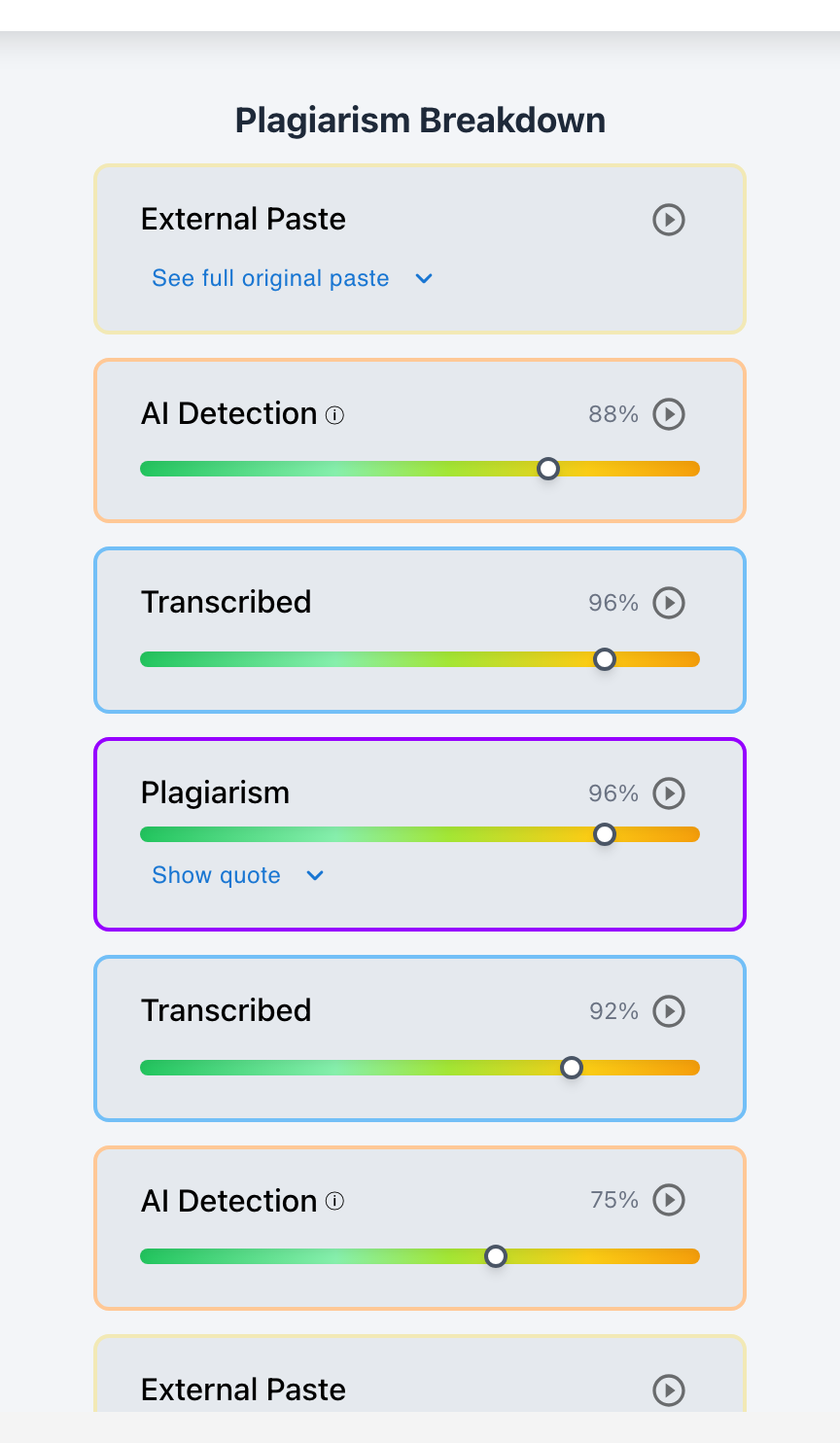
No. While manually rewriting or retyping ChatGPT-generated text can lower scores on simple automated AI detectors, students cannot hide AI usage from a comprehensive, multi-signal evaluation.
A common strategy among students looking to bypass AI detectors is to generate an essay with ChatGPT on a second monitor or smartphone and manually retype it—rephrasing sentences, replacing complex vocabulary, or intentionally introducing minor grammatical errors. While this tactic evades basic copy-paste detection, it leaves clear structural, forensic, physical, and behavioral footprints that experienced teachers readily spot.
Rewriting text alters surface vocabulary, but it does not change the underlying generative blueprint: formulaic architectural symmetry, lack of localized classroom context, hallucinated citations, linear transcription typing cadences, and oral comprehension gaps.
Checkmark Plagiarism exposes rewritten AI text by combining AI detection with essay writing playback, static AI detection, plagiarism detection, autograding, and integrations with Canvas and Google Classroom.
How Students Attempt to Disguise ChatGPT Text
1. Manual Transcription & Retyping
Reading ChatGPT output from a phone or second window and typing it into the assignment word-for-word to simulate keystroke history.
2. Synonym & Phrasing Tweaks
Swapping out signature AI words (e.g., changing "delve" to "look into") while keeping the exact sentence structure and argument flow intact.
3. Clause Inversion & Simplification
Breaking long AI sentences into shorter clauses or flipping passive voice to active to disrupt automated perplexity calculations.
4. Hybrid Drafting
Writing authentic introduction and conclusion paragraphs while rewriting AI-generated text for complex body and analysis sections.
Why Rewriting ChatGPT Still Leaves Unmistakable Clues
1. Transcription Cadence in Essay Writing Playback
There is a vast behavioral difference between composing thoughts and copying text from another screen. When reviewing Checkmark Plagiarism's essay writing playback, teachers can observe:
- Continuous Linear Speed: A student transcribing text types at a constant, uninterrupted 60–80 words per minute from the first sentence to the last.
- Absence of Ideation Pauses: Authentic drafting features frequent pauses—stopping for 30–90 seconds to think, research, or outline the next thought. Transcription lacks developmental pauses.
- Lack of Structural Restructuring: Authentic human writers frequently delete entire paragraphs, rewrite introductions halfway through, or reorganize evidence. Transcribed text proceeds in a single, unedited linear stream.
Read more in how Checkmark writing process analysis works.
2. Rewriting Does Not Fix Hallucinated Citations
If ChatGPT invented a non-existent journal article, fake author, or phantom DOI, manually retyping that citation does not make the publication real. Searching JSTOR or Google Scholar immediately reveals that the source does not exist. Read more in can ChatGPT cite sources that don't exist?
3. Preserving ChatGPT's Formulaic Architecture
Even when rewritten in casual language, the essay retains ChatGPT's distinct structural blueprint:
- A rigid, symmetrical 3-point progression across identical paragraph lengths.
- Compulsive balance and neutrality that avoids taking a bold, personal stance.
- Generic analysis that completely avoids mentioning specific classroom lectures, handouts, or local discussions.
Comparison: Authentic Human Drafting vs. Rewritten AI Transcription
Authentic Human Drafting
- Non-linear keystrokes: deletions, backspacing, restructuring.
- Multi-session timeline: outline → draft → revision.
- Deep integration with class-specific discussions and page numbers.
- All cited academic sources exist and are verified.
- Student fluently explains all arguments and revisions orally.
Rewritten AI Transcription
- Single-session, continuous linear typing cadence.
- Zero structural reorganizations or major paragraph deletes.
- Generic analysis that avoids classroom constraints.
- Contains non-existent or hallucinated academic citations.
- Student struggles to explain complex concepts during conferences.
The Oral Conference: The Ultimate Test of Authorship
No matter how carefully a student rephrased ChatGPT text, they cannot fake conceptual mastery during a live conference:
- "Can you explain your thesis and why you chose this specific argument?"
- "What does this technical term mean in Section 3?"
- "Where did you find this journal article, and what was the author's primary finding?"
A student who simply transcribed AI output will stumble, while a student who authentically wrote the paper will explain their ideas with natural familiarity. Read our guide on what questions should I ask a student about a suspicious assignment?
A 6-Step Protocol to Detect Rewritten AI Submissions
Educator Verification Protocol for Rewritten AI:
- 1. Review essay writing playback to inspect keystroke cadences, typing speed, and ideation pauses.
- 2. Audit all cited academic sources in Google Scholar or JSTOR to catch hallucinated references.
- 3. Inspect the document for rigid architectural symmetry and generic prompt responses.
- 4. Compare the submission against verified historical student baseline writing samples.
- 5. Hold a brief, supportive conference to evaluate real-time oral conceptual mastery.
- 6. Base academic integrity determinations on the cohesive multi-signal evidence package.
How Checkmark Plagiarism Exposes Rewritten AI Text
Checkmark Plagiarism combines **AI detection, essay writing playback, static AI detection, plagiarism detection, autograding, and Canvas/Google Classroom integrations** to analyze typing behavior, audit citations, and give educators unassailable proof of authorship.
Frequently Asked Questions
Can teachers tell if you retype ChatGPT word-for-word?
Yes. Essay writing playback captures the continuous linear typing speed without natural drafting pauses or revisions, revealing transcription from another screen.
Does rewriting ChatGPT in your own words bypass AI detectors?
It may lower statistical detector scores, but it does not bypass essay writing playback analysis, citation verification, baseline comparisons, or oral comprehension checks.
Why does transcribing ChatGPT look different in version history?
Authentic writing is messy and iterative—typing, backspacing, pausing, and restructuring. Transcribing looks like a continuous, unbroken stream of perfect prose.
Can citation checks catch rewritten ChatGPT essays?
Yes. Manually retyping a hallucinated citation does not make the source real. When teachers search academic databases, non-existent sources immediately expose AI use.
What if a student genuinely writes very quickly with few revisions?
Fast authentic writers still show natural keystroke cadences, distinct sentence rhythms, valid sources, and fluent oral mastery during conferences.
Is using ChatGPT to write an essay and then rewriting it considered cheating?
Yes, unless explicitly permitted by the instructor. Using AI to generate the core arguments and structure constitutes unauthorized assistance and authorship misrepresentation.
How does comparing previous student writing reveal rewritten AI?
It shows whether the underlying analytical depth and argument structure match the student's authentic baseline or represent an uncharacteristic leap in reasoning.
What should a teacher do if they suspect an essay was transcribed from ChatGPT?
Examine writing playback logs, audit citations in academic databases, and invite the student to discuss their research journey in a supportive conference.
Can Checkmark Plagiarism distinguish between typing and pasting?
Yes. Checkmark's essay writing playback records exact keystroke timestamps, distinguishing between keystroke typing, wholesale pastes, and linear transcription.
How does Checkmark Plagiarism help teachers detect rewritten AI?
Checkmark Plagiarism provides visual playback replays, citation verification logs, dual AI/plagiarism scans, and seamless LMS integration.
Superficial Rewriting Cannot Replace Authentic Thinking
Rewriting or transcribing ChatGPT output alters surface words, but it cannot manufacture genuine human ideation, authentic research, or iterative drafting timelines. By evaluating the complete writing process, educators uphold scholarship with absolute clarity and fairness.
Checkmark Plagiarism supports this comprehensive approach with AI detection, essay writing playback, static AI detection, plagiarism detection, autograding, and integrations with Canvas and Google Classroom.
See how Checkmark pairs essay writing playback with multi-signal detection to expose rewritten AI text and verify authentic drafting. View a sample report or request a demonstration.