
Yes. Brief, targeted oral follow-up questions are among the most reliable, decisive, and humane methods available to verify student authorship and detect unauthorized AI use.
While generative AI tools like ChatGPT can write flawless essays and automated paraphrasers can lower statistical detector scores, a student who did not write the paper cannot fake genuine conceptual mastery during a live conversation. A student who spent days researching, outlining, typing, and revising will naturally and comfortably explain their ideas, whereas a student who submitted AI-generated text will struggle to define complex vocabulary, summarize arguments, or explain how sources were located.
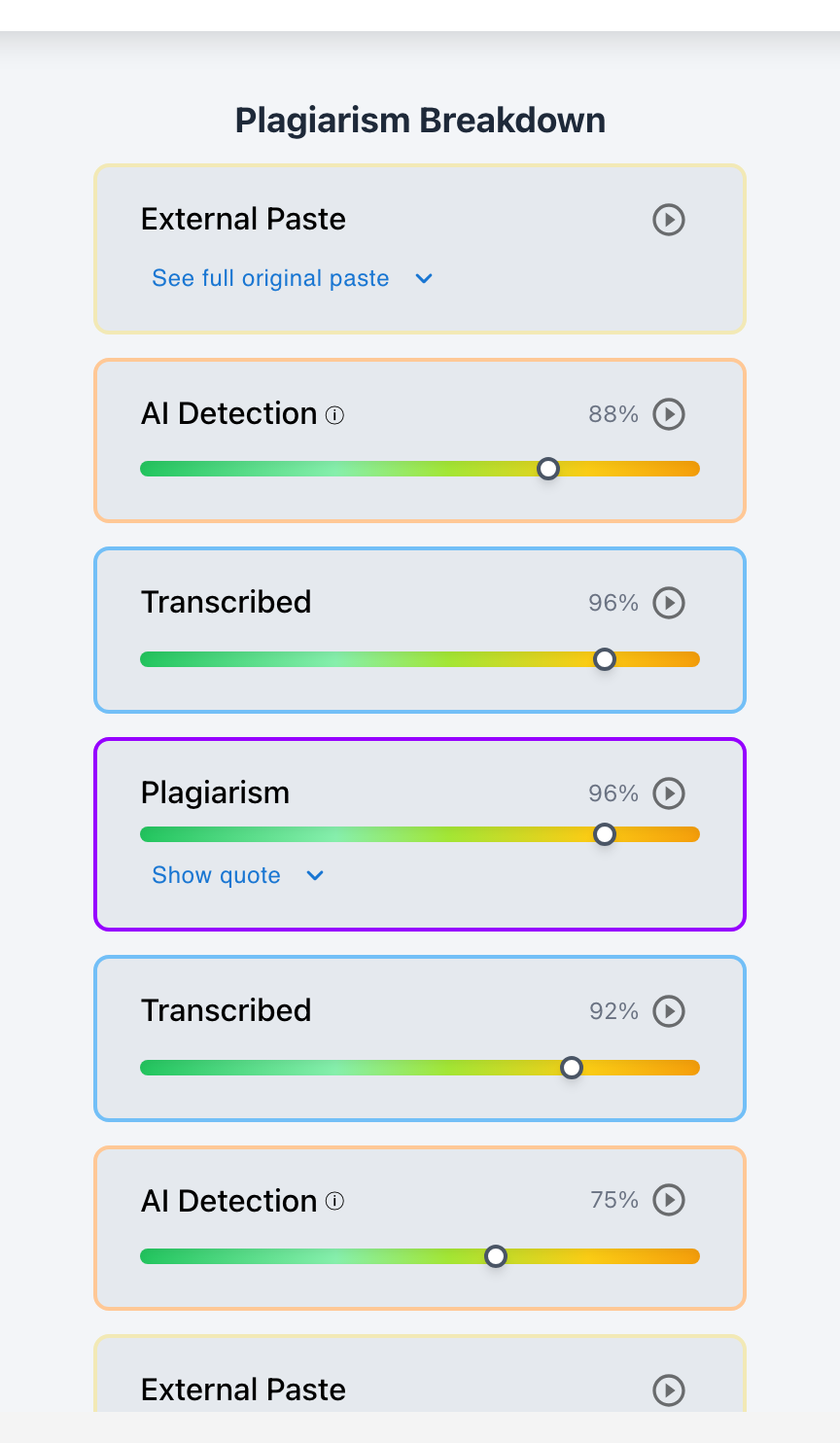
When paired with essay writing playback timelines and citation audits, a 2-minute oral check-in provides undeniable, due-process-compliant proof of authentic student ownership.
Checkmark Plagiarism supports oral verification by pairing essay writing playback with AI detection, plagiarism detection, autograding, and integrations with Canvas and Google Classroom.
The 4 Dimensions Tested by Oral Follow-Up Questions
1. Thesis & Conceptual Mastery
Can the student articulate the core thesis and main supporting arguments in their own everyday conversational language?
2. Vocabulary & Phrasing Ownership
Can the student define advanced technical terms or explain complex sentences found within their submitted paragraphs?
3. Research & Source Retrieval
Can the student explain how they located a specific cited study and summarize the author's primary findings without reading from the page?
4. Writing Process & Revision Recall
Can the student describe which section was hardest to write, what changed between drafts, and why specific arguments were cut?
Sample Oral Verification Questions for Educators
Keep questions open-ended, supportive, and focused on inquiry rather than accusation:
- "Can you summarize your main argument and conclusion for me in 30 seconds?"
- "In paragraph 3, you used the phrase [insert technical term]. What does that mean in your own words?"
- "How did you find this specific journal article, and what was the author's main takeaway?"
- "Which part of this essay took you the longest to draft, and what made it challenging?"
Read our complete question bank in what questions can I ask to find out if a student used ChatGPT?
How to Interpret Student Spoken Responses
Authentic Authorship Signals
- Speaks freely in conversational words without reading.
- Recalls specific research struggles and deleted ideas.
- Understands the basic claims of cited sources.
- Comfortably defines vocabulary used in the paper.
AI Disconnect Signals
- Reads directly from the paper rather than speaking freely.
- Cannot define advanced vocabulary or technical terms.
- Has no memory of cited sources or where they were found.
- Cannot explain why the paper took a specific stance.
How Essay Writing Playback Grounds the Conversation
Oral questions are most powerful when anchored in objective timeline data from Checkmark Plagiarism's essay writing playback:
- "Playback shows that paragraphs 3 and 4 were pasted into the document at 11:15 PM in one event. Can you walk me through how you wrote those sections?"
- "I see that total active typing time was 12 minutes for this 1,500-word paper. Can you show me the rough notes you were working from?"
Read more in how Checkmark writing process analysis works.
A 5-Step Protocol for Conducting 2-Minute Oral Check-Ins
Educator Oral Check-In Protocol:
- 1. Frame the check-in as a routine, low-stakes celebration of their research and writing.
- 2. Ask the student to summarize their thesis and core arguments without looking at the paper.
- 3. Pick one technical term from the essay and ask the student to define it in plain language.
- 4. Ask about one cited academic source and where it was located.
- 5. Corroborate responses with essay writing playback logs before finalizing grades.
How Checkmark Plagiarism Prepares Teachers for Conferences
Checkmark Plagiarism combines **AI detection, essay writing playback, static AI detection, plagiarism detection, autograding, and Canvas/Google Classroom integrations** to generate instant evidence summaries, making student check-ins fast, fair, and objective.
Frequently Asked Questions
Why is an oral question more effective than an AI detector score?
Detectors provide statistical probabilities, whereas oral questions test real human comprehension. A student who wrote an essay understands it; a student who used AI does not.
What if a student gets anxious and freezes during questioning?
Create a supportive environment. Ask low-stakes questions first ("What was the most interesting fact you learned?") to help them relax before discussing specific arguments.
How long does an oral check-in take?
A focused check-in takes only 2–3 minutes during class time or office hours to verify genuine conceptual ownership.
Can students with high anxiety write their answers instead?
If needed for accommodations, ask the student to handwrite a 5-minute in-class summary of their thesis and sources without access to the internet.
What if a student cannot define vocabulary in their essay?
Repeated inability to explain words or sentences used in their own paper strongly indicates that the student did not author the text independently.
Should oral follow-up questions be announced in the syllabus?
Yes. Clearly state that short oral check-ins or defenses may be used to verify authorship on all major written assignments.
Can writing playback be shared with the student during the meeting?
Yes. Reviewing the writing playback timeline together grounds the conversation in observable facts rather than subjective accusations.
How do oral questions protect students from false accusations?
A student whose paper was falsely flagged by an AI detector can easily prove authentic authorship by speaking fluently about their research and writing.
What if a student admits they used ChatGPT during the check-in?
Acknowledge their honesty, determine the extent of AI involvement, and follow your course policy regarding revision opportunities or integrity reporting.
How does Checkmark Plagiarism support oral check-ins?
Checkmark Plagiarism highlights key vocabulary, flags wholesale paste timestamps, and audits citations directly inside Canvas and Google Classroom.
Dialogue Reveals Genuine Intellectual Growth
Oral questioning turns assessment into a meaningful conversation between teacher and student. By pairing spoken dialogue with essay writing playback and citation audits, educators defend academic rigor while fostering genuine intellectual confidence.
Checkmark Plagiarism supports this principled standard with AI detection, essay writing playback, static AI detection, plagiarism detection, autograding, and integrations with Canvas and Google Classroom.
See how Checkmark pairs essay writing playback with multi-signal detection to support fast, fair, and conclusive student oral check-ins. View a sample report or request a demonstration.