
When an educator suspects that a student relied on ChatGPT to complete an essay, the most effective way to uncover the truth is not an accusation—it is a series of strategic, open-ended questions.
Direct accusations ("Did ChatGPT write this?") trigger immediate panic, defensiveness, and blanket denials. In contrast, curiosity-driven questions about the writing process, thesis development, source retrieval, and vocabulary allow honest students to demonstrate authentic mastery while gently revealing when a student is disconnected from the work submitted under their name.
Below is a curated bank of 25+ targeted questions categorized across the writing lifecycle, designed to evaluate authorship fairly, constructively, and defensibly.
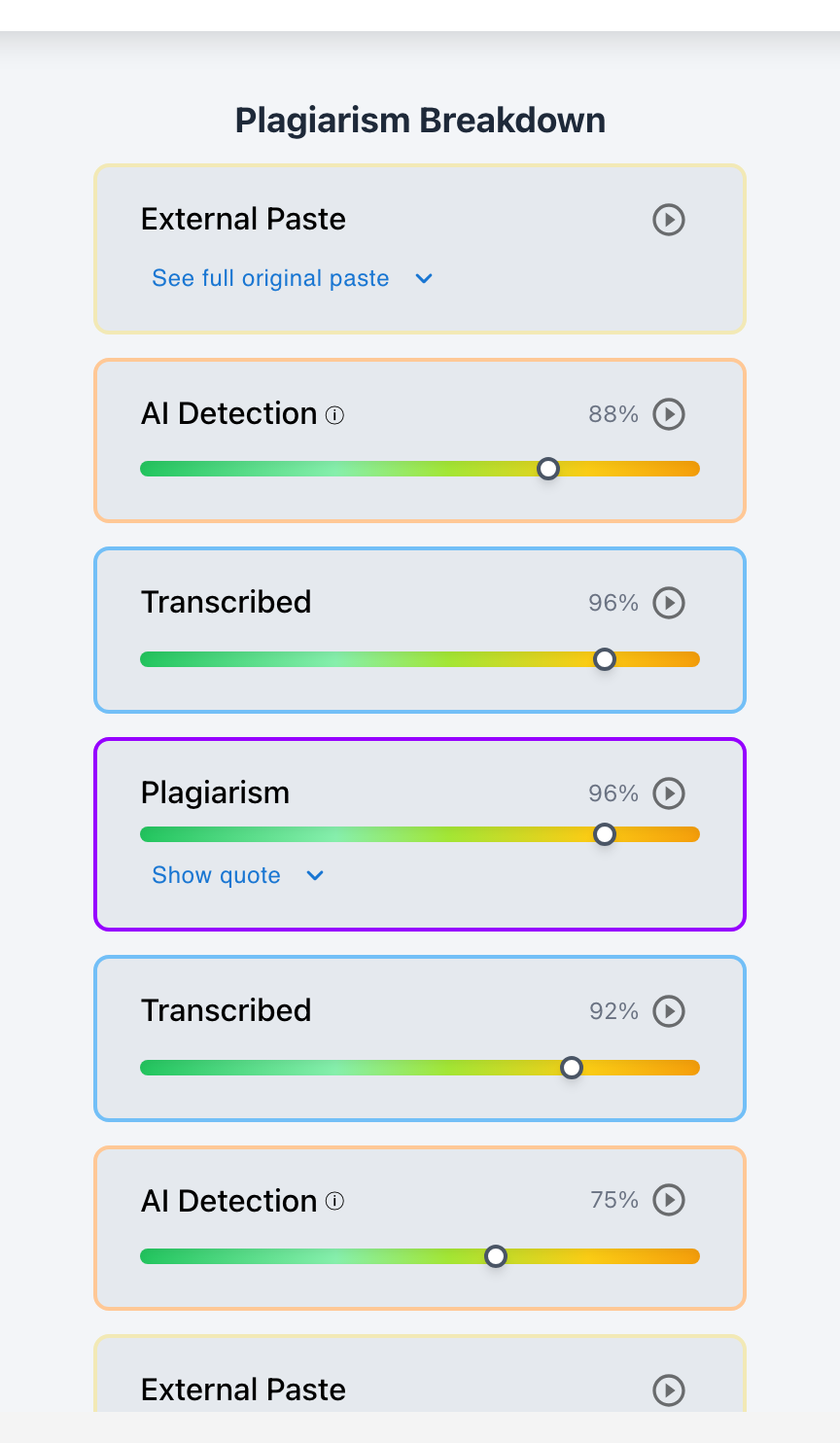
Checkmark Plagiarism supports these student dialogues by pairing AI detection with essay writing playback, static AI detection, plagiarism detection, autograding, and integrations with Canvas and Google Classroom.
The 5 Categories of Strategic Verification Questions
1. Writing Process & Timeline
Inquiries that explore how the essay developed from initial brainstorming to final revisions.
2. Conceptual & Thesis Defense
Questions testing real-time oral comprehension of the central arguments and counterpoints.
3. Vocabulary & Terminology
Checks asking students to define advanced terms and complex sentences in plain words.
4. Research & Citation Integrity
Questions investigating how sources were located, evaluated, and connected to arguments.
Category 1: Process & Drafting Questions
These questions establish the physical timeline of creation:
- "Can you walk me through your writing process from the moment you received the prompt to final submission?"
- "Which section of this paper was the most difficult for you to write, and how did you work through it?"
- "Did your thesis change between your first rough draft and your final version? What made you change it?"
- "I noticed paragraphs 3 and 4 appeared at once in the document history. Did you draft those sections in another app or document?"
- "How many drafts did you write, and where did you do your brainstorming?"
Category 2: Thesis & Conceptual Mastery Questions
A student who wrote the essay can summarize the ideas in plain, conversational language:
- "In your own words, what is the main argument you are making in this paper?"
- "Why did you choose this specific counterargument in paragraph 4, and how did you refute it?"
- "If you had two more weeks to work on this paper, what additional argument would you explore?"
- "How does your conclusion connect back to the historical context you established in the introduction?"
Category 3: Vocabulary & Terminology Questions
ChatGPT frequently inserts advanced vocabulary that students may not recognize:
- "You used the phrase [insert complex phrase] in paragraph 2. What does that mean in your own words?"
- "Can you explain what this sentence means without looking at the paper?"
- "What made you choose this specific term rather than a simpler alternative?"
Note: Spoken explanations do not need to sound formal—they simply need to demonstrate authentic familiarity with the concept.
Category 4: Source & Research Questions
These questions instantly expose hallucinated citations and fake AI references:
- "How did you find this specific journal article in your bibliography?"
- "What was the main conclusion of the author you cited in Section 3?"
- "Did you read this entire book, or did you focus on a specific chapter? Which chapter?"
- "Can you show me where you retrieved this quotation from the text?"
Read more in can ChatGPT cite sources that don't exist?
Category 5: Tool Usage & Assistance Questions
Direct, neutral questions about technology encourage honest disclosure:
- "Did you use any digital tools, grammar checkers, or AI writing assistants while completing this paper?"
- "What specific role did those tools play—brainstorming, grammar editing, or sentence rewriting?"
- "Did you consult with a tutor, peer, or writing center on this assignment?"
How to Interpret Student Responses
Authentic Student Responses
- Explains ideas in plain, conversational language.
- Recalls specific struggles, revisions, and choices.
- Offers to share rough notes, outlines, or early files.
- Knows what sources said, even if exact dates are forgotten.
Disconnected AI Responses
- Reads directly from the paper rather than speaking freely.
- Cannot define advanced vocabulary used in the text.
- Cannot explain how cited sources were retrieved.
- Claims to have written a 2,000-word paper in one 20-minute session.
How Essay Writing Playback Grounds the Conversation in Fact
Rather than relying on vague impressions, Checkmark Plagiarism's essay writing playback provides objective timeline data that anchors the conference in verifiable facts:
- "I see that at 10:24 PM, 1,100 words were pasted into the document in one event. Can you show me the Word draft where you wrote those paragraphs?"
- "Playback shows you spent 11 minutes total active drafting time on this 1,500-word essay. Can you walk me through how you composed it so quickly?"
Read more in how Checkmark writing process analysis works.
A 6-Step Protocol for the Student Conference
Educator Protocol for Student Writing Conferences:
- 1. Schedule a private, supportive meeting to discuss the paper.
- 2. Open with positive reinforcement about specific ideas in the paper.
- 3. Ask open-ended questions about the thesis and writing process.
- 4. Test oral comprehension on 2–3 advanced terms and complex sentences.
- 5. Inquire about research sources and examine document writing playback logs.
- 6. Provide 24–48 hours for the student to share external drafts or notes if needed.
How Checkmark Plagiarism Empowers Constructive Dialogue
Checkmark Plagiarism combines **AI detection, essay writing playback, static AI detection, plagiarism detection, autograding, and Canvas/Google Classroom integrations** to give educators clear, objective data that makes student conferences transparent, fair, and educational.
Frequently Asked Questions
What is the best opening question for a suspected AI paper?
Open with curiosity: "I found your argument interesting. Can you walk me through how you developed your thesis and selected your sources?"
What if a student gets nervous and freezes?
Reassure the student that the meeting is an exploratory conversation. Ask simpler, low-stakes questions about their topic before discussing complex arguments.
Should I ask directly if they used ChatGPT?
Yes, after discussing their writing process and sources. Ask neutrally: "Did you use ChatGPT or any AI tools while working on this assignment? How did you use them?"
What if a student cannot define words in their paper?
Repeated inability to define specialized terms or explain complex sentences is a strong indicator of detached authorship or AI generation.
How does writing playback help during the conference?
Writing playback allows you to review the exact drafting timeline together with the student, discussing paste events and typing sessions objectively.
What if a student claims they wrote the paper in another program?
Give them a 24–48 hour window to email the original external file with version history or timestamp metadata.
Can a student who used ChatGPT answer process questions well?
Students who used AI struggle when asked about specific revision decisions, deleted arguments, or how obscure citations were located.
Should I record the student conference?
Check school and state consent policies. Taking detailed written notes summarizing questions asked and student answers is standard and effective.
What if the student admits they used ChatGPT during the conference?
Acknowledge their honesty, determine the exact scope of AI involvement, and follow your course policy regarding revisions or academic integrity reporting.
How does Checkmark Plagiarism support educator conferences?
Checkmark Plagiarism provides visual playback timelines, citation audit logs, and dual AI/plagiarism reports directly within Canvas and Google Classroom.
Dialogue Reveals What Algorithms Cannot
A thoughtful, question-driven conference is the most humane and effective tool in an educator's repertoire. By pairing open-ended inquiry with essay writing playback and citation audits, teachers uncover authentic authorship and defend academic integrity with compassion and rigor.
Checkmark Plagiarism supports this principled standard with AI detection, essay writing playback, static AI detection, plagiarism detection, autograding, and integrations with Canvas and Google Classroom.
See how Checkmark pairs essay writing playback with multi-signal detection to support constructive, evidence-based student conferences. View a sample report or request a demonstration.