
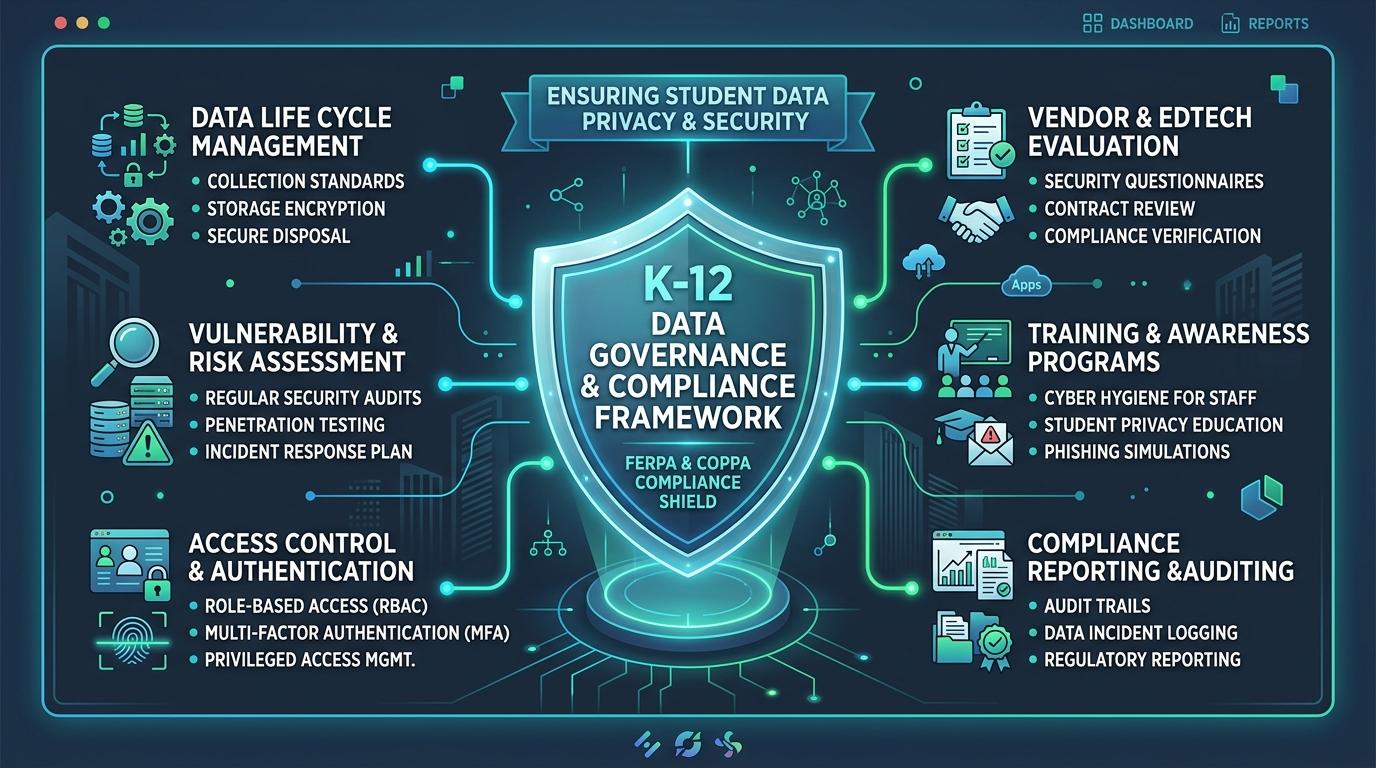
As generative artificial intelligence, automated rubric grading, and AI-assisted writing analytics become standard across K-12 and higher education, school districts face an existential regulatory and ethical challenge: the systemic harvesting of student intellectual property and personally identifiable information (PII) by commercial machine learning vendors. Under federal statutes including the Family Educational Rights and Privacy Act (FERPA, 34 CFR Part 99) and the Children’s Online Privacy Protection Act (COPPA, 15 U.S.C. §§ 6501–6506)—as well as strict state laws like New York Education Law § 2-d, Illinois SOPPA, and California SOPIPA—school districts cannot legally permit vendors to ingest student prose into machine learning training pipelines, nor can they tolerate secondary data warehousing. Commercial “opt-out checkboxes” represent a cosmetic illusion: they do not prevent intermediate cloud logging, staging cache ingestion, or irreversible parameter memorization. To ensure absolute compliance, protect student intellectual property, and preserve community trust, district leaders must mandate True Zero-Data-Retention (ZDR) architecture. This comprehensive guide deconstructs the legal landscape, exposes the technical attack vectors of neural model memorization, details the mathematics of non-retaining cryptographic hash vaults, and outlines how Checkmark Plagiarism delivers multidimensional academic integrity, patent-pending Essay Playback™, and quote-anchored rubric autograding within a verifiable, 100% ephemeral, zero-training security perimeter.
Checkmark Plagiarism empowers school boards, superintendents, and IT leadership to implement defensible writing governance by unifying passage-level AI detection, side-by-side plagiarism verification, rubric-based autograding, and patent-pending Essay Playback™ writing process telemetry within a strict zero-retention, FERPA-compliant infrastructure integrated with Canvas LMS and Agilix Buzz LMS.
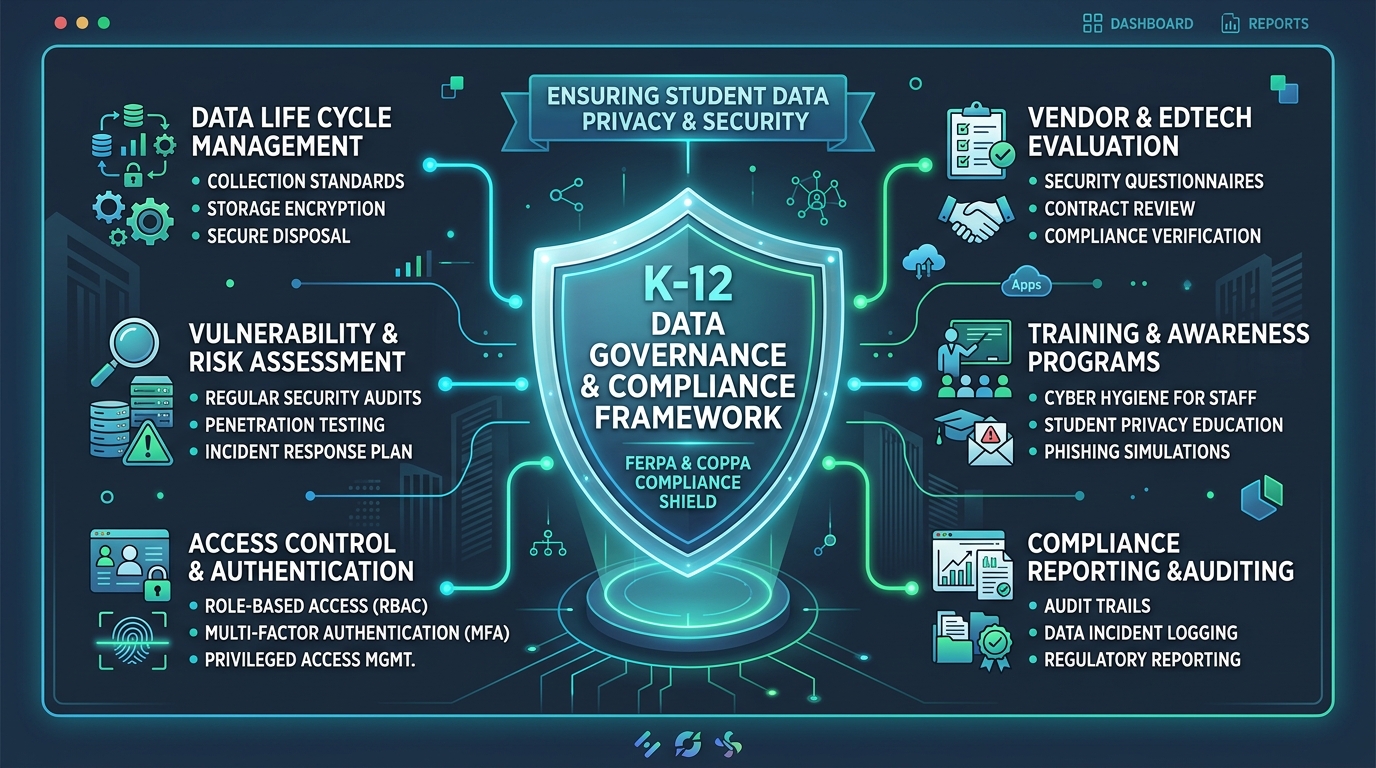
1. The Commercial AI Data Rush: How Student Writing Became Machine Learning Fuel
Over the past three decades, educational technology procurement focused primarily on static relational databases: storing grades in Student Information Systems (SIS), distributing course materials through Learning Management Systems (LMS), and conducting basic keyword searches for plagiarism. Student records sat in encrypted, password-protected database tables, queried only when authorized educators requested them.
The widespread deployment of Large Language Models (LLMs), deep learning transformer architectures, and natural language processing (NLP) classifiers has radically upended this traditional software ecosystem. Deep neural networks are not passive relational databases; they are data-hungry probabilistic computing engines whose commercial value depends directly upon the volume, quality, and diversity of their training datasets.
Why Student Writing is the “Holy Grail” for Commercial AI Developers
Having largely exhausted open-web public repositories (such as Wikipedia, Common Crawl, and digitized public-domain literature), commercial AI developers face a severe scarcity of high-grade human writing. In this competitive landscape, K-12 and collegiate student writing represents an extraordinarily valuable asset:
Linguistic Scaffolding
Student essays provide organic, graded progressions of vocabulary acquisition, syntactic complexity, and cognitive reasoning spanning grades 3 through 12 and higher education.
Authentic Variance
Unlike synthetic AI text or polished corporate copy, student writing exhibits authentic syntactic variation, genuine exploratory transitions, colloquial phrasing, and unprompted creative synthesis.
Domain Reasoning
High school and college essays contain dense, original analyses of specific literary texts, local historical archives, scientific laboratory experiments, and philosophical arguments that cannot be scraped from consumer websites.
The Legacy EdTech Bait-and-Switch
For years, legacy academic integrity and automated grading platforms conditioned school districts to accept contracts where student papers were deposited into massive, centralized, global repositories. Originally billed as a necessary mechanism for cross-school plagiarism checking, these multi-million-document archives were quietly re-evaluated as unregulated machine learning goldmines.
When generative AI surged into mainstream adoption, several legacy vendors altered their terms of service, granting themselves expansive commercial licenses to repurpose student submissions to train proprietary LLMs, tune autograders, and refine AI detection classifiers.
School district technology directors, chief information security officers (CISOs), and school boards have realized that without strict, architectural zero-retention policies, their students have become unpaid, involuntary training contributors for commercial software corporations.
2. Federal & State Statutory Frameworks: The Legal Illegality of AI Model Training
When an educational technology platform captures student essays, prompts, or writing telemetry and routes them into model training, caching logs, or persistent data stores, the school district is thrust into immediate non-compliance with cornerstone federal and state student privacy laws.
| Statute / Legal Domain | Vendor Data Practice | Statutory Violation & District Exposure |
|---|---|---|
| FERPA (34 CFR Part 99) |
Ingesting student writing into neural network training loops or multi-tenant persistence layers. | Violates 34 CFR § 99.31(a)(1)(i)(B) “School Official” exception and § 99.33 secondary-use prohibition. |
| COPPA (15 U.S.C. §§ 6501-6506) |
Logging writing telemetry and essay submissions from children under age 13 for product R&D. | Direct breach of commercial profiling ban; schools cannot consent to vendor AI training on behalf of parents. |
| NY Education Law § 2-d (New York State) |
Retaining student PII or metadata in cloud training datasets or unencrypted logging buffers. | Direct violation of commercialization ban, Parents' Bill of Rights, and mandatory NIST CSF security alignment. |
| Illinois SOPPA (105 ILCS 85/) |
Amassing student writing profiles or using student prose to develop commercial algorithms. | Violates statutory ban on profiling and unauthorized derivative commercial data utilization. |
| California SOPIPA (Cal. Bus. & Prof. Code) |
Creating persistent student profiles or retaining data beyond immediate educational fulfillment. | Prohibits K-12 commercial profiling and mandates immediate student data purging upon service completion. |
| Student Copyright & IP (17 U.S.C. § 102) |
Forcing minor clickwrap licenses to create derivative AI works from original student essays. | Void under common law minor capacity; constitutes unauthorized commercial infringement of student works. |
1. FERPA: The Collapse of the “School Official” Safe Harbor
The Family Educational Rights and Privacy Act (FERPA, 20 U.S.C. § 1232g; 34 CFR Part 99) protects the privacy of student education records. By default, educational institutions cannot disclose education records containing personally identifiable information (PII) without prior written parental consent.
Public school districts routinely deploy third-party EdTech software by designating the vendor as a “School Official” under 34 CFR § 99.31(a)(1)(i)(B). To qualify for and maintain this legal safe harbor, the vendor must satisfy four mandatory criteria:
- Legitimate Educational Interest: The vendor performs an institutional service or function for which the school would otherwise use internal employees (e.g., grading assistance, writing integrity analysis).
- Direct Control: The vendor operates under the direct control of the school or district regarding the use and maintenance of education records.
- Strict Purpose Limitation (34 CFR § 99.33(a)): The vendor must use the student data exclusively for the authorized educational purpose specified in the underlying contract.
- Prohibition on Redisclosure: The vendor is legally prohibited from redisclosing or repurposing the data to any third party or internal division without explicit district authorization.
The moment an EdTech vendor channels student writing into a machine learning training pipeline, fine-tuning queue, or internal algorithmic benchmark, the vendor ceases to operate under the district's direct control for a sole educational purpose. The vendor is repurposing confidential student education records to build, calibrate, or monetize a commercial asset. This constitutes an illegal secondary use under 34 CFR § 99.33(a), immediately invalidating the “School Official” exception and exposing the district to federal compliance investigations and potential loss of federal funding through the U.S. Department of Education's Student Privacy Policy Office (SPPO).
2. COPPA: Protecting K-8 Minors from Commercial Profiling
The Children’s Online Privacy Protection Act (COPPA, 15 U.S.C. §§ 6501–6506; 16 CFR Part 312) prohibits the online collection, retention, and commercial use of personal information from children under the age of 13 without verifiable parental consent.
Under the Federal Trade Commission’s (FTC) long-standing educational guidance, school districts may act as the agent of the parent and provide consent on their behalf only when the software is used strictly and exclusively for an educational purpose benefiting the school.
Schools lack the legal authority to consent to commercial data harvesting, advertising profile creation, or commercial AI model training on behalf of children under 13:
- When an elementary or middle school student drafts a personal narrative describing their home life, emotional struggles, or family traditions, logging that text into an AI model's training corpus violates COPPA.
- Retaining behavioral typing metrics (keystroke cadence, pause durations) from minors in persistent vendor cloud logs without immediate ephemeral deletion violates COPPA’s strict data minimization mandates (16 CFR § 312.7).
3. State Data Sovereignty Acts: Zero Tolerance for Product Development
State legislatures have enacted aggressive statutes that eliminate ambiguity regarding vendor data exploitation:
- New York Education Law § 2-d: Explicitly outlaws the sale, commercialization, or release of student Personally Identifiable Information (PII) for any commercial or marketing purpose. NY § 2-d defines PII broadly to include indirect identifiers and derived student artifacts. Vendors that use student submissions to train or improve internal algorithms are subject to mandatory contract cancellation, civil fines, and a multi-year ban from doing business with any New York school district.
- Illinois Student Online Personal Protection Act (SOPPA, 105 ILCS 85/): Strictly prohibits EdTech operators from engaging in targeted profiling, amassing student dossiers, or utilizing student data to develop or enhance commercial software applications. It requires districts to maintain public rosters of all data shared with vendors and guarantees parents the statutory right to request complete data deletion.
- California Student Online Personal Information Protection Act (SOPIPA, Cal. Bus. & Prof. Code §§ 22584–22585): Prohibits operators of K-12 websites, applications, and cloud software from using student information to amass profiles, market products, or retain student data beyond the immediate fulfillment of school purposes. Once the educational service is performed, data must be deleted upon district directive.
4. Student Intellectual Property & Copyright Protection
Under United States copyright law (17 U.S.C. § 102), original student essays, creative narratives, laboratory reports, and research papers are automatically protected intellectual property from the millisecond they are fixed in a tangible medium of expression (e.g., typed into a digital word processor or LMS text box).
Minors lack the legal capacity to enter into binding commercial contracts or assign their copyright licenses through forced software “Click to Accept Terms” modals. When a commercial EdTech vendor inserts boilerplate terms granting itself an irrevocable, perpetual, worldwide license to “reproduce, adapt, modify, publish, and create derivative works” from student prose for machine learning optimization, those terms are legally void and unenforceable against minors. School boards that allow such vendors to operate across their classrooms risk severe intellectual property liabilities.
3. The Technical Threat Vectors of AI Model Training on Student Writing
Many district technology committees mistakenly assume that if a vendor “strips student names” (anonymization/pseudonymization) before feeding essays into machine learning models, student privacy is preserved.
In modern computational linguistics and deep learning architectures, this assumption is mathematically and technically false.
1. Model Memorization and Overfitting in Deep Transformers
Generative Large Language Models and deep neural classifiers do not merely identify abstract patterns; they routinely memorize verbatim strings of text during training passes.
Empirical research in AI security (notably by Carlini et al., Extracting Training Data from Large Language Models) has repeatedly proven that deep transformers overfit on rare, unique token sequences:
- A student writing a deeply personal essay about their sibling's rare genetic illness, a contentious family legal dispute, or specific local neighborhood events generates unique n-gram sequences.
- During the gradient descent optimization phase, these specific token combinations are permanently encoded into the model’s billions of numerical parameters (weights and biases).
2. Model Inversion and Training Data Extraction Attacks
Once a student's essay is memorized within the parameter matrix of an AI model, that data is vulnerable to Model Inversion and Adversarial Extraction Attacks:
- Third-party users—including other students, outside researchers, or malicious actors interacting with the AI tool—can craft specific adversarial prefix prompts (e.g., “Complete the narrative about the high school student in [District Name] who...”).
- The model’s generative sampling mechanism outputs the verbatim text, names, emotional disclosures, and factual events contained in the original student submission.
- De-identification is useless against contextual reconstruction: An essay discussing a specific school teacher, a unique sports injury, and a local town event contains enough contextual metadata to trivially identify the author within minutes.
3. The Multi-Tier Sub-Processor API Logging Trap
Even when an EdTech vendor claims they do not train models on student data, their underlying software architecture often relies on third-party generative AI Application Programming Interfaces (APIs) such as OpenAI, Anthropic, Google Cloud Vertex AI, or AWS Bedrock.
Unless the vendor has established an explicit, legally binding Zero Data Retention (ZDR) Enterprise Agreement with those sub-processors:
- Every student essay submitted for automated grammar feedback, autograding, or AI detection is transmitted as an API payload.
- The sub-processor stores the prompt payload, user metadata, and system completion in persistent diagnostic logging buffers for 30 to 90 days.
- These third-party staging logs create an expansive, unmonitored attack surface vulnerable to cloud breaches, insider leaks, and unauthorized subpoenas.
Full essay cached on diagnostic servers
Unencrypted prompt persistence
Student prose harvested for commercial R&D
4. The Computational Impossibility of “Machine Unlearning”
When a parent or school district exercises their statutory right under FERPA, SOPPA, or GDPR to demand the immediate deletion of a student's data, traditional software platforms execute a straightforward SQL query: DELETE FROM submissions WHERE student_id = X;.
In machine learning, “deleting” data from a trained neural network is mathematically and computationally intractable:
- Once backpropagation modifies a model's weights based on a student's essay tokens, that student's writing is distributed across billions of non-linear floating-point numbers.
- There is no surgical mechanism to “extract” or “unlearn” a single document's influence from a live neural network without retraining the entire model from scratch at immense computational and financial cost.
- Therefore, any EdTech vendor that ingests student writing into training workflows makes compliance with statutory deletion mandates impossible.
4. The Illusion of “Opt-Out Checkboxes” vs. True Zero-Retention Architecture
In response to growing school district pushback, many commercial AI vendors introduced administrative “opt-out checkboxes.” District technology directors must understand why these toggles are cosmetic public relations measures rather than genuine security architectures.
| Architectural Dimension | Cosmetic “Opt-Out” Checkbox | True Zero-Data Retention (Checkmark ZDR) |
|---|---|---|
| Processing Location | Ingests full essay into cloud staging disks | Processes entirely in volatile RAM |
| Logging Lifespan | Retains data in 30-to-90-day diagnostic logs | Purges RAM buffer immediately post-analysis |
| Model Training | Past model weights retain student PII | Zero model training on student submissions |
| Disk Storage | Data written to persistent multi-tenant disks | Zero disk persistence of raw manuscript text |
| Security Enforcement | Relies on administrative trust & config flags | Enforced by immutable code-level architecture |
| Sub-Processor Terms | Sub-processors continue prompt log caching | Legally binding sub-processor ZDR agreements |
The Architectural Failure of the “Opt-Out” Model
When an IT administrator checks an “Opt Out of Model Training” toggle in a vendor's settings dashboard:
- The Ingress Pipeline Remains Unchanged: The student's essay is still transmitted, parsed, and stored in the vendor’s primary cloud databases, search indices, and backup snapshots.
- Diagnostic & Telemetry Capture Persists: Monitoring tools (Datadog, CloudWatch, Sentry) continue logging request payloads containing raw student essays for debugging, error tracking, and latency optimization.
- Sub-Processor Leaks Continue: The vendor's backend systems continue dispatching API calls to external cloud LLM providers whose default configurations retain prompt logs for 30 to 90 days.
- Historical Poisoning: Opt-outs apply exclusively on a go-forward basis. All student writing ingested prior to the toggle being activated remains permanently embedded within the vendor’s historical model checkpoints.
The Anatomy of True Zero-Data-Retention (ZDR)
In stark contrast to cosmetic opt-outs, True Zero-Data-Retention (ZDR) is an uncompromising technical architecture built upon four immutable engineering principles:
free() / garbage collection). No raw text is written to persistent databases, logs, or storage.Volatile RAM-Only Execution
The student's text is loaded strictly into ephemeral Random Access Memory. Computational linguistic analysis, perplexity scoring, and rubric parsing occur entirely in RAM.
Zero Disk Persistence of Raw Manuscripts
The vendor's infrastructure never writes unencrypted student essays to persistent block storage (Amazon EBS, Google Persistent Disk), relational databases (PostgreSQL), or NoSQL stores.
Immediate Memory Zeroization
The instant the analysis pipeline completes and the report payload is returned to the educator's authenticated browser session, the server-side memory buffer is completely flushed and overwritten.
Non-Negotiable Non-Training Covenant
Underlying AI models operate strictly in deterministic inference mode. Model weights are static, frozen, read-only artifacts that cannot receive backpropagation gradients or parameter updates from user requests.
5. Cryptographic Hash Vaults: Plagiarism Detection Without Storing Student Manuscripts
A primary reason legacy EdTech vendors claimed they “needed” to store student essays was peer-to-peer plagiarism detection. For decades, schools were told: “If we don't save your students' papers in our permanent database, how can we detect if a student in Period 4 copies an essay from a student in Period 1, or from another school in your district?”
Modern cryptography and computer science have rendered this argument completely obsolete.
Through Isolated Cryptographic Hash Vaults, academic integrity systems can achieve 100% accurate, cross-class, cross-cohort, and cross-district plagiarism detection without ever storing a single line of raw student manuscript text.
SHA256("structural tension in hamlet...") → e3b0c44298fc1c14...The Mathematics of Cryptographic Fingerprinting
1. Text Normalization & Rolling K-Shingling
When an essay is processed in RAM, the text is normalized (case folding, punctuation stripping) and segmented into overlapping sequences of words known as k-shingles (e.g., sequences of 7 to 9 consecutive words).
2. One-Way Irreversible Cryptographic Hashing
Each shingle is processed through a one-way mathematical hashing algorithm (such as SHA-256 or MinHash) combined with a district-specific cryptographic salt:
Because cryptographic hashing is strictly one-way and irreversible, it is mathematically impossible to reconstruct the original student essay, sentences, or personal disclosures from the resulting hash values.
3. Locality-Sensitive Hash Matching (LSH) & Jaccard Similarity
The system stores only these mathematical hash sets in an isolated district vault. When a new submission arrives, its temporary hash set is compared against the vault's stored fingerprints using Jaccard similarity metrics: J(A, B) = |A ∩ B| / |A ∪ B|.
4. Absolute Privacy Preservation
If a match is detected between two essays within the district, the system alerts the teacher to the shared mathematical fingerprint. Even in the event of a catastrophic server breach, an attacker possessing the hash vault gains zero readable text, zero student essays, and zero personal information.
6. Checkmark Plagiarism: Enterprise Security Architecture & The Complete Educator Suite
Checkmark Plagiarism (checkmarkplagiarism.com) was engineered from the ground up to solve the academic integrity and AI governance crisis facing modern education. Built on the foundational philosophy of “Stop guessing, start trusting,” Checkmark replaces opaque, punitive AI percentage scores with transparent, defensible, multidimensional evidence—all housed within a strict Zero-Data-Retention (ZDR) and Zero-Training security architecture.
• Ephemeral RAM Execution: Immediate Zeroization Post-Analysis
• Full FERPA, COPPA, NY Ed Law § 2-d, IL SOPPA & CA SOPIPA Compliance
- Granular passage underlines
- Calibrated confidence bar
- Perplexity & burstiness analysis
- <150 word guardrail (N/A)
- Immune to AI humanizers
- Educator-only flag states
- Keystroke-by-keystroke replay
- Timeline scrub (1x – 8x speed)
- External paste tracking + original text
- Transcription rhythm detection
- Google Docs & Canvas sync
- Exonerates honest students
- Criterion-by-criterion rubric scoring
- Quote-anchored feedback drafts
- Teacher final grading authority
- 1-Click Canvas grade passback
- 1-Click Buzz LMS grade passback
- Google Classroom grade sync
1. The Multi-Factor AI Detection Engine: Granular, Defensible Evidence
Unlike legacy tools that output a single, arbitrary document-wide percentage (e.g., “78% AI Written”) that sparks combative confrontations and false accusations, Checkmark provides granular, passage-level linguistic analysis:
- Passage-Level Granularity: Checkmark underlines specific sentences and paragraphs directly within the essay, anchoring each highlight to an individual evidence card in the sidebar.
- Calibrated Confidence Sliders: Rather than binary labels, each evidence card features a calibrated confidence scale illustrating whether the passage reflects typical human writing variations or predictable AI linguistic patterns.
- Linguistic Perplexity & Burstiness Analysis: Evaluates word predictability (perplexity), sentence length diversity (burstiness), syntactic rhythm, and transitional consistency.
- Immunity to “AI Humanizers” & Paraphrasers: Third-party humanizers (e.g., QuillBot, Undetectable AI) swap synonyms to evade surface-level detectors, but they cannot fake authentic human composing history, keystroke dynamics, or natural drafting pauses.
- Honest Guardrails for Short Submissions: On short-answer responses and essays under ~150 words, Checkmark automatically displays
N/Arather than generating unreliable guesses on insufficient sample sizes. - Educator-Only Flag Statuses: Integrity flag statuses (
Flagged,Resolved,Not Flagged) remain private to educators, empowering teachers to conduct thoughtful investigations before engaging students.
2. Defensible Web & Peer Plagiarism Matching
Checkmark’s plagiarism engine pairs comprehensive global scanning with private local protection:
- Billions of Live Web Sources: Scans real-time web pages, academic encyclopedias, open-access journals, and digital periodicals with side-by-side quote comparisons and direct clickable links.
- Dedicated Uncited Source Styling: Specifically identifies and highlights uncredited source usage with visual citation styling, enabling educators to coach students on proper bibliography formatting rather than treating citation mistakes as intentional fraud.
- Two-Way Linked Evidence Cards: Clicking any highlighted passage in the essay smoothly scrolls the teacher to its corresponding evidence card in the sidebar, and vice versa.
- Zero-Retention Peer Matching: Utilizes Checkmark's isolated cryptographic hash vaults to verify originality across classroom cohorts without permanently storing raw manuscripts.
3. Patent-Pending Essay Playback™: Keystroke Dynamics & Process Evidence
The cornerstone of Checkmark’s defensible integrity suite is Essay Playback™—a patent-pending technology that reconstructs the student's entire writing journey keystroke by keystroke.
- Interactive Timeline Scrubbing (1x to 8x): Teachers can scrub through the entire writing process like a video, watching authentic idea formulation, composing pauses, real-time deletions, word substitutions, and restructuring.
- External Paste Tracking with Complete Text Preservation: Automatically flags any text pasted into the document from outside sources. Checkmark captures and preserves the exact original pasted text, ensuring teachers have complete evidence even if the student subsequently edits or rewrites every word.
- Transcription Detection: Identifies mechanical, unnatural typing rhythms with zero natural composing pauses or revisions—instantly catching instances where a student manually retypes an AI-generated essay from a secondary phone screen or dictation tool.
- Exonerating Honest Students: Essay Playback™ serves as an unassailable shield for honest students falsely flagged by crude black-box AI detectors, providing undeniable visual proof of their authentic drafting process.
- Native Ecosystem Integration: Seamlessly captures revision history across Google Docs, Canvas LMS embedded editors, Buzz LMS, and Microsoft Word.
4. AI Autograder with Teacher-in-the-Loop & Direct LMS Grade Passback
Checkmark transforms essay assessment by automating tedious mechanical grading while preserving complete educator autonomy:
- Quote-Anchored Rubric Justifications: Autogrades essays against custom rubrics, generating precise criterion point breakdowns accompanied by written justifications tied directly to specific quotes in the student's prose.
- Flexible Rubric Ingestion: Create rubrics natively in-app, upload existing PDF/image scoring guides, or sync rubrics directly from Canvas LMS, Buzz LMS, or Google Classroom.
- Teacher Final Authority: All AI autogrades remain private drafts until reviewed, modified, and approved by the teacher.
- 1-Click LMS Gradebook Passback: Pushes finalized scores, criterion breakdowns, and qualitative feedback directly into the Canvas, Buzz, or Google Classroom gradebook with a single click, eliminating manual data entry.
7. Real-World District Case Studies in Data Governance and Compliance
The following real-world scenarios illustrate the operational, legal, and educational stakes involved in school district EdTech AI procurement.
| Scenario | Architecture Deployed | Compliance & District Outcome |
|---|---|---|
| Scenario 1: Shadow IT Breach |
Free consumer AI writing tool; unmonitored vendor model training on 45,000 district essays. | Catastrophic FERPA complaint; student medical PII leaked in public AI model completions. |
| Scenario 2: Sub-Processor Logging |
Legacy plagiarism tool utilizing commercial LLM API with default 60-day diagnostic prompt logging. | NY Ed Law § 2-d investigation; contract termination and state audit penalties. |
| Scenario 3: District ZDR Rollout (35,000 Students) |
Checkmark Plagiarism Enterprise; 100% ephemeral RAM processing, Essay Playback™, and LMS passback. | 100% FERPA/COPPA compliance; 60% faster grading; zero false accusations via Playback™. |
The Shadow IT & Model Extraction Breach (Midwest Suburban District)
- The Incident: A high school English department adopted a popular “free” online AI grammar and writing assistant without district IT review. Over an 18-month period, 45,000 student essays were submitted through the platform. The vendor’s clickwrap terms granted the company unrestricted rights to train its internal generative models on user submissions.
- The Exposure: A student submitted a deeply personal narrative describing their family's confidential medical bankruptcy and local foster care placement. Months later, computer science researchers conducting model inversion audits on the vendor's commercial AI writing tool successfully extracted the verbatim narrative and local identifiers.
- The Fallout: The district faced an administrative FERPA complaint through the U.S. Department of Education, severe community backlash, and a formal investigation by the State Attorney General for failing to maintain direct control over student education records under 34 CFR § 99.31.
The Sub-Processor 60-Day Logging Failure (New York Consortium)
- The Incident: A consortium of 12 New York school districts licensed a legacy plagiarism detector that marketed itself as “100% FERPA and NY State Ed Law § 2-d Compliant.”
- The Audit: During a routine technical security audit, the district's cybersecurity director discovered that the vendor had integrated a commercial third-party LLM API to power its new “AI Writing Feedback” feature. The vendor failed to execute a Zero Data Retention (ZDR) agreement with the API provider, resulting in every student submission being stored on the third-party sub-processor's diagnostic servers for 60 days.
- The Outcome: The consortium immediately issued a breach of contract notice. The vendor was fined under NY Education Law § 2-d for unauthorized secondary data transmission and prohibited from bidding on state educational contracts for three years.
District-Wide Zero-Retention Deployment (35,000-Student California District)
- The Deployment: A large unified school district in Southern California integrated Checkmark Plagiarism across its Canvas LMS ecosystem for grades 6–12 (35,000 students).
- The Architecture: Checkmark’s 100% ephemeral in-memory processing engine was deployed with zero disk retention, zero model training, and isolated cryptographic hash vaults for district-wide peer matching.
- The Results:
- Complete Statutory Compliance: Satisfied all California SOPIPA, COPPA, and FERPA mandates with verified zero-retention sub-processor agreements.
- Elimination of False Accusations: In three contested AI writing cases, teachers utilized Checkmark’s patent-pending Essay Playback™ to review keystroke dynamics, verifying that the students had authentically drafted their essays over multiple hours, completely exonerating them.
- Teacher Workload Reduction: High school English teachers reported saving an average of 4.5 hours per week utilizing Checkmark’s quote-anchored rubric autograding and 1-click Canvas grade passback.
8. The 10-Point Technical Procurement Audit Matrix for District Leaders
School boards, superintendents, and district technology directors must subject every EdTech AI vendor to rigorous technical auditing before signing or renewing software contracts.
| # | Procurement Audit Criteria | Mandatory Technical Requirement |
|---|---|---|
| 1 | Ephemeral In-Memory Processing | 100% RAM processing; zero raw essay text written to persistent disk storage. |
| 2 | Explicit Non-Training Guarantee | Legally binding covenant that student text is NEVER used to train or fine-tune models. |
| 3 | Sub-Processor ZDR Enforceability | Verified Zero-Data Retention (ZDR) contracts with all third-party AI API providers. |
| 4 | Cryptographic Hash Peer Vaults | Peer plagiarism matching executed via SHA-256 hashes; zero plaintext manuscript storage. |
| 5 | Keystroke & Writing Process Telemetry | Patent-pending Essay Playback™ with 1x-8x scrub, paste tracking, and typing dynamics. |
| 6 | Passage-Level AI Granularity | Calibrated confidence evidence cards; zero arbitrary, black-box whole-paper scores. |
| 7 | Short-Text Sample Guardrails | Mandatory N/A display on text <150 words to prevent unscientific false accusations. |
| 8 | Teacher-in-the-Loop Autograding | Quote-anchored rubric justifications with 1-click Canvas/Buzz LMS grade passback. |
| 9 | Identity & Access Security | SAML 2.0 / SSO (Google & Microsoft SSO), FERPA/COPPA compliance, SOC 2 Type II. |
| 10 | Immediate Data Purge & Verification | Automated cryptographic deletion verification upon session or contract termination. |
9. Contract Redlining Playbook: Required DPA Clauses for EdTech AI Vendors
When negotiating Data Privacy Agreements (DPAs), Student Data Addendums (SDAs), and Master Service Agreements (MSAs), district legal counsel and procurement officers should insist on the following non-negotiable clauses.
“Vendor expressly covenants and agrees that any and all student submissions, essays, text prompts, writing process telemetry, keystroke dynamics, audio recordings, autograding interactions, and derived metadata (collectively, 'Student Education Data') provided by or on behalf of the District shall NEVER be used, ingested, tokenized, vectorized, or processed by Vendor, its affiliates, or its sub-processors to train, retrain, fine-tune, calibrate, validate, benchmark, or optimize any artificial intelligence model, machine learning algorithm, Large Language Model (LLM), neural network, or commercial product feature. This prohibition is absolute and survives the expiration or termination of this Agreement.”
“Vendor warrants and certifies that all Student Education Data processed for purposes of academic integrity analysis, similarity detection, writing feedback, and automated rubric scoring shall be processed exclusively within ephemeral, volatile Random Access Memory (RAM). Vendor shall not write, cache, persist, or store raw Student Education Data to any permanent disk storage, relational database, document store, or unencrypted logging infrastructure. Upon the completion of the real-time analytical response and delivery of the report payload to the authorized user session, all server-side memory buffers containing Student Education Data shall be immediately zeroized and purged.”
“To the extent Vendor utilizes third-party cloud infrastructure or artificial intelligence Application Programming Interfaces (APIs) to fulfill the services herein, Vendor warrants that it has executed legally binding Zero-Data-Retention (ZDR) enterprise agreements with each sub-processor prohibiting prompt logging, completion caching, abuse-monitoring retention, and model training. Vendor shall provide the District with a complete, updated roster of all sub-processors and, upon request, certified third-party SOC 2 Type II audit reports demonstrating architectural compliance.”
“Vendor agrees that all peer-to-peer and cross-cohort plagiarism matching shall be executed exclusively via one-way irreversible cryptographic hashes (e.g., salted SHA-256 or Locality-Sensitive Hashing). Vendor shall not maintain, build, or contribute to any centralized global database of plain-text student manuscripts. All cryptographic hashes generated from District student submissions shall remain logically isolated within the District’s private tenant and shall be permanently deleted upon District directive or contract termination.”
10. Frequently Asked Questions (FAQs) for District Leaders & Educators
1. Does FERPA completely ban the use of AI tools in public school classrooms?
No. FERPA does not prohibit educational institutions from utilizing artificial intelligence or cloud-based educational software. However, FERPA strictly regulates how student education records are shared and processed. Under the “School Official” exception (34 CFR § 99.31(a)(1)(i)(B)), districts may deploy AI tools only if the vendor operates under the school's direct control, uses student data solely for the designated educational purpose, and strictly refrains from unauthorized secondary uses—such as training commercial machine learning models or building marketing profiles. Deploying zero-retention platforms like Checkmark ensures complete FERPA compliance.
2. If a vendor anonymizes or strips student names before training AI models, is that legal?
No. Under federal statutes and state privacy laws (such as NY Education Law § 2-d and Illinois SOPPA), de-identification is insufficient when full-text student essays are involved. High-dimensional vector embeddings and LLM training pipelines can easily memorize unique biographical details, local references, and rare phrase structures contained in student writing, making contextual re-identification trivial. Furthermore, state laws explicitly prohibit using any student-derived data—anonymized or not—for commercial product development.
3. How does Checkmark detect peer plagiarism if it doesn't store student essays?
Checkmark utilizes Isolated Cryptographic Hash Vaults. When an essay is analyzed in volatile RAM, the text is converted into overlapping word shingles, salted with a district-specific cryptographic key, and transformed into one-way SHA-256 hashes. These mathematical fingerprints are stored in the district’s isolated private vault. When another student submits an essay, its mathematical fingerprints are compared against the vault without ever storing, exposing, or retaining raw, readable student prose.
4. Why are whole-paper AI percentage scores considered legally and pedagogically dangerous?
Whole-paper percentage scores (e.g., “85% AI Generated”) operate as uninterpretable black boxes. They fail to identify which specific sentences triggered the flag, provide zero transparency into the underlying linguistic evidence, and suffer from high false-positive rates on non-native English speakers and neurodivergent writers. Accusing a student based solely on a single percentage score violates fundamental principles of academic due process and destroys student-teacher trust. Checkmark solves this by providing passage-level underlines, calibrated confidence sliders, and empirical writing process evidence via Essay Playback™.
5. How does Essay Playback™ protect honest students from false AI accusations?
Essay Playback™ records the student's authentic typing, drafting, and revising trajectory keystroke by keystroke. If a student is unfairly accused of using AI by an external tool, the educator can open Checkmark’s playback viewer and scrub through the writing timeline at 1x to 8x speed. Watching the student formulate ideas, pause to think, delete sentences, rewrite paragraphs, and organize structure over multiple hours provides indisputable visual proof of authentic human authorship.
6. Does Checkmark share student writing or telemetry with OpenAI or other AI companies?
No. Checkmark Plagiarism operates a closed, secure, zero-retention security perimeter. Student submissions are processed in volatile RAM and are never shared with third-party consumer AI platforms, sold to data brokers, or utilized to train general commercial AI models. All operations adhere strictly to FERPA, COPPA, and enterprise SOC 2 Type II security standards.
7. Can Checkmark integrate directly with our district's existing LMS and gradebook?
Yes. Checkmark provides enterprise LTI 1.3 integrations for Canvas LMS, Buzz LMS, and Google Classroom, as well as seamless single sign-on (SSO) via Google Workspace and Microsoft Azure Active Directory. Teachers can sync rubrics directly from the LMS, review quote-anchored autograde suggestions, and push finalized grades and qualitative feedback straight back into the district gradebook with a single click.
11. The Path Forward: Stop Guessing, Start Trusting
The generative AI revolution in education presents immense opportunities for personalized feedback, curriculum scaffolding, and automated teacher workflows—but it must not come at the expense of student privacy, data sovereignty, and ethical due process.
School districts can no longer afford to accept ambiguous vendor promises or cosmetic “opt-out” checkboxes. By establishing True Zero-Data-Retention (ZDR) procurement standards, demanding cryptographic hash isolation, and deploying multidimensional integrity platforms that prioritize process transparency over punitive black-box scores, educational leaders can protect their students while empowering their teachers.
Checkmark Plagiarism stands as the industry leader in this movement: delivering patent-pending Essay Playback™, granular passage-level AI detection, quote-anchored rubric autograding, and 1-click LMS grade passback within an uncompromising, FERPA- and COPPA-compliant, zero-retention security architecture.
Upgrade Your District to Verifiable Zero-Training Integrity
Protect student intellectual property, achieve 100% FERPA/COPPA compliance, and equip teachers with patent-pending Essay Playback™ and quote-anchored rubric autograding.