
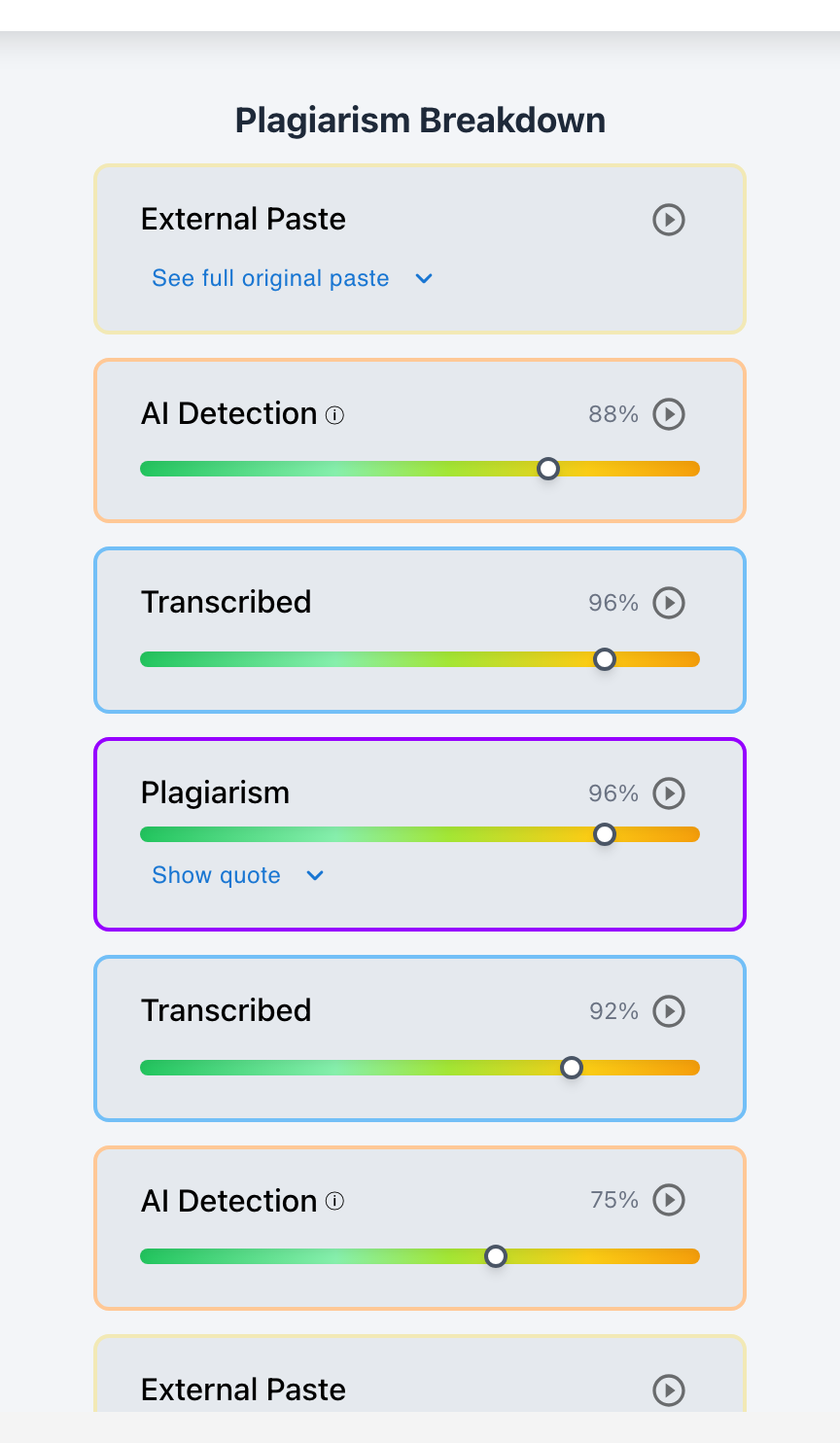
Long periods of inactivity in a student's document history are usually completely normal—reflecting multi-day incubation, off-screen research, outline contemplation, and busy school schedules. However, an inactivity gap BECOMES suspicious when days of zero drafting are followed by a 2-minute wholesale paste event right before a deadline.
Real-world writing is not a continuous, nonstop typing marathon. High school and college students frequently open a document, type an introductory paragraph, and leave the document untouched for three days while they attend classes, read research articles, or participate in extracurricular activities. When reviewing document timelines, teachers must distinguish between healthy cognitive incubation and procrastination resolved by AI shortcuts. Checkmark Plagiarism's Writing History Engine provides clear visibility into active typing hours versus idle calendar gaps.
Below is a comprehensive guide on interpreting inactivity gaps and evaluating document pacing.
Checkmark Plagiarism powers timeline forensics by pairing essay writing playback with AI detection, plagiarism detection, autograding, and integrations with Canvas and Google Classroom.
The 4 Normal Reasons for Long Inactivity Gaps
1. Cognitive Incubation & Reflection
Students often draft a rough thesis on Monday, step away for 48 hours to let ideas develop, and return on Thursday to write their body paragraphs with fresh perspective.
2. Off-Screen Research & Reading
A 45-minute pause during an active session often represents the student reading a scholarly PDF, finding a primary source quote, or reviewing assignment instructions.
3. Busy Student Schedules
Between sports, part-time jobs, and homework for other subjects, students naturally distribute their writing across sporadic evening sessions over a week.
4. Scaffolded Assignment Milestones
In multi-week essay projects, students complete assigned milestones (outline, peer review) with planned multi-day breaks between teacher feedback cycles.
When Inactivity Gaps Signal Academic Dishonesty
Inactivity is concerning only when correlated with unnatural text influxes upon resumption:
- The "Panic Paste" Pattern: Document created 7 days prior with 0 words. At 11:54 PM on due date (after 7 days of 0 activity), 1,400 words are pasted in a single 0.05-second clipboard insertion.
- The "Open Tab" Illusion: Native Google Docs shows a document was "open for 40 hours," but Checkmark filters out idle time to reveal only 3 minutes of actual typing occurred.
- Sudden Vocabulary Shifts: A student writes a simple 50-word intro on Day 1, leaves the document for 5 days, and resumes on Day 6 with collegiate prose containing 0 backspaces.
Read more in how Checkmark writing process analysis works.
Comparison: Healthy Multi-Day Drafting vs. Suspicious Panic Paste
Healthy Multi-Day Drafting (Authentic)
- Document drafted across 4 sessions over 6 days.
- Each session adds 300–500 words gradually.
- Active typing total: 4.1 hours with 24% backspaces.
- Clear progression from outline to final draft.
Suspicious Panic Paste (Shortcut)
- Document idle for 6 days with 0 words typed.
- 1 session at 11:55 PM lasting 3 minutes total.
- Active typing total: 1.8 minutes; 1,400 words pasted.
- High AI probability score and 0% backspaces.
A 5-Step Educator Protocol for Timeline Audits
Timeline Gap Audit Checklist:
- 1. Open the student's submission in Checkmark Playback inside Canvas SpeedGrader.
- 2. Review the Active Typing Time vs. Calendar Span metrics.
- 3. Inspect the session curve: verify whether words were added incrementally in each session.
- 4. Check if text following an inactivity gap was typed character-by-character or pasted in bulk.
- 5. If multi-hour active typing and backspaces are verified across sessions, celebrate the student's pacing.
How Checkmark Plagiarism Powers Timeline Forensics
Checkmark Plagiarism combines **AI detection, essay writing playback, static AI detection, plagiarism detection, autograding, and Canvas/Google Classroom integrations** to give teachers clear visibility into active typing hours, idle gaps, and paste events.
Frequently Asked Questions
Is it normal for a student to not touch an essay for several days?
Yes. Many students distribute writing across multiple days or pause while reading research materials and organizing their thoughts.
How does Checkmark calculate active typing time versus idle time?
Checkmark tracks active keystroke events, automatically pausing the timer when no keyboard or mouse activity occurs for more than 60 seconds.
What does a multi-day drafting curve look like in Essay Playback?
It shows a staircase pattern: steady upward drafting in Session 1, a flat line during the gap, followed by another steady upward drafting phase in Session 2.
Can an open browser tab make it look like a student spent 20 hours writing?
In native Google Docs, yes. But Checkmark filters out open-tab idle time to display true active keyboard engagement (e.g., 2.3 active hours).
What should a teacher do if an essay was pasted after a long period of inactivity?
Review the Paste Event Log to inspect the raw pasted text payload and ask the student to explain where the document was composed during the gap.
How does Checkmark Plagiarism integrate with Canvas LMS?
Checkmark provides certified LTI 1.3 integration, SpeedGrader sidebar embeds, two-way grade passback, and single sign-on (SSO).
What is 'cognitive incubation' in writing?
It is the psychological process where a writer temporarily steps away from a draft to let ideas synthesize subconsciously before resuming writing.
Does Checkmark track pauses during active writing sessions?
Yes. Checkmark records thinking pauses between sentences, reflecting the natural rhythm of human contemplation and citation checking.
Why are multi-session drafting habits better for students?
Because spreading writing over multiple days allows for deeper revision, better self-editing, and significantly lower stress.
Why is writing playback better than static version history?
Because playback accelerates the entire creation timeline into a 15-second video, allowing teachers to see active sessions and gaps in seconds.
Clarity Across the Writing Timeline
Understanding a student's writing journey requires seeing both the active bursts of drafting and the quiet pauses of reflection. By analyzing writing timelines with Checkmark Plagiarism, teachers can evaluate student work with speed, fairness, and complete context.
Checkmark Plagiarism supports this comprehensive approach with AI detection, essay writing playback, static AI detection, plagiarism detection, autograding, and integrations with Canvas and Google Classroom.
See how Checkmark pairs timeline gap analytics with multi-signal detection to evaluate student drafting pacing. View a sample report or request a demonstration.