
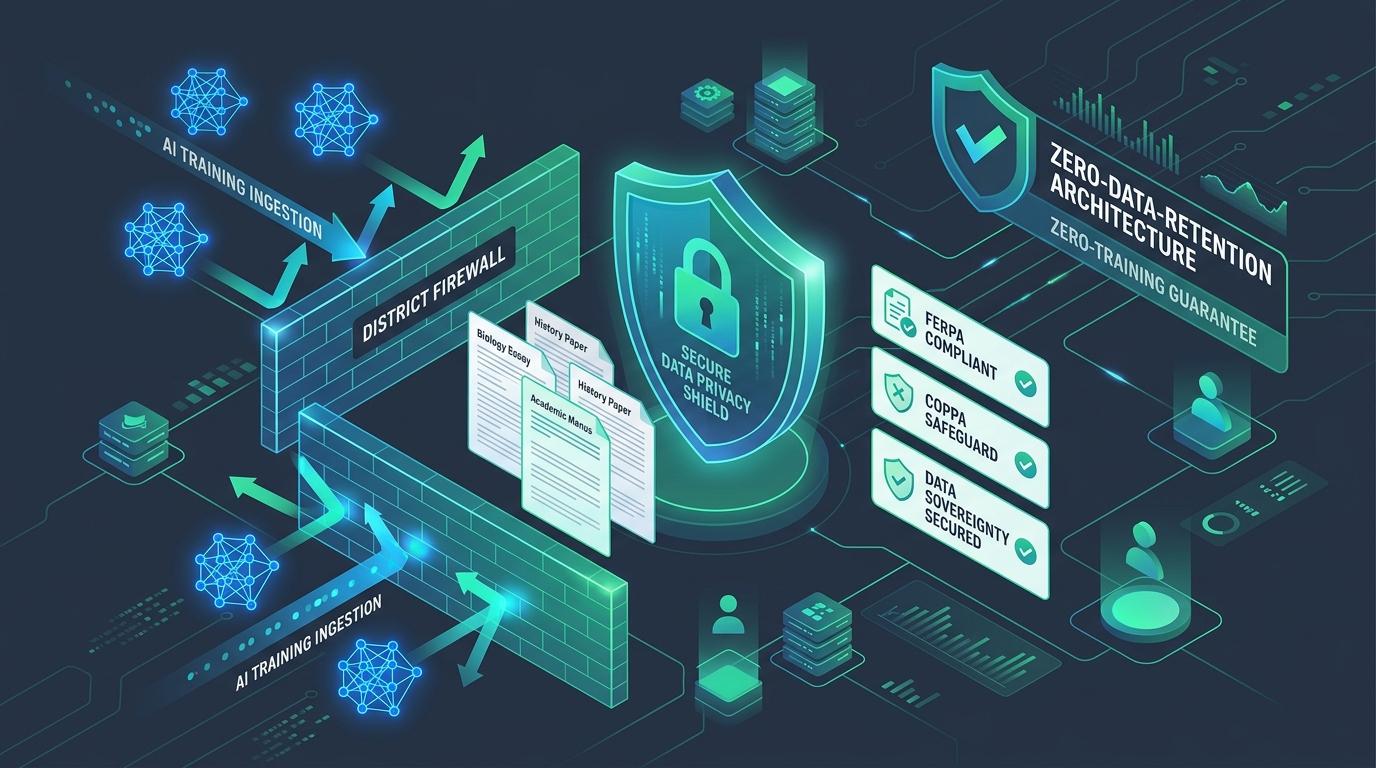
Across the United States, K-12 school boards, district superintendents, and university procurement committees are enacting sweeping bans on commercial educational technology vendors that harvest student essays, reflections, and writing telemetry to train proprietary artificial intelligence models. What commercial vendors portray as harmless “algorithmic optimization” represents a systemic threat to student data sovereignty, federal statutory compliance under FERPA and COPPA, and student intellectual property rights. Once ingested into deep neural networks, student writing cannot be deleted, exposing schools to catastrophic model inversion attacks, training memorization leaks, and unauthorized secondary-use liabilities. This comprehensive guide examines the technical mechanics of the EdTech AI training pipeline, dissects the legal failure of vendor “opt-out” checkboxes, provides a concrete procurement redlining playbook, and illustrates how Checkmark Plagiarism delivers enterprise academic integrity, patent-pending Essay Playback™, and rubric autograding within a verifiable, 100% Zero-Data-Retention (ZDR) and zero-training security architecture.
Checkmark Plagiarism empowers school boards, superintendents, and IT leadership to implement defensible writing governance by unifying passage-level AI detection, side-by-side plagiarism verification, rubric-based autograding, and patent-pending Essay Playback™ writing process telemetry within a strict zero-retention, FERPA-compliant infrastructure integrated with Canvas LMS and Agilix Buzz LMS.
1. The Commercial Data Rush: How Student Writing Became Free AI Training Fuel
To understand why school districts from California to New York are abruptly canceling long-standing software contracts and issuing vendor stop-work orders, one must examine the acute economic pressure currently reshaping the commercial artificial intelligence industry: the high-quality training data shortage.
Generative Large Language Models (LLMs) and natural language processing (NLP) classifiers require trillions of tokens of diverse, syntactically coherent, and logically reasoned text. Having largely exhausted open-web public repositories (such as Wikipedia, Common Crawl, and digitized public domain literature), commercial AI developers have encountered severe data bottlenecks.
Why Student Writing is the “Holy Grail” for AI Training
In this competitive landscape, student writing represents an extraordinarily valuable, irreplaceable training corpus:
Linguistic Scaffolding
Student submissions provide naturally graded progressions of syntax, vocabulary development, and reasoning capability spanning grades 3 through 12 and collegiate levels.
Authentic Human Variance
Unlike boilerplate web copy, student essays contain genuine syntactic burstiness, authentic structural missteps, colloquial transitions, and unprompted creative synthesis.
Domain Reasoning
High school and collegiate essays contain dense analyses of specific literary passages, historical documents, laboratory data, and philosophical debates rarely found in web scrapes.
The Hidden Business Model of Legacy EdTech
For over a decade, legacy plagiarism detection platforms and digital writing assistants normalized business models predicated on data accumulation. Students were required to submit original term papers into centralized, global databases under standard clickwrap End User License Agreements (EULAs).
With the advent of generative AI, legacy vendors realized that these multi-million-document archives were no longer just static similarity indexes—they were multi-billion-dollar machine learning goldmines. Vendors quietly updated their privacy policies to grant themselves commercial licenses to feed student prose directly into internal neural network training pipelines, autograding engines, and commercial generative writing assistants.
School districts are recognizing that their students have unwittingly become unpaid data-labelers and content-providers for venture-backed commercial AI platforms.
2. Legal & Regulatory Catastrophes: Why Model Training Violates Federal and State Law
When an EdTech vendor captures student essays and processes them through an AI model-training pipeline, the district is not merely experiencing an ethical breach—it is entering immediate non-compliance with cornerstone federal and state student privacy statutes.
| Statute / Legal Domain | Vendor Model Training Action | Legal Violation & District Consequence |
|---|---|---|
| FERPA (34 CFR Part 99) |
Uses student prose to train or calibrate commercial AI. | Violates “School Official” exception; illegal secondary disclosure without consent. |
| COPPA (15 U.S.C. §§ 6501-6506) |
Ingests writing & telemetry from children under age 13. | Commercial profiling & model ingestion without verifiable parental consent. |
| State Privacy Laws (NY 2-d, SOPPA, SOPIPA) |
Retains student writing in model weights & cloud logs. | Direct breach of statutory student data sovereignty & mandatory deletion mandates. |
| Student IP & Copyright (17 U.S.C. § 102) |
Repurposes student copyright for commercial derivative AI. | Unenforceable minor clickwrap; unauthorized commercialization of student creative IP. |
1. FERPA and the Collapse of the “School Official” Exception
Under the Family Educational Rights and Privacy Act (FERPA, 34 CFR Part 99), educational agencies may not disclose education records containing Personally Identifiable Information (PII) without prior written parental consent.
Districts legally deploy cloud software by designating vendors as “School Officials” under 34 CFR § 99.31(a)(1)(i)(B). To maintain this legal safe harbor, the vendor must:
- Perform an institutional service for which the school would otherwise use internal staff;
- Remain under the direct control of the school or district regarding the use and maintenance of student records;
- Use student records solely for the authorized educational purpose specified in the contract.
The instant an EdTech vendor channels a student essay into a machine learning training loop, model validation dataset, or algorithmic tuning workflow, the vendor ceases to operate under the district's direct control for an exclusive educational purpose. It is repurposing student records to build proprietary commercial assets. This constitutes an unauthorized secondary disclosure under 34 CFR § 99.33(a), subjecting the district to federal administrative investigation and jeopardizing federal funding.
2. COPPA Violations in K-8 Classrooms
The Children’s Online Privacy Protection Act (COPPA, 15 U.S.C. §§ 6501–6506) strictly governs the collection and use of personal information from children under the age of 13.
While schools may consent on behalf of parents for software used exclusively for educational benefit, schools cannot legally consent to commercial data harvesting or AI model training on behalf of children under 13. When a K-8 writing tool logs student stories, personal diary entries, or writing behavioral keystrokes to train generative algorithms, the vendor is in direct violation of COPPA’s commercial profiling prohibitions.
3. State Data Sovereignty Laws (NY Education Law § 2-d, Illinois SOPPA, California SOPIPA)
Individual state legislatures have enacted even more stringent statutory firewalls:
- New York Education Law § 2-d: Explicitly prohibits using student Personally Identifiable Information (or any derived data) for commercial, advertising, or product development purposes, mandating severe financial penalties and mandatory contract termination for non-compliant vendors.
- Illinois Student Online Personal Protection Act (SOPPA): Bans EdTech vendors from engaging in targeted profiling or amassing student data to create commercial products.
- California Student Online Personal Information Protection Act (SOPIPA): Prohibits the use of student information to amass a profile on a K-12 student for any non-educational purpose.
4. Student Intellectual Property Rights
Under United States copyright law, original student essays, creative writing, and research papers are protected intellectual property from the moment they are fixed in a tangible medium of expression (17 U.S.C. § 102).
Minors lack the legal capacity to enter into binding commercial contracts or assign copyright licenses through forced software “Agree to Terms” pop-ups. When vendors claim broad rights to “reproduce, adapt, modify, and build derivative works” from student submissions to train AI, they are systematically infringing upon student intellectual property.
3. The Technical Danger: Model Memorization, Data Inversion, and Prompt Telemetry
Beyond legal compliance, the technical realities of deep learning architecture create permanent security vulnerabilities when student essays are ingested into neural networks.
What is Model Inversion and Training Data Extraction?
A common misconception among non-technical administrators is that AI models act like abstract summarizing filters that “forget” the raw text once trained. In computer science, empirical research has repeatedly demonstrated that deep neural networks suffer from training data memorization:
- Unintended Memorization: Rare token sequences—such as a student writing about a specific family tragedy, detailing personal mental health struggles in a reflective humanities essay, or mentioning local community addresses—are frequently memorized verbatim within the model's weights.
- Model Inversion Attacks: Adversarial researchers or malicious users can execute algorithmic querying techniques that extract verbatim training data directly out of commercial models without ever having direct database access.
- Prefix Matching Exploits: By feeding a model specific starting clauses or geographic/thematic prompts, users can trigger the generative decoder to emit paragraphs of copyrighted student prose and sensitive biographical identifiers.
| Dimension | Traditional Server Breach | AI Model Inversion Leak |
|---|---|---|
| Breach Vector | Stolen database / SQL dump | Querying the live AI model weights |
| Data Form | Relational records / text files | Generated probabilistic text reconstructs original prose |
| Remediation Protocol | Patch server, rotate API keys | Must destroy entire model weights and retrain from scratch |
| Auditability | Server access logs detect exfiltration footprint | Extremely hard to trace or differentiate from normal query usage |
| Reversibility | Data deleted from server & backups | Irreversible once baked into billions of neural parameters |
The Sub-Processor & Telemetry Exposure Chain
Most EdTech startups and legacy vendors claiming to offer “AI features” do not run localized, isolated machine learning clusters. Instead, they operate as application layers that pipe student text to third-party commercial foundation model APIs (e.g., OpenAI, Anthropic, Google Cloud Vertex, Amazon Bedrock).
When a vendor transmits student essays through standard commercial API tiers:
- Server Logging Buckets: Foundation providers default to caching prompt and completion payloads on external servers for 30 to 90 days for “abuse monitoring.”
- Human-in-the-Loop Review: Portions of logged data may be routed to human contractors for reinforcement learning from human feedback (RLHF) and data labeling.
- Keystroke & Behavioral Telemetry: Granular writing telemetry (typing speed, pause durations, copy-paste timestamps) is frequently captured in product analytics databases, creating unmonitored biometric profiles of student work habits.
4. The Fallacy of “Opt-Out” Toggles vs. True Zero-Data Retention (ZDR)
When school boards confront EdTech vendors regarding student privacy, the vendor's standard defensive maneuver is to point to an “Administrative Opt-Out Checkbox” in the software settings.
District technology directors and procurement officers must recognize that opt-out checkboxes are an architectural illusion that fails fundamental technical and legal scrutiny.
| Technical Dimension | Vendor “Opt-Out” Checkbox | Zero-Data Retention (ZDR) |
|---|---|---|
| Architectural Ingestion | Ingests, logs, and parses on server disk | Volatile RAM processing only |
| Server-Side Storage | Retained 30-90 days in telemetry & abuse logs | 0 seconds (Immediate memory buffer wipe upon response) |
| Vector Indexing | Stored in persistent multi-tenant vector databases | Isolated ephemeral cache; no cross-school indexing |
| Model Training Exposure | High risk due to config errors & legacy models | Structurally impossible; zero bytes saved to disk |
| The “Machine Unlearning” Risk | Data ingested prior to opt-out remains in neural net | No historical data ever captured or memorized |
| Peer Similarity Matching | Stores readable text in a shared global database | One-way district-isolated cryptographic hash vaults |
The Three Structural Flaws of “Opt-Out” Settings
1. The Machine Unlearning Impossibility
If a school district uses a vendor's platform for six months before an administrator discovers and enables the “Opt-Out of AI Training” toggle, the student data submitted during those six months cannot be extracted from the vendor's neural networks.
In machine learning, selective data extraction (machine unlearning) is mathematically complex and largely unfeasible without wiping the entire model and retraining from scratch at prohibitive computational expense. Consequently, opt-out toggles only apply to future submissions, leaving previously ingested student intellectual property permanently embedded in the vendor's commercial weights.
✓ 1-Click SQL Command: Permanently deleted from disk tables, transaction logs, and operational caches.
× Distributed Across Billions of Parameters: Impossible to purge without completely destroying and retraining the model.
2. Default-to-Ingest Engineering
Systems designed around “opt-out” mechanisms operate default-to-ingest pipelines. Student text is transmitted, logged, and indexed by default unless a specific account-level conditional flag intercepts the payload.
In production SaaS environments, a single software update, API schema migration, database refactoring, or administrative account sync failure can silently disable the opt-out flag, routing thousands of student essays into training queues without school notification.
3. 30-Day Server Retention Loops
Commercial API vendors that offer “zero training” settings frequently maintain mandatory 30-day prompt-caching windows for abuse detection. Unless a vendor has executed enterprise Zero-Data-Retention (ZDR) agreements with audited endpoint bypasses, student writing continues to sit in plaintext cloud log pools.
5. Real-World Case Studies: The Fallout of Unregulated Vendor Training
The risks of vendor model training are not theoretical; they have manifested in severe disruptions across K-12 school districts and higher education institutions.
| District / Institution | Vendor Action / Root Cause | Concrete Impact & Resolution |
|---|---|---|
| Suburban Unified K-12 (18,000 Students) |
Writing assistant ingested personal narratives to train commercial generative engine. | Massive parental outcry; school board issued emergency vendor ban; state DPA review opened. |
| R1 Research University (Humanities Dept) |
Capstone senior theses fed into third-party AI classifier via unvetted plagiarism tool. | Research IP leaked via public model queries; university filed formal copyright complaint. |
| Regional High School Consortium (12 High Schools) |
Legacy detector added papers to shared commercial database without parental disclosure. | District transitioned to Checkmark Plagiarism ZDR stack; 100% data sovereignty restored. |
The Personal Narrative Leak in a Suburban High School
In late 2024, a high-performing suburban school district in the Midwest mandated a commercial writing assistant across all high school English classrooms. Students submitted autobiographical essays detailing sensitive family challenges, medical diagnoses, and community experiences.
- An independent cybersecurity audit discovered the vendor's updated terms granted rights to feed all text into an internal LLM fine-tuning cluster.
- The school board held an emergency public session, voting unanimously to terminate the contract immediately.
- Because the vendor had already integrated the training runs into its model weights, the prose could not be extracted, causing permanent data loss for students.
The Honors Thesis Inversion at a Major University
A senior history honors student submitted a 60-page capstone thesis containing original archival discoveries regarding regional 19th-century labor disputes. The instructor submitted the thesis through an unvetted third-party AI detection tool.
- Three months later, a colleague querying a commercial generative search engine received verbatim excerpts and unpublished archival citations from the student's unreleased thesis.
- The third-party tool had routed the manuscript to an open commercial API that cached and indexed the document into its knowledge base.
- University counsel enacted strict department-wide bans on non-ZDR educational software.
6. Checkmark Plagiarism: Enterprise Zero-Training & Zero-Retention Architecture
To eliminate the risks of data harvesting, statutory non-compliance, and model memorization leaks, Checkmark Plagiarism (checkmarkplagiarism.com) was engineered from the ground up on a foundation of absolute student data sovereignty: “Stop guessing, start trusting.”
Checkmark provides educators, department chairs, and district technology directors with an integrated academic integrity and autograding platform backed by a legally binding, technically audited Zero-Training and Zero-Retention (ZDR) guarantee.
Perplexity, burstiness & calibrated confidence
Quote-anchored feedback drafts & criterion scores
Keystroke dynamics, external paste capture & revision flow
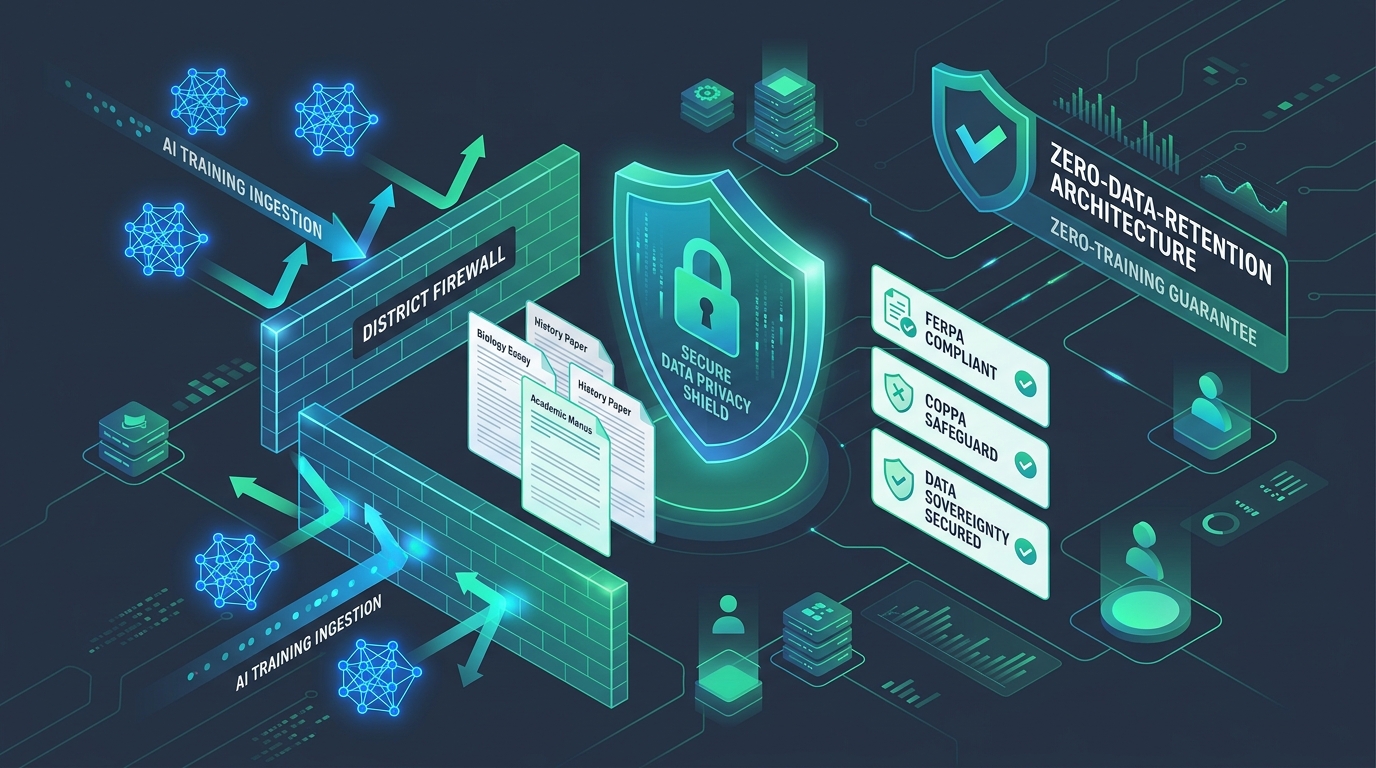
The Five Pillars of Checkmark's Data Privacy Architecture
Zero AI Model Training Guarantee
Checkmark guarantees in legally binding Data Privacy Agreements (DPAs) that student submissions, writing telemetry, and instructor feedback are never used to train, retrain, fine-tune, or validate any machine learning model, LLM, or algorithmic classifier. Student work remains 100% the property of the student and the district.
Ephemeral In-Memory (RAM) Execution
When an essay is analyzed for AI patterns, plagiarism, or rubric scoring, the payload is loaded into volatile RAM over TLS 1.3 encrypted tunnels. Linguistic analysis and rubric evaluations are calculated ephemerally, the evaluation report is transmitted to the educator console, and the memory buffer is immediately deallocated and wiped. No prompt caches or raw text remain on server disks.
Isolated District Cryptographic Hash Vaults (Peer Plagiarism Protection)
Checkmark replaces shared global databases with one-way district-isolated cryptographic hash vaults. Student writing is converted into mathematical n-gram hashes and irreversible cryptographic shingles, allowing exact and near-match peer plagiarism detection across district cohorts without storing readable text or exposing papers to external institutions.
Patent-Pending Essay Playback™: Defensible Process Evidence
Generic AI detectors produce opaque percentages that cannot be defended. Checkmark's patent-pending Essay Playback™ reconstructs the entire writing journey keystroke-by-keystroke, allowing educators to scrub through the drafting session like a video at 1x to 8x speed. It captures external paste events with timestamped original text and detects manual transcription, protecting honest students from false accusations.
Quote-Anchored Rubric Autograding with Teacher-in-the-Loop
Checkmark's autograder accelerates grading workflows while maintaining complete educator authority. It generates first-draft criterion scores and quote-anchored feedback cards tied directly to specific passages. Teachers review and edit every comment before one-click publishing to Canvas, Buzz, or Google Classroom gradebooks.
7. District Procurement & Contract Redlining Playbook
School boards, superintendents, and district technology directors should incorporate the following 8-Step Technical Audit Protocol and contract redline clauses into all standard Request for Proposals (RFPs) and Data Privacy Agreements (DPAs).
| # | Audit Step | Mandatory Procurement Requirement |
|---|---|---|
| 1 | Model Training Ban | Require explicit 0% training clause in master contract and DPA. |
| 2 | Zero-Data Retention | Mandate 0-day retention; verify volatile RAM processing architecture. |
| 3 | Sub-Processor Audit | Require list of all LLM APIs and enforce ZDR agreements with logging disabled. |
| 4 | De-Identification Ban | Reject clauses granting vendor commercial rights to “anonymized/derived text.” |
| 5 | Cryptographic Hashing | Mandate isolated hash vaults for peer plagiarism matching without cleartext pooling. |
| 6 | Telemetry Governance | Restrict keystroke telemetry strictly to teacher audit views; ban behavioral commercialization. |
| 7 | State DPA Execution | Require signature on standard state DPAs (SDPC NDPA Exhibit E, NY 2-d, SOPPA, SOPIPA). |
| 8 | Independent Compliance | Require third-party SOC 2 Type II reports and annual FERPA security audits. |
Side-by-Side Contract Redlining Guide
Clause 1: Artificial Intelligence Model Training & Secondary Use
“Customer grants Vendor a worldwide, royalty-free, perpetual license to use, reproduce, modify, aggregate, and process Customer Data, including student submissions, to develop, tune, optimize, and train Vendor's machine learning models, algorithms, and commercial services.”
“Vendor explicitly agrees and warrants that it shall not use, disclose, compile, or process any Student Data, student submissions, writing process telemetry, or derived metadata to train, retrain, fine-tune, calibrate, or validate any artificial intelligence model, machine learning system, neural network, or algorithmic scoring tool, whether owned by Vendor or any third party. Any violation of this clause constitutes a material breach resulting in immediate contract termination and statutory liquidated damages.”
Clause 2: Data Retention & Ephemeral Processing Mandate
“Vendor retains Customer Data for as long as necessary to fulfill business purposes, conduct quality assurance, and comply with operational standards.”
“Vendor shall operate under a strict Zero-Data-Retention (ZDR) architecture for all algorithmic evaluations. Student submissions and associated telemetry shall be processed ephemerally in volatile system memory (RAM) and purged immediately upon transmission of the evaluation report to the District. Vendor shall not persist cleartext student submissions on persistent disk storage, temporary caching layers, or third-party sub-processor logging environments.”
Clause 3: Sub-Processor Security & API Architecture
“Vendor may utilize third-party cloud infrastructure and sub-processors at its discretion to provide services.”
“Vendor shall maintain enforceable Data Privacy Agreements with all third-party sub-processors and foundation model API providers that explicitly enforce Zero Data Retention (ZDR), zero prompt logging, and zero model training. Vendor shall provide District with 30 days prior written notice of any proposed sub-processor changes, granting District full authority to reject any sub-processor that does not meet the District's data sovereignty standards.”
8. Summary Comparison: Commercial EdTech vs. Checkmark Plagiarism
| Architectural & Policy Dimension | Standard Commercial EdTech | Checkmark Plagiarism |
|---|---|---|
| AI Model Training Policy | Uses student essays for proprietary model training | 100% Zero Model Training guarantee in master DPA |
| Data Retention Lifespan | 30 to 90+ days in cloud databases & prompt logs | 0-day retention; Volatile RAM ephemeral processing |
| AI Detection Granularity | Opaque whole-paper % score (Black-box guess) | Passage-level highlights with calibrated cards |
| Writing Process Verification | None (Static text snapshot only) | Patent-Pending Essay Playback™ (1x to 8x scrub) |
| External Paste Tracking | Basic word-count diffs (Easily bypassed) | Timestamped original text capture + jump-to-event |
| Peer Plagiarism Matching | Global cleartext archive (Cross-school exposure) | District-isolated one-way cryptographic hash vaults |
| Rubric Autograding & LMS Sync | Disconnected AI chatbots with no LMS integration | Quote-anchored rubric drafts synced to gradebook |
| Student Flag Visibility | Opaque flags visible to students (Unwarranted stress) | Educator-only private flags (Supportive coaching) |
| Regulatory Compliance | Self-attested compliance claims (EULA clickwrap) | FERPA, COPPA, CSPC, SOC 2 Type II compliant |
9. Frequently Asked Questions (FAQ)
1. Why is training AI models on student essays a violation of FERPA?
Under FERPA’s “School Official” exception (34 CFR § 99.31), outside technology contractors may access student education records without parental consent only if they perform an institutional service under the direct control of the district for the sole purpose of that educational service. Using student submissions to train, fine-tune, or validate commercial AI algorithms constitutes an unauthorized commercial secondary use under 34 CFR § 99.33(a), exposing the district to federal non-compliance.
2. Can a school district legally consent to AI model training on behalf of parents?
No. While school districts can consent to educational data processing necessary for classroom instruction under FERPA and COPPA, districts have no statutory authority to waive student privacy rights for commercial product development, advertising profiling, or AI model training.
3. What is the difference between a model training “opt-out” and Zero-Data Retention (ZDR)?
An “opt-out” toggle is an administrative software switch in a system that is otherwise engineered to ingest and store data by default; it does not purge previously trained models (due to the mathematical impossibility of machine unlearning) and often leaves data exposed in 30-day logging caches. In contrast, Zero-Data Retention (ZDR) is an architectural standard where data is processed exclusively in volatile RAM and immediately wiped upon response delivery, ensuring zero text is ever written to disk or accessible for training.
4. How does Checkmark Plagiarism detect peer copying without storing student essays in a readable database?
Checkmark utilizes district-isolated one-way cryptographic hashing and n-gram shingling. Student writing is converted into mathematical fingerprints that allow exact and near-match similarity detection within the district’s private repository without storing readable cleartext files or exposing student prose to external school systems.
5. What is Patent-Pending Essay Playback™ and how does it protect honest students?
Essay Playback™ reconstructs the entire writing session keystroke-by-keystroke, allowing educators to scrub through the timeline like a video at 1x to 8x speed. When generic AI detectors produce false-positive flags against honest students, Essay Playback™ provides transparent, indisputable process evidence—showing natural composing pauses, revisions, deletions, and research flow—to completely exonerate the student.
6. Does Checkmark share student writing with third-party AI companies?
No. Checkmark maintains isolated enterprise infrastructure governed by strict Zero-Data-Retention agreements. Student writing is never shared, sold, or exposed to third-party commercial training loops.
7. How does Checkmark integrate into existing district Learning Management Systems?
Checkmark connects seamlessly via 1EdTech LTI 1.3 Advantage and native extensions for Canvas LMS, Buzz LMS, Google Classroom, Google Docs, and Microsoft OneDrive. Autograded rubric feedback and integrity evidence sync directly back into teacher gradebooks with one click.
Conclusion: Reclaiming Student Data Sovereignty
The rapid expansion of artificial intelligence in education must not come at the expense of student privacy, intellectual property, or community trust. School boards and educational technology leaders have both the legal duty and the technical leverage to demand that vendors respect the sanctity of student writing.
By replacing predatory, data-harvesting software with Checkmark Plagiarism’s Zero-Training, Zero-Retention architecture, districts can provide their teachers with industry-leading academic integrity tools, authentic keystroke process evidence, and quote-anchored rubric autograding—while guaranteeing that student writing remains private, protected, and sovereign.
Upgrade Your District to Verifiable Zero-Training Integrity
Protect student intellectual property, achieve 100% FERPA/COPPA compliance, and equip teachers with patent-pending Essay Playback™ and quote-anchored rubric autograding.