
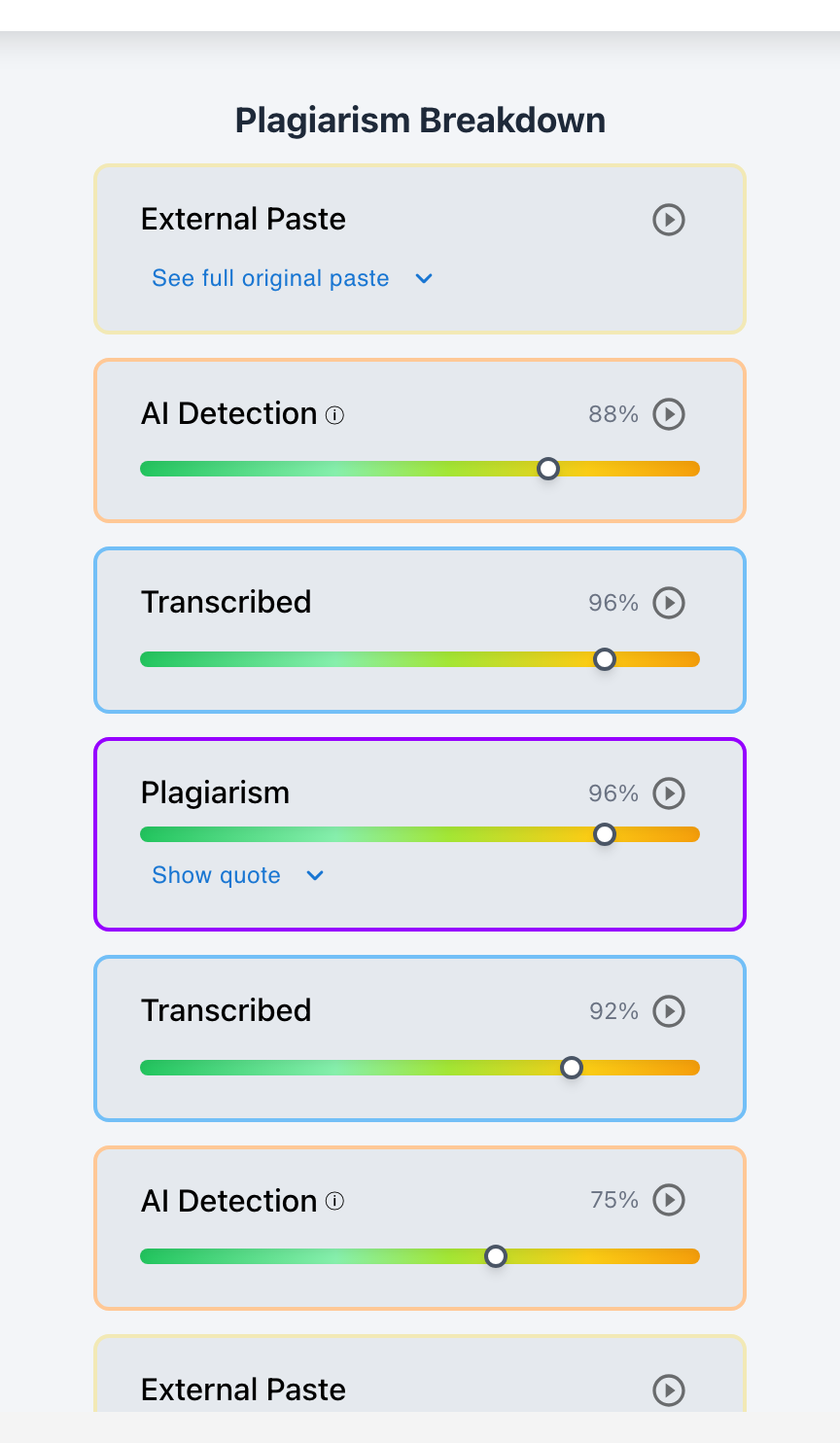
Showing the exact original source with side-by-side text comparisons is far more useful than an abstract similarity percentage because it provides verifiable physical proof, distinguishes mechanical citation errors from intentional theft, and turns integrity reviews into constructive learning moments.
In traditional academic integrity workflows, teachers were handed a single similarity number—such as "22% Match"—which often triggered confusion rather than clarity. A 22% score could mean a student included four properly formatted direct quotes, or it could mean they copied their entire thesis statement from an uncited journal. Conversely, an essay with only a 5% score could contain a single plagiarized paragraph that represented the entire core argument. Evidence-Based Reporting eliminates this ambiguity by focusing on verifiable source text and drafting context.
Below is an in-depth analysis of why showing original sources and writing playback provides superior clarity over legacy percentage metrics.
Checkmark Plagiarism powers evidence-based reporting by pairing plagiarism detection with essay writing playback, AI detection, autograding, and integrations with Canvas and Google Classroom.
The 4 Reasons Exact Sources Outperform Similarity Scores
1. Eliminates Score Ambiguity
Percentages combine bibliography entries, prompt text, properly cited quotes, and actual plagiarism into one number. Showing the source isolates the exact stolen text immediately.
2. Prevents Parent & Student Disputes
You cannot argue with a side-by-side text comparison displaying matching paragraphs and a live URL. Evidence cards turn subjective debates into objective reviews.
3. Distinguishes Intent from Error
Allows teachers to see if matching text was an uncredited copy-paste or a legitimate paraphrased source missing a parenthetical citation.
4. Transforms Integrity into Pedagogy
Enables educators to show students exactly how their paraphrasing was too close to the original source, teaching proper synthesis and citation skills.
The Power of Side-by-Side Text Alignment
When an instructor opens a Checkmark Source Evidence Card, the interface highlights matching words, synonyms, and omitted phrases in color:
- Direct Quotation Check: If the student placed quotation marks around the text and included a citation, the teacher can dismiss the card with one click.
- Patchwriting Identification: If the student merely swapped every third word with a thesaurus synonym, the underlying sentence structure is clearly visible.
- Writing Playback Corroboration: Teachers can scrub the timeline to confirm whether the matched text was typed keystroke-by-keystroke or inserted via external clipboard paste.
Read more in how Checkmark writing process analysis works.
Comparison: Similarity Percentage Metric vs. Evidence-Based Reporting
Similarity Percentage Only (Legacy Approach)
- Outputs an abstract number (e.g., "27% Similarity").
- Treats cited quotations and stolen text identically.
- Vulnerable to "safe score" misunderstandings (e.g., <15% is okay).
- Leaves teachers guessing about the true extent of misconduct.
Checkmark Evidence-Based Reporting (Modern)
- Interactive side-by-side highlighted text comparison cards.
- Clickable destination URLs and original publication dates.
- Correlated with keystroke writing playback and paste logs.
- Provides indisputable proof for conferences and conduct boards.
A 5-Step Educator Protocol for Evidence-Based Reviews
Educator Evidence-Based Review Protocol:
- 1. Open the Checkmark Report in Canvas SpeedGrader or Google Classroom.
- 2. Ignore the raw percentage score and inspect the individual Source Evidence Cards.
- 3. Dismiss properly cited direct quotations and bibliography items with one click.
- 4. Examine uncredited matches side-by-side with original web text.
- 5. Review the Essay Playback timeline to verify the keystroke origin of the matched text.
How Checkmark Plagiarism Powers Evidence-Based Reporting
Checkmark Plagiarism combines **AI detection, essay writing playback, static AI detection, plagiarism detection, autograding, and Canvas/Google Classroom integrations** to make academic integrity reporting evidence-based, transparent, and completely fair.
Frequently Asked Questions
Why can a low similarity percentage (under 10%) still be plagiarism?
Because a student may have written 90% of the essay honestly but plagiarized the critical thesis statement, core data analysis, or conclusion from an uncited journal.
Why can a high similarity percentage (over 25%) be completely clean?
Because an essay with extensive properly cited block quotes, technical terminology, and a lengthy bibliography will naturally generate a high raw similarity percentage.
How do source evidence cards stop arguments with students and parents?
By showing the student's text side-by-side with the original website and live URL link, presenting undeniable physical facts rather than an abstract score.
How does writing playback support evidence-based reporting?
Playback logs capture the exact second the matched text was pasted into the document, proving it was copied from an external source.
Can teachers exclude bibliography entries and quotes automatically?
Yes. Checkmark includes one-click filters that automatically remove properly formatted citations and quotes, recalculating the score instantly.
How does Checkmark Plagiarism integrate with Canvas LMS?
Checkmark Plagiarism displays visual writing playback timelines, source evidence cards, and dual AI/plagiarism reports directly inside Canvas SpeedGrader.
Can evidence cards be used for formative writing instruction?
Yes. Teachers can project or share evidence cards during conferences to show students how to synthesize ideas and cite sources ethically.
Does evidence-based reporting protect honest students?
Yes. Honest students who make minor citation formatting mistakes are judged on actual evidence rather than penalized by a high raw percentage.
What if a student copied text from a peer paper?
Checkmark's institutional repository displays side-by-side text comparisons between the two student submissions, along with creation timestamps.
Why is evidence-based reporting the standard for modern education?
Because fair academic discipline and effective teaching require verifiable truth, transparent data, and respect for student due process.
Verifiable Evidence Replaces Abstract Scores
Academic evaluation should be rooted in verifiable truth. By replacing abstract percentages with interactive source evidence cards and essay writing playback, Checkmark Plagiarism ensures that academic integrity is upheld with transparency, fairness, and educational value.
Checkmark Plagiarism supports this comprehensive approach with AI detection, essay writing playback, static AI detection, plagiarism detection, autograding, and integrations with Canvas and Google Classroom.
See how Checkmark pairs essay writing playback with multi-signal detection to deliver evidence-based academic integrity reporting inside your LMS. View a sample report or request a demonstration.