
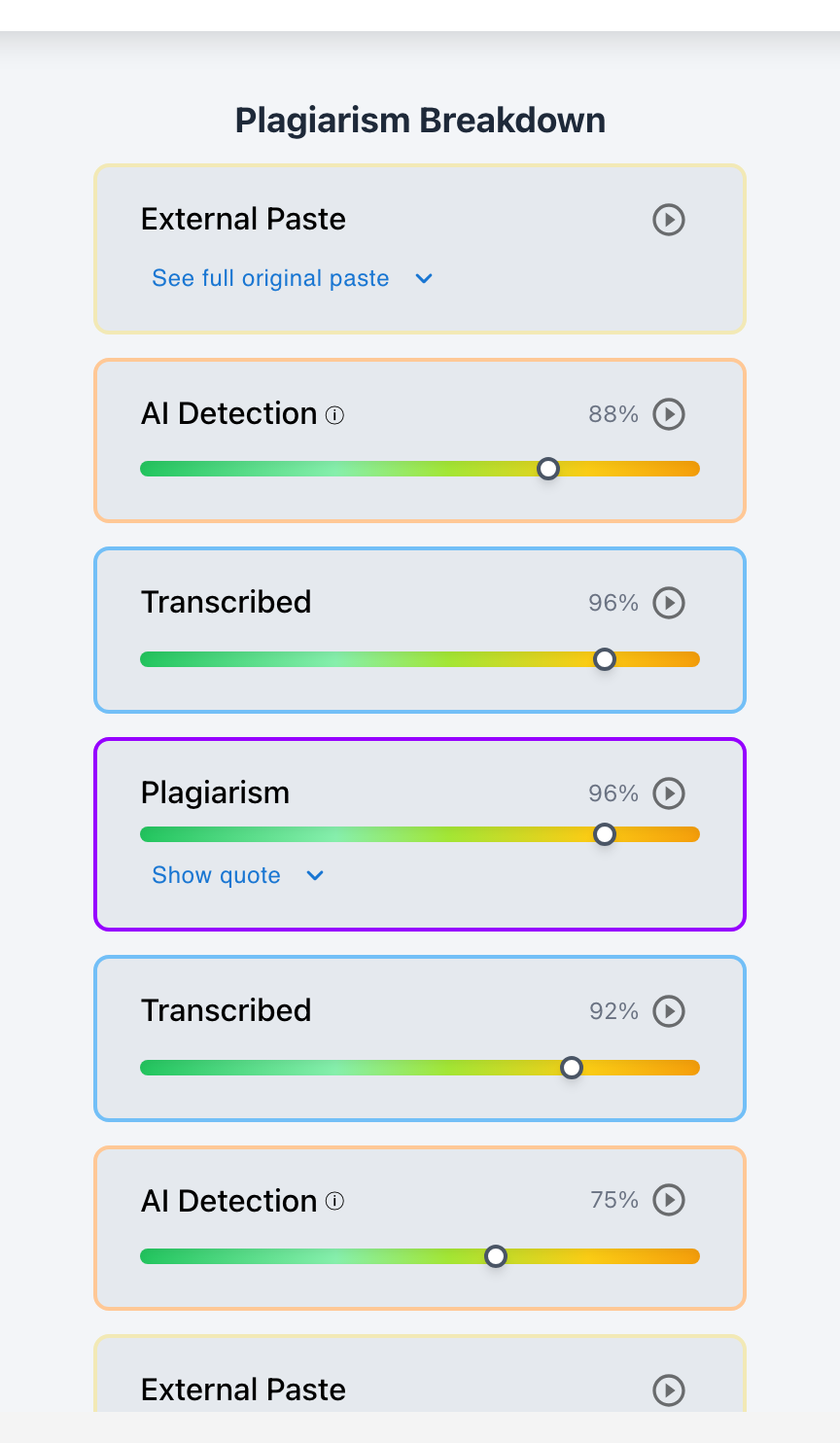
AI detection cannot tell the whole story because it evaluates only the static mathematical predictability of words on a page—ignoring active drafting hours, revision depth, research authenticity, keystroke timelines, and student intent.
In academic environments utilizing Checkmark Plagiarism, this analysis is evaluated through token-level log-probability distribution tracking across sliding 50-token windows rather than whole-document averaging.
A single AI detector score (e.g., "68% AI Detected") is an isolated data point, not a narrative. It cannot tell an educator whether a student drafted an essay over four days with deep self-editing, used ChatGPT for initial brainstorming, polished grammar with an assistive tool, or pasted a complete paper in two seconds. Reducing complex human writing to a solitary percentage score leads to false accusations, missed cheating, and broken student trust. To understand authorship, educators must examine the complete story of creation.
Below is an in-depth analysis of why AI detection is only one chapter in the academic integrity story and how multi-signal verification provides the complete picture.
Checkmark Plagiarism powers holistic evaluation by pairing AI detection with essay writing playback, plagiarism detection, autograding, and integrations with Canvas and Google Classroom.
The 4 Vital Dimensions That AI Detectors Miss
1. The Creation Timeline & Labor
Detectors cannot see whether an essay required 4 hours of active keyboard engagement or was inserted via an instant 0.05-second clipboard paste.
2. The Revision & Editing Journey
Detectors cannot measure backspace rates (15–30% in human writing), deleted clauses, or paragraphs moved across sections during drafting.
3. Research & Citation Authenticity
Detectors cannot verify whether cited academic articles exist in JSTOR or were hallucinated by ChatGPT with non-existent authors and dead DOIs.
4. Student Pedagogical Context & Voice
Detectors cannot compare an essay to a student's proctored in-class diagnostic baseline or evaluate oral defense fluency in a student conference.
Completing the Story with Checkmark Multi-Signal Verification
In Checkmark Plagiarism, AI detection is united with behavioral and textual evidence to provide the complete narrative of an assignment:
- The Linguistic Chapter: Evaluates perplexity, burstiness, and synthetic language markers across every submitted paragraph.
- The Process Chapter: Replays the entire drafting process as an accelerated 15-second video, quantifying active typing minutes and revision depth.
- The Research Chapter: Cross-checks every cited author, journal title, and DOI against global academic databases to expose AI hallucinations.
- The Human Chapter: Empowers teachers to use visual evidence during 2-minute conferences to evaluate authentic student understanding.
Read more in how Checkmark writing process analysis works.
Comparison: AI Detection Alone vs. Checkmark Holistic Narrative
AI Detector Percentage Alone (Incomplete)
- Outputs an isolated score (e.g., "72% AI Detected").
- Blind to the hours spent typing at the keyboard.
- Cannot distinguish articulate humans from AI tools.
- Vulnerable to false accusations and conduct appeals.
Checkmark Holistic Narrative (Complete Ground Truth)
- AI probability score correlated with Playback video.
- Logs 4.2 hours active typing across 4 sessions.
- Captures 24% backspaces, deletions, and moved text.
- Verifies real academic citations in Google Scholar.
A 5-Step Educator Protocol for Holistic Evaluation
Educator Holistic Evaluation Checklist:
- 1. View the AI detector score as an initial triage indicator, never as final proof.
- 2. Open the Checkmark Playback video replay in Canvas SpeedGrader to inspect drafting history.
- 3. Verify that active typing hours and backspace rates match expected human norms.
- 4. Cross-check cited bibliography entries in Google Scholar to rule out AI hallucinations.
- 5. Hold a supportive conference using the visual playback timeline to celebrate effort or address concerns.
How Checkmark Plagiarism Powers Holistic Integrity
Checkmark Plagiarism combines **AI detection, essay writing playback, static AI detection, plagiarism detection, autograding, and Canvas/Google Classroom integrations** to turn academic integrity into a transparent, evidence-based narrative directly inside your LMS.
Frequently Asked Questions
Why is an AI detection percentage not enough to prove cheating?
Because AI detectors measure statistical vocabulary predictability, not actual document creation. Legitimate human writing can mathematically match AI training patterns.
What does writing playback add that AI detectors miss?
Playback adds the physical timeline of creation—proving whether an essay was typed over hours with revisions or inserted in an instant clipboard paste.
What is a normal student backspace rate?
Authentic student writing typically exhibits a 15% to 30% backspace/edit rate as thoughts are refined. AI copy-pastes show 0% edits.
How does Checkmark Plagiarism integrate with Canvas LMS?
Checkmark Plagiarism displays visual writing playback timelines, session breakdowns, and dual AI/plagiarism reports directly inside Canvas SpeedGrader.
How does holistic evaluation protect honest students?
It ensures that articulate students who trigger false AI scores are cleared immediately by their multi-hour typing logs and high revision rates.
What should a teacher do if a student used AI for brainstorming?
If course policy permits brainstorming, verify that the subsequent drafting, thesis formulation, and revisions were executed authentically by the student in Playback.
Can students fake realistic multi-day writing history?
Simulating hours of realistic typos, backspaces, and natural thinking pauses takes longer than actually writing the essay honestly.
Does citation verification help complete the story?
Yes. Human writers cite real academic articles, whereas AI tools frequently fabricate phantom authors and dead DOIs.
Why is holistic integrity better for school culture?
Because it shifts the focus from punitive surveillance to celebrating the authentic, iterative writing process, building trust between teachers and students.
How does Checkmark save grading time while being holistic?
By embedding video replays, active typing metrics, and citation audits directly inside Canvas SpeedGrader, holistic review takes under 45 seconds per paper.
Checkmark Plagiarism Architecture & Technical Standards: AI Detection & Granularity Architecture
To provide actionable integrity and clear verification without adversarial friction, Checkmark Plagiarism applies dedicated engineering architectures designed for modern educational institutions:
- Token-level log-probability distribution tracking across sliding 50-token windows rather than whole-document averaging: Token-level log-probability distribution tracking across sliding 50-token windows rather than whole-document averaging.
- Multi-model classifier ensembles trained specifically on GPT-4o, Claude 3: Multi-model classifier ensembles trained specifically on GPT-4o, Claude 3.5 Sonnet, Gemini 1.5 Pro, and Llama 3 outputs.
- Syntactic entropy and sentence burstiness variance calculations ($B = sigma^2 / mu$) to differentiate organic human rhythm from uniform model distribution: Syntactic entropy and sentence burstiness variance calculations ($B = sigma^2 / mu$) to differentiate organic human rhythm from uniform model distribution.
- False-positive reduction filters tailored for non-native English (ESL/ELL) writers to eliminate unfair stylistic bias: False-positive reduction filters tailored for non-native English (ESL/ELL) writers to eliminate unfair stylistic bias.
- Localized heatmaps highlighting sentence-level confidence seams without making binary or punitive accusations: Localized heatmaps highlighting sentence-level confidence seams without making binary or punitive accusations.
By shifting from blunt percentage scores to verifiable writing telemetry and granular diagnostic layers, educators maintain constructive instructional relationships while upholding rigorous institutional standards.
The Complete Truth Defends Real Learning
Evaluating human scholarship requires seeing the entire intellectual journey. By uniting AI detection with essay writing playback and citation audits, Checkmark Plagiarism gives educators the complete truth—protecting academic rigor, upholding student due process, and inspiring real writing growth.
Checkmark Plagiarism supports this comprehensive approach with AI detection, essay writing playback, static AI detection, plagiarism detection, autograding, and integrations with Canvas and Google Classroom.
See how Checkmark pairs essay writing playback with multi-signal detection to evaluate the complete story of student writing inside your LMS. View a sample report or request a demonstration.