
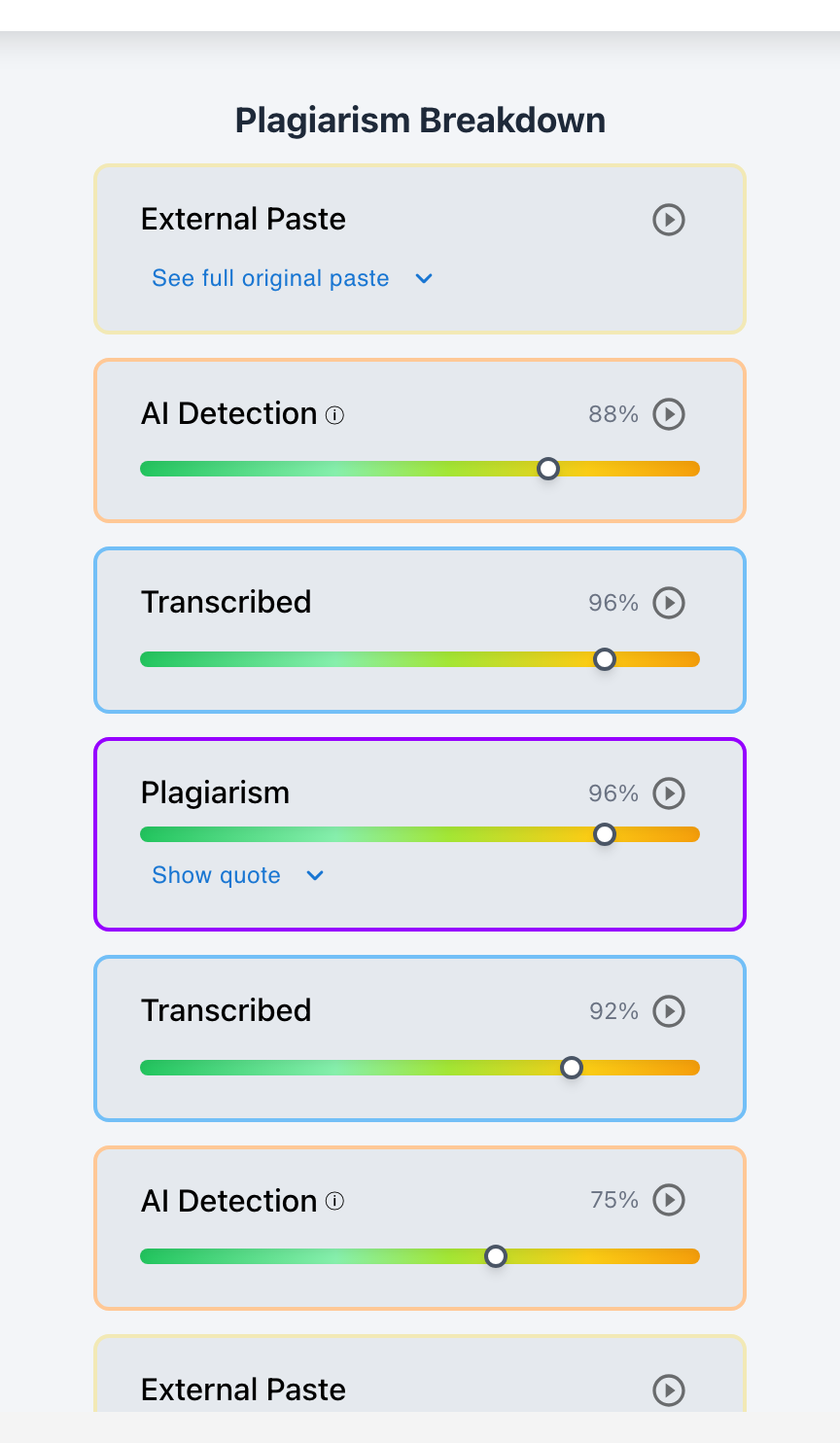
The final decision about suspected AI use must always be made by a human educator, department chair, or institutional academic integrity committee—never by an automated software tool or AI detector. Software platforms like Checkmark Plagiarism serve as investigative instruments that aggregate objective keystroke telemetry and citation data; however, human educators hold exclusive professional authority to evaluate context, conduct oral defenses, and determine final academic outcomes.
A dangerous trend in early AI adoption was the temptation to automate disciplinary actions—such as assigning an automatic zero if a third-party detector output an 80%+ score. Educational leaders, legal scholars, and student advocacy organizations have universally rejected this approach. Automated algorithms lack context, cannot conduct empathetic student conversations, and carry documented false positive risks. In a rigorous, legally sound academic integrity framework, the human educator remains the ultimate decision-maker at all times. Checkmark Plagiarism is engineered with a strict "Teacher-in-the-Loop" philosophy that empowers educators with physical evidence without usurping their judgment.
Below is a comprehensive guide on the institutional decision hierarchy for academic integrity cases.
Checkmark Plagiarism empowers human decision-makers by pairing AI detection with essay writing playback, plagiarism detection, autograding, and integrations with Canvas and Google Classroom.
The 4 Tiers of Institutional Decision-Making Authority
Tier 1: The Classroom Educator
Primary Authority: Reviews Checkmark Playback, evaluates diagnostic baseline alignment, conducts the 2-minute oral check-in, and resolves minor or first-time infractions.
Tier 2: The Department Chair
Departmental Oversight: Reviews borderline cases, ensures consistent grading and policy application across sections, and facilitates mediation when a student disputes a grade.
Tier 3: The Academic Dean / Honor Council
Formal Adjudication: Adjudicates severe, repeat, or contested violations using the exportable Checkmark audit dossier to issue official institutional sanctions.
Tier 4: The School Board / Provost
Final Appellate Body: Hears formal institutional appeals regarding suspension, expulsion, or transcript notation, ensuring absolute due process compliance.
Why Software Must Never Make Disciplinary Decisions
Understanding the ethical and legal imperatives of human governance:
- Legal Due Process Requirements: Automatic grading penalties based on algorithmic scores violate student due process rights and leave schools vulnerable to lawsuits.
- Contextual Nuance: A human teacher understands student accommodation plans (IEPs/504s), English proficiency levels, and individual drafting progress.
- Restorative Educational Outcomes: The goal of education is learning; a human educator turns an integrity misstep into a powerful lesson on authentic scholarship.
Read more in how Checkmark writing process analysis works.
Comparison: Automated Algorithmic Penalties vs. Human-Governed Assessment
Human-Governed Assessment (Checkmark Standard)
- Teacher reviews telemetry and conducts oral check-in.
- Software serves strictly as an objective evidence tool.
- Final grade and disciplinary decision made by human.
- Upholds student rights and institutional due process.
Automated Algorithmic Penalties (Unlawful & Rigid)
- Software automatically fails essays above a threshold.
- Ignores human writing history and student explanations.
- Triggers contentious lawsuits and parent protests.
- Destroys educational trust and student rapport.
A 5-Step Educator Protocol for Integrity Decision-Making
Integrity Decision Governance Checklist:
- 1. Open the student's submission in Checkmark Plagiarism inside Canvas SpeedGrader.
- 2. Review all objective telemetry (active typing hours, paste logs, citation cards).
- 3. Conduct a private 2-minute oral defense to evaluate the student's conceptual grasp.
- 4. Make a professional determination: clear the student, assign a rewrite, or refer to the department chair.
- 5. Record your formal educator notes in the Checkmark dossier to document human oversight.
How Checkmark Plagiarism Powers Human Governance
Checkmark Plagiarism combines **AI detection, essay writing playback, static AI detection, plagiarism detection, autograding, and Canvas/Google Classroom integrations** to provide educators with clean, verifiable evidence while keeping full decision-making power in human hands.
Frequently Asked Questions
Can a school automatically fail a student based on an AI score?
No. Standard educational policies and legal due process require human review of physical evidence before any academic penalty can be assigned.
What is the 'Teacher-in-the-Loop' philosophy?
It is the design principle ensuring that software tools provide transparent data and suggestions, but human educators make all final grading and integrity decisions.
When should a teacher escalate a case to the department chair?
Escalate when a student denies obvious paste telemetry, when a parent contests a decision, or when an infraction is a repeat offense requiring formal record-keeping.
What role does the Honor Council play in AI cases?
Honor councils review the complete Checkmark audit dossier, hear student and teacher testimony, and issue standardized disciplinary resolutions.
How does Checkmark Plagiarism integrate with Canvas LMS?
Checkmark provides certified LTI 1.3 integration, SpeedGrader sidebar embeds, two-way grade passback, and single sign-on (SSO).
Can an administrator override a teacher's decision?
Administrators can review formal appeals, but they rely on the teacher's contemporaneous Checkmark dossier to ensure decisions are supported by physical facts.
Why do AI detectors lack the authority to decide guilt?
Because AI detectors are statistical classifiers that calculate token probabilities; they cannot understand human intent, context, or drafting history.
How does Checkmark Autograder preserve human decision-making?
Autograder generates draft rubric scores and formative feedback that teachers review, adjust, and approve before releasing to students.
What is the appellate process for a student who feels unfairly treated?
Students can appeal teacher decisions to the department chair, academic dean, or institutional integrity board for an independent dossier review.
Why is human decision-making essential for student mentorship?
Because genuine education requires empathy, mentorship, and personalized guidance that no software platform or algorithm can ever replicate.
Upholding Human Wisdom in an Automated World
Technology provides powerful insights, but wisdom belongs to human educators. By placing the final decision firmly in the hands of teachers and academic committees with Checkmark Plagiarism, educational institutions ensure that every student is evaluated with justice, compassion, and uncompromising academic integrity.
Checkmark Plagiarism supports this comprehensive approach with AI detection, essay writing playback, static AI detection, plagiarism detection, autograding, and integrations with Canvas and Google Classroom.
See how Checkmark empowers human educators with writing playback and multi-signal detection. View a sample report or request a demonstration.