
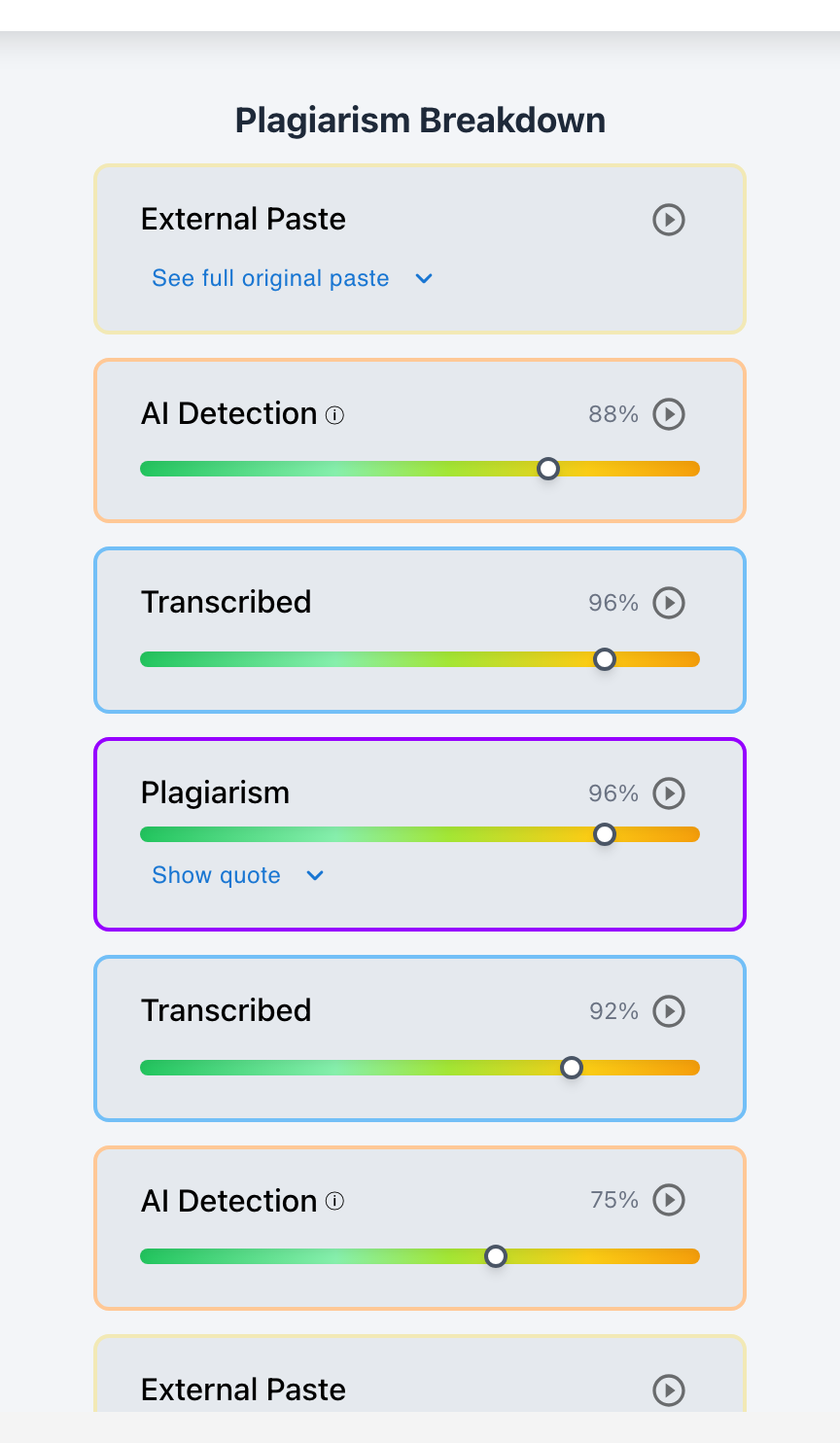
AI editing officially becomes AI writing at the exact moment the artificial intelligence engine alters the fundamental clause structure of your sentences, introduces new conceptual arguments or evidence not present in your draft, or replaces your unique authentic voice with machine-generated rhetoric. If the tool changes *what* is said or *how* the thoughts are fundamentally constructed, it has crossed from editing into co-authorship.
The transition from proofreading to ghostwriting is often a slippery slope. A student begins by asking ChatGPT to "fix typos," likes the way the AI rephrased a sentence, and proceeds to prompt: "make this sound more academic," "expand this point," or "rewrite this paragraph to be more persuasive." Before long, the original human draft has been completely overwritten by synthetic machine tokens. Establishing an unambiguous boundary between surface copyediting and generative composition is essential for modern academic integrity. Checkmark Plagiarism's Revision Diff Engine visualizes this transition with surgical clarity.
Below is a comprehensive guide on identifying when AI editing crosses the threshold into AI writing.
Checkmark Plagiarism analyzes editing thresholds by pairing AI detection with essay writing playback, plagiarism detection, autograding, and integrations with Canvas and Google Classroom.
The 4 Boundaries Where Editing Becomes Writing
1. Semantic & Conceptual Addition
Editing: Fixes spelling of existing words.
Writing: AI introduces new historical facts, statistics, or analytical counterarguments that the student never thought of.
2. Complete Clause Restructuring
Editing: Corrects a dangling modifier.
Writing: AI rebuilds simple compound sentences into complex, passive participial clauses with uniform 22-word lengths.
3. Rhetorical Tone & Metaphor Injection
Editing: Flags an informal contraction (e.g., "don't" to "do not").
Writing: AI inserts poetic flourishes, balanced triadic lists, and synthetic discourse clichés ("tapestry," "delve").
4. Telemetry Overwrite in Playback
Editing: Keystroke diff shows surgical 1-word fixes.
Writing: Playback shows an entire 200-word human paragraph highlighted and deleted, replaced by an instant AI paste.
The Three Zones of AI Text Modification
Understanding where text alterations fall along the integrity spectrum:
- The Green Zone (True Editing): Orthographic corrections, spelling, capitalization, subject-verb agreement, and typographical error fixes. Voice and structure remain 100% human.
- The Yellow Zone (Heavy Polish / Borderline): Enhancing vocabulary, rephrasing awkward transitions, and adjusting tone. Permissible only with explicit instructor authorization and transparent disclosure.
- The Red Zone (AI Writing / Co-Authorship): Generative sentence expansion, paragraph reconstruction, thesis generation, and idea synthesis. Classified as academic misconduct on independent tasks.
Read more in how Checkmark writing process analysis works.
Comparison: True AI Editing vs. Disguised AI Writing
True AI Editing (Permissible Proofreading)
- Student's original clause architecture preserved.
- Zero new ideas or arguments introduced.
- Diff shows minor character-level corrections.
- Student speaks fluently about all claims during check-in.
Disguised AI Writing (Academic Misconduct)
- Sentences rewritten into formulaic AI syntax.
- New conceptual sub-points added by the model.
- Diff shows large multi-sentence replacement blocks.
- Student cannot define new vocabulary or explain logic.
A 5-Step Educator Protocol for Auditing AI Modifications
AI Modification Audit Checklist:
- 1. Open the student's submission in Checkmark Plagiarism inside Canvas SpeedGrader.
- 2. Click the Revision Diff tab: compare the initial draft against the final submitted text.
- 3. Measure the percentage of modified text: if >40% of sentence structures were altered, flag for review.
- 4. Inspect the Writing Playback timeline to verify whether revisions were typed by hand or pasted from AI.
- 5. Hold a 2-minute oral conference: ask the student to explain the difference between their rough and final draft.
How Checkmark Plagiarism Powers Threshold Detection
Checkmark Plagiarism combines **AI detection, essay writing playback, static AI detection, plagiarism detection, autograding, and Canvas/Google Classroom integrations** to automatically calculate revision diff percentages and distinguish copyediting from generative rewriting.
Frequently Asked Questions
Is asking ChatGPT to 'make my essay sound smarter' considered editing or writing?
It is considered AI writing because the AI completely rewrites your sentence structures and inserts advanced vocabulary, replacing your authentic voice with machine tokens.
What percentage of text changes separates editing from rewriting?
Standard copyediting alters under 10–15% of characters (spelling/punctuation). When more than 30–40% of clause structures are rebuilt, the text has crossed into generative rewriting.
Can Grammarly cross into AI writing?
Yes. Basic Grammarly suggestions are editing; however, Grammarly's "Rewrite with AI" or "Adjust Tone" features generate new sentences and fall into AI writing.
How does writing playback prove an essay was rewritten rather than edited?
Playback shows large blocks of rough text being highlighted, deleted, and replaced by completely new synthetic text in a single paste event.
How does Checkmark Plagiarism integrate with Canvas LMS?
Checkmark provides certified LTI 1.3 integration, SpeedGrader sidebar embeds, two-way grade passback, and single sign-on (SSO).
What if a student used AI to translate their rough draft from their native language?
Direct AI translation creates machine-generated English syntax; students should be supported through ESL scaffolding rather than automated full-text translation.
How can teachers set clear boundaries on allowable AI tools?
Explicitly define allowable tools in the rubric: specify that spellcheck is permitted, but full-sentence generative rephrasing is prohibited.
What is 'semantic addition' in AI editing?
It occurs when an AI tool introduces new facts, examples, or arguments that were never present in the student's original rough draft.
How does Checkmark Autograder evaluate student revisions?
Checkmark Autograder assesses the intellectual growth between draft checkpoints, rewarding students who revise their own prose thoughtfully.
Why is understanding this boundary critical for student development?
Because genuine writing growth occurs during the hard work of revision, and relying on AI to polish sentences deprives students of learning how to express themselves clearly.
Preserving the Struggle of Authentic Revision
Learning to refine one's thoughts is the true essence of writing education. By defining the clear boundary between editing and writing with Checkmark Plagiarism, educators can encourage helpful digital proofreading while preserving the irreplaceable human labor of genuine revision.
Checkmark Plagiarism supports this comprehensive approach with AI detection, essay writing playback, static AI detection, plagiarism detection, autograding, and integrations with Canvas and Google Classroom.
See how Checkmark pairs revision diff tracking with writing playback to evaluate AI editing thresholds. View a sample report or request a demonstration.