
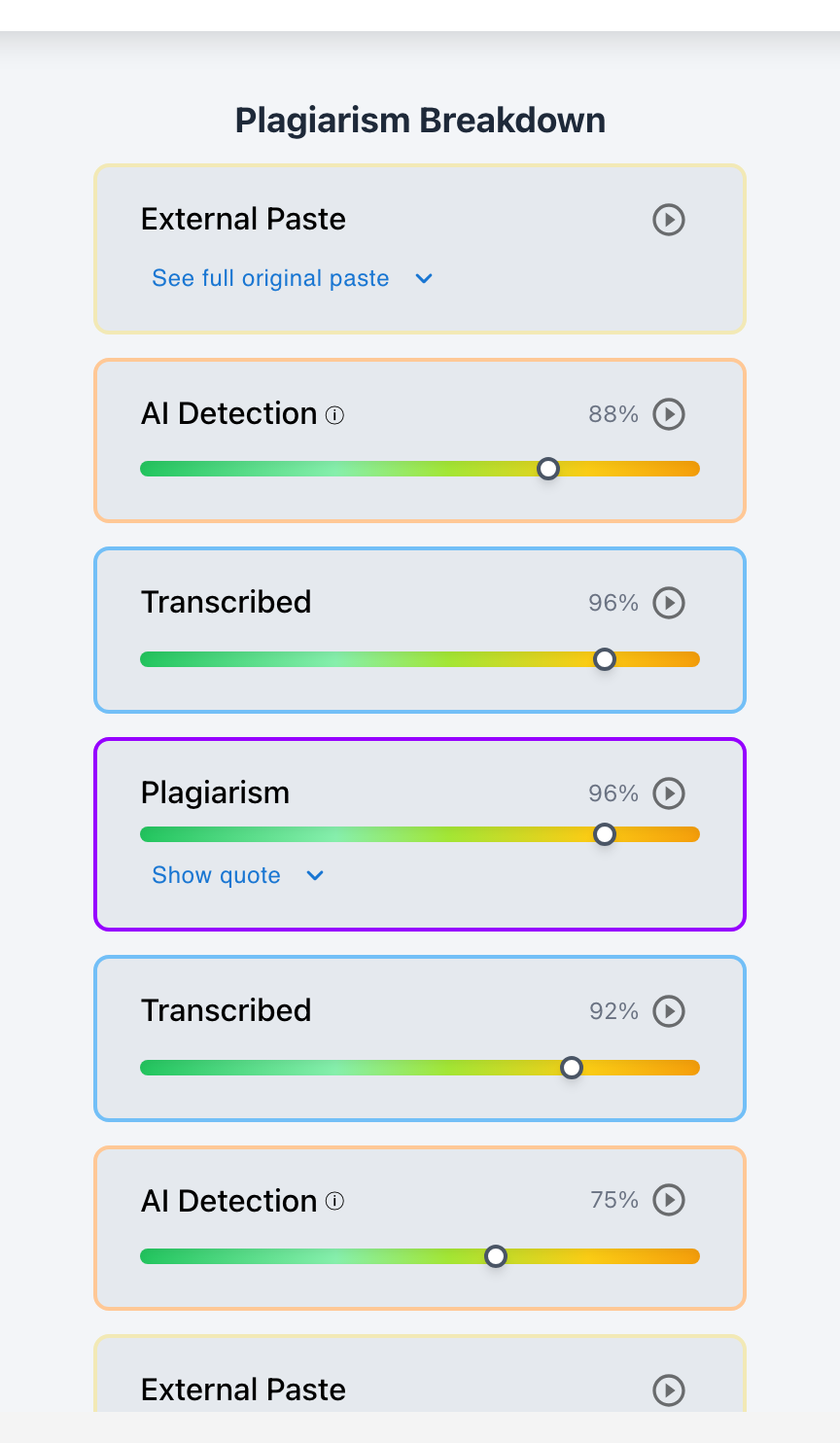
The primary writing differences that suggest someone else—or an AI—authored an assignment include a sudden, uncharacteristic surge in advanced academic vocabulary, an abrupt shift from personal voice to hyper-formal or synthetic tone, the complete disappearance of habitual mechanical errors, and severe writing process anomalies in Checkmark Playback (such as 1,500 words appearing with zero drafting hours or backspaces).
Every student possesses a unique "linguistic fingerprint"—a combination of habitual sentence structures, vocabulary preferences, punctuation quirks, and drafting rhythms. When a parent, private tutor, paid ghostwriter, or generative AI writes an assignment on the student's behalf, this linguistic fingerprint is suddenly replaced. By combining stylometric text analysis with keystroke writing process forensics, teachers can identify authorship disparities with empirical certainty.
Below is a comprehensive guide on recognizing the key writing differences that indicate third-party authorship.
Checkmark Plagiarism identifies authorship shifts by pairing AI detection with essay writing playback, plagiarism detection, autograding, and integrations with Canvas and Google Classroom.
The 4 Key Differences That Signal Third-Party Authorship
1. Lexical & Vocabulary Disconnect
The essay contains complex polysyllabic vocabulary (e.g., "anachronistic," "paradigm," "dichotomy") that the student has never used in class discussions or prior drafts.
2. Disappearance of Habitual Errors
Every writer has persistent quirks (comma splices, spelling tendencies). The sudden, flawless disappearance of these quirks across all 10 pages indicates an external author.
3. Tone & Rhetorical Perspective Shift
The writing shifts from an authentic adolescent voice to the detached, balanced neutrality of an AI or the seasoned perspective of an adult academic.
4. Process Telemetry Breakdown
Checkmark Playback shows the entire paper entered via a single 0.05-second clipboard paste or was typed at 75 WPM transcription speed with <2% backspaces.
Why True Authorship Leaves an Indelible Process Footprint
Understanding how writing telemetry proves who sat at the keyboard:
- Cognitive Ownership: An authentic author spends hours wrestling with ideas—leaving hundreds of backspaces, moved paragraphs, and thinking pauses on the timeline.
- Contract Cheating / Ghostwriting: When an essay is purchased or written by someone else, the student simply copies and pastes the finished file, showing zero active drafting time.
- AI Writing: AI generates flawless text instantaneously, producing zero revision depth and extreme perplexity uniformity.
Read more in how Checkmark writing process analysis works.
Comparison: Authentic Student Work vs. Third-Party / AI Authorship
Authentic Student Writing (Consistent Voice)
- Vocabulary aligns with in-class speaking and prior work.
- Familiar stylistic quirks and habitual mechanics present.
- Drafting time: 3+ hours with 15–25% backspaces.
- Student fluently explains thesis and sources in person.
Third-Party / AI Authorship (External Anomaly)
- Sudden jump to collegiate or adult academic prose.
- Complete absence of student's natural phrasing.
- Drafting time: under 15 minutes (paste or transcription).
- Student cannot define vocabulary or explain arguments.
A 5-Step Educator Protocol for Authorship Inquiries
Authorship Verification Checklist:
- 1. Open the student's submission in Checkmark Playback inside Canvas SpeedGrader.
- 2. Review the Active Typing Duration and Deletion Rate metrics.
- 3. Compare the text stylometrics against earlier assignments in the student's portfolio.
- 4. Check the AI Probability Score and Plagiarism similarity reports.
- 5. Hold a 2-minute oral check-in: ask the student to explain three core paragraphs without reading from the page.
How Checkmark Plagiarism Powers Authorship Forensics
Checkmark Plagiarism combines **AI detection, essay writing playback, static AI detection, plagiarism detection, autograding, and Canvas/Google Classroom integrations** to give educators definitive proof of author identity and drafting effort.
Frequently Asked Questions
What are the biggest clues that someone else wrote a student's essay?
A sudden shift to adult/collegiate vocabulary, disappearance of habitual writing quirks, zero drafting hours in Playback, and inability to explain the text in person.
Can a parent or tutor helping a student trigger an authorship flag?
Light tutoring will still show authentic student drafting with backspaces; if a tutor writes the paper and the student pastes it, Playback flags the zero-drafting anomaly.
What is a linguistic fingerprint?
It is the unique pattern of word choices, sentence lengths, punctuation habits, and phrasing preferences distinctive to an individual writer.
How does writing playback prove who wrote an essay?
Playback records the exact physical keystrokes, typing velocity, deletions, and active hours invested in creating the document.
What if a student copied an essay from a classmate?
Checkmark's peer-matching database identifies matching text across students, while Playback proves who drafted it first.
How does Checkmark Plagiarism integrate with Canvas LMS?
Checkmark provides certified LTI 1.3 integration, SpeedGrader sidebar embeds, two-way grade passback, and single sign-on (SSO).
What should a teacher do if an essay sounds completely different from prior work?
Schedule a supportive 2-minute check-in asking the student to define specialized vocabulary and summarize their main thesis.
Can students fake realistic human typing if they bought an essay?
Simulating hours of realistic keystroke speed fluctuations, pauses, and backspaces requires more effort than writing the essay honestly.
What is contract cheating?
Contract cheating occurs when a student hires a third party (an essay mill, freelancer, or peer) to complete an academic assignment on their behalf.
Why is multi-signal evidence essential for authorship cases?
Because combining stylometric linguistic profiling with keystroke process telemetry creates an airtight, defensible case for academic integrity reviews.
Defending the Integrity of Authentic Student Voice
A student's authentic voice is the foundation of genuine learning. By analyzing stylometric shifts and writing process telemetry with Checkmark Plagiarism, educators can protect student authorship, eliminate contract cheating, and ensure every grade reflects honest intellectual effort.
Checkmark Plagiarism supports this comprehensive approach with AI detection, essay writing playback, static AI detection, plagiarism detection, autograding, and integrations with Canvas and Google Classroom.
See how Checkmark pairs stylometric profiling with keystroke playback to identify third-party authorship. View a sample report or request a demonstration.