
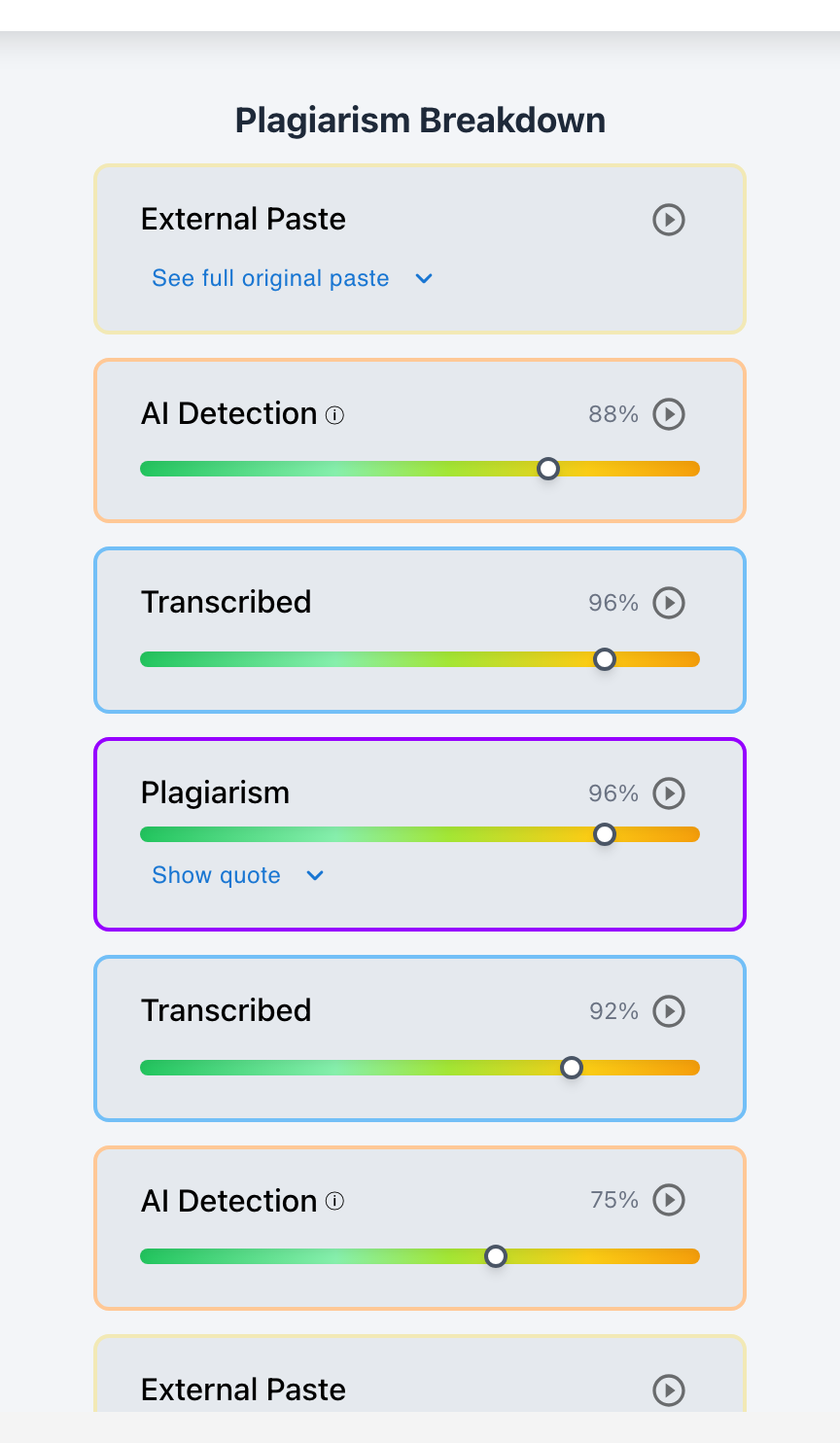
When evaluating an AI essay grader, teachers and school leaders should look for four essential non-negotiable features: 1) Strict "Teacher-in-the-Loop" Architecture (requiring explicit educator review and one-click override control before grades reach students); 2) Evidence-Grounded Highlighting (visual, color-coded overlays quoting student text to justify every score); 3) Native LMS Integration (seamless LTI 1.3 sync with Canvas SpeedGrader and Google Classroom); and 4) Unified Multi-Signal Verification (pairing autograding with keystroke writing playback, AI detection, and plagiarism checking).
As educational technology companies rush to release automated grading tools, the market has become crowded with superficial, black-box products. Many of these tools simply feed student text into generic chatbot prompts, outputting arbitrary letter grades with generic feedback that fails to align with classroom rubrics or state standards. Choosing the right AI essay grader requires evaluating tools through a rigorous pedagogical, forensic, and ethical lens. Checkmark Autograder sets the gold standard for educator-first automated assessment.
Below is a comprehensive guide and checklist on what educators should prioritize when selecting an AI essay grader.
Checkmark Plagiarism embodies the complete grading standard by pairing autograding with essay writing playback, AI detection, plagiarism detection, and integrations with Canvas and Google Classroom.
The 4 Non-Negotiable Pillars of an AI Essay Grader
1. Teacher-in-the-Loop Sovereign Control
The platform must never release grades autonomously. Teachers must retain 100% review, editing, and override authority over every suggested score and comment.
2. Evidence-Grounding & Textual Overlays
Every rubric score must be visually justified by quoting specific student sentences, highlighting thesis statements, evidence synthesis, and counter-arguments in color.
3. Native LMS & SpeedGrader Integration
Certified LTI 1.3 integration that renders pre-scored rubrics directly inside Canvas SpeedGrader or Google Classroom with two-way gradebook passback.
4. Multi-Signal Integrity Integration
Combines autograding with keystroke writing playback, static AI detection, and web plagiarism checking on a single interactive document canvas.
The 3 Major Red Flags to Avoid in AI Graders
Warning signs that indicate an unpedagogical or untrustworthy tool:
- Red Flag 1: Black-Box Autonomous Publishing: Tools that automatically post grades directly to students without human teacher inspection or approval.
- Red Flag 2: Generic Unanchored Feedback: Tools that output vague advice ("Good essay, improve transitions") without quoting specific student sentences.
- Red Flag 3: Student Data Mining & Model Training: Vendors that retain student writing to train public commercial AI models, violating FERPA and student privacy laws.
Read more in how Checkmark writing process analysis works.
Comparison: Generic AI Tools vs. Checkmark Educator-First Platform
Checkmark Educator-First Platform (Gold Standard)
- Strict Teacher-in-the-Loop review and override control.
- Color-coded visual evidence highlighting in SpeedGrader.
- Custom rubric ingestion from Canvas and Google Classroom.
- Integrated writing playback, AI, and plagiarism checking.
Generic AI Chatbot Graders (Unpedagogical & Risky)
- Arbitrary scoring unaligned with course rubrics.
- Requires manual copy-pasting into external websites.
- No process telemetry or keystroke writing playback.
- Potential FERPA data privacy and student IP risks.
A 5-Step Evaluation Checklist for School Purchasing Teams
AI Essay Grader Evaluation Checklist:
- 1. Verify Teacher-in-the-Loop governance: confirm grades cannot publish without teacher review.
- 2. Test Custom Rubric Fidelity: upload a complex 6-criteria rubric and check scoring alignment.
- 3. Inspect Evidence Grounding: verify that all feedback notes directly quote student sentences.
- 4. Test Canvas SpeedGrader / Google Classroom integration: confirm two-way grade passback.
- 5. Verify FERPA Compliance: ensure zero retention and no commercial model training on student text.
How Checkmark Plagiarism Sets the AI Grading Standard
Checkmark Plagiarism combines **AI detection, essay writing playback, static AI detection, plagiarism detection, autograding, and Canvas/Google Classroom integrations** to provide schools with an uncompromised, educator-first assessment environment.
Frequently Asked Questions
What is the most important feature in an AI essay grader?
Strict Teacher-in-the-Loop control: ensuring that the teacher reviews, edits, and approves all scores before students ever see them.
Can an AI grader handle complex, non-traditional rubrics?
Yes. Checkmark Autograder handles complex multi-tier rubrics, state ELA scales, and College Board AP 6-point analytical frameworks seamlessly.
How does Checkmark protect student data privacy?
Checkmark complies with FERPA, CSPC, and SOC 2 Type II standards; student essays are never sold or used to train public commercial AI models.
Does Checkmark require teachers to switch between multiple tabs?
No. Checkmark embeds all autograding feedback, evidence highlights, and writing playback directly inside Canvas SpeedGrader and Google Classroom.
Can teachers customize the tone and style of AI feedback?
Yes. Educators can configure feedback settings for encouraging, rigorous, Socratic, or technical tones tailored to their classroom culture.
How does Autograder integrate with writing playback?
Checkmark allows teachers to review rubric evaluations alongside a 15-second keystroke playback video that proves the writing was authentic.
What if an essay contains plagiarism or AI generation?
Autograder automatically flags the integrity risk and routes the submission to the teacher for manual review before any rubric score is assigned.
How much time does Checkmark save per teacher per semester?
Educators save an average of 100 to 150 hours of grading time per semester, eliminating weekend grading burnout entirely.
Can schools pilot Checkmark before committing to a full deployment?
Yes. Schools and districts can request a live demonstration and pilot program across specific academic departments.
Why is Checkmark the preferred choice for modern educators?
Because it is built from the ground up for teachers—combining high-speed grading automation with total human sovereignty, transparency, and integrity.
The Future of Thoughtful, Empowered Assessment
AI should elevate the human educator, not automate away the art of teaching. By choosing Checkmark Autograder, schools equip their teachers with an intelligent, transparent, and sovereign grading co-pilot that transforms assessment into a joy.
Checkmark Plagiarism supports this comprehensive approach with AI detection, essay writing playback, static AI detection, plagiarism detection, autograding, and integrations with Canvas and Google Classroom.
See how Checkmark Autograder sets the gold standard for educator-first AI grading in Canvas. View a sample report or request a demonstration.