
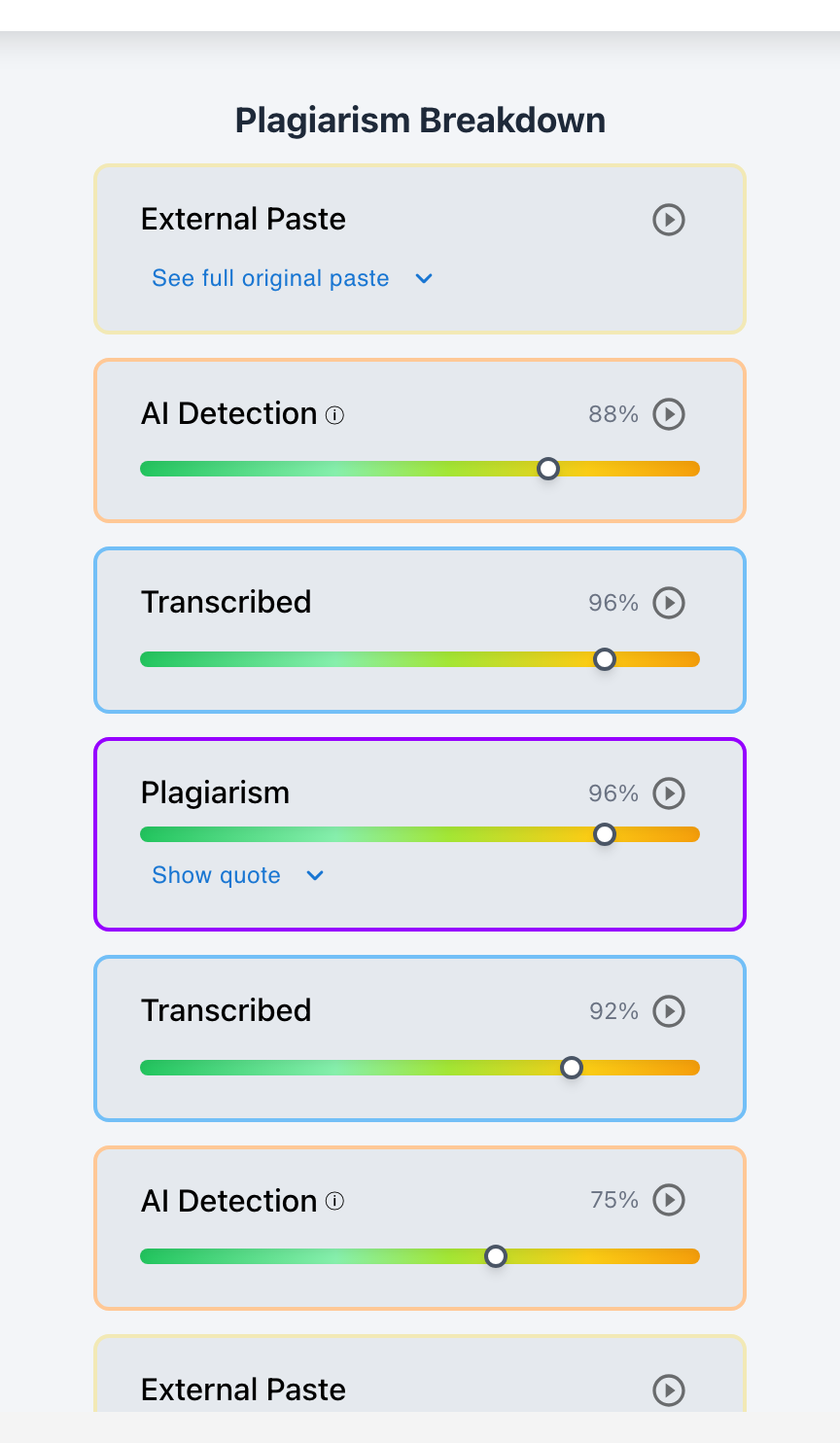
When an AI detector score and document writing history disagree, educators must prioritize physical writing history as the objective ground truth—evaluating active typing duration, revision depth, and oral defenses to resolve the discrepancy.
In modern grading workflows, teachers occasionally encounter two perplexing contradictions: (1) an essay receives an 85% AI score, but the writing history shows 4.5 hours of active keystrokes and 25% backspaces, or (2) an essay receives a 0% AI score, but the writing history shows an entire 1,500-word paper appeared in a single 1-second paste. Resolving these discrepancies requires understanding what each signal measures and relying on Checkmark Plagiarism's Combined Report to guide fair academic decisions.
Below is an educator's decision framework for resolving conflicting integrity evidence.
Checkmark Plagiarism powers multi-signal resolution by pairing essay writing playback with AI detection, plagiarism detection, autograding, and integrations with Canvas and Google Classroom.
The Two Conflict Scenarios & How to Resolve Them
Scenario A: High AI Score + Robust Writing History
Diagnosis: False Positive. The student writes in a formal, highly structured academic tone that triggered the detector, but 4+ hours of active typing and revisions prove authentic human authorship.
Scenario B: Low AI Score + Instant 1-Second Paste
Diagnosis: External Paste / Plagiarism. The text was not generated by ChatGPT, but copied from a classmate, purchased from a paper mill, or drafted offline in Word. Check the Plagiarism match report.
Why Process Evidence Outranks Statistical AI Scores
In the hierarchy of forensic evidence, physical process logs always supersede statistical text predictions:
- Statistical AI Detectors: Measure mathematical probability based on training data. They can be fooled by formal grammar or altered prompts.
- Keystroke Writing Playback: Records physical keypresses, timestamped deletions, and formulation pauses inside the document. Physical reality cannot be simulated.
- The Rule of Ground Truth: If writing playback proves multi-hour human composition with healthy backspace rates (15–30%), the AI detector score must be disregarded.
Read more in how Checkmark writing process analysis works.
Comparison: Resolving Integrity Conflicts
High AI (85%) + High Process (4 hrs typing)
- Evidence: Multi-session draft, 24% backspaces, verified citations.
- Cause: Articulate student writing in formal academic syntax.
- Action: Clear student of all suspicion; grade paper on merit.
Low AI (5%) + Zero Process (<3 min drafting)
- Evidence: Blank page to 1,500 words in 1 second; 0% typing.
- Cause: Peer copying, contract cheating, or uncredited paste.
- Action: Review plagiarism database matches & request external files.
A 5-Step Decision Protocol for Conflicting Reports
Educator Conflict Resolution Checklist:
- 1. Open the Checkmark Combined Report in Canvas SpeedGrader or Google Classroom.
- 2. Compare the AI Probability Score directly against the Active Typing Hours and Backspace Rate.
- 3. If active typing exceeds 3 hours and backspaces exceed 15% → dismiss the high AI score.
- 4. If active typing is under 5 minutes → investigate the paste origin via Plagiarism Matching.
- 5. Conduct a 2-minute oral check-in to confirm conceptual understanding and close the inquiry.
How Checkmark Plagiarism Powers Combined Reporting
Checkmark Plagiarism combines **AI detection, essay writing playback, static AI detection, plagiarism detection, autograding, and Canvas/Google Classroom integrations** to harmonize text metrics and process logs into a unified, actionable report inside your LMS.
Frequently Asked Questions
Which is more reliable: an AI detector score or writing history?
Writing history is significantly more reliable because it records physical keypresses, active typing duration, and revisions, whereas AI scores are statistical estimates.
What if an essay gets an 80% AI score but has 4 hours of typing?
This is an AI detector false positive. The multi-hour typing history and natural revision rate prove that the student authored the paper personally.
What if an essay gets a 0% AI score but was pasted in 1 second?
The essay was likely copied from an external source (a friend, website, or purchased paper) rather than generated by AI. Check the plagiarism database report.
Can writing playback detect if a student pasted human-written text?
Yes. Playback flags every clipboard paste event regardless of whether the pasted text was written by AI or a human.
What is a normal student backspace rate?
Authentic student writing typically exhibits a 15% to 30% backspace/edit rate as thoughts are refined. AI copy-pastes show 0% edits.
How does Checkmark Plagiarism integrate with Canvas LMS?
Checkmark Plagiarism displays visual writing playback timelines, session breakdowns, and dual AI/plagiarism reports directly inside Canvas SpeedGrader.
What should a teacher do if both signals flag an essay (High AI + 1-sec Paste)?
This confirms unauthorized AI generation. Present the combined report and paste timestamp during a constructive academic integrity conference.
Does citation verification help resolve conflicts?
Yes. Human writers cite real academic articles, whereas AI tools frequently fabricate phantom authors and dead DOIs.
Can an oral check-in break the tie?
Yes. A 2-minute conversation asking the student to explain their thesis and define vocabulary instantly confirms whether they understand the material.
Why is a combined report essential for modern schools?
Because relying on a single signal leads to false accusations or missed cheating. Combining linguistic metrics with process evidence guarantees fair evaluation.
Clarity Emerges When Evidence Is Combined
Contradictions in software data disappear when educators look at the complete picture. By harmonizing AI linguistic analysis with physical essay writing playback, Checkmark Plagiarism gives teachers the confidence to make fair, accurate, and defensible decisions.
Checkmark Plagiarism supports this comprehensive approach with AI detection, essay writing playback, static AI detection, plagiarism detection, autograding, and integrations with Canvas and Google Classroom.
See how Checkmark pairs essay writing playback with multi-signal detection to resolve conflicting integrity evidence inside your LMS. View a sample report or request a demonstration.