
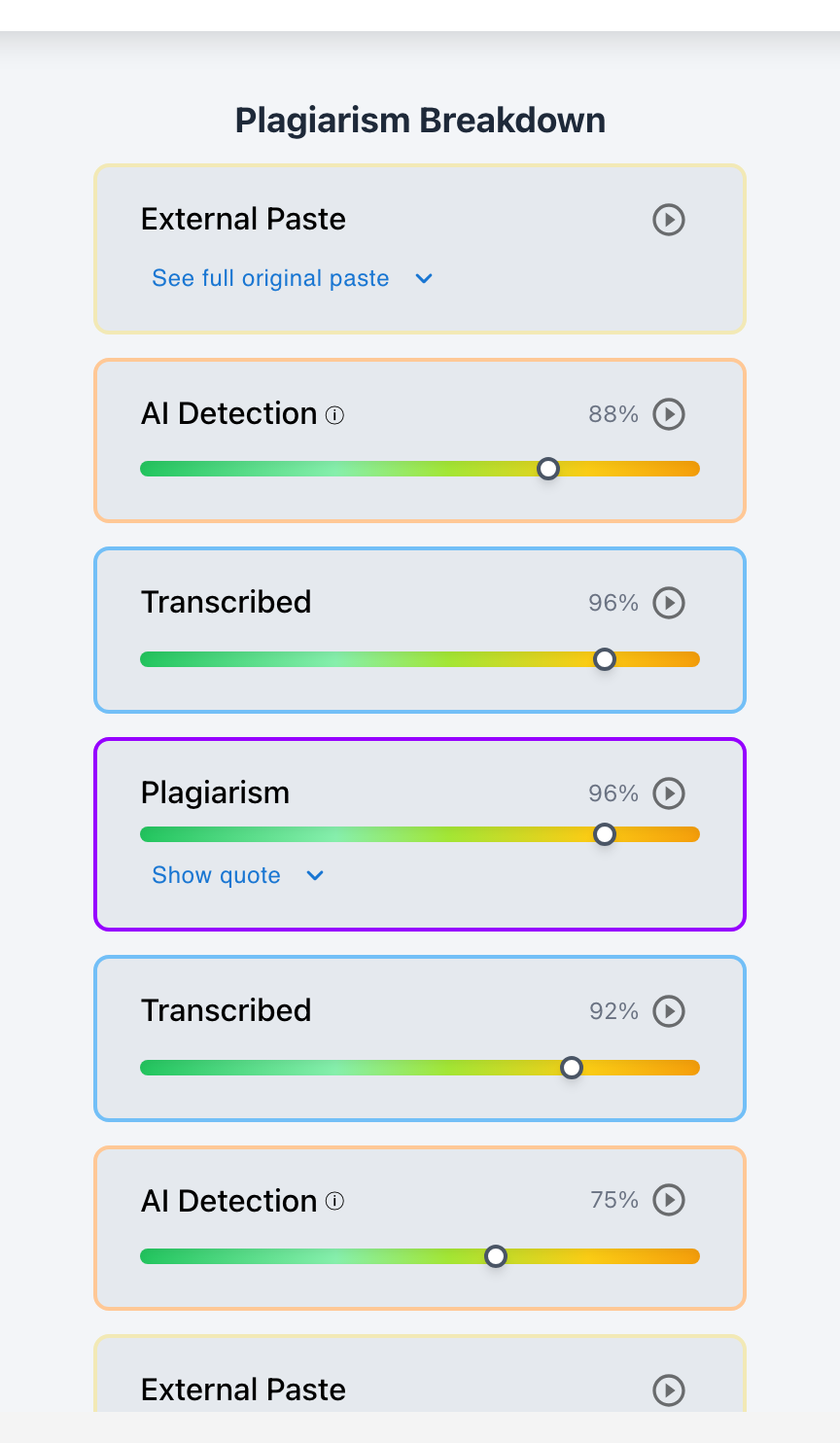
When a student asserts that an AI detector score is wrong, teachers should validate their claim by asking a 4-tier sequence of diagnostic authorship questions: 1) Process Questions ("Let's review your Checkmark Playback together—can you walk me through your drafting sessions and revisions?"); 2) Research Questions ("Where did you access this specific study and how did you find it?"); 3) Argumentative Questions ("Why did you choose this specific thesis angle over alternative counterarguments?"); and 4) Lexical Questions ("What does this sophisticated phrase mean in the context of your argument?").
AI detectors are probabilistic statistical tools that can and do generate false positives. When an honest, hardworking student receives a high AI probability badge, their immediate response is rightful indignation: "The AI detector is wrong! I wrote this!" Arguing about whether the detector is accurate is a dead end. Instead, an expert educator immediately pivots: "AI detectors can make mistakes, so let's set the detector aside and look at your actual writing process and ideas." Checkmark Plagiarism equips teachers with both keystroke telemetry and diagnostic questioning prompts directly in Canvas SpeedGrader.
Below is a comprehensive guide on the exact diagnostic questions to ask students who contest an AI detection score.
Checkmark Plagiarism empowers fair authorship verification by pairing AI detection with essay writing playback, plagiarism detection, autograding, and integrations with Canvas and Google Classroom.
The 4-Tier Diagnostic Questioning Framework
Tier 1: Process & Drafting History
"Can you show me where and when you drafted this essay? Let's open your writing playback in Canvas and review your revision timeline together."
Tier 2: Research & Source Discovery
"How did you find this specific academic study cited in paragraph 3? Can you pull up the article or show me the library database you used?"
Tier 3: Conceptual & Rhetorical Choices
"In Section 2, you made a strong connection between these two historical events. What led you to structure your counterargument that way?"
Tier 4: Lexical & Vocabulary Mastery
"You used the phrase 'inexorable paradigm shift' in your conclusion. What does that mean in your own words, and why did you select it?"
How Honest Writers vs. AI Users Respond
Observing the stark contrast in student responses during diagnostic questioning:
- The Honest Student (False Positive): Eagerly opens their laptop, shows browser bookmarks and research notes, explains their thesis with passion, and readily demonstrates that they spent 4 hours typing in Playback.
- The Dishonest Student (Evasion): Gives vague, non-committal answers ("I found the source on Google somewhere"), cannot define vocabulary words used in their own conclusion, and becomes evasive when asked to review their paste logs in Playback.
Read more in how Checkmark writing process analysis works.
Comparison: Arguing About Detectors vs. Diagnostic Questioning
Diagnostic Questioning (Checkmark Protocol)
- Sets detector scores aside immediately.
- Focuses on student ideas, research, and keystrokes.
- Instantly clears honest, articulate students.
- Provides supportive due process in under 3 minutes.
Arguing About Detectors (Counterproductive)
- Teacher insists the detector is 99% accurate.
- Student insists the detector is completely broken.
- Conversation degenerates into an unprovable debate.
- Leaves both parties frustrated without a resolution.
A 5-Step Educator Protocol for Questioning Conferences
Questioning Conference Checklist:
- 1. Validate the student's concern: "I understand detectors can make errors, so let's focus on your research."
- 2. Open Checkmark Playback in Canvas SpeedGrader to review typing telemetry side-by-side.
- 3. Ask Tier 2 (Research Discovery) and Tier 3 (Conceptual Design) questions.
- 4. If the student articulates their work fluently and playback confirms drafting, fully exonerate the paper.
- 5. If the student cannot explain basic claims and telemetry shows instant pastes, assign a restorative rewrite.
How Checkmark Plagiarism Powers Authorship Inquiries
Checkmark Plagiarism combines **AI detection, essay writing playback, static AI detection, plagiarism detection, autograding, and Canvas/Google Classroom integrations** to generate recommended diagnostic questions based on specific sentences in the student's submission.
Frequently Asked Questions
Why is asking diagnostic questions better than re-running the detector?
Because running another detector only outputs another statistical estimate, whereas questioning evaluates genuine human comprehension and knowledge.
What if an articulate student gets nervous during questioning?
Reassure the student, keep questions conversational, and let their Checkmark Playback typing history do the heavy lifting in validating their effort.
How does Checkmark generate recommended questions?
Checkmark identifies high-complexity vocabulary and low-perplexity sentences, generating customized comprehension prompts in the SpeedGrader sidebar.
Can a student bring evidence to answer these questions?
Yes. Students are encouraged to show physical book pages, browser search histories, and early outline drafts.
How does Checkmark Plagiarism integrate with Canvas LMS?
Checkmark provides certified LTI 1.3 integration, SpeedGrader sidebar embeds, two-way grade passback, and single sign-on (SSO).
What if a student cannot define a word they used in their paper?
If a student cannot define an advanced term appearing in their conclusion, it strongly indicates that the text was generated externally or copied without comprehension.
How long should a questioning conference take?
A focused 4-tier questioning session takes only 2 to 3 minutes when supported by Checkmark Playback telemetry.
What should a teacher do if the student answers all questions flawlessly?
Praise their deep research, apologize for any initial stress caused by the automated flag, and award full credit for their hard work.
How does Checkmark Autograder support oral defense verification?
Autograder benchmarks student answers against rubric criteria, helping teachers record objective notes directly in the LMS.
Why is diagnostic questioning essential for fair grading?
Because it honors the human mind behind the writing, ensuring that technology serves as a tool for inquiry rather than a blunt instrument of accusation.
Honoring the Human Author with Fair Inquiry
True writing mastery resides in the mind of the student. By replacing algorithmic debates with the 4-tier diagnostic questioning framework and Checkmark Plagiarism, educators ensure that honest scholarship is always vindicated and academic integrity is upheld with compassion and truth.
Checkmark Plagiarism supports this comprehensive approach with AI detection, essay writing playback, static AI detection, plagiarism detection, autograding, and integrations with Canvas and Google Classroom.
See how Checkmark pairs writing playback with diagnostic questioning prompts to resolve AI disputes. View a sample report or request a demonstration.