
Executive Summary
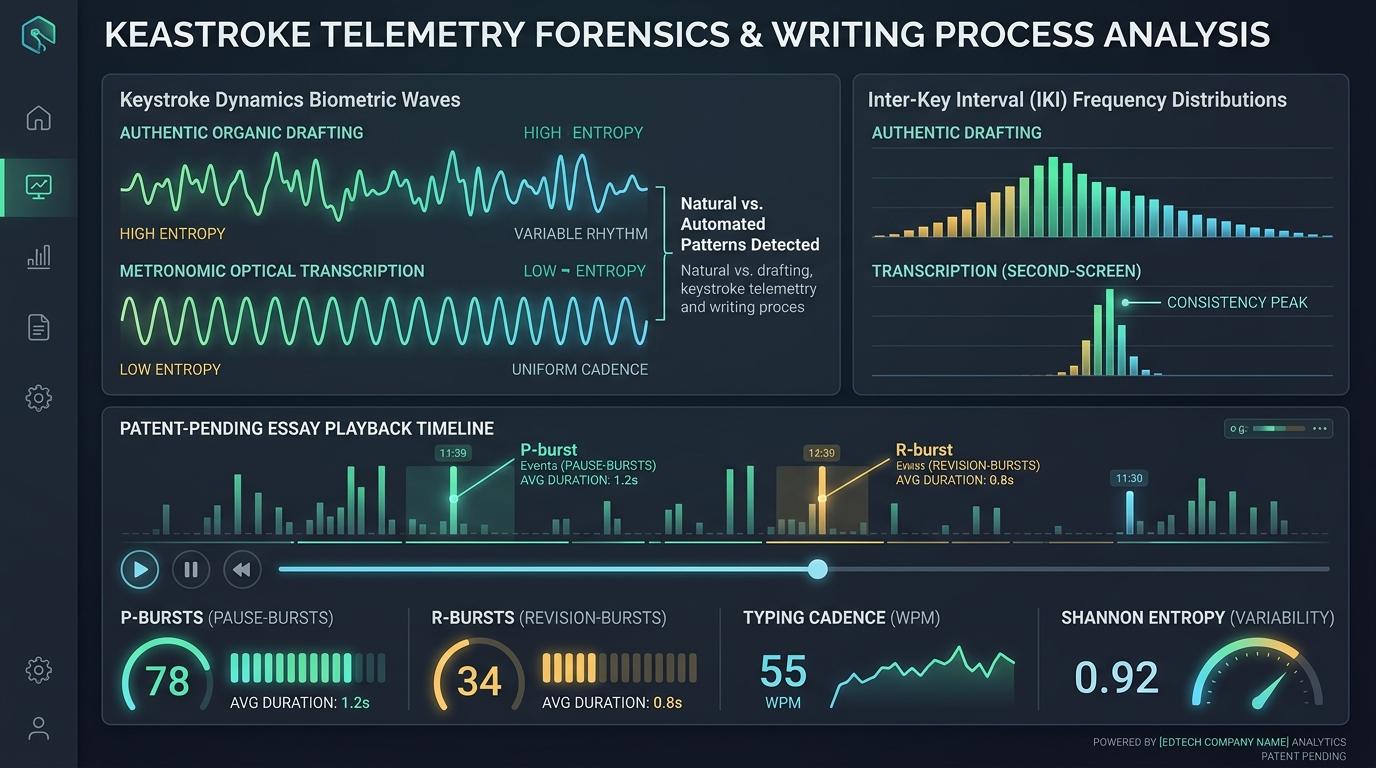
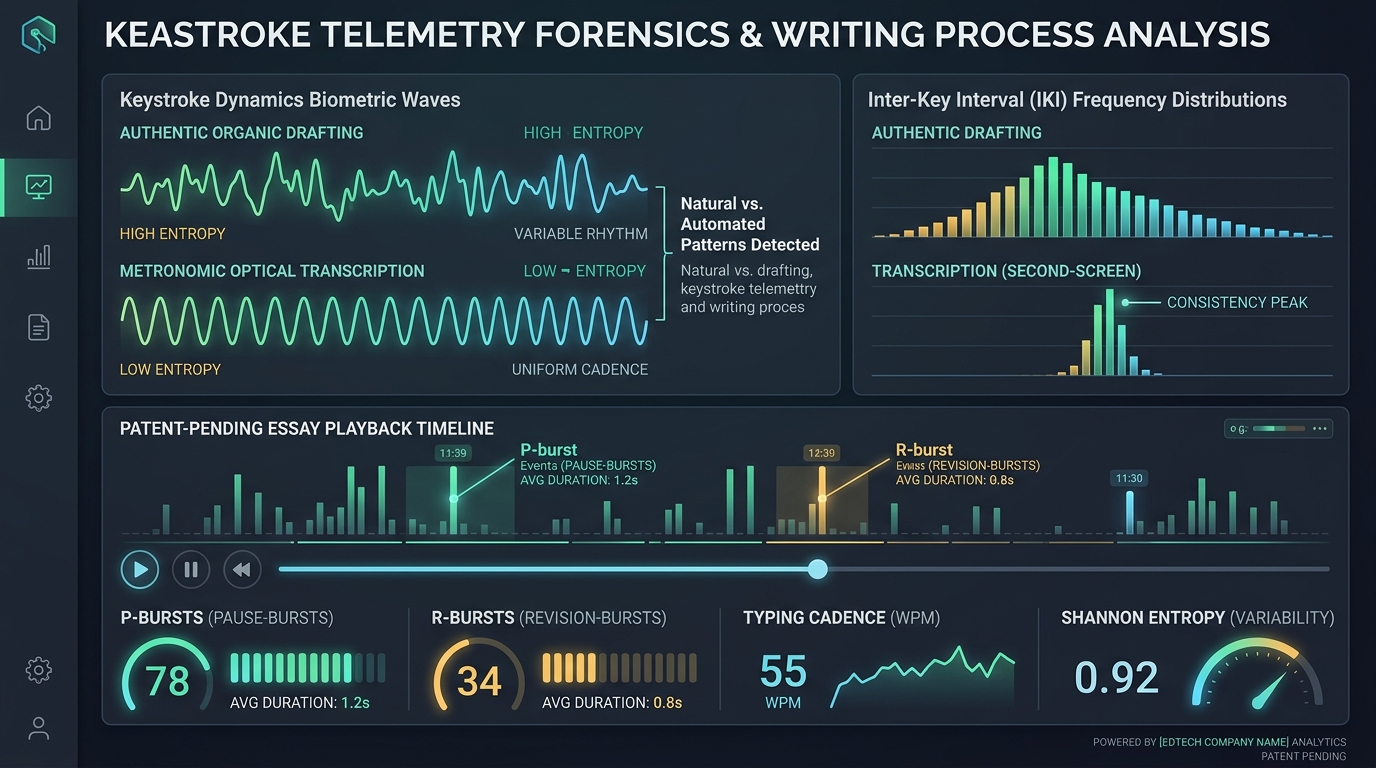
When students attempt to bypass clipboard paste monitors and static AI text detectors by manually retyping text from a secondary screen, smartphone, or printed page, they inadvertently leave behind a definitive biometric signature. Authentic cognitive composition is fundamentally non-linear, characterized by wide Inter-Key Interval (IKI) variance, cognitive pause bursts (P-bursts) at syntactic boundaries, and recursive revision bursts (R-bursts). In contrast, manual optical transcription exhibits metronomic typing cadence, narrow Gaussian IKI distributions, and monotonic linear character insertion (0 → N). Through keystroke dynamics and patent-pending Essay Playback™, Checkmark Plagiarism provides educators and academic integrity officers with transparent, mathematically defensible process telemetry—empowering supportive student conferences, detecting unauthorized transcription, and providing conclusive proof of innocence for honest writers.
As artificial intelligence writing assistants become ubiquitous, academic institutions face a critical dilemma: traditional clipboard listeners catch only raw copy-paste actions, while static AI classifiers remain vulnerable to text "humanizers" and synonym substitutions. Checkmark Plagiarism bridges this evidentiary gap through a triangulated suite integrating patent-pending Essay Playback™, passage-level AI detection, live web and student repository plagiarism scanning, and teacher-in-the-loop rubric autograding for Canvas LMS, Google Classroom, and Buzz LMS.
The Evolution of Evasion: From Clipboard Pasting to Optical Retyping
In the early stages of generative AI adoption in secondary and post-secondary education, identifying unapproved AI generation relied heavily on basic document auditing. Students copied text directly from ChatGPT or Claude, pasted it into their learning management system (LMS) editor or Google Docs, and submitted the assignment. Educators and administrative tools caught these instances through basic clipboard metadata: single-timestamp block insertions of 800 words, mismatched font formatting, or sudden leaps in word count.
As awareness of clipboard logging spread across student forums and social platforms, evasion techniques shifted rapidly toward manual optical transcription (often referred to as the "retype bypass").
Raw Clipboard Paste
- Direct copy from LLM into editor
- Flagged by standard paste event listeners
- Massive block character insertions in 0.1s
- Formatting artifacts and mismatched HTML
AI Text Humanizers
- QuillBot / Undetectable AI paraphrasing
- Perturbs vocabulary and syntax patterns
- Bypasses static perplexity classifiers
- Still susceptible to passage-level analysis
Optical Retype Bypass
- Phone / tablet propped on desk
- Manual copy-typing word-for-word
- Zero clipboard paste events logged
- Superficial appearance of manual drafting
The Telemetry Breakthrough: While optical transcription produces zero clipboard events, it collapses the biological friction of original human composition into a mechanical, pause-less motor loop.
In an optical transcription scenario:
- The student generates an essay prompt response using an LLM on their mobile phone, tablet, or adjacent monitor.
- They may run the output through a text "humanizer" (e.g., Undetectable AI or QuillBot) to distort surface linguistic patterns.
- Rather than copying and pasting the text, the student places the secondary device next to their keyboard and manually types the content into the LMS or word processor word-for-word.
To standard plagiarism scanners and static AI detectors, this submission appears pristine:
- Document session duration shows active engagement (e.g., 28 minutes of active keyboard activity).
- The clipboard event listener registers zero external paste actions.
- Surface linguistic classifiers may yield inconclusive results if the text was heavily paraphrased or humanized.
Yet, despite bypassing superficial clipboard checks, the student cannot bypass the fundamental biometrics of human cognition. The temporal and physical mechanics of transcribing existing text differ radically from the cognitive mechanics of authoring original thought.
The Psycholinguistic Foundations: Cognitive Drafting vs. Optical Transcription
To analyze writing telemetry, we must examine the psycholinguistic architecture of text generation. In their seminal cognitive model of writing, John R. Hayes and Linda S. Flower demonstrated that organic composition is not a linear conveyor belt, but a non-linear, recursive cognitive cycle composed of three competing sub-processes:
- Idea retrieval from long-term memory
- Goal setting & rhetorical transitions
- Argument logic & evidence synthesis
- Generates macro-planning pauses (3–15s)
- Lexical access & syntactic packaging
- Motor execution (finger-to-key mapping)
- Syntactic production bursts (P-bursts)
- Variable intra-clause pause latency
- Real-time error detection & monitoring
- Micro-revisions (backspaces, typo fixes)
- Macro-revisions (clause cuts, restructuring)
- Non-linear cursor backtracking
1. The Organic Drafting Cognitive Cycle
When a student writes an authentic essay:
- Working Memory Saturation: The writer must simultaneously retrieve subject-matter knowledge from long-term memory, evaluate audience constraints, organize rhetorical transitions, and select precise syntactic frames.
- Cognitive Pauses: Before constructing a complex sentence, the brain enters a planning pause (often 1.5 to 8+ seconds) while lexical retrieval and grammatical structuring occur.
- Immediate Local Revision: As thoughts translate into keystrokes, visual and motor feedback loops trigger immediate self-correction. The student spots a weak adjective, deletes it via four backspaces, types a stronger synonym, pauses to reread the clause, and continues.
- Global Recursive Navigation: The student moves the cursor back three paragraphs to insert a connecting transition, updates a thesis statement, or rearranges supporting evidence.
2. The Optical Transcription Motor Loop
When a student transcribes text from a secondary screen, the entire planning and rhetorical retrieval apparatus is bypassed. The cognitive load collapses into an optical-motor copy loop:
Because the vocabulary, syntax, logic, and structure have already been solved by the generative AI model, the student experiences zero composing friction:
- No multi-second pauses at complex clause transitions or paragraph thresholds.
- No macro-revisions, structural rearrangements, or deleted lines of thought.
- Metronomic typing velocity that remains identical across trivial filler words and dense disciplinary arguments.
By logging timestamped keystroke events, modern integrity telemetry captures these fundamental psycholinguistic differences with mathematical precision.
The Core Mathematical Metrics of Keystroke Telemetry
Keystroke dynamics captures every key-down, key-up, cursor navigation, and text mutation event as an immutable time-series tuple:
Where:
kiis the key identifier (e.g., character code,Backspace,ArrowLeft,Delete).tdown, iandtup, irepresent millisecond-accurate timestamps for key press and release.ciis the integer cursor position within the document buffer.aiis the mutation action (e.g., character insertion, block selection, text deletion).
From this raw event stream, four primary mathematical metrics isolate authentic writing from transcription:
Standard deviation σIKI and distribution shape (heavy-tailed log-normal multimodal vs. tight Gaussian).
Pause latency scaled to grammatical hierarchy (Paragraph > Sentence > Clause > Word > Morpheme).
Deletion ratios Rdel, macro-clause cuts, and non-linear cursor trajectory entropy.
Sustained net composition velocity vs. cognitive drafting decay and Shannon operational entropy H(X).
1. Inter-Key Interval (IKI) Distributions & Standard Deviation
The Inter-Key Interval (IKI) is the duration between the release of key i and the press of key i+1:
Authentic Drafting Distribution
In authentic human drafting, IKI distributions are heavy-tailed, highly skewed, and bimodal or multimodal (log-normal):
- Intra-word bigram motor executions (e.g., typing
th,er,ingin familiar words) occur rapidly:80 ms ≤ IKI ≤ 160 ms. - Lexical retrieval transitions (choosing an uncommon noun or verb) introduce mid-tier intervals:
350 ms ≤ IKI ≤ 900 ms. - Cognitive formulation intervals (commas, clause junctures, sentence beginnings) generate major temporal spikes:
1,500 ms ≤ IKI ≤ 6,000+ ms.
As a result, the standard deviation of IKI (σIKI) in authentic drafting is exceptionally high relative to the mean:
Manual Transcription Distribution
In copy-typing or optical transcription, the writer is executing motor instructions from a continuous visual buffer. The IKI distribution collapses into a narrow, single-mode Gaussian distribution:
- Keystrokes cluster tightly around the typist's physical motor rhythm (
μIKI ≈ 180 ms - 280 ms). - The standard deviation drops dramatically:
σIKI < 0.25 · μIKI. - Pauses exceeding 1,500 ms are virtually absent during active typing runs, appearing only when the student manually shifts their gaze or scrolls the phone screen.
Burst of fast typing → mid-pause at difficult vocabulary → extended multi-second cognitive pause at sentence boundary.
Unbroken mechanical cadence: 220ms interval between characters, words, clauses, and sentences with zero planning hesitation.
2. Pause Burst Analysis (P-Bursts) & Syntactic Boundary Hierarchy
A P-burst (Pause Burst) is defined as a contiguous sequence of characters produced between two cognitive pauses exceeding a defined threshold τ (typically τ = 2,000 ms).
In psycholinguistics, cognitive pauses obey a strict Syntactic Boundary Hierarchy. The duration of a pause correlates directly with the grammatical depth and cognitive complexity of the linguistic boundary:
| Linguistic Boundary | Authentic Human Drafting | Manual Transcription | Cognitive Rationale |
|---|---|---|---|
| Within-Word (Intra-morpheme) | 80 ms – 180 ms | 110 ms – 220 ms | Physical finger muscle memory |
| Inter-Word (Between words) | 220 ms – 550 ms | 180 ms – 280 ms | Next-word lexical lookahead |
| Intra-Sentence Clause (, ; :) | 800 ms – 2,200 ms | 200 ms – 380 ms (Flat) | Syntactic restructuring of next thought |
| Sentence Boundary (. ! ?) | 2,500 ms – 7,500 ms | 250 ms – 450 ms (Flat) | Macro-argument planning & validation |
| Paragraph Threshold ( ) | 8,000 ms – 45,000+ ms | 400 ms – 1,200 ms (Flat) | Thematic transition & outline review |
The Optical Saccade Anomaly
In manual transcription, the pause signature at syntactic boundaries disappears. A student copy-typing an AI-generated essay from an adjacent screen will finish a complex 35-word periodic sentence, type a period, hit the spacebar, and immediately begin typing the subsequent sentence within 280 milliseconds.
The only pauses present in transcription telemetry are optical saccade fixations (200–450 ms), representing the time required for the student's eyes to jump from the document screen to the secondary device, acquire the next 4–6 words in visual memory, and return to the keyboard. These saccades occur at arbitrary character counts (often mid-word or across irrelevant prepositions) rather than at natural syntactic junctures.
3. Revision Burst Dynamics (R-Bursts) & Structural Entropy
An R-burst (Revision Burst) measures the frequency, magnitude, and spatial dispersion of text deletions, replacements, and non-linear cursor movements.
Cursor Movement: Jumps from pos 1,400 → pos 210 → pos 1,450 → pos 950.
Deletion Ratio: 8.0% – 22.0% of all keystrokes.
Morphology: Whole-clause deletions, rephrased sentences, active restructuring.
Cursor Movement: Unidirectional increment from pos 0 → pos 7,850.
Deletion Ratio: 0.1% – 1.5% of all keystrokes.
Morphology: 1-stroke typo corrections immediately upon motor miscue.
4. Velocity Acceleration & Typing Telemetry Entropy
To measure drafting sustainability, telemetry models calculate the relationship between a student's Gross Motor Speed (raw physical typing speed on memorized strings) and their Net Composition Velocity (actual text production rate over time).
| Telemetry Attribute | Authentic Drafting | Manual Transcription | Diagnostic Indicator |
|---|---|---|---|
| Net Composition Velocity | 15 – 38 WPM | 55 – 95+ WPM (Sustained) | Cognitive drafting friction vs. mechanical copy |
| Cognitive Velocity Decay (Slope) | Negative (Fatigue & reflection dips) | Flat / Steady Motor Pace | Human mental fatigue across multi-paragraph essays |
| Keystroke Shannon Entropy H(X) | High (H > 3.8 bits) | Low (H < 2.1 bits) | Operational diversity (modifiers, clicks, arrows, cuts) |
| Multi-Tab Research Context Switching | High (Consulting sources & PDFs) | Near Zero (External device view) | Authentic academic sourcing verification |
| Session Fragmentation | Multi-session drafts (Hours / Days) | Single compressed burst (15–30 min) | Organic development vs. single-sitting transcribing |
By evaluating the categorical distribution of keystroke actions (character keys, modifier keys, deletion keys, arrow navigation, cursor clicks, selection highlights), we calculate the Shannon entropy H(X) of the event stream:
Authentic writing exhibits high entropy (H > 3.8 bits) due to rich operational diversity (frequent cursor relocations, text selections, modifier shortcuts, backspaces, and punctuation adjustments). Manual transcription exhibits low entropy (H < 2.1 bits), consisting almost exclusively of sequential alphanumeric characters and spacebar strokes.
Detailed Telemetry Matrix: Authentic Drafting vs. Manual Transcription
The following comprehensive matrix contrasts the telemetry signatures captured across drafting sessions:
| Telemetry Dimension | Authentic Human Drafting | Manual Optical Transcription |
|---|---|---|
| IKI Standard Deviation | High (σ > 450 ms); heavy-tailed | Low (σ < 120 ms); tight Gaussian |
| Distribution Shape | Log-normal, multimodal (bursty) | Unimodal, single-rate motor pace |
| Paragraph Pause Latency | 15,000 ms – 60,000+ ms | 300 ms – 1,200 ms |
| Clause Pause Latency | 1,200 ms – 3,500 ms | 150 ms – 350 ms |
| Deletion Ratio (Rdel) | 8.0% – 22.0% of all strokes | 0.1% – 1.8% of all strokes |
| Deletion Morphology | Block cuts, whole words, clause rewrites | Isolated 1-character typo corrections |
| Cursor Vector Trajectory | Non-linear, bidirectional, multi-hop | Monotonic forward append (0 → N) |
| Drafting vs Typing Speed | 18 – 35 WPM net production rate | 60 – 95+ WPM sustained copy rate |
| Research Latency Gaps | Frequent pauses to verify facts/quotes | Absent (source already synthesized by AI) |
| P-Burst Length | Variable (3 to 18 words per burst) | Fixed by visual buffer (4 to 7 words) |
| Operational Entropy | H > 3.8 bits (Rich actions) | H < 2.1 bits (Alpha-numeric only) |
| Session Distribution | Multi-day or multi-hour iterations | Single compressed 15–30 min burst |
Checkmark Plagiarism’s Patent-Pending Essay Playback™: Visualizing Process Telemetry
While raw time-series equations and millisecond timestamps provide mathematical certainty, educators, department chairs, and parents require intuitive, visually transparent evidence. An academic integrity investigation should never rest on an uninterpretable, black-box percentage score.
Checkmark Plagiarism solves this through patent-pending Essay Playback™, an integrated suite that transforms millions of telemetry data points into an interactive, scrubbable visual record.
"Furthermore, the sociopolitical ramifications..."
Live Web & Academic Repositories: 0% Direct Match
Jump to 08:42 in session timeline to watch real-time typing.
1. 1x to 8x Scrubbable Chronological Video Player
Educators can scrub through the entire writing session like a high-definition video timeline. At variable speeds (1x, 2x, 4x, 8x), teachers can watch the exact sequence of composition:
- Observe natural composing pauses where the student stopped to think.
- Watch real-time sentence construction, typo corrections, and phrasing reorganizations.
- Instantly identify unnatural, uninterrupted typing streams where complex paragraphs appear without hesitation.
2. Cadence Anomaly Indicators & Composing Friction Heatmaps
Checkmark's telemetry engine automatically highlights segments of the timeline where typing dynamics deviate from authentic composition baselines:
- Cadence Anomaly Flags: Identifies passages typed with extreme IKI regularity, lack of syntactic pauses, and sub-1% deletion ratios.
- Composing Friction Heatmaps: Visualizes cognitive effort across the document. Authentic human writing displays warm friction zones (frequent edits, variable pacing), while transcribed text appears as an unbroken, low-friction cool zone.
3. Preserved External Paste History with Complete Text Capture
When a student does paste text into the document, Checkmark does not simply log a generic "Paste Event." The system:
- Captures and stores the full original pasted text, preserving the exact clipboard contents at the millisecond it entered the editor.
- Maintains this original capture even if the student subsequently edits, rewrites, or deletes every individual word to disguise the paste.
- Provides a dedicated "Jump to Playback" button that positions the timeline directly at the paste event.
4. Triangulated Multi-Factor Integrity Suite
Checkmark never forces teachers to rely on a single data point. The platform triangulates process telemetry with linguistic and source evidence:
- Passage-Level AI Detection: Highlights specific sentences directly in the text with calibrated confidence sliders (typical human style vs. typical AI pattern), accompanied by detailed linguistic evidence cards in the sidebar. Below 150 words, Checkmark displays
N/Arather than guessing on insufficient sample sizes. - Side-by-Side Plagiarism Matching: Scans billions of live web pages and student repositories, displaying side-by-side quote comparisons with direct source links.
- Rubric Autograder with Teacher Authority: Generates quote-anchored formative feedback aligned with custom institutional rubrics, keeping the educator fully in control of final grading.
Real-World Case Studies: Telemetry in the Classroom
To illustrate how keystroke telemetry operates across real academic settings, consider three representative scenarios:
| Case Profile | 1. AP Literature Essay | 2. Higher Ed Research Paper | 3. Non-Native English (ELL) |
|---|---|---|---|
| Submission Context | 1,400-word Hamlet Analysis | 3,200-word Bioethics Paper | 1,100-word History Essay |
| Clipboard Paste Events | 0 Pastes Logged | 0 Pastes Logged | 0 Pastes Logged |
| Static AI Detector Score | 42% (Inconclusive) | 18% (False Negative) | 88% (False Positive Flag) |
| IKI Standard Dev (σ) | 92 ms (Metronomic) | 104 ms (Metronomic) | 680 ms (High Variance) |
| Deletion Ratio (Rdel) | 0.6% (Zero block cuts) | 1.1% (Micro-typos only) | 19.4% (Heavy Recursive Edits) |
| Syntactic Pauses | Absent at clause boundaries | Absent across dense quotes | Extended vocabulary pauses |
| Playback Finding | Optical copy from iPhone | Split-screen AI transcription | Authentic human struggle |
| Pedagogical Outcome | Restorative rewrite conference | Academic integrity review | Exonerated; Student protected |
Secondary AP Literature – The iPhone Retype Bypass
- Context: A high school senior in an AP English Literature course submitted a 1,400-word essay analyzing thematic motifs in Hamlet.
- Initial Observation: The student submitted the paper 25 minutes after opening the document. The text contained sophisticated literary terminology ("coruscating psychological verisimilitude"), but an uncalibrated third-party AI detector gave an inconclusive 42% score. Clipboard logs showed zero paste events.
- Telemetry Analysis: Checkmark’s Essay Playback™ revealed that the entire 1,400 words were typed in a single 22-minute session at a sustained rate of 76 WPM with a 0.6% deletion ratio. The pause between paragraphs 2 and 3 was only 410 ms.
Higher Education Bioethics – Paraphrased Split-Screen Transcription
- Context: An undergraduate student in a 300-level biomedical ethics seminar submitted a 3,200-word research paper on CRISPR gene editing regulations.
- Initial Observation: The student used an AI paraphraser to disguise raw LLM output. Static AI detectors returned a low 18% score, and web plagiarism scanners showed no direct matches.
- Telemetry Analysis: Checkmark’s telemetry logs indicated that 3,200 words were typed in two 30-minute sessions with zero navigation backtracks. The cursor trajectory was 100% monotonic (0 → 3,200). Complex citations and multi-part medical terms were typed without a single verification pause.
Protecting an ELL / ESL Student – Overturning a False AI Accusation
- Context: A non-native English speaker in a 10th-grade World History class submitted an 1,100-word essay on the Industrial Revolution.
- Initial Observation: A generic whole-document AI detector flagged the paper with an 88% AI probability score, triggered by the student's formal, predictable sentence structures. The student was facing severe disciplinary action.
- Telemetry Analysis: Checkmark’s Essay Playback™ showed a rich, authentic 3.5-hour writing journey across four distinct drafting sessions. The telemetry displayed an extensive deletion ratio of 19.4%, with hundreds of backspaces where the student tested word choices. IKI variance was exceptionally high (σ = 680 ms), with natural 4-to-12-second vocabulary retrieval pauses.
The 4-Phase Educator Verification Protocol: From Flag to Restorative Dialogue
When reviewing essays with anomalous telemetry or suspected AI transcription, institutions should follow a structured, non-punitive protocol designed to uphold academic standards while fostering student trust:
Before reading the prose, check the Checkmark Writing Process Summary card:
- Examine Net Composition Velocity: Is the net drafting speed (>60 WPM) drastically higher than typical cognitive drafting norms (18–35 WPM)?
- Inspect Deletion Ratio (Rdel): Is the total backspace/delete volume below 2%?
- Check Cursor Trajectory: Did the student write strictly from 0 → N with zero non-linear revisions?
If triage metrics indicate an anomaly:
- Open the Essay Playback™ viewer and set playback speed to 4x.
- Scrub to major syntactic transitions (e.g., paragraph beginnings, complex multi-clause sentences).
- Observe pause latencies: Did the student pause for several seconds to construct the argument, or did keystrokes appear at an unbroken, metronomic cadence?
- Check external paste captures to confirm whether any background material was inserted.
Checkmark's core philosophy is "Stop guessing, start trusting." The goal of an integrity conference is never to trap or humiliate a student, but to review objective process data collaboratively:
- Open the Playback Together: Sit with the student and open the Checkmark timeline.
- Use Non-Accusatory, Open-Ended Prompts: "Let's watch the playback of how you developed this third argument. Can you walk me through what you were thinking right here?"
- Evaluate Conceptual Ownership: Ask the student to explain the meaning of advanced vocabulary words or complex syntax appearing in the transcribed section.
- If Authentic Composition is Confirmed: Affirm the student's work, document the exonerating telemetry in the LMS, and resolve all flags.
- If Unauthorized Transcription is Acknowledged: Focus on why the student felt the need to bypass the writing process (e.g., time management panic, lack of confidence in research). Provide an opportunity for an in-class, scaffolded rewrite where the student earns credit by demonstrating authentic drafting.
Institutional AI Policy & Syllabus Guidelines
To ensure legal, ethical, and pedagogical clarity, school districts and higher education institutions should incorporate explicit keystroke transparency and process accountability policies into their academic integrity guidelines.
"Writing is a cognitive process of thinking, revising, and articulating original ideas. In this course, academic integrity is evaluated not merely on the final text, but on the authenticity of the drafting process."
1. Authorized vs. Unauthorized AI Use: Generative AI tools (e.g., ChatGPT, Claude) may be used for initial brainstorming or concept clarification ONLY when explicitly permitted by the assignment prompt and cited accordingly.
2. Authorship & Transcription: All submitted prose must be organically composed by the student. Copying, pasting, dictating, or manually transcribing AI-generated text from a secondary screen, phone, or document is strictly prohibited and constitutes authorship fraud.
3. Process Verification via Keystroke Telemetry: Essays must be composed within the designated LMS/Google Docs environment with writing telemetry active. Timestamped revision history and Essay Playback™ data serve as definitive evidence to protect honest students and verify authentic authorship. In the event of a process anomaly, students may be asked to discuss their drafting history in a conference.
Key Administrative Directives for Technology Directors
- Zero Model Training Guarantees: Ensure vendor contracts explicitly state that student keystroke telemetry, essays, and metadata are never used to train public or commercial AI models. Checkmark Plagiarism maintains strict zero-retention model training policies.
- FERPA and COPPA Compliance: Writing telemetry must be encrypted in transit and at rest, restricted to authenticated educators, and never shared with third-party data brokers.
- Native LMS Integration: Deploy telemetry tools seamlessly within Google Docs, Canvas LMS, Buzz LMS, and Microsoft 365 to ensure passive, unobtrusive capture without requiring cumbersome lockdown browsers or intrusive webcam proctoring.
Frequently Asked Questions (FAQ)
1. Can a fast touch-typist be falsely flagged for manual transcription?
No. Gross typing speed (how fast fingers hit keys) is completely distinct from composition telemetry. An expert typist who drafts organically still exhibits wide IKI variance, cognitive pauses at syntactic boundaries, natural backspaces (typically 8–15% deletion ratio), and non-linear cursor movements to revise earlier sentences. Manual transcription is identified by the absence of cognitive friction (metronomic cadence, flat IKI distributions, and zero structural revisions), not high motor speed.
2. What if a student drafts their essay on paper first and then types it up?
When a student types up a handwritten draft, their telemetry will look similar to transcription because they are copying existing physical notes. However, Checkmark’s protocol handles this transparently: during Phase 3 of the verification protocol, the student simply presents their physical handwritten outline or draft. The teacher can compare the handwritten notes to the playback stream, immediately validating the student's authentic authorship.
3. How does keystroke telemetry differ from Google Docs Version History?
Standard Google Docs version history takes periodic, low-resolution snapshots (often spaced several minutes or hours apart). It cannot capture millisecond-level Inter-Key Intervals, continuous cursor navigation, pause burst durations at clause boundaries, or individual backspace frequencies. Checkmark’s patent-pending Essay Playback™ captures the continuous time-series event stream, providing a complete, scrubbable keystroke-by-keystroke reconstruction that standard LMS or document histories cannot match.
4. Can students bypass telemetry by using automated typing scripts or browser extensions?
No. Automated typing scripts (bots or auto-typers designed to inject text character-by-character) produce unnaturally rigid, mathematically perfect IKI intervals (e.g., exactly 50 ms between every stroke). This creates an immediate, extreme telemetry anomaly score in Checkmark. Furthermore, synthetic typing bots lack human biometrics, such as natural micro-delays on complex physical bigrams (e.g., reaching across the keyboard for q or p).
5. Why are static AI detectors alone insufficient for detecting optical transcription?
Static AI detectors evaluate only the final, flat text string. If a student uses an "AI humanizer," paraphrasing tool, or manual synonym swapping prior to retyping, statistical perplexity and burstiness filters often return inconclusive scores or false negatives. Keystroke telemetry analyzes the temporal process of creation, making it immune to surface-level text manipulation.
6. Does Checkmark Plagiarism record student keystrokes outside of the assignment document?
No. Checkmark Plagiarism strictly limits telemetry capture to the active assignment document buffer within authorized educational environments (Google Docs, Canvas LMS, Buzz LMS, Word). It never logs keystrokes in other browser tabs, desktop applications, personal chats, or system utilities, fully respecting student privacy and FERPA/COPPA compliance standards.
7. How does keystroke telemetry protect non-native English (ELL/ESL) students?
Non-native English speakers frequently produce formal, predictable syntax that causes generic, statistical AI detectors to trigger false-positive alerts. Keystroke telemetry protects these students by documenting their authentic cognitive effort: high pause latencies during vocabulary selection, extensive dictionary lookups, recursive backspaces, and multi-pass structural edits. The playback provides unassailable proof that the student authored the work themselves.
The Path Forward: Stop Guessing, Start Trusting
The emergence of AI transcription tools and second-screen evasion tactics has rendered black-box percentages and crude paste counters obsolete. Upholding academic integrity in the modern classroom requires moving away from unprovable suspicions and toward transparent, defensible, process-based evidence.
By combining patent-pending Essay Playback™, millisecond-accurate keystroke dynamics, passage-level AI detection, and side-by-side plagiarism source matching, Checkmark Plagiarism empowers educators to:
- Eliminate the guesswork from academic integrity investigations.
- Conduct restorative, supportive, evidence-backed student conferences.
- Protect honest and non-native English students from unjust accusations.
- Restore confidence and authentic learning to the writing classroom.
Bring Transparent Process Telemetry to Your Institution
See how patent-pending Essay Playback™ and multi-factor integrity reporting eliminate false positives and protect student writing across your school or district.