
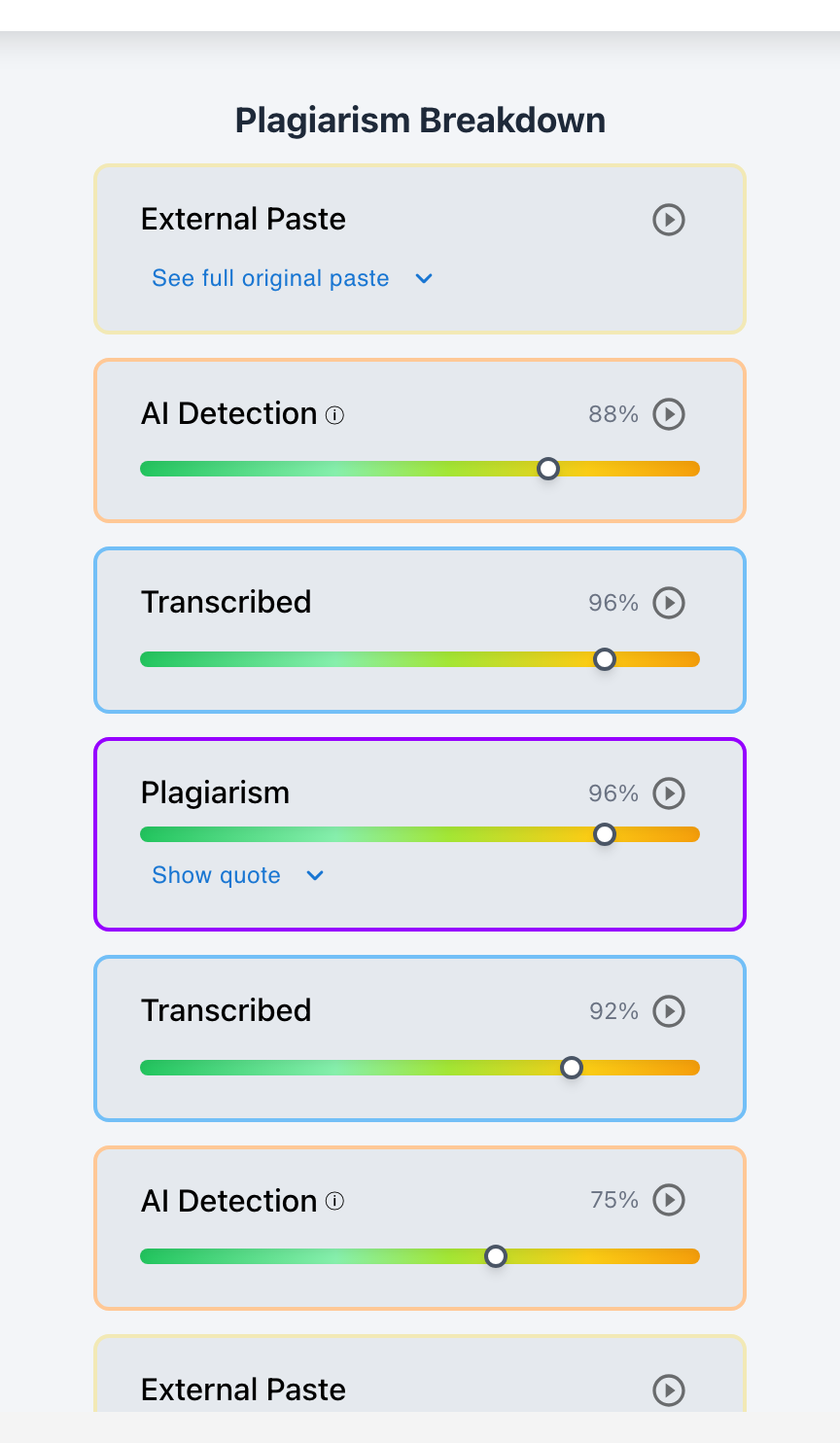
The fundamental difference between version history and writing history is the dimension of time and granularity: Version History captures static, periodic snapshots of document state saved every few minutes (showing only the net changes between saves), whereas Writing History records continuous, millisecond-level keystroke telemetry (capturing every keypress, pause, backspace, and clipboard paste event in an interactive, second-by-second video playback replay).
In modern digital assessment, conflating "version history" with "writing history" creates massive forensic vulnerabilities. A student who pastes a 1,500-word ChatGPT essay during an autosave window can make the submission look like an active version in native history. Version history can tell you what text existed at 10:15 PM, but only true writing history can tell you how the text entered the document—whether it was typed across 3 hours or inserted in a 0.05-second clipboard paste. Checkmark Plagiarism bridges this gap by turning coarse version history into continuous, actionable writing history.
Below is a comprehensive guide on the technical and pedagogical differences between version history and writing history.
Checkmark Plagiarism transforms version history into writing history by pairing essay writing playback with AI detection, plagiarism detection, autograding, and integrations with Google Classroom and Canvas.
The 4 Core Distinctions: Version History vs. Writing History
1. Temporal Granularity
Version History: Saves discrete, coarse snapshots every 5–15 minutes.
Writing History: Records continuous, second-by-second keystroke inter-arrival intervals.
2. Biometric & Cadence Telemetry
Version History: Shows only static text diffs without speed or rhythm.
Writing History: Measures typing velocity (WPM), cadence jitter, and cognitive pauses.
3. Clipboard Paste Forensics
Version History: Bundles pastes and typing into identical green highlights.
Writing History: Explicitly flags 0.05-second clipboard paste payloads with character counts.
4. Active Time vs. Document Age
Version History: Vulnerable to open idle browser tabs simulating days of work.
Writing History: Filters out idle pauses to report true active typing minutes.
Why Version History Alone Leaves Integrity Gaps
Understanding why snapshot-based history is vulnerable to evasion:
- The "Autosave Blind Spot": If a student pastes text and immediately spends 2 minutes fixing a few typos before the next autosave snapshot triggers, version history shows a single composite save, masking the paste event.
- The "Make a Copy" Loophole: Copying text into a fresh document wipes version history clean; writing history detects the single-snapshot paste event and flags 0 active typing hours.
- The Playback Advantage: Writing history converts static text into an interactive 15-second video time-lapse, allowing teachers to watch the essay compose itself in seconds.
Read more in how Checkmark writing process analysis works.
Comparison: Version History (Snapshots) vs. Writing History (Playback)
Writing History (Checkmark Playback Telemetry)
- Continuous keystroke recording and 15-second video.
- Explicit character-level clipboard paste flags.
- Active typing hours calculated (discounts idle tabs).
- Biometric keystroke cadence analysis (flags auto-typers).
Version History (Native Cloud Snapshots)
- Static snapshots saved every 5–15 minutes.
- Cannot confirm if text was typed or pasted.
- Open background tabs look like active drafting hours.
- Requires tedious manual clicking through timestamps.
A 5-Step Educator Protocol for Analyzing Writing History
Writing History Audit Checklist:
- 1. Open the student's submission in Google Classroom or Canvas SpeedGrader.
- 2. Launch Checkmark Writing Playback: check the Active Typing Duration badge (e.g., 3+ hours).
- 3. Inspect the Paste Event Log: verify whether text entered organically or in a single 0.05-second payload.
- 4. Play the 15-second time-lapse replay to observe drafting flow, pauses, and backspaces.
- 5. Corroborate writing history with AI detection and plagiarism reports for an airtight evaluation.
How Checkmark Plagiarism Powers True Writing History
Checkmark Plagiarism combines **AI detection, essay writing playback, static AI detection, plagiarism detection, autograding, and Canvas/Google Classroom integrations** to upgrade coarse version snapshots into comprehensive, continuous writing history.
Frequently Asked Questions
Why is writing history more reliable than version history?
Because writing history records every individual keystroke and exact paste duration, whereas version history only shows high-level snapshots that can mask paste shortcuts.
Can a student fake writing history like they fake version history?
No. Faking writing history requires replicating organic human keystroke cadence, cognitive boundary pauses, and variable typing bursts, which cannot be simulated by scripts.
How does writing history detect AI-generated text?
Writing history exposes the 0.05-second clipboard paste payload where the entire AI essay entered the document without prior drafting.
What if a student drafted in Google Docs—does Checkmark record writing history?
Yes. Checkmark integrates directly with Google Workspace, capturing continuous keystroke telemetry while students draft in Google Docs.
How does Checkmark Plagiarism integrate with Canvas LMS?
Checkmark provides certified LTI 1.3 integration, SpeedGrader sidebar embeds, two-way grade passback, and single sign-on (SSO).
Can writing history exonerate a student falsely flagged by an AI detector?
Yes. Having 3+ hours of recorded active keystrokes and organic backspaces provides incontrovertible proof of human composition, overriding any detector score.
Does writing history require students to install special software?
No. Checkmark runs seamlessly in the browser during assigned LMS writing sessions with zero software installation required for students.
How does Checkmark Autograder use writing history?
Autograder analyzes active drafting hours, session counts, and revision depth to provide formative feedback and evaluate student persistence.
Can writing history be shared with parents during conferences?
Yes. Checkmark exports secure, shareable time-lapse video links and PDF dossiers that allow parents to watch the essay's creation.
Why is the transition from version history to writing history inevitable?
Because in the age of generative AI, evaluating the *process* of writing is the only way to ensure academic integrity and reward authentic human thought.
The Evolution of Academic Process Integrity
The future of writing assessment belongs to process telemetry. By upgrading from static version history to continuous writing history with Checkmark Plagiarism, educators eliminate loopholes, protect honest writers, and ensure that every grade reflects genuine intellectual growth.
Checkmark Plagiarism supports this comprehensive approach with AI detection, essay writing playback, static AI detection, plagiarism detection, autograding, and integrations with Google Classroom and Canvas.
See how Checkmark turns static version history into continuous keystroke writing playback. View a sample report or request a demonstration.