
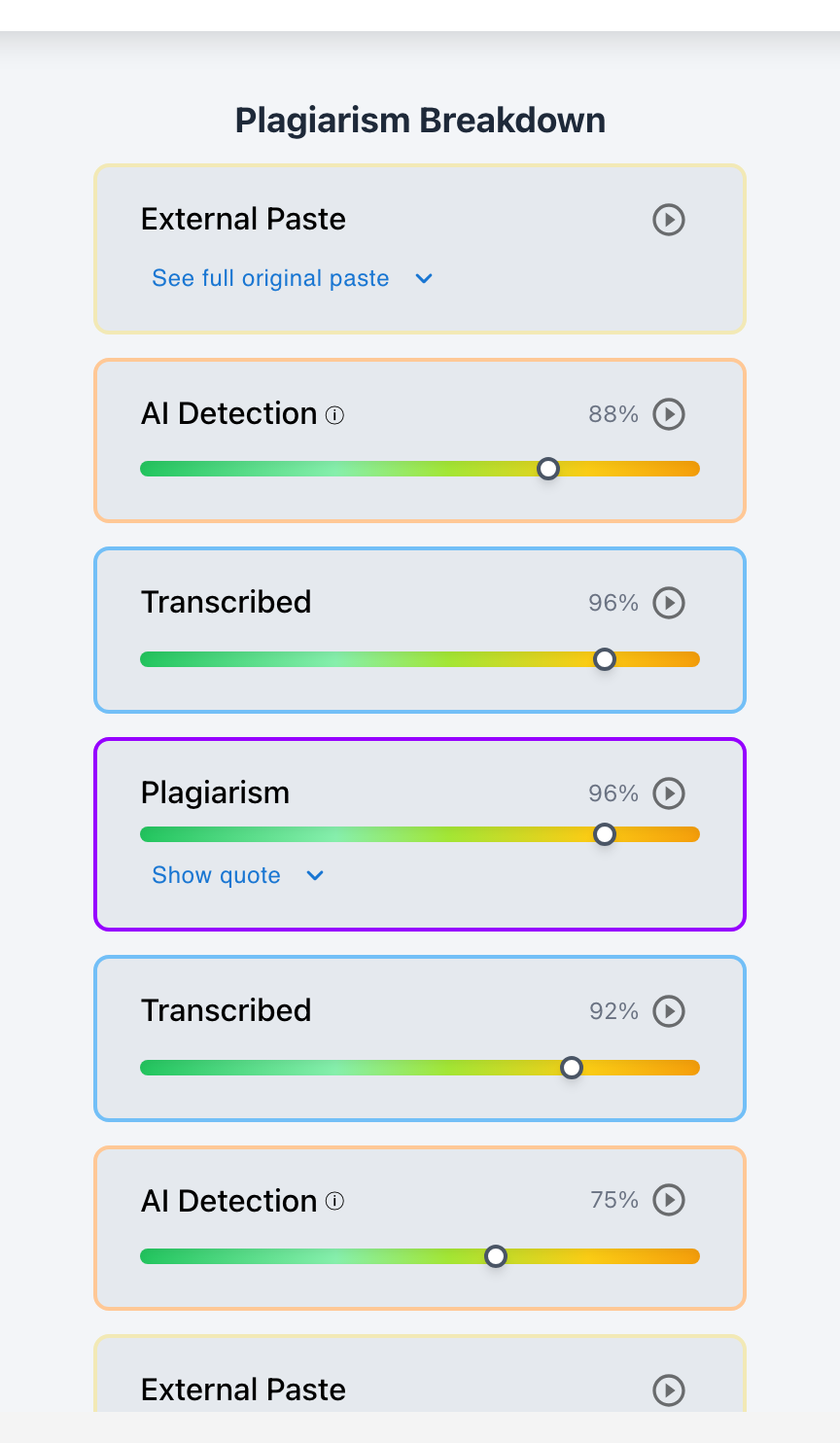
A take-home essay is naturally expected to be better than timed in-class writing due to unhurried revision, access to research notes, and lower test anxiety. However, when an out-of-class paper exhibits a radical leap to collegiate rhetoric accompanied by zero drafting hours and near-zero backspaces in Checkmark Playback, it almost always points to unauthorized AI generation or third-party ghostwriting.
Every educator knows that timed, in-class "cold writes" produce rougher prose than multi-week take-home projects. At home, students can outline, consult dictionaries, visit writing tutors, and revise multiple drafts. But there is a biological limit to how much prose can improve overnight: a student who struggles with basic subject-verb agreement on Thursday does not organically write error-free, doctoral-level literary criticism by Monday morning without external intervention. Checkmark Plagiarism bridges this diagnostic gap by pairing in-class baseline comparisons with keystroke writing process forensics.
Below is a comprehensive guide on evaluating disparities between in-class and out-of-class writing.
Checkmark Plagiarism resolves writing disparities by pairing AI detection with essay writing playback, plagiarism detection, autograding, and integrations with Canvas and Google Classroom.
The 4 Legitimate Reasons Take-Home Essays Excel
1. Multiple Iterative Revision Cycles
The student spent 4+ active hours across multiple days drafting, deleting, rephrasing, and polishing their sentences.
2. Access to Writing Center Tutoring
The student sought feedback from a school peer tutor, incorporating structural advice and sentence combining strategies.
3. Reduced Writing & Test Anxiety
Many students experience cognitive freezing during timed in-class assessments, but compose fluently in a quiet, low-stress home environment.
4. Unhurried Source Consulting
The student had time to look up precise evidence, verify quotes, and carefully weave primary citations into their analysis.
When the Disparity Signals Academic Misconduct
In contrast, unauthorized assistance produces a distinct pattern of red flags:
- The Telemetry Contradiction: Despite the dramatic improvement in quality, Checkmark Playback shows the entire 1,500-word essay was completed in under 15 minutes with <2% backspaces.
- Lexical & Conceptual Amnesia: When asked in class to explain a complex argument from their paper, the student appears completely unfamiliar with the content.
- AI Probability Spikes: Neural classifiers score the take-home essay above 85% AI probability with characteristic low perplexity and uniform burstiness.
Read more in how Checkmark writing process analysis works.
Comparison: Authentic Take-Home Growth vs. AI-Assisted Disparity
Authentic Take-Home Growth (Legitimate)
- Improvement matches multi-hour drafting effort.
- 18% to 28% backspaces across multiple sessions.
- Student speaks fluently and proudly about their ideas.
- AI probability score remains low or moderate.
AI-Assisted Disparity (Unauthorized Shortcut)
- Radical leap in prose with <15 mins active drafting.
- <2% backspaces; zero sentence restructuring.
- Student cannot define vocabulary or explain thesis.
- High AI probability score and paragraph heatmaps.
A 5-Step Educator Protocol for Disparity Inquiries
Writing Disparity Audit Checklist:
- 1. Open the student's submission in Checkmark Playback inside Canvas SpeedGrader.
- 2. Review the Active Typing Duration and Deletion Rate metrics.
- 3. Compare the take-home paper against the student's In-Class Diagnostic Baseline.
- 4. If active typing exceeds 3+ hours with healthy backspaces, celebrate the student's take-home revision effort.
- 5. If active typing is under 20 minutes, hold a brief 2-minute oral check-in to assess cognitive ownership.
How Checkmark Plagiarism Powers Disparity Diagnostics
Checkmark Plagiarism combines **AI detection, essay writing playback, static AI detection, plagiarism detection, autograding, and Canvas/Google Classroom integrations** to turn writing disparities into clear, actionable evidence.
Frequently Asked Questions
Is it normal for a student to write better at home than in class?
Yes. Access to notes, multiple drafts, and zero time pressure naturally produces higher-quality writing for most students.
How does writing playback resolve in-class vs out-of-class disputes?
Playback proves whether an improved take-home paper was earned through hours of active typing and revision or inserted via a quick paste.
What if a student suffers from severe writing anxiety during timed tests?
Writing anxiety is common; Playback protects these students by proving that their excellent take-home essays were authored through genuine multi-hour drafting.
How can teachers verify if a student understood an advanced essay?
Conduct a brief 2-minute conference: ask the student to define 2 vocabulary words and explain their main arguments without reading the text.
How does Checkmark Plagiarism integrate with Canvas LMS?
Checkmark provides certified LTI 1.3 integration, SpeedGrader sidebar embeds, two-way grade passback, and single sign-on (SSO).
What if a student had heavy parental help on an essay?
If a parent wrote the essay and the student pasted it, Playback will flag the zero-drafting anomaly; if the parent provided oral feedback while the student typed, Playback shows authentic typing.
What should a teacher do before accusing a student of AI use?
Review the combined AI score, in-class baseline, and Playback telemetry before scheduling a supportive check-in.
Can students fake realistic typing rhythms at home?
Simulating hours of realistic keystroke speed fluctuations, pauses, and backspaces requires more physical effort than writing honestly.
How does Autograder evaluate student revision effort?
Checkmark Autograder tracks revision lift between drafts, rewarding students who invest time into substantive self-editing.
Why is multi-signal proof essential for disparity cases?
Because combining baseline comparison with keystroke process telemetry eliminates guesswork and protects student due process.
Celebrating Effort, Protecting Integrity
When students take time to revise, their writing should shine. By analyzing drafting process telemetry alongside in-class baselines in Checkmark Plagiarism, educators can reward genuine hard work while addressing unauthorized shortcuts with absolute fairness.
Checkmark Plagiarism supports this comprehensive approach with AI detection, essay writing playback, static AI detection, plagiarism detection, autograding, and integrations with Canvas and Google Classroom.
See how Checkmark pairs in-class baseline comparisons with keystroke playback to evaluate writing disparities. View a sample report or request a demonstration.