
A student submits a polished essay, but when you ask to see an outline, rough draft, or earlier version, they have nothing. Should that be considered suspicious? Not necessarily.
Some students write directly into a final document, delete old versions, draft in apps that do not save history, work from handwritten notes, or simply do not keep intermediate files. At the same time, missing drafts remove one potential source of verification when questions arise regarding ChatGPT or AI writing.
The key is to avoid treating "no drafts" as equivalent to "the student used AI." Instead, teachers rely on previous student writing baselines, source citations, oral conceptual understanding, AI detection, plagiarism checks, and neutral student conferences.
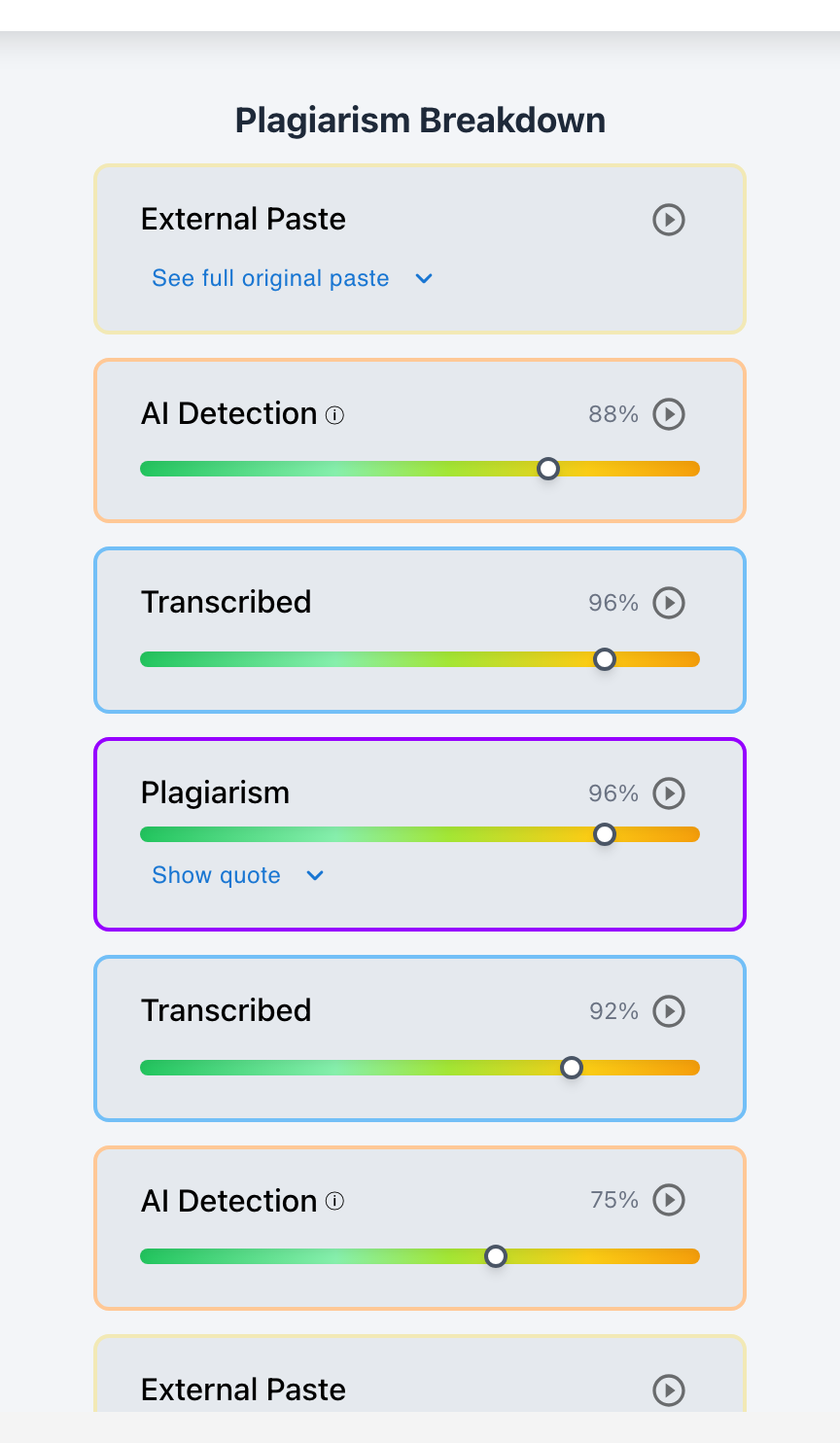
Checkmark Plagiarism's essay writing playback helps teachers examine internal document drafting when process data exists, while static AI detection and plagiarism detection analyze completed submissions where draft history is absent.
Why Might a Student Have No Drafts?
- Composed Directly in Document: Many students type and edit simultaneously in a single file rather than creating separate draft documents.
- Deleted Intermediate Files: Cleaning up desktop folders and trash after completing assignments.
- Handwritten Planning: Outlining and brainstorming on paper, index cards, or notebooks.
- Drafting in Simple Apps: Using basic notepad apps or offline text editors that lack version history.
Review the Writing History That Does Exist
Even if there is no separate file labeled "Rough Draft," the submitted document itself may contain extensive internal drafting evidence: multiple writing sessions, sentence rewrites, paragraph reordering, and gradual source additions.
How Checkmark Plagiarism's Essay Writing Playback Helps
Checkmark Plagiarism's essay writing playback allows teachers to examine how an assignment developed: multi-session drafting, large text additions, revisions, deleted passages, and editing behavior over time. A student may have no separate draft files while still demonstrating substantial evidence of genuine writing inside the document history. Read more in how Checkmark writing process analysis works.
Evaluating Authorship When Drafts Are Missing
Conceptual Comprehension
Ask the student to explain the core thesis, define advanced terminology, and discuss the reasoning behind key paragraphs in plain language.
Source Authentication
Verify whether cited journal articles, book chapters, author names, and quotes exist in academic indices.
What Does a Concerning Pattern Look Like?
Concerning Corroborating Pattern
- No separate drafts or notes available
- Document history shows instant 1,400-word paste
- Writing style diverges completely from past work
- Multiple citations do not exist in databases
- Student cannot explain the thesis, terms, or sources
Valid Multi-Signal Ownership
- No separate drafts saved (edited in place)
- Playback shows 4 multi-hour drafting sessions
- Writing style fits established student baseline
- All citations and direct quotes are verified
- Student fluently explains all arguments and revisions
What If There Is No Writing History (PDFs / Word Files)?
When students submit completed PDFs or Word files without version logs, Checkmark Plagiarism's static AI detection provides an objective analysis of completed submissions to pair with baseline comparisons, citation checks, and student conferences.
A Practical Process When a Student Has No Drafts
A Practical 14-Step Review Process When Drafts Are Missing:
- 1. Avoid assuming the absence of drafts automatically proves AI use.
- 2. Ask neutrally where and how the assignment was originally composed.
- 3. Review writing playback for internal drafting activity in the final document.
- 4. Compare the submission against previous student writing baselines.
- 5. Ask the student to explain the central thesis and major arguments.
- 6. Inquire about important terminology and advanced vocabulary.
- 7. Verify cited sources, author names, and direct quotes in academic databases.
- 8. Review AI detection reports as one corroborating signal among several.
- 9. Check plagiarism detection results for traditional web/database source matches.
- 10. Inquire neutrally about writing tools, grammar assistants, and tutoring help.
- 11. Ask directly and neutrally about generative AI usage where applicable.
- 12. Consider alternative supporting evidence such as handwritten notes or bookmarks.
- 13. Compare the student's explanation against all available objective evidence.
- 14. Follow established school academic-integrity procedures if concerns persist.
How Checkmark Plagiarism Helps When Draft Evidence Is Limited
Checkmark Plagiarism combines **essay writing playback, AI detection, static AI detection, plagiarism detection, autograding, and Canvas/Google Classroom integrations** to evaluate assignments across multiple independent dimensions even when rough drafts are unavailable.
Frequently Asked Questions
Is it suspicious if a student has no rough draft?
Not necessarily. Some students write directly in the final document, delete earlier files, use handwritten notes, or do not save intermediate drafts.
Does having no drafts mean a student used ChatGPT?
No. The absence of drafts does not identify how the assignment was created.
What should I ask a student who has no drafts?
Ask where they wrote the assignment, how they developed the thesis, what they revised, what tools they used, and whether they have notes or other supporting materials.
What if the student says they wrote everything directly in the final document?
Review the writing history when available. Gradual drafting and revision inside the final document may support that explanation.
What if the final document also has no meaningful writing history?
Ask where the text was originally created and consider other evidence such as previous writing, student understanding, sources, plagiarism results, and AI detection.
Can an AI detector make up for missing drafts?
AI detection provides another statistical signal, but cannot replace process evidence or prove authorship by itself.
What if the student cannot explain their own essay?
Repeated inability to explain major arguments, sources, or terminology can justify further review, especially when combined with other concerns.
Should teachers require students to keep drafts?
They can, particularly when writing process is an important part of the course. The expectation should be communicated before the assignment begins.
What if a student deleted their drafts?
Ask them to explain how the assignment developed and consider any remaining evidence, including writing history, notes, sources, and previous work.
How does Checkmark Plagiarism help when no drafts are available?
Checkmark Plagiarism combines AI detection, static AI detection, plagiarism detection, essay writing playback, autograding, and Canvas and Google Classroom integrations.
No Drafts Means Less Process Evidence—Not Proof of AI
Missing draft files create an information gap, but do not constitute proof of misconduct. By examining baseline comparisons, citation validity, oral comprehension, and multi-signal detection, teachers can evaluate authorship thoroughly and fairly.
Checkmark Plagiarism supports this evidence-based approach with essay writing playback, AI detection, static AI detection, plagiarism detection, autograding, and integrations with Canvas and Google Classroom.
See how Checkmark pairs essay writing playback with multi-signal detection to investigate submissions even when separate drafts are unavailable. View a sample report or request a demonstration.