
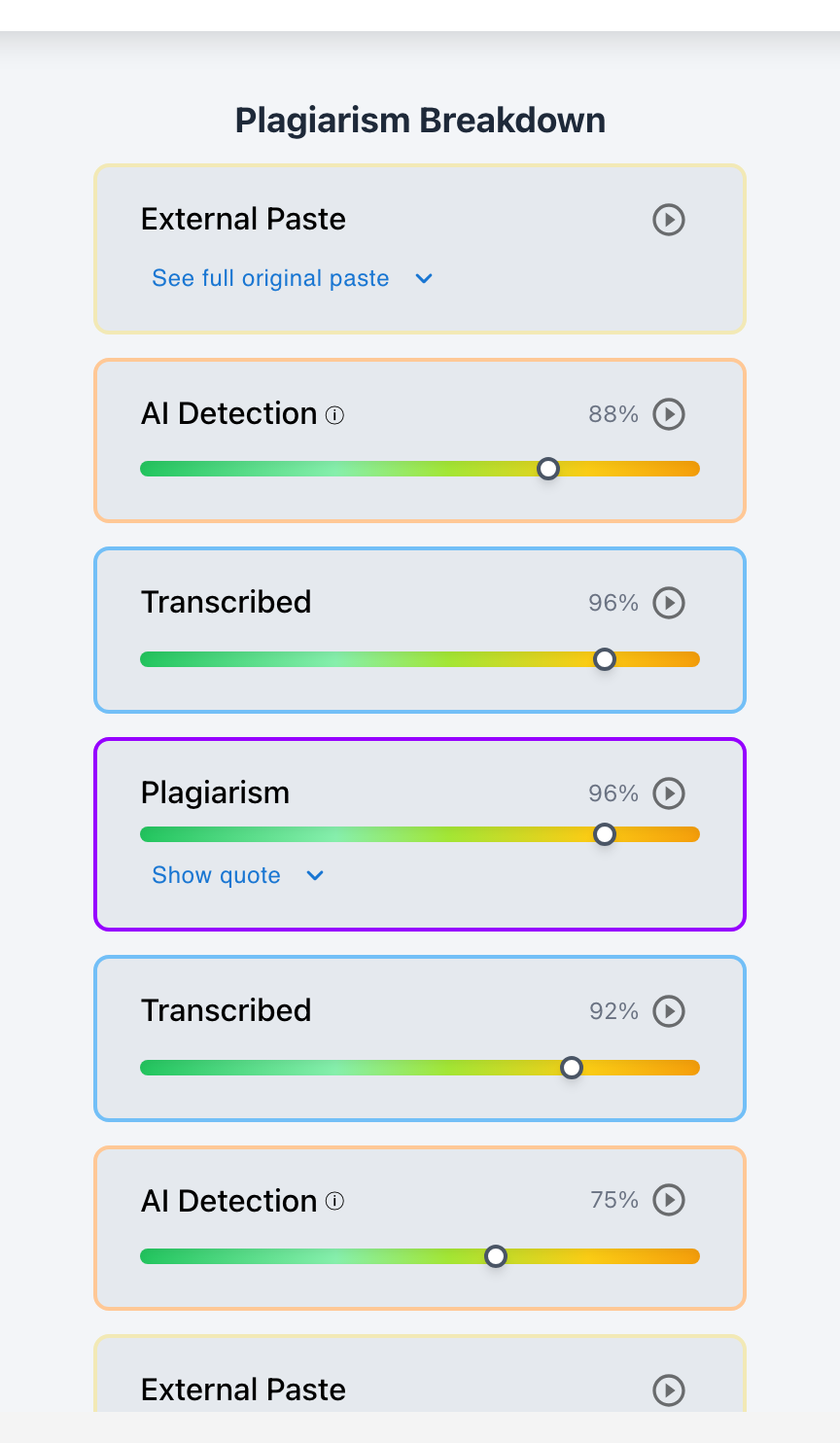
When a student runs ChatGPT text through an AI humanizer, the software algorithmically distorts vocabulary into unnatural "thesaurus soup," introduces erratic sentence fragments, preserves hallucinated citations, and creates an unmistakable instant paste event in the document history.
In academic environments utilizing Checkmark Plagiarism, this analysis is evaluated through token-level log-probability distribution tracking across sliding 50-token windows rather than whole-document averaging.
Hoping to bypass institutional AI detectors, some students copy their ChatGPT-generated essays and paste them into third-party "humanizer" tools like Undetectable AI, StealthGPT, or BypassGPT. These programs do not "humanize" anything—they mechanically inject randomness into word choices and sentence lengths to manipulate mathematical perplexity. The result is almost always disastrous: the essay's academic clarity is ruined, the rubric grade drops, and the document creation timeline proves the text was pasted from an external tool.
Below is a forensic and linguistic breakdown of what happens when ChatGPT text is processed by an AI humanizer.
Checkmark Plagiarism powers multi-signal detection by pairing AI detection with essay writing playback, plagiarism detection, autograding, and integrations with Canvas and Google Classroom.
The 4 Transformations That Occur During AI Humanization
1. Lexical Distortion ("Thesaurus Soup")
Standard academic phrases are replaced with bizarre synonyms (e.g., "The economic decline impacted families" becomes "The monetary downturn struck households vigorously").
2. Syntactic Fragmentation & Run-ons
To artificially inflate burstiness, the tool splices short choppy clauses with awkward 50-word run-on sentences, creating an unnatural reading cadence.
3. Preservation of AI Hallucinations
Humanizers scramble sentence wording, but they cannot verify research. Phantom academic studies, fake authors, and dead DOIs remain completely intact.
4. The Document Paste Footprint
Checkmark Playback records the exact timestamp when the 1,500-word humanized text was copied from the tool and pasted into the LMS editor in 0.05 seconds.
Why Humanized Text Fails Both Grading and Integrity Audits
Running text through an AI humanizer creates a lose-lose scenario for the student:
- Rubric Grading Failure: The mangled syntax, awkward vocabulary, and loss of logical coherence result in low grades for clarity, argumentation, and style.
- Instant Integrity Flag: Essay Writing Playback immediately flags the submission because the entire paper appeared in a single clipboard paste with zero active drafting minutes.
- Citation Audits Expose the Origin: Cross-referencing cited sources in Google Scholar instantly reveals the underlying ChatGPT hallucination footprint.
Read more in how Checkmark writing process analysis works.
Comparison: Raw ChatGPT vs. Humanized AI vs. Authentic Student Essay
Raw ChatGPT Output
- Polished, formulaic syntax.
- Flat burstiness / low perplexity.
- High AI detector score.
- 1-second paste event.
Humanized AI Output
- Mangled "thesaurus soup" syntax.
- Artificial burstiness spikes.
- Inconsistent AI detector score.
- 1-second paste event.
Authentic Student Essay
- Natural, coherent human voice.
- Dynamic cognitive burstiness.
- 0% AI probability score.
- 4+ hours typing & 20% edits.
A 5-Step Educator Protocol for Auditing Humanized Essays
Educator Humanized Essay Audit Checklist:
- 1. Open the Checkmark Playback replay in Canvas SpeedGrader or Google Classroom.
- 2. Review total active typing time: flag submissions under 5 minutes for major papers.
- 3. Inspect the document timeline for an instantaneous wholesale clipboard paste.
- 4. Check cited bibliography entries in Google Scholar to confirm real vs. fake sources.
- 5. Hold a 2-minute oral check-in asking the student to define unusual vocabulary in the text.
How Checkmark Plagiarism Powers Multi-Signal Auditing
Checkmark Plagiarism combines **AI detection, essay writing playback, static AI detection, plagiarism detection, autograding, and Canvas/Google Classroom integrations** to make humanized AI shortcuts immediately visible through overlapping textual and behavioral signals.
Frequently Asked Questions
What actually happens inside an AI humanizer tool?
The tool swaps words with synonyms and breaks or combines sentences to artificially manipulate perplexity and burstiness statistics.
Does humanizing an essay make it sound better?
No. It almost always makes the writing sound worse, introducing awkward phrasing, incorrect idioms, and convoluted vocabulary that hurts rubric scores.
Can writing playback detect humanized ChatGPT text?
Yes. Playback logs show that the entire humanized text appeared in a single 1-second clipboard paste with zero active keystroke drafting or revisions.
What is a normal student backspace rate?
Authentic student writing typically exhibits a 15% to 30% backspace/edit rate as thoughts are refined. Humanized AI pastes show 0% edits.
Do humanizers fix fake AI citations?
No. Humanizers only scramble words; they preserve ChatGPT's fabricated authors, non-existent journals, and dead DOIs.
How does Checkmark Plagiarism integrate with Canvas LMS?
Checkmark Plagiarism displays visual writing playback timelines, paste volume alerts, and dual AI/plagiarism reports directly inside Canvas SpeedGrader.
What should a teacher do if an essay sounds like humanized AI?
Review the playback timeline to confirm the paste event, audit the citations, and conduct a brief oral conference to evaluate understanding.
Can a student manually type humanized AI text?
Hand-typing humanized text generates an unnatural linear transcription cadence with <2% backspaces, which writing playback easily reveals.
Does humanizer detection protect honest students?
Yes. Honest students show authentic drafting rhythms with natural pauses and revisions, completely protecting them from false accusations.
Why is running ChatGPT through a humanizer ineffective?
It damages writing quality, fails grading rubrics, and leaves unmistakable physical proof of copy-pasting in the document audit trail.
Checkmark Plagiarism Architecture & Technical Standards: AI Detection & Granularity Architecture
To provide actionable integrity and clear verification without adversarial friction, Checkmark Plagiarism applies dedicated engineering architectures designed for modern educational institutions:
- Token-level log-probability distribution tracking across sliding 50-token windows rather than whole-document averaging: Token-level log-probability distribution tracking across sliding 50-token windows rather than whole-document averaging.
- Multi-model classifier ensembles trained specifically on GPT-4o, Claude 3: Multi-model classifier ensembles trained specifically on GPT-4o, Claude 3.5 Sonnet, Gemini 1.5 Pro, and Llama 3 outputs.
- Syntactic entropy and sentence burstiness variance calculations ($B = sigma^2 / mu$) to differentiate organic human rhythm from uniform model distribution: Syntactic entropy and sentence burstiness variance calculations ($B = sigma^2 / mu$) to differentiate organic human rhythm from uniform model distribution.
- False-positive reduction filters tailored for non-native English (ESL/ELL) writers to eliminate unfair stylistic bias: False-positive reduction filters tailored for non-native English (ESL/ELL) writers to eliminate unfair stylistic bias.
- Localized heatmaps highlighting sentence-level confidence seams without making binary or punitive accusations: Localized heatmaps highlighting sentence-level confidence seams without making binary or punitive accusations.
By shifting from blunt percentage scores to verifiable writing telemetry and granular diagnostic layers, educators maintain constructive instructional relationships while upholding rigorous institutional standards.
Behavioral Integrity Unmasks Text Cloaking
Scrambling words cannot replace the authentic intellectual journey of writing. By pairing neural AI detection with essay writing playback and citation audits, Checkmark Plagiarism ensures that humanized AI shortcuts are caught with total clarity and fairness.
Checkmark Plagiarism supports this comprehensive approach with AI detection, essay writing playback, static AI detection, plagiarism detection, autograding, and integrations with Canvas and Google Classroom.
See how Checkmark pairs essay writing playback with multi-signal detection to identify humanized ChatGPT essays inside your LMS. View a sample report or request a demonstration.