
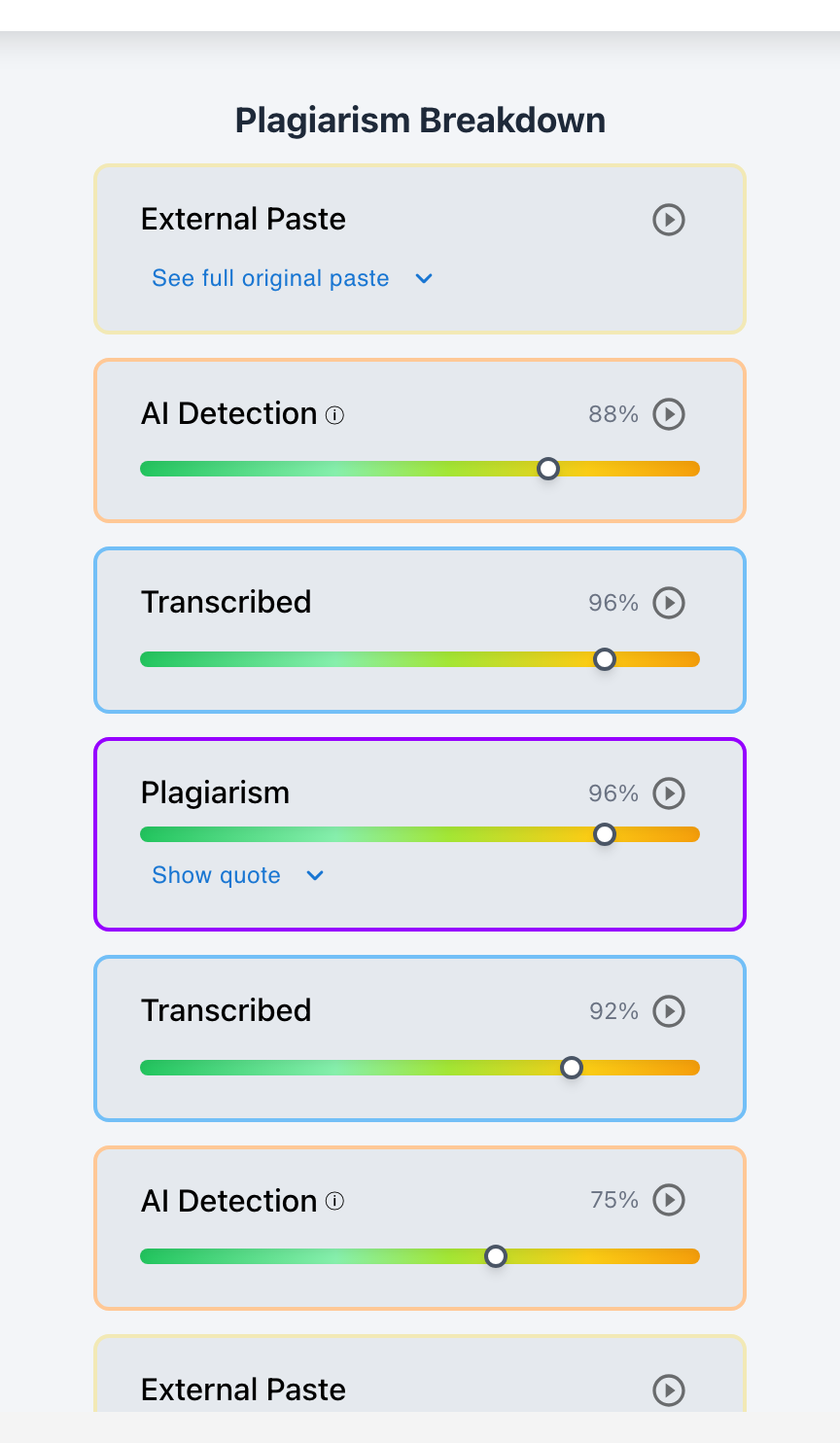
Before issuing any academic penalty for AI cheating (such as a zero, mandatory rewrite, or disciplinary referral), schools should require proof meeting the "Two-Pillar Standard of Evidence": corroboration from at least two independent categories: 1) Physical Process Telemetry (e.g., Checkmark Playback logging a 0.05-second paste payload of >500 words or <15 minutes of active typing); 2) Citation Verification (e.g., Crossref confirming hallucinated DOIs or non-existent journal titles); or 3) Documented Oral Incongruity (e.g., failure to explain core thesis claims during a 2-minute conference). An AI detector score alone is strictly insufficient.
Issuing an academic penalty is a serious administrative action that impacts a student's grade point average, academic record, and college admissions opportunities. In the era of generative AI, penalizing a student based solely on a single number from a proprietary detection algorithm creates severe institutional liability and risks punishing innocent students. Establishing an explicit, multi-signal standard of proof ensures that penalties are applied with absolute fairness, unassailable evidence, and complete legal defensibility.
Below is a comprehensive guide on the required evidence thresholds for academic integrity sanctions.
Checkmark Plagiarism generates multi-signal proof by pairing AI detection with essay writing playback, plagiarism detection, autograding, and integrations with Canvas and Google Classroom.
The 3 Categories of the Two-Pillar Evidentiary Standard
Category 1: Process Telemetry
Objective Physical Proof: Checkmark Playback confirms <15 minutes of active drafting for a full essay, a 0.05-second paste event, or <3% backspaces.
Category 2: Citation Fabrication
Factual Disproof: Checkmark's automated DOI scan confirms cited academic journal articles, volume numbers, or authors do not exist in published reality.
Category 3: Documented Oral Inability
Pedagogical Incongruity: Documented failure during a structured 2-minute conference to define key vocabulary or explain the central thesis.
Why Two Pillars Are Required for Any Penalty
Understanding the legal and pedagogical necessity of multi-category corroboration:
- Eliminating False Accusations: An innocent student who writes eloquently might trigger an AI detector (0 categories met) → No penalty permitted.
- Closing the Evasion Loophole: A student who pastes ChatGPT with fake sources meets Category 1 (paste log) AND Category 2 (hallucinated citations) → Two Pillars met: Penalty enforced with 100% confidence.
- Total Administrative Defensibility: When school leadership presents a compiled Checkmark dossier containing physical keystroke logs and database verification, disputes are resolved instantly.
Read more in how Checkmark writing process analysis works.
Comparison: Single-Score Sanctions vs. Two-Pillar Standard
Checkmark Two-Pillar Standard (Objective & Defensible)
- Requires corroboration across 2 independent evidence pillars.
- Physical keystroke telemetry logs paste events.
- Automated database checks prove fake citations.
- Withstands parent meetings, honor boards, and legal review.
Single-Score Sanctions (Speculative & Vulnerable)
- Issues penalties based solely on a percentage score (e.g., 85%).
- Zero physical proof of how the text entered the file.
- Frequently overturned on appeal, undermining teacher authority.
- Exposes the school to legal liability and parental friction.
A 5-Step Educator Protocol for Verifying Penalty Thresholds
Penalty Threshold Verification Checklist:
- 1. Open the student's submission in Canvas SpeedGrader with Checkmark enabled.
- 2. Check Category 1: does Writing Playback log an instant paste payload or <15 mins active typing?
- 3. Check Category 2: does the Source Verification Card flag non-existent DOIs or fake references?
- 4. Check Category 3: conduct the 2-minute oral check-in and record the student's responses.
- 5. If at least TWO categories are validated, export the Checkmark PDF dossier and apply handbook sanctions.
How Checkmark Plagiarism Powers Evidence Verification
Checkmark Plagiarism combines **AI detection, essay writing playback, static AI detection, plagiarism detection, autograding, and Canvas/Google Classroom integrations** to automatically evaluate submissions against the Two-Pillar standard, removing all guesswork from disciplinary decisions.
Frequently Asked Questions
Can a teacher fail a student based only on an AI detector percentage?
No. School policies should strictly prohibit single-score penalties because detectors are statistical tools that lack physical process evidence.
What is considered 'Category 1' telemetry evidence?
Checkmark Playback logs showing a student pasted 1,000+ words in 0.05 seconds, spent less than 15 minutes drafting a long essay, or made near-zero backspaces.
What is considered 'Category 2' citation evidence?
Confirming through Crossref or Google Scholar database queries that cited journal articles or DOIs were fabricated by AI hallucinations.
How does the Two-Pillar standard protect honest students?
An honest student who writes sophisticated prose may trigger an AI detector, but their 4 hours of typing telemetry and valid citations immediately clear them from penalty.
How does Checkmark Plagiarism integrate with Canvas LMS?
Checkmark embeds the Two-Pillar evidence summary directly inside Canvas SpeedGrader, displaying telemetry badges and citation checks in one view.
What should happen if only ONE pillar is met?
If evidence is borderline (e.g., an isolated paste event but valid citations and strong oral defense), the teacher should treat it formatively with a minor revision requirement rather than a disciplinary penalty.
Can teachers export the two-pillar evidence for parents?
Yes. Checkmark exports a standardized, FERPA-compliant PDF audit dossier containing all telemetry charts, video links, and citation checks.
How does Autograder align with evidence thresholds?
Checkmark Autograder automatically pauses grade release on submissions meeting the Two-Pillar risk threshold, routing them for educator review.
Does this evidentiary standard comply with legal due process?
Yes. By requiring objective, physical, and verifiable proof, schools meet the highest standards of administrative due process.
Why is an explicit evidence standard essential for school leadership?
Because it ensures consistent, transparent, and fair disciplinary actions across every department and classroom.
Objective Proof for Uncompromising Integrity
Disciplinary actions must always be anchored in truth. By enforcing the Two-Pillar Standard of Evidence with Checkmark Plagiarism, educators ensure that academic penalties are supported by incontrovertible physical telemetry and factual proof, protecting student due process and upholding academic excellence.
Checkmark Plagiarism supports this comprehensive approach with AI detection, essay writing playback, static AI detection, plagiarism detection, autograding, and integrations with Canvas and Google Classroom.
See how Checkmark verifies multi-pillar integrity evidence in Canvas SpeedGrader. View a sample report or request a demonstration.