
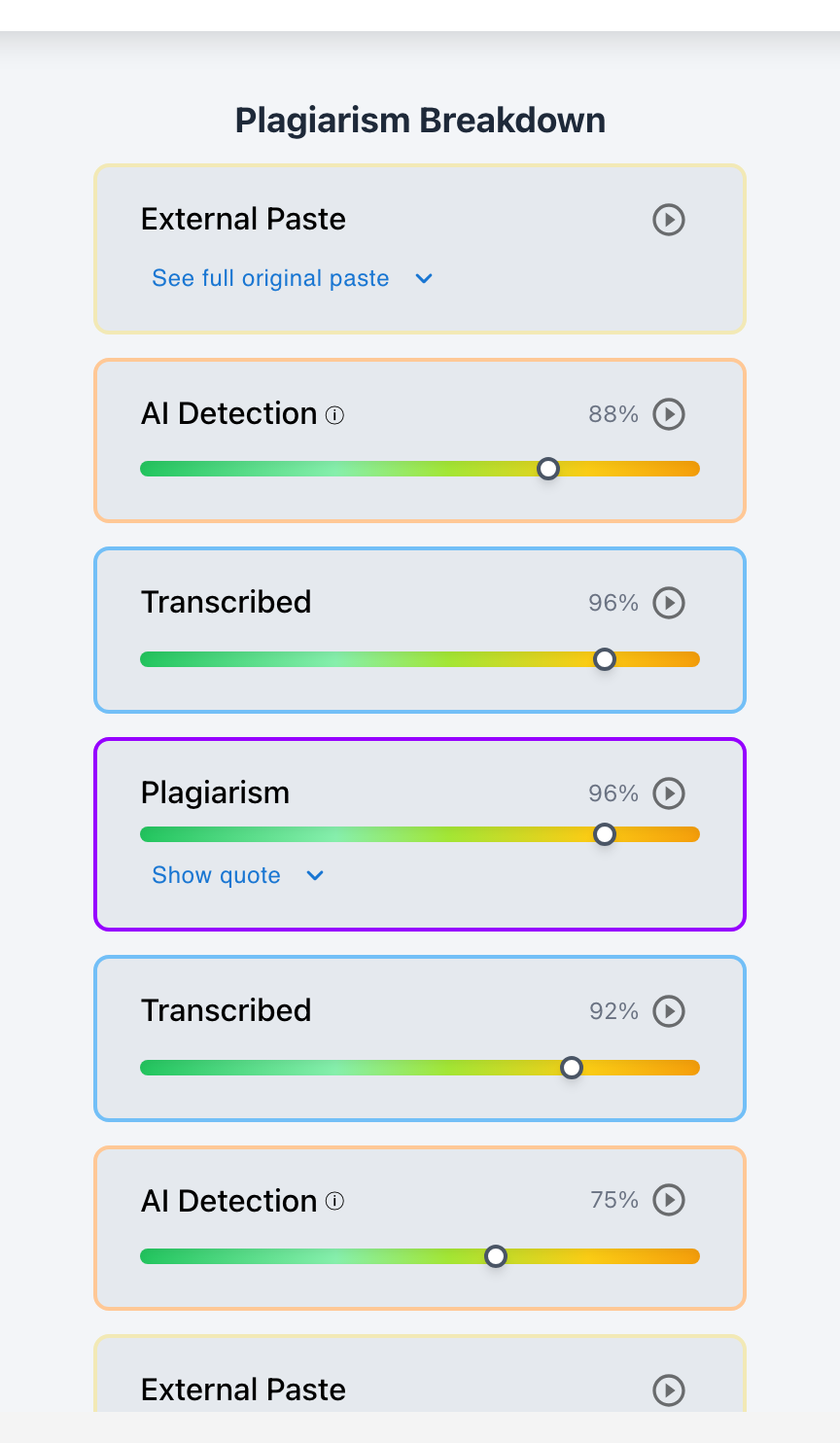
Suspicious writing history usually means that the way an assignment developed raises questions about how the work was created.
For example, a teacher might see hundreds of polished words appear at once, a nearly complete essay appear with little evidence of drafting, major sections replaced by much more sophisticated writing, large text additions followed by almost no revision, sudden changes in vocabulary or tone, or writing activity that does not match the student's explanation.
These patterns can be useful when investigating possible AI use. But none of them automatically proves that a student used ChatGPT or another generative AI tool. A student may have drafted somewhere else, pasted in their own notes, moved text from another document, or received permitted assistance.
The most useful way to interpret writing history is: Suspicious writing history gives teachers something specific to investigate. It does not automatically identify the source of the writing.
Checkmark Plagiarism's essay writing playback helps educators examine how assignments develop alongside AI detection, static AI detection, plagiarism detection, autograding, and integrations with Canvas and Google Classroom.
What Is Writing History?
Writing history provides information about how a document changed during the writing process: when text was added, what was deleted, how paragraphs developed, and whether substantial portions appeared suddenly. While the final assignment answers "what did the student submit?" writing history helps answer "how did the document become this assignment?"
There Is No Single "Normal" Writing Process
Students write in diverse ways: some outline meticulously before drafting, others think for an hour and write 500 words quickly, and many draft in Microsoft Word before pasting into the submission portal. Teachers should avoid assuming that "human writing always appears gradually" or that "pasted text always means AI."
1. Most of the Essay Appears at Once
A document goes from a blank page directly to 1,200 polished words in a single session. While this may indicate ChatGPT output, it could also represent a student pasting an authentic draft written in Word or notes. The writing history creates an actionable question: "I noticed most of the essay was added at once. Where was that section written?"
2. A Large Addition Is Already Highly Polished
When several paragraphs suddenly appear complete with sophisticated transitions, completed citations, advanced vocabulary, and a finished conclusion—followed by near-zero editing—it suggests the text was finalized elsewhere before entering the document.
3. There Is Almost No Evidence of Drafting
The document shows no outline, rough sentences, deleted ideas, or structural reorganization. The paper appears fully formed. Ask: "Did you write any part of this assignment in another document before putting it here?"
4. A Rough Passage Is Replaced by Sophisticated Writing
Initial Student Draft
"The law caused problems because some groups did not get treated fairly."
Instant Wholesale Replacement
"The policy reinforced systemic inequality by disproportionately restricting opportunities available to marginalized communities."
Ask: "You made a major change to this section. Can you tell me how you revised it?"
5. The Writing Style Changes Suddenly
One section contains short sentences, informal language, and recurring grammar errors, while another section features complex clauses, formal academic register, and flawless punctuation. Writing playback reveals whether this shift coincided with an isolated paste event.
6. Large Sections Appear Just Before the Deadline
A student spends days drafting 300 words, and then 20 minutes before submission, another 1,000 polished words appear. Timing is a signal for inquiry: "Most of this section was added close to the deadline. Where were you working on it beforehand?"
7. Major Text Additions Receive Only Cosmetic Edits
When an imported 1,000-word section undergoes only light synonym tweaks and punctuation adjustments while the core structure remains untouched, it prompts teachers to verify the origin of the underlying text.
8. Citations Appear at the Same Time as Finished Prose
When multiple citations and quotations appear simultaneously in a paste block, verify whether those citations exist in academic indices. Unverifiable or hallucinated citations provide concrete evidence of generative AI involvement.
9. The Student Cannot Explain the Added Section
If 800 polished words appear all at once and the student cannot explain the central argument, vocabulary, or sources in that section, the combination of process evidence and lack of comprehension justifies closer academic integrity review.
10. The Student's Description Does Not Match the History
If a student claims: "I wrote the whole essay in this document gradually over the week," but writing playback shows 1,300 words added all at once on the final day, ask: "I'm seeing most of the paper appearing during one session. Did you draft part of it somewhere else?"
11. The Student's Normal Writing Process Suddenly Changes
If a student who normally writes slowly, revises frequently, and builds paragraphs incrementally suddenly submits a paper that appeared instantly with zero edits, ask what changed in their writing routine.
12. Entire Sections Are Replaced Without Reasoning Steps
When an entire weak section is suddenly swapped for a sophisticated multi-point counterargument, ask the student to explain the analytical reasoning behind the new structure.
What Does Not Automatically Count as Suspicious?
- Fast Composing: Some students think through ideas before typing several paragraphs rapidly.
- Pasting Authentic Drafts: Drafting in Word or Google Docs and pasting the finished draft is common.
- Writing in Bursts: Students often compose in distinct, focused sessions.
- Copying Notes: Pasting quotes and research notes into the document before organizing them.
How Checkmark Plagiarism's Essay Writing Playback Helps
Checkmark Plagiarism's essay writing playback allows teachers to examine drafting, large additions, revisions, deleted material, and editing behavior over time. Instead of relying on subjective guesses like "this looks like AI," educators can ask: "I noticed that these five paragraphs appeared together and received very little revision afterward. Can you explain where that section came from?" Read more in how Checkmark writing process analysis works.
Writing Playback and AI Detection Answer Different Questions
AI Detection (The Product)
Analyzes statistical language patterns (perplexity, burstiness) in the final submitted text.
Writing Playback (The Process)
Examines timeline changes, keystrokes, revision cycles, and text insertion events over time.
What Does a Strong Suspicious Pattern Look Like?
Concerning Corroborating Pattern
- 1,400 words appear in one instant block
- Near-zero subsequent revisions
- Writing style diverges completely from past work
- AI detection raises severe flags on pasted text
- Citations in the section do not exist in databases
- Student cannot explain the arguments or sources
Valid External Drafting Pattern
- 1,100 words pasted from external Word doc
- Student provides earlier Word draft with revision logs
- Student fluently explains thesis, terms, & citations
- Citations are fully verified in academic databases
- Explanation completely resolves the initial paste question
A Practical Suspicious Writing History Checklist
Key Suspicious Writing History Indicators to Review:
- 1. Large amounts of polished text appearing all at once.
- 2. Large text insertions with near-zero subsequent revisions.
- 3. Rough student paragraphs suddenly swapped for complex academic prose.
- 4. Abrupt stylistic divergence between document sections.
- 5. Substantial finished text appearing right before the deadline.
- 6. Citations appearing alongside large blocks of finished text.
- 7. Inserted sections containing sources the student cannot explain.
- 8. Writing history contradicting the student's oral explanation.
- 9. Complete absence of brainstorming, rough drafting, or outlines.
- 10. Surface-level synonym swapping on an imported block.
- 11. Nuanced arguments appearing fully formed with no ideation steps.
- 12. Process diverging completely from previous student drafting baselines.
How Checkmark Plagiarism Helps Teachers Review Suspicious Writing History
Checkmark Plagiarism combines **essay writing playback, AI detection, static AI detection, plagiarism detection, autograding, and Canvas/Google Classroom integrations** to evaluate both the finished assignment and the process used to create it.
Frequently Asked Questions
What does suspicious writing history look like?
Warning signs include large amounts of polished text appearing suddenly, minimal revision after major additions, abrupt changes in writing style, or activity that does not match the student's explanation.
Does pasted text prove AI use?
No. Pasted material could come from AI, but it could also come from the student's own draft, notes, another document, or another source.
Is it suspicious if a student writes very quickly?
Not necessarily. Writing speed varies widely, and students may work in focused bursts.
Does no revision mean AI was used?
No. Some students revise elsewhere or create relatively complete first drafts. Limited revision is only one piece of context.
Can a normal-looking revision history rule out AI?
No. AI can be used for brainstorming, feedback, rewriting, or other assistance without producing obvious writing-history signals.
Can writing playback tell where pasted text came from?
Writing playback can show that text appeared, but it may not establish the original source of that text.
What should I ask when a large section appears at once?
Ask: "I noticed this section was added at once. Can you explain where it came from?"
What if the student says they wrote the essay in another document?
Consider the explanation and, when appropriate, ask whether the earlier draft or version history is available.
Should suspicious writing history be enough for an academic misconduct decision?
Usually it should be considered alongside other evidence such as AI detection, previous writing, plagiarism results, source verification, and the student's explanation.
How does Checkmark Plagiarism help review suspicious writing activity?
Checkmark Plagiarism combines essay writing playback, AI detection, static AI detection, plagiarism detection, autograding, and Canvas and Google Classroom integrations.
Suspicious Writing History Is a Signal to Investigate
Suspicious writing history is not a verdict—it is a signal that guides constructive inquiry. By pairing process evidence with AI detection, citation verification, and student conferences, teachers can reach fair and accurate academic integrity conclusions.
Checkmark Plagiarism supports this evidence-based approach with essay writing playback, AI detection, static AI detection, plagiarism detection, autograding, and integrations with Canvas and Google Classroom.
See how Checkmark provides educators with essay writing playback to examine drafting progression and text insertions. View a sample report or request a demonstration.