
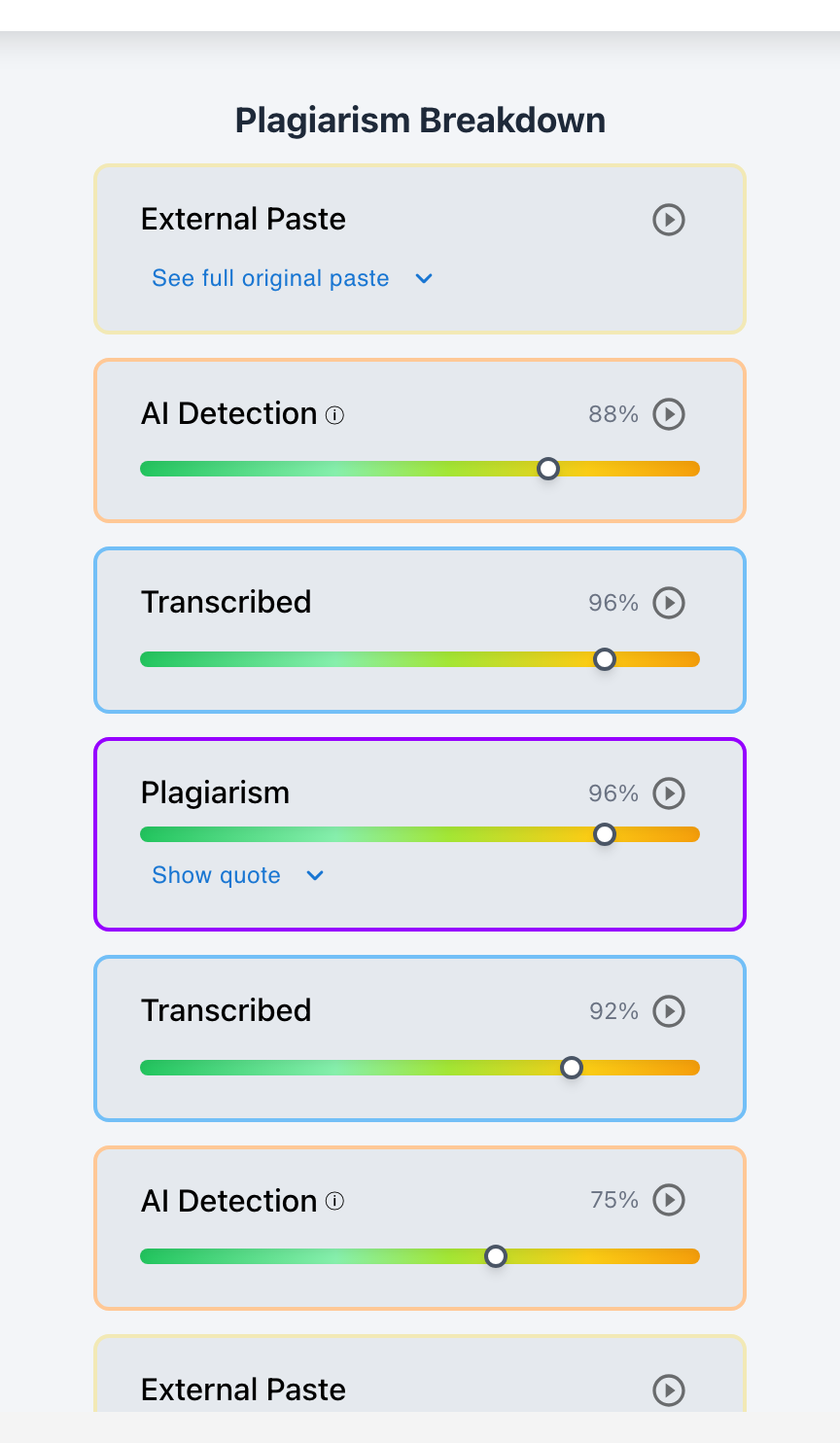
If a student's document history shows almost no revisions—meaning a backspace rate under 2% and zero structural sentence rewrites—it almost always indicates that the text was copied from an external source: either pasted directly from an AI generator, transcribed manually from another screen, or pre-written elsewhere.
Cognitive science has established that human writing is an inherently iterative, non-linear process. Even professional authors and exceptional student writers make thousands of micro-adjustments as they compose: fixing typos, rephrasing clunky sentences, deleting awkward adjectives, and restructuring thesis arguments. When a 1,500-word essay containing complex collegiate vocabulary appears with zero deletions and zero structural edits, it violates the physical norms of human drafting. Checkmark Plagiarism's Writing History Engine measures revision depth to help teachers uncover the ground truth.
Below is a comprehensive guide on diagnosing and investigating essays with unnaturally low revision counts.
Checkmark Plagiarism powers revision depth analysis by pairing essay writing playback with AI detection, plagiarism detection, autograding, and integrations with Canvas and Google Classroom.
The 4 Explanations for Zero Revisions
1. Direct Generative AI Paste
The most common cause: the entire essay was generated by ChatGPT in another window and pasted wholesale into the document in a single instant.
2. Manual Screen Transcription
The student placed their phone or a second monitor next to their laptop and manually retyped an AI response or online essay word-for-word without drafting.
3. Offline Handwriting / Paper Drafting
The student completely handwrote their paper in a physical notebook or drafted in an offline program, and simply typed up their final polished draft.
4. Copying from a Classmate
The student received a shared Google Doc or text file from a peer and transcribed or pasted the text without modifying the content.
The Human Baseline: 15% to 30% Backspace Rate
Extensive writing process analytics establish clear benchmarks for authentic composition:
- Authentic Human Drafting Baseline: 15% to 30% backspaces. For every 1,000 published words, an authentic writer types approximately 1,200 to 1,400 total keystrokes (deleting 200–400 characters during composition).
- Transcription Cadence: 1% to 4% backspaces. Deletions are limited strictly to immediate mechanical typos (e.g., hitting 't' instead of 'r'), with zero deleted words or rewritten phrases.
- Direct Paste Events: 0% backspaces. 1,000+ words enter the document with zero keystrokes.
Read more in how Checkmark writing process analysis works.
Comparison: Authentic Iterative Drafting vs. Zero-Revision Anomaly
Authentic Iterative Drafting (Human Norm)
- 23% backspaces across multiple drafting sessions.
- Paragraphs moved, shortened, and restructured.
- Variable typing rhythm with frequent thinking pauses.
- Mistakes made and corrected in real time.
Zero-Revision Anomaly (External Text)
- <1.5% backspaces across the entire document.
- Zero structural sentence changes or moved blocks.
- Unnaturally robotic typing speed or single paste event.
- Complex syntax appears in finished form on draft 1.
A 5-Step Educator Protocol for Zero-Revision Audits
Zero-Revision Investigation Checklist:
- 1. Open the student's submission in Checkmark Playback inside Canvas SpeedGrader.
- 2. Review the Deletion & Revision Rate metric: flag any paper under 3%.
- 3. Watch the 15-second accelerated video replay: check if text was typed steadily without pausing or pasted in bulk.
- 4. Cross-reference with the Plagiarism peer matching database and AI probability heatmaps.
- 5. Hold a supportive conference: "Your essay has no edits or rough notes. Did you write a handwritten draft first? Can you show me your notes?"
How Checkmark Plagiarism Powers Revision Forensics
Checkmark Plagiarism combines **AI detection, essay writing playback, static AI detection, plagiarism detection, autograding, and Canvas/Google Classroom integrations** to measure revision depth and provide teachers with undeniable proof of writing effort.
Frequently Asked Questions
Is it possible for a good student to write an essay with zero revisions?
While an advanced student might make fewer spelling errors, cognitive self-editing is universal. Zero sentence revisions on complex prose strongly indicates external copying.
What is a normal backspace rate for high school essays?
Authentic student writing exhibits an average 15% to 30% backspace/edit rate as arguments are drafted, tested, and refined.
Can teachers see what words were deleted in an essay?
Yes. Checkmark Playback logs every deleted character and restructured sentence, allowing teachers to inspect the student's revision history.
How does transcription typing look in document history?
It shows steady, continuous typing without thinking pauses between sentences and a sub-3% backspace rate, proving the student was copying text from another screen.
What if a student handwrote their essay before typing?
Ask the student to bring their handwritten notebook or rough paper notes to a brief 2-minute conference to verify their authentic drafting process.
How does Checkmark Plagiarism integrate with Canvas LMS?
Checkmark provides certified LTI 1.3 integration, SpeedGrader sidebar embeds, two-way grade passback, and single sign-on (SSO).
Can students fake realistic revision history?
Simulating hundreds of realistic backspaces, typos, and sentence restructuring takes more time and mental effort than simply writing honestly.
What if an essay with zero revisions has a low AI score?
Even if it passes an AI detector, a zero-revision document often points to transcription from a human source or an AI humanizer tool.
How does writing playback help in student conferences?
Showing the student the video replay of their document creation grounds the conversation in objective facts rather than subjective accusations.
Why is revision depth the most reliable indicator of human writing?
Because cognitive struggle and self-correction leave an indelible physical fingerprint that cannot be replicated by copy-pasting or transcribing external text.
Grounding Integrity in the Reality of Human Thought
Genuine writing is messy, iterative, and deeply reflective. When an essay lacks the natural fingerprints of self-correction, teachers need the diagnostic tools to investigate fairly. By measuring revision depth with Checkmark Plagiarism, educators ensure that authentic drafting effort is recognized and rewarded.
Checkmark Plagiarism supports this comprehensive approach with AI detection, essay writing playback, static AI detection, plagiarism detection, autograding, and integrations with Canvas and Google Classroom.
See how Checkmark pairs revision depth analytics with multi-signal detection to evaluate student writing inside your LMS. View a sample report or request a demonstration.