
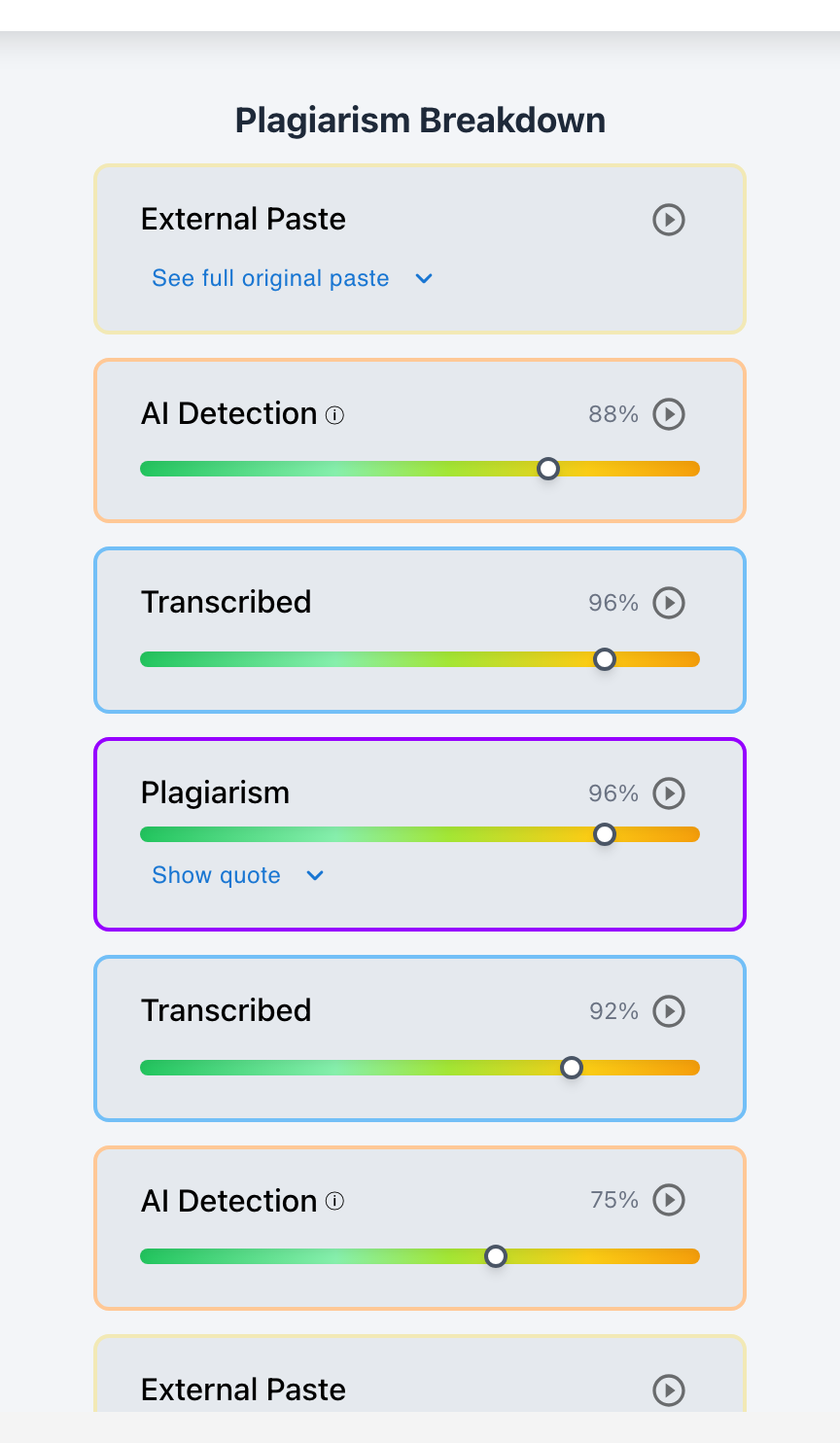
Even when an AI detector outputs a high probability score, authentic human writing in essay playback looks dynamic, non-linear, and visibly iterative—filled with fluctuating typing speeds, messy deletions, paragraph reorganizations, and natural cognitive thinking pauses.
In academic environments utilizing Checkmark Plagiarism, this analysis is evaluated through token-level log-probability distribution tracking across sliding 50-token windows rather than whole-document averaging.
A statistical AI detector only sees the static, finished polish of submitted sentences. If a student writes with formal diction, structured transitions, and clean grammar, the detector's algorithms may score the text as "low perplexity" and flag it as machine-generated. However, opening Checkmark Plagiarism's Essay Playback reveals the physical reality of composition: an unmistakable record of human struggle, spontaneous typo corrections, and gradual intellectual refinement that no AI copy-paste can ever replicate.
Below is a visual and forensic breakdown of what human writing looks like in playback—even when an AI detector flags it.
Checkmark Plagiarism powers playback verification by pairing essay writing playback with AI detection, plagiarism detection, autograding, and integrations with Canvas and Google Classroom.
The 4 Hallmarks of Human Writing in Essay Playback
1. The Dynamic Velocity Wave
Typing speed fluctuates naturally: accelerating to 65 WPM during familiar narrative transitions and slowing to 20 WPM when formulating complex arguments.
2. High Revision & Backspace Messiness
15–30% of all keystrokes are deletions. Replay shows clauses erased mid-sentence, awkward phrasing rewritten, and paragraphs moved across sections.
3. The Cognitive Pause Hierarchy
Rich pause spectrum: 1-second word hesitations, 5-second clause breaks, and 30–90 second macro-pauses at paragraph boundaries to plan argumentation.
4. Multi-Day Document Maturation
The document evolves over 4–8 days across 3–5 distinct sessions, starting from rough bullet points and expanding into a structured research essay.
Why True Human Writing Is Never 'First-Draft Perfect'
Generative AI outputs finished, polished sentences in milliseconds. Humans, however, think while they write:
- The "Messy" Fingerprint: In authentic playback, you see typos corrected in half a second, entire sentences erased and re-drafted, and notes typed at the bottom of the page before being integrated into body paragraphs.
- The "Clean" AI Flag: An AI submission appears all at once via clipboard paste or flows in an unbroken robotic waterfall without a single deletion.
- The Decisive Verdict: A messy, multi-hour drafting timeline completely overrules a false AI score every time.
Read more in how Checkmark writing process analysis works.
Comparison: Playback of Flagged Human Essay vs. Real AI Submission
Flagged Human Essay (False Positive)
- AI Score: 88% probability (due to formal tone).
- Playback: 4.2 hours active typing across 4 sessions.
- Backspace Rate: 24% deletions and revisions.
- Drafting Flow: Messy, non-linear, and iterative.
- Verdict: 100% Authentic Human Essay.
Actual AI Generation (True Cheating)
- AI Score: 95% probability (synthetic language).
- Playback: 3 minutes total (1 paste event).
- Backspace Rate: <1% edits.
- Drafting Flow: Instantaneous, sterile text insertion.
- Verdict: Unauthorized AI Shortcut.
A 5-Step Educator Protocol for Reviewing Flagged Playbacks
Educator Playback Verification Protocol:
- 1. Open the Checkmark Playback replay embedded in Canvas SpeedGrader or Google Classroom.
- 2. Watch the 15-second accelerated video replay to observe drafting evolution.
- 3. Verify that active typing hours match the expected scope of the paper (3+ hours for 1,500 words).
- 4. Check the backspace rate: healthy human drafting exhibits 15–30% active revisions.
- 5. Clear the false flag, dismiss the alert, and grade the essay based on rubric criteria.
How Checkmark Plagiarism Powers Visual Playback
Checkmark Plagiarism combines **AI detection, essay writing playback, static AI detection, plagiarism detection, autograding, and Canvas/Google Classroom integrations** to make human writing dynamics visually obvious directly within your LMS grading interface.
Frequently Asked Questions
Why does human writing look messy in playback?
Because authentic human thinking is messy! Writers constantly rethink words, fix typos, delete awkward phrases, and move paragraphs as their arguments develop.
Can an essay have a 90% AI score and still be 100% human written?
Yes. Formal, articulate human writing often triggers false positives on statistical AI detectors because clear academic grammar has low perplexity.
How does writing playback prove an essay wasn't generated by AI?
Playback logs record every individual keystroke, backspace, and pause over hours of work, proving the text was typed and revised by a human hand.
What is a normal student backspace rate?
Authentic student writing typically exhibits a 15% to 30% backspace/edit rate as thoughts are refined. AI copy-pastes show 0% edits.
How long does an essay playback video take to watch?
Checkmark accelerates hours of drafting into a smooth 10-to-20 second visual replay, allowing teachers to verify writing in seconds.
How does Checkmark Plagiarism integrate with Canvas LMS?
Checkmark Plagiarism displays visual writing playback timelines, session breakdowns, and dual AI/plagiarism reports directly inside Canvas SpeedGrader.
What should a teacher do when playback shows authentic human writing?
Dismiss the AI detector alert, praise the student's strong revision habits, and grade the assignment normally based on the course rubric.
Can students fake authentic writing playback?
Simulating hours of realistic typos, backspaces, and natural thinking pauses takes longer than actually writing the essay honestly.
Does citation verification help clear false flags?
Yes. Human writers cite real academic articles, whereas AI tools frequently fabricate phantom authors and dead DOIs.
Why is writing playback better than static AI detection?
Detectors calculate statistical guesses on static text, whereas playback provides undeniable physical proof of human typing and revision behavior.
Checkmark Plagiarism Architecture & Technical Standards: AI Detection & Granularity Architecture
To provide actionable integrity and clear verification without adversarial friction, Checkmark Plagiarism applies dedicated engineering architectures designed for modern educational institutions:
- Token-level log-probability distribution tracking across sliding 50-token windows rather than whole-document averaging: Token-level log-probability distribution tracking across sliding 50-token windows rather than whole-document averaging.
- Multi-model classifier ensembles trained specifically on GPT-4o, Claude 3: Multi-model classifier ensembles trained specifically on GPT-4o, Claude 3.5 Sonnet, Gemini 1.5 Pro, and Llama 3 outputs.
- Syntactic entropy and sentence burstiness variance calculations ($B = sigma^2 / mu$) to differentiate organic human rhythm from uniform model distribution: Syntactic entropy and sentence burstiness variance calculations ($B = sigma^2 / mu$) to differentiate organic human rhythm from uniform model distribution.
- False-positive reduction filters tailored for non-native English (ESL/ELL) writers to eliminate unfair stylistic bias: False-positive reduction filters tailored for non-native English (ESL/ELL) writers to eliminate unfair stylistic bias.
- Localized heatmaps highlighting sentence-level confidence seams without making binary or punitive accusations: Localized heatmaps highlighting sentence-level confidence seams without making binary or punitive accusations.
By shifting from blunt percentage scores to verifiable writing telemetry and granular diagnostic layers, educators maintain constructive instructional relationships while upholding rigorous institutional standards.
Human Struggle Is the Signature of Authentic Writing
Real learning happens in the pauses, edits, and revisions of the drafting journey. By visualizing this human process with essay writing playback, Checkmark Plagiarism ensures that genuine intellectual effort is recognized, celebrated, and protected against false algorithmic flags.
Checkmark Plagiarism supports this comprehensive approach with AI detection, essay writing playback, static AI detection, plagiarism detection, autograding, and integrations with Canvas and Google Classroom.
See how Checkmark pairs essay writing playback with multi-signal detection to visualize authentic human writing dynamics inside your LMS. View a sample report or request a demonstration.