
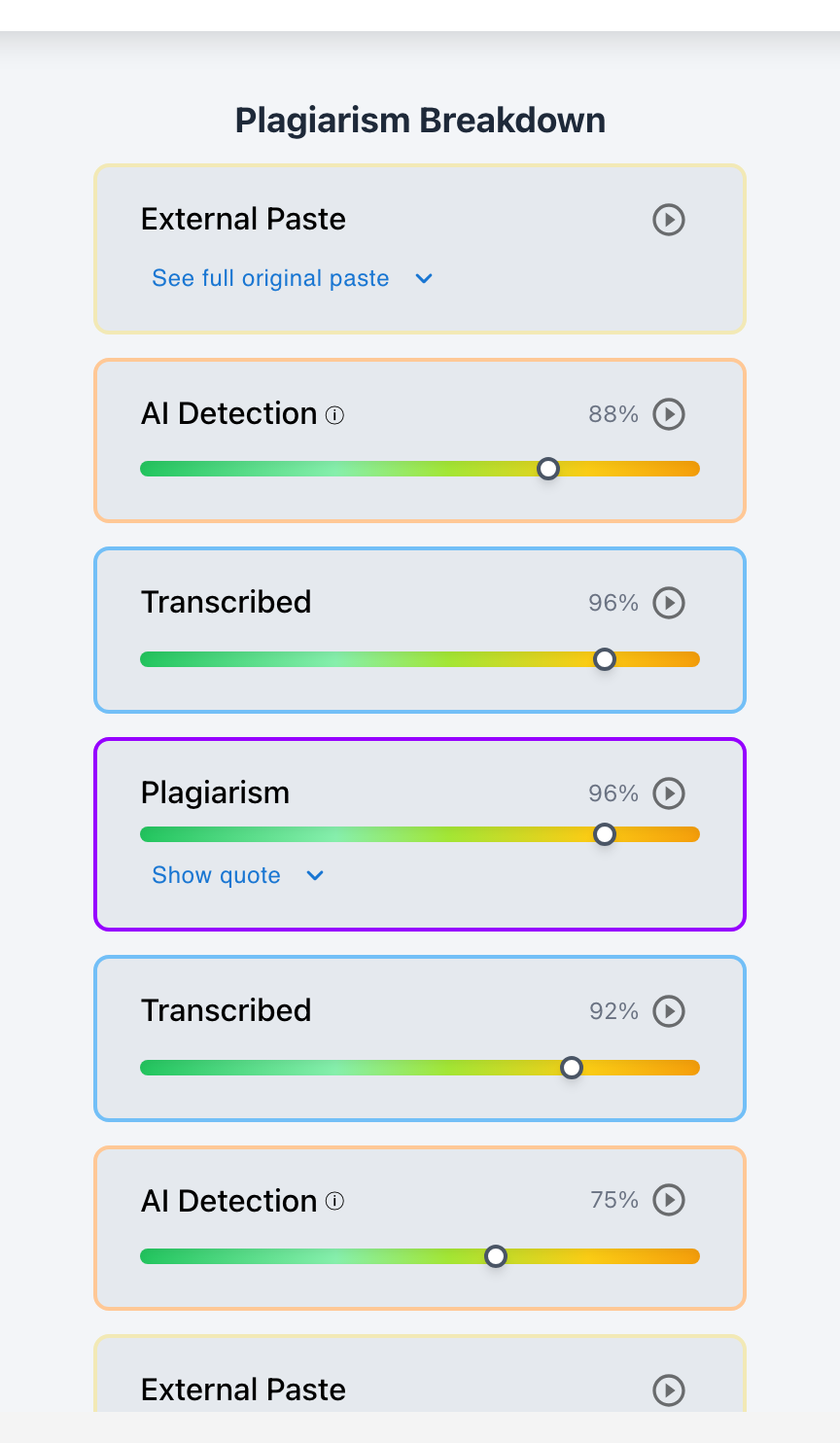
Authentic essay writing in revision history is dynamic, non-linear, and visibly iterative—characterized by messy brainstorming notes, frequent sentence restructuring, deleted arguments, and gradual syntactic refinement over multiple days.
When educators inspect the creation history of a genuinely student-authored paper, they do not see a pristine, linear waterfall of text that appears perfectly on the first try. Instead, they witness the authentic cognitive struggle of a writer at work: initial thesis attempts that get erased and rewritten, paragraphs moved across pages to improve flow, and citations added incrementally as research develops.
Through Checkmark Plagiarism's Playback & History Engine, educators can visualize the 5 distinct stages of authentic drafting to celebrate genuine student effort.
Checkmark Plagiarism powers revision history analysis by pairing essay writing playback with AI detection, plagiarism detection, autograding, and integrations with Canvas and Google Classroom.
The 5 Stages of Authentic Writing in Revision History
Stage 1: The Messy Genesis
The document begins with rough bullet points, fragmented thesis ideas, and scratchpad notes that are gradually expanded or deleted.
Stage 2: The Variable Drafting Sprint
Sentences appear at variable typing speeds (30–70 WPM) with natural typos, immediate backspace corrections, and short thinking pauses.
Stage 3: Structural Reorganization
Entire paragraphs are cut and pasted into new positions, weak arguments are deleted, and new transition sentences are inserted between sections.
Stage 4: Incremental Citation Synthesis
Citations and bibliography entries appear one by one over several days as the student searches library databases and integrates evidence.
Stage 5: Surface Polishing & Mechanics
In the final session, the student performs localized proofreading: adjusting commas, fixing misspelled words, refining word choices, and standardizing header formatting.
Read more in how Checkmark writing process analysis works.
Comparison: Authentic Revision History vs. Synthetic Generation
Authentic Writing History (Human Process)
- Messy early drafts that evolve into polished prose.
- 15–30% backspaces, deletions, and sentence rewrites.
- Multiple distinct sessions spread across days.
- Citations added individually during active research.
Synthetic Generation (AI Shortcut)
- Empty document instantly populated with 1,500 words.
- 0% early brainstorming or deleted arguments.
- 1 single session lasting under 5 minutes.
- Citations pasted simultaneously with body text.
A 5-Step Educator Protocol for Reviewing Revision History
Educator Revision History Audit Protocol:
- 1. Open the Checkmark Playback replay in Canvas SpeedGrader or Google Classroom.
- 2. Scrub through the timeline to observe the 5 stages of natural drafting evolution.
- 3. Confirm that total active typing time aligns with the scope of the paper.
- 4. Check the edit and deletion rate: healthy drafting exceeds 15% revisions.
- 5. Use the timeline to provide positive feedback on student self-editing habits.
How Checkmark Plagiarism Powers Revision Analytics
Checkmark Plagiarism combines **AI detection, essay writing playback, static AI detection, plagiarism detection, autograding, and Canvas/Google Classroom integrations** to make revision history intuitive, visual, and immediately accessible inside your LMS.
Frequently Asked Questions
Is it bad if my revision history looks messy?
No! A messy revision history with lots of deleted sentences, moved paragraphs, and backspaces is the ultimate proof of authentic, thoughtful human composition.
What does an AI essay look like in revision history?
It looks unnaturally clean and instant: an entire 1,500-word essay appears in a single snapshot or paste event with zero prior drafts or deleted sentences.
Can revision history protect me from false AI accusations?
Yes. If your essay triggers an AI detector score, your multi-session revision history showing hours of typing and edits instantly clears you of suspicion.
How many drafting sessions are normal for an essay?
For a standard 1,500-word essay, 3 to 5 separate drafting and editing sessions across several days is typical for authentic human writers.
What is a normal student backspace rate?
Authentic student writing typically exhibits a 15% to 30% backspace/edit rate as thoughts are refined. AI pastes show 0% edits.
What if I wrote my paper in Microsoft Word and pasted it in?
Provide your original Word document with version history to prove your authentic drafting stages and multi-day composition.
How does Checkmark Plagiarism integrate with Canvas LMS?
Checkmark Plagiarism displays visual writing playback timelines, session breakdowns, and dual AI/plagiarism scores directly inside Canvas SpeedGrader.
Can teachers see what I deleted in Google Docs?
Yes. Checkmark Playback logs every deleted word, clause, and paragraph, showing how your arguments evolved over time.
Why is revision history better than static AI detection?
Detectors provide probabilistic estimates, whereas revision history provides objective physical proof of human typing and revision timelines.
How does reviewing revision history help teachers coach writing?
Teachers can see where students struggled, how they reorganized paragraphs, and offer targeted guidance on argument structure and style.
Celebrating the Journey of Human Writing
Writing is a process of discovery, refinement, and perseverance. By celebrating the authentic stages of revision and verifying drafting with Checkmark Plagiarism, educators uphold academic rigor while inspiring real student growth.
Checkmark Plagiarism supports this comprehensive approach with AI detection, essay writing playback, static AI detection, plagiarism detection, autograding, and integrations with Canvas and Google Classroom.
See how Checkmark pairs essay writing playback with multi-signal detection to visualize authentic revision history inside your LMS. View a sample report or request a demonstration.