
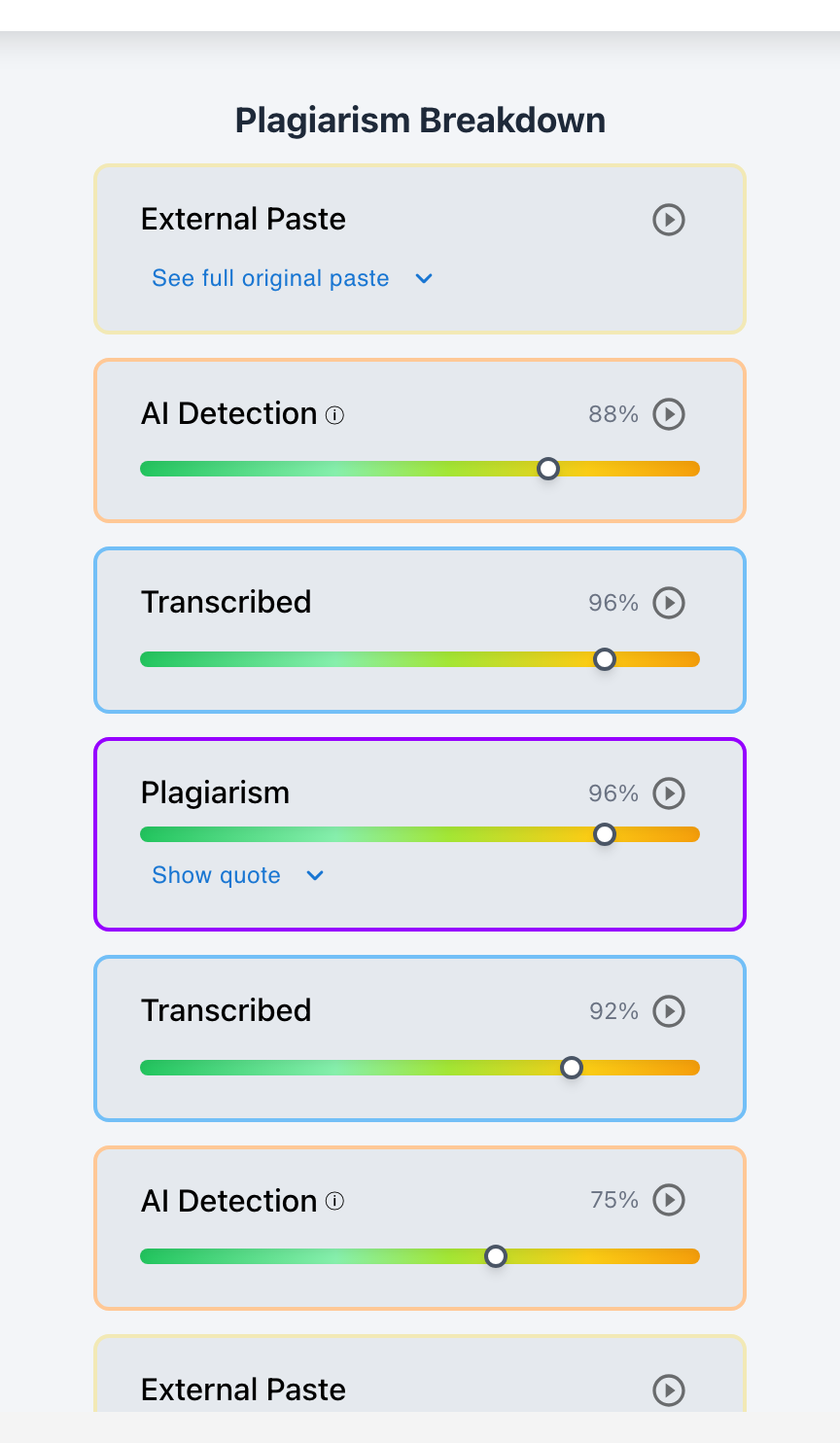
In writing history, AI transcription looks like an unnaturally straight, unbroken linear slope—characterized by a continuous 70+ WPM typing speed, rhythmic 1.5-second glance pauses (as the student looks at a phone or secondary monitor), a backspace rate under 2%, and instant transitions between complex paragraphs without cognitive planning pauses.
When watching an accelerated 15-second replay in Checkmark Playback, an authentic human essay looks dynamic and messy: words appear in fits and starts, sentences are drafted and deleted, pauses stretch for minutes between sections, and the drafting curve resembles an irregular staircase. In contrast, transcribing machine-generated text produces a robotic, linear visual signature that immediately stands out to educators.
Below is a comprehensive visual and quantitative guide on what AI transcription looks like in document history.
Checkmark Plagiarism visualizes transcription telemetry by pairing essay writing playback with AI detection, plagiarism detection, autograding, and integrations with Canvas and Google Classroom.
The 4 Visual Characteristics of AI Transcription in Playback
1. Unbroken Linear Growth Slope
The word count graph rises in a perfectly straight 45-degree angle from 0 to 1,500 words over 20 minutes without the flat plateaus of human thinking.
2. Rhythmic "Pulse-Pause" Cadence
The playback video reveals text appearing in rapid 5- to 8-word bursts (matching visual working memory) separated by uniform 1.5-second pauses to glance at a secondary screen.
3. The Ghost Revision Anomaly (<2% Edits)
Deletions are limited exclusively to immediate physical slip-of-the-finger typos (e.g., hitting "t" instead of "y"), with zero deleted sentences or restructured arguments.
4. Zero Section-Transition Friction
The student transitions from the introduction into complex body paragraphs in under 2 seconds without pausing to consult outlines or research sources.
Why Authentic Writing Looks Like an Irregular Staircase
Understanding the visual contrast between thinking and transcribing:
- The Human "Staircase" Curve: Authentic writers draft a paragraph (steep rise), pause for 2 minutes to think (flat plateau), delete a sentence (slight dip), and resume typing (next step).
- The AI Transcription "Ramp": Because the student is reading pre-written text, there are no thinking plateaus or deletion dips—producing a smooth, continuous ramp.
- Collegiate Vocabulary with Zero Hesitation: Complex words like "juxtaposition" or "bourgeoisie" are typed at the exact same velocity as simple words like "the" and "and."
Read more in how Checkmark writing process analysis works.
Comparison: Authentic Drafting Staircase vs. AI Transcription Ramp
Authentic Writing (Dynamic Staircase Curve)
- Drafting graph resembles an irregular staircase.
- 18% to 28% backspaces with active sentence rewrites.
- Frequent 45–90 second cognitive thinking pauses.
- Total active typing duration: 3.5+ hours for 1,500 words.
AI Transcription (Linear Ramp Curve)
- Drafting graph rises in an unbroken straight line.
- <2% backspaces; zero sentence restructuring.
- Uniform 1.5s glance pauses; zero thinking plateaus.
- Total active typing duration: 20 minutes for 1,500 words.
A 5-Step Educator Protocol for Transcription Telemetry Reviews
Transcription Playback Review Checklist:
- 1. Open the student's submission in Checkmark Playback inside Canvas SpeedGrader.
- 2. Inspect the Word Count Growth Curve: check if the graph rises in an unbroken straight line.
- 3. Review the Backspace Rate: verify if deletions are below 2% across the paper.
- 4. Watch the 15-second video replay: observe the continuous pulse-pause typing cadence.
- 5. Cross-reference with the AI Probability Score and hold a brief 2-minute oral check-in.
How Checkmark Plagiarism Powers Visual Process Forensics
Checkmark Plagiarism combines **AI detection, essay writing playback, static AI detection, plagiarism detection, autograding, and Canvas/Google Classroom integrations** to make AI transcription visually obvious and objectively verifiable.
Frequently Asked Questions
What does AI transcription look like on a word count graph?
It appears as an unbroken, straight diagonal line rising from 0 to 1,500 words in 20 minutes without the flat pauses and dips of human writing.
Why do students pause for 1.5 seconds while transcribing?
Because they are glancing back and forth between their secondary screen (phone/iPad) and their keyboard to read the next chunk of words.
Can an authentic writer have a straight drafting curve?
No. Even professional authors experience cognitive pauses, sentence restructuring, and typing fatigue that produce an irregular staircase curve.
How long does an Essay Playback video take to watch?
Checkmark accelerates the entire creation timeline into a smooth 15-second video replay directly within Canvas SpeedGrader.
What does a normal human revision look like in Playback?
It shows words being typed, highlighted, deleted, and rephrased with new vocabulary as the student refines their thoughts.
How does Checkmark Plagiarism integrate with Canvas LMS?
Checkmark provides certified LTI 1.3 integration, SpeedGrader sidebar embeds, two-way grade passback, and single sign-on (SSO).
What if a student says they wrote the essay on paper first?
Ask the student to show their handwritten notebook or outline during a brief check-in to confirm authentic offline drafting.
Does transcription detection work on Google Classroom?
Yes. Checkmark extracts revision history and keystroke timelines seamlessly from Google Docs submissions.
Can students simulate human pauses to fool the playback graph?
Simulating 3.5 hours of realistic typing rhythms, pauses, and backspaces requires more time and effort than simply writing honestly.
Why is visual writing playback more persuasive in conferences?
Because watching a 15-second video of robotic transcription provides concrete physical facts that students cannot deny.
Visualizing the Physical Reality of Composition
Human thought has a rhythm. By visualizing drafting curves and keystroke telemetry with Checkmark Plagiarism, educators can easily differentiate between authentic intellectual struggle and mechanical AI transcription with absolute certainty.
Checkmark Plagiarism supports this comprehensive approach with AI detection, essay writing playback, static AI detection, plagiarism detection, autograding, and integrations with Canvas and Google Classroom.
See how Checkmark pairs visual playback telemetry with multi-signal detection to identify AI transcription. View a sample report or request a demonstration.