
At first glance, an essay written by ChatGPT appears impressive: the grammar is pristine, the vocabulary is sophisticated, and the paragraphs are neatly organized.
However, upon closer inspection, seasoned educators quickly recognize that ChatGPT-generated writing suffers from distinctive structural formulas, rhetorical cliches, uniform sentence rhythms, and a conspicuous lack of analytical depth. While it mimics the superficial appearance of academic prose, it rarely exhibits the messy, idiosyncratic, and original insights of authentic student thinking.
Understanding what a ChatGPT essay looks like—its architectural anatomy, linguistic habits, and conceptual limitations—helps teachers spot potential generative AI use and verify authorship using essay writing playback, citation audits, and baseline comparisons.
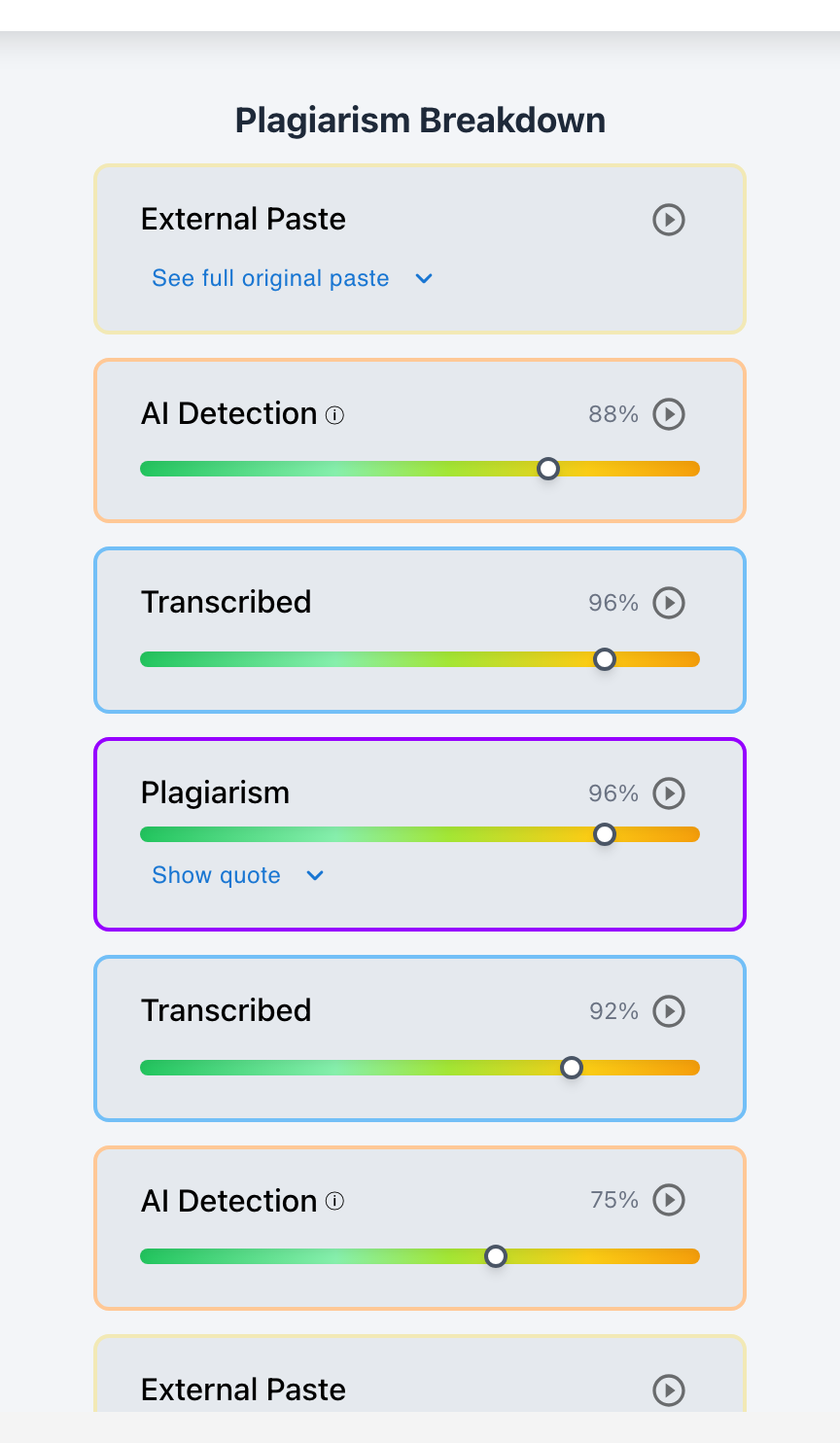
Checkmark Plagiarism pairs stylistic analysis with physical process verification by combining AI detection, essay writing playback, static AI detection, plagiarism detection, autograding, and integrations with Canvas and Google Classroom.
The Anatomy of a Typical ChatGPT Essay
1. The Sweeping Introduction
Opens with grand historical platitudes ("Throughout human history..."), offers generic definitions, and ends with a formulaic 3-point thesis.
2. Symmetrical Body Paragraphs
Each body paragraph is identical in length, begins with heavy transitions ("Furthermore," "Moreover"), and summarizes broad concepts without concrete specifics.
3. The Trite Conclusion
Opens with "In conclusion," mechanically restates the prompt, calls the topic a "testament to human resilience," and ends with a hollow moral.
Distinctive Linguistic Fingerprints of ChatGPT
1. The ChatGPT Cliche Lexicon
Because large language models rely on statistical frequency across vast web data, default outputs repeatedly gravitate toward specific words and metaphors:
- Favorite Verbs & Adjectives: Delve, foster, underscore, multifaceted, crucial, paramount, pivotal, intricate, tapestry, beacon, testament.
- Over-Signaled Transitions: Furthermore, moreover, in addition, on the one hand / on the other hand, it is important to remember, ultimately.
- Formulaic Sentence Starters: "Not only does X do Y, but it also fosters Z..." or "By examining the intricate nuances of..."
2. Low Burstiness and Flat Perplexity (Rhythmic Monotony)
Human writers write with varied sentence lengths: short, punchy statements mixed with long, complex, meandering reflections. ChatGPT, by contrast, writes with extreme mathematical regularity: nearly every sentence is between 18 and 24 words, creating a smooth, monotonous cadence that reads like an encyclopedia entry. Read more in what does an AI detection percentage actually mean?
3. Compulsive Symmetry and Neutrality
ChatGPT is safety-trained to avoid strong bias, producing essays that relentlessly hedge and balance opposing perspectives even when the prompt asks for a passionate, one-sided argument.
Side-by-Side Comparison: Authentic Student vs. ChatGPT Writing
Authentic Student Writing Example
"When Gatsby looks across the water at the green light, he isn't just dreaming about Daisy—he's trapped by his own obsession with the past. In chapter 5, during their awkward tea party, Nick notices how nervous Gatsby is. This shows that Gatsby built an impossible fantasy that real life could never match."
- Specific chapter references & character emotions.
- Natural, conversational, yet analytical voice.
- Varied sentence rhythm and unique interpretation.
ChatGPT Generated Writing Example
"In F. Scott Fitzgerald's timeless masterpiece, The Great Gatsby, the iconic green light serves as a multifaceted symbol of aspiration, ambition, and the elusive nature of the American Dream. Furthermore, this pivotal motif underscores the protagonist's profound yearning for connection and serves as a testament to human longing."
- Pompous filler adjectives ("timeless masterpiece," "pivotal motif").
- Zero specific chapter details or scene descriptions.
- Generic, formulaic language that could apply to any book.
What ChatGPT Essays Always Lack
- Class-Specific Anchors: ChatGPT essays never reference that specific lecture you gave last Tuesday, the unique handout you distributed, or the specific student debate from class.
- Authentic Citation Context: ChatGPT essays frequently cite non-existent sources or provide high-level summaries without exact page numbers. Read more in can ChatGPT cite sources that don't exist?
- Messy Revision Marks: Human thinking involves drafting, rewriting, scratching out sentences, and correcting errors.
How Essay Writing Playback Exposes ChatGPT Submissions
While an AI-written essay looks polished on the surface, its creation timeline looks completely artificial. When using Checkmark Plagiarism's essay writing playback, teachers can see:
- Instant Wholesale Pastes: 1,200 words appearing in a single second at 11:45 PM.
- Zero Keystroke Evolution: No active drafting time, no backspacing, no rephrasing of awkward sentences.
- Zero Multi-Session Drafting: The entire document was assembled in under 10 minutes.
Read more in how Checkmark writing process analysis works.
A 7-Point Checklist to Spot a ChatGPT Essay
ChatGPT Essay Identification Checklist:
- [ ] Sweeping, cliché introduction ("Throughout history...").
- [ ] Overuse of signature words: delve, tapestry, crucial, testament, foster, multifaceted.
- [ ] Perfectly uniform paragraph lengths and monotonous 20-word sentence structures.
- [ ] Failure to reference specific classroom discussions, lectures, or assigned page numbers.
- [ ] Flawless grammar paired with shallow, superficial analytical insight.
- [ ] Essay writing playback shows large wholesale paste events with minimal active typing time.
- [ ] Student is unable to explain key vocabulary or summarize the argument orally.
How Checkmark Plagiarism Helps Teachers Analyze Writing
Checkmark Plagiarism combines **AI detection, essay writing playback, static AI detection, plagiarism detection, autograding, and Canvas/Google Classroom integrations** to give teachers complete visibility into writing quality and document creation history.
Frequently Asked Questions
What are the most common words ChatGPT uses in essays?
Common hallmarks include delve, tapestry, testament to, crucial, pivotal, multifaceted, foster, underscores, and furthermore.
Why do ChatGPT essays sound so generic?
Because language models generate statistically average responses based on internet training data, avoiding personal anecdotes, quirky insights, or bold, controversial stances.
Can students hide ChatGPT writing by changing a few words?
Light editing alters some surface vocabulary, but writing playback timelines and citation audits easily expose the underlying generative structure.
Do ChatGPT essays contain spelling or grammar mistakes?
Rarely. ChatGPT outputs flawless standard grammar, which is often a major clue when submitted by a student who typically struggles with mechanics.
How does sentence length reveal ChatGPT writing?
ChatGPT produces low burstiness (sentences of nearly identical length and structure), whereas human writing exhibits dramatic variation between short and long sentences.
What should a teacher do when an essay looks like ChatGPT?
Check the essay writing playback timeline, audit citations for hallucinations, compare against previous baseline writing, and hold a supportive conference with the student.
Why does ChatGPT fail to cite specific page numbers?
ChatGPT generates text through next-token prediction without browsing live book pages, leading to vague summaries or completely hallucinated page references.
Can an essay written by an authentic top-performing student look like ChatGPT?
Formal student writing can share high vocabulary, but authentic essays feature specific classroom examples, unique voice, and multi-session drafting playback logs.
How does writing playback prove an essay was written by ChatGPT?
Playback logs show an empty document receiving hundreds of polished words in an instant paste with zero subsequent drafting or structural revision.
How does Checkmark Plagiarism detect ChatGPT-written essays?
Checkmark Plagiarism combines statistical AI detection with visual essay writing playback, citation audits, and LMS integrations to provide full multi-signal proof.
Surface Polish Cannot Replace Authentic Thinking
Recognizing the anatomy of a ChatGPT essay allows educators to distinguish superficial generative polish from genuine intellectual growth. By combining stylistic awareness with essay writing playback and student dialogue, teachers uphold authentic learning and scholarship.
Checkmark Plagiarism supports this comprehensive approach with AI detection, essay writing playback, static AI detection, plagiarism detection, autograding, and integrations with Canvas and Google Classroom.
See how Checkmark pairs essay writing playback with multi-signal detection to distinguish authentic student prose from ChatGPT generation. View a sample report or request a demonstration.